

⏳ 13 min read · Last updated: September 2026
Organic hydroponic nutrients for herbs are possible, but they are not a straight swap for the bottle of mineral nutrient that comes with most kits. Organic fertilizers are made for soil, where bacteria and fungi break them down into the simple minerals roots can drink. A jar of water has none of that life. So organic material that feeds a garden bed can sit in a reservoir, rot, cloud the water and smell, while the herbs above it go hungry.
That does not mean you have no choices. It means the choice needs to be made with the water in mind. This guide explains what actually happens to organic feed in water, when a hydroponic-labeled organic or bio blend is worth trying, which system it needs, how to read EC and pH when you use one, and what to do when the water turns. If you are just starting, the apartment hydroponics beginner’s guide explains nutrients from the ground up.
Organic Hydroponic Nutrients: The Short Answer
- Never put soil fertilizer, organic or not, into a hydroponic system. It does not dissolve or balance properly, and in water it rots.
- If you want an organic-leaning feed, choose one labeled for hydroponics, and use it in an aerated system rather than a still Kratky jar.
- EC meters under-read organic feeds, because much of their nitrogen is not yet in a form that conducts. Watch the plants as well as the meter.
- Keep the water at 65 to 75°F (18 to 24°C), check pH first when anything looks wrong, and change the reservoir every 2 weeks, or at once if it clouds or smells.
- For flavor, light and the right feed strength matter far more than whether the bottle says organic.
Three Kinds of Feed, Side by Side
Here is how the three main options behave in a small indoor system.
- Wondering whether organic is worth it at all? → read why organic feed struggles in water
- Set on trying an organic-leaning blend? → go to using one safely
- Water already cloudy or smelly? → jump to troubleshooting
Why Organic Feed Struggles in Water
Plants do not eat compost or fish. They take up dissolved minerals: nitrate, potassium, calcium and the rest. In soil, organic fertilizer becomes those minerals slowly, because a huge community of microbes breaks it down, and the soil itself holds the pieces until roots use them. That whole process is what “feeding the soil” means.
A hydroponic reservoir has almost none of that. It is a tank of water with roots in it. Put raw organic matter in, and three things happen together. First, very little of it becomes plant food quickly, so the herbs go pale even though the tank looks rich. Second, the microbes that do show up feed on it and use up the oxygen the roots need. Third, anything that lacks oxygen starts to rot, and rotting organic matter in a warm apartment smells. That is the cloudy, sour reservoir most people meet the first time they try it.
How Organic Hydroponics Can Work

Organic hydroponics is possible, and growers do it commercially, but it works by rebuilding a little of the soil’s biology in the tank. The feed is pre-digested or formulated to break down cleanly, the water is aerated hard so the helpful microbes have oxygen, and the grower watches the system closely. That is a real project, not a bottle swap. For a first herb jar on a windowsill, it is more risk than most people need.
Are Mineral Nutrients the Unnatural Option?
Many people reach for organic because “chemical fertilizer” sounds like something to avoid in food. It helps to know what a hydroponic mineral nutrient actually is: the same dissolved minerals a plant pulls out of good soil, supplied directly in the water. A basil leaf cannot tell whether the nitrate it absorbed came from a bottle or from compost broken down by soil bacteria. The molecule is the same.
The real line to draw is not organic against mineral. It is hydroponic against soil. Never use soil fertilizer of either kind in water, because it neither dissolves nor balances properly, and a hydroponic nutrient is formulated for exactly this job. If you want to understand the product on your shelf, the beginner nutrients guide explains how two-part and one-part nutrients work, and the nutrients roundup for small systems compares the options.
Using an Organic-Leaning Blend Safely
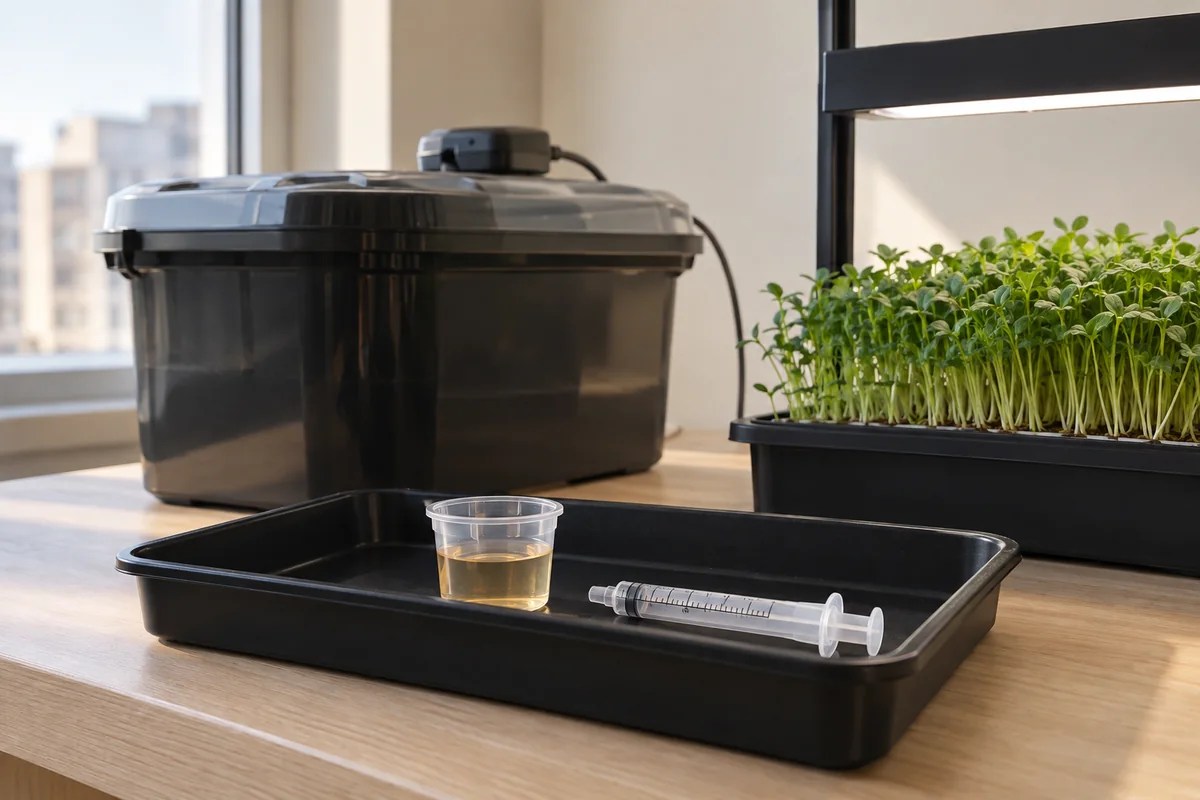
If you still want to try an organic or bio blend, set it up to succeed. The rules below are what separate a working tank from a smelly one.
- Buy only products labeled for hydroponics. “For soil use” means it will rot in water. Pour a little into a clear glass first: a translucent liquid is a better sign than a thick, muddy one.
- Use an aerated system. A DWC bucket with an air stone keeps oxygen in the water for the roots and the microbes. A still Kratky jar has no way to do that, so keep organic blends out of jars. DWC vs Kratky explains the difference.
- Mix it outside the reservoir. Shake the bottle hard, measure the dose into a jug of water, stir well, and pour that in. Thick liquid poured straight in sinks and coats the roots.
- Keep the water cool. Hold it at 65 to 75°F (18 to 24°C). Warm water holds less oxygen and feeds the bacteria you do not want.
- Change it on time. Replace the whole reservoir every 2 weeks, and at once if it clouds or smells, instead of waiting for the date.
- Clean more thoroughly. Organic feeds leave a film on the walls, tubing and air stone. Scrub it off at each change with soapy water, then wipe with diluted hydrogen peroxide.
Between changes, top off the bucket daily with plain pH-adjusted water only, never with more feed, because plants drink water faster than they use nutrients. The top-off guide explains why. A quiet air pump makes the aerated setup easier to live with in a small flat.
Ingredients to Keep Out of an Indoor Reservoir
Some organic inputs are fine in a garden and a disaster in a tank of water in your kitchen. Check the ingredient list before you pour:
- Fish emulsion, which smells strongly enough indoors to fill a small flat.
- Raw kelp or seaweed meal, since the solids clog net cups and air stones.
- Unfiltered compost or worm teas, because they turn standing water murky within days.
- Molasses and other sugary additives, which feed explosive bacterial blooms that strip the oxygen from the water.
- Manures and guanos, which belong in soil and bring bacteria you do not want near roots in water.
If a product lists any of these and does not say it is made for hydroponics, it goes in a garden bed, not in your reservoir.
EC and pH With Organic Feeds
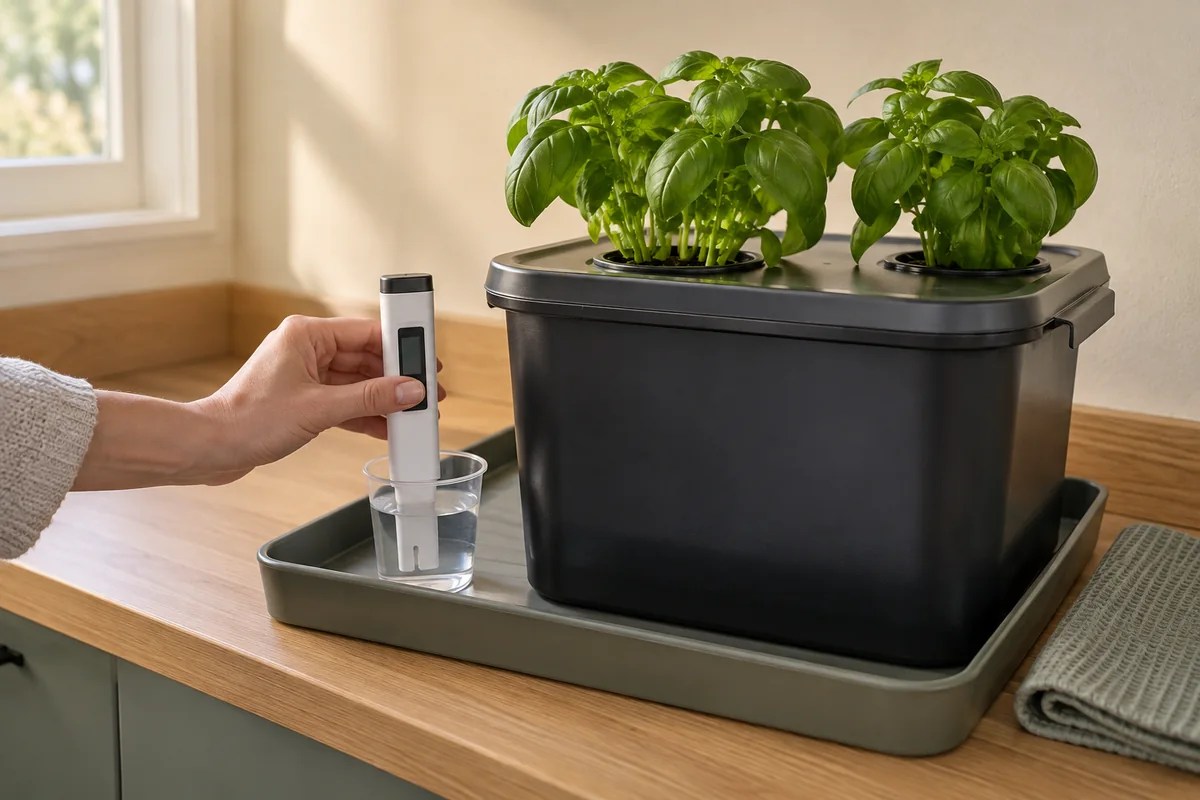
An EC meter measures the salts dissolved in water, which is a good stand-in for “how much food is in there” with a mineral nutrient. With an organic feed it tells you less. Part of the nitrogen in an organic blend is still locked in organic molecules that do not conduct electricity until microbes break them down. So an organic tank can read low while holding plenty of material, and it can read differently from one day to the next as that material breaks down.
Use the meter anyway, as a baseline, and add your eyes. If the reading says “weak” but the plants are dark green and growing, do not add more. Pale, slow growth with a normal-looking reading is worth a closer look at pH before anything else. A good EC meter and the guide to EC for herbs help you interpret it.
pH Moves More
Organic tanks tend to drift in pH more than mineral ones, because microbial activity changes the water as the feed breaks down. So check pH more often, and keep it within 5.5 to 6.5 for most herbs. Out-of-range pH locks nutrients out even when the tank is full of them, so check pH first whenever leaves pale. Adjust in small steps: dilute a drop of adjuster in a cup of tank water, add it, stir, and test again. The pH and nutrient calculator helps with doses, and why pH keeps drifting covers the causes.
Feed Targets for Common Herbs
Whatever the source of the feed, the herbs want the same strength. These are the figures from the crop table this site uses, with harvest times counted from seed unless noted.
| Herb | Difficulty | Mature EC | First harvest |
|---|---|---|---|
| Basil | Easy | 1.0 to 1.6 | 5 to 6 weeks |
| Mint | Very forgiving | 2.0 to 2.4 | 4 to 5 weeks from a rooted cutting |
| Chives | Easy but slow | 1.8 to 2.0 | 7 to 9 weeks |
| Parsley | Slow to start | 1.4 to 1.8 | 6 to 8 weeks |
| Cilantro | Advanced | 1.4 to 1.8 | 6 to 8 weeks |
| Oregano | Intermediate | 1.4 to 1.8 | 8 to 10 weeks |
| Thyme | Intermediate | 1.2 to 1.6 | 10 to 13 weeks, or 4 to 6 from a cutting |
Seedlings of all of these start lower, at EC 1.0 to 1.2, before rising to the mature figure. With an organic blend, aim for the low end of each range at first, since the meter reads low and it is easier to add than to take away. The seed to harvest calculator turns a sowing date into a likely harvest window for each.
The herb EC, pH and harvest figures are the ones the crop table on this site uses, and the crop sources page lists the research behind them. Oklahoma State’s EC and pH guide for hydroponics explains what an EC reading measures, and University of Missouri Extension’s hydroponics guide covers nutrient solutions for home systems. The advice on organic blends (aeration, mixing in a jug, cleaning) is general good practice rather than a tested recipe, so treat it as a starting point.
Troubleshooting Organic Reservoirs
Organic tanks go wrong faster than mineral ones, especially in a warm flat, so act on the first sign.
| What you see | Most likely cause | What to do |
|---|---|---|
| Cloudy, murky water | A bacterial bloom, since the organic material feeds it | Change the reservoir now, and also check the water temperature |
| Sour or rotten smell | Oxygen has run out, so material is rotting | Check the roots for slime before you clean and refill |
| Brown slime on roots | Root rot, especially when the water runs warm | Rinse and trim the roots, and treat with peroxide in fresh solution |
| Pale leaves while the meter reads fine | pH out of range, or feed not yet available | Check pH first, before you add anything |
| Air stone bubbling weakly | Film clogging the pores | Scrub or replace it, and also keep a spare stone |
| Tiny black flies around the setup | Fungus gnats drawn to wet organic matter | Cover wet surfaces and clean the tank, then also hang sticky traps |
Rescuing Roots From a Bad Tank

When the water has turned, move quickly. Lift the plant out, rinse the roots under cool running water, and trim anything brown and slimy with clean scissors. Empty the tank, scrub it with soapy water, rinse, and wipe it with diluted hydrogen peroxide. Refill with fresh solution, and for an active infection add 3 ml of 3% hydrogen peroxide per liter; hydrogen peroxide for root rot explains how to use it. Run the plant at a gentler EC 1.2 to 1.5 for 4 to 7 days while it recovers. After a rescue like that, many growers go back to a mineral nutrient, at least until the plant is strong again. Preventing root rot and what to do when the water smells cover the rest.
Warm Rooms Make It Worse
Everything that goes wrong in an organic tank goes wrong faster in warm water. Above 72°F (22°C) the air stone matters more, and above 75°F (24°C) rot sets in quickly. Keep the reservoir out of the sun and away from heat, and never cool it with ice, because the swing shocks roots. A frozen bottle against the outside of the container, or a cooler spot, works better. Small system temperature fixes has more ideas, and if gnats have moved in, the fungus gnat guide covers them.
A Word From Sarah
Before buying an organic nutrient, write down why you want one. If the answer is taste, spend the money on light instead: a herb under a proper LED on a 14 hour timer tastes stronger than the same herb in any bottle under a dim window. If it is about avoiding sprays, hydroponic herbs grown indoors rarely need any. And if it is simply that you like the idea, that is fine too. Just start with one aerated bucket, keep a mineral-fed jar of the same herb beside it, and let the two plants tell you whether it was worth it.
Frequently Asked Questions
Can I use organic nutrients in hydroponics?
Yes, but only products labeled for hydroponics, and ideally in an aerated system. Organic fertilizer made for soil needs soil microbes to break it down, so in a jar of water it rots, clouds the water and smells, while the plants go hungry. Never use soil fertilizer in a hydroponic system.
Can I use organic nutrients in a Kratky jar?
It is best avoided. A Kratky jar is still water with no air stone, so organic material and the microbes feeding on it use up the oxygen the roots need, and the jar tends to cloud and smell. Use a hydroponic mineral nutrient in jars, and keep organic blends for an aerated bucket.
Why does my organic hydroponic water smell bad?
A sour or rotten smell means oxygen has run out and organic material is rotting. Warm water makes it worse. Check the roots for brown slime, empty and clean the container, and refill with fresh solution. Keeping the water at 65 to 75°F with an air stone running helps stop it coming back.
Why does my EC meter read low with organic nutrients?
Part of the nitrogen in an organic feed is still locked in organic molecules that do not conduct electricity until microbes break them down. So the meter under-reads what is in the tank. Use it as a baseline, watch the plants, and do not keep adding feed just because the number looks low.
Do herbs taste better with organic hydroponic nutrients?
Not in any reliable way. Flavor depends far more on strong light and the right feed strength than on where the nutrients came from. A basil plant under a proper LED for 14 hours a day, fed at EC 1.0 to 1.6, tastes stronger than a dimly lit plant on any nutrient.
Are hydroponic mineral nutrients safe to eat from?
Yes. Hydroponic nutrients supply the same dissolved minerals a plant takes from good soil, such as nitrate, potassium and calcium, directly in the water. The plant absorbs the same molecules either way. What matters is using a product made for hydroponics at the right strength.
How often should I change an organic hydroponic reservoir?
Change it every 2 weeks, and immediately if the water clouds or smells, without waiting for the date. Top off daily in between with plain pH-adjusted water only. Scrub the walls, tubing and air stone at each change, because organic feeds leave a film that harbors bacteria.
Which organic fertilizers should never go in a hydroponic reservoir?
Fish emulsion, raw kelp meal, unfiltered compost or worm teas, molasses and other sugars, and manures or guanos. They smell, clog net cups and air stones, or feed bacterial blooms that strip oxygen from the water. If a product does not say it is made for hydroponics, keep it for soil.
Will organic nutrients clog my air stone?
They can. Organic blends leave a film that coats the fine pores of an air stone, so the bubbles get weaker over time. Scrub the stone at each reservoir change, or replace it when it no longer bubbles evenly, and keep a spare so the roots never go without air.
How do I clean a reservoir after organic nutrients?
Empty it, scrub the walls, lid, tubing and air stone with warm soapy water, rinse well, and wipe everything with diluted hydrogen peroxide. Do not use bleach, which is hard to rinse out fully and harms roots at the next fill. Let it dry before you refill it.
Happy growing! 🌿
Sarah, Urban Hydro Space

Sarah Whitfield is the founder of Urban Hydro Space and an indoor gardening enthusiast dedicated to helping apartment dwellers grow fresh herbs and vegetables in small spaces. She researches hydroponic systems carefully from real specifications and verified buyer feedback, and shares practical tips and honest, clearly labeled product picks to make indoor gardening accessible for beginners.


