Hydroponic plants wilting makes no sense at first, because the roots are sitting in water. How can a plant with its feet in a reservoir look thirsty? The answer is that wilting isn’t really about the water around the roots. It’s about water getting into the plant. Roots that are short of oxygen, rotting, stranded above the waterline or stuck in a solution that’s too strong all stop drinking, so the leaves droop even when the jar is full.

I’ve put the eight common causes in the order I’d check them, each with a quick test and a fix. Some wilting is harmless, though, and passes by evening, so that’s where I start. New to growing in water? The apartment hydroponics beginner’s guide explains how roots breathe and drink in each system.
Why Are My Hydroponic Plants Wilting? The Quick Check
Work down this list in order, because the first three checks solve most cases:
- Does it recover by evening? A midday droop that lifts by late afternoon is normal, especially in Kratky.
- Is the water level where it should be? Roots left above the waterline cannot drink.
- What do the roots look like and smell like? Brown, slimy and sour means rot.
- How warm is the water? Above 72°F (22°C), oxygen runs short; above 75°F (24°C), rot becomes likely.
- Is the pump or air stone running? In DWC and countertop gardens, no air means no oxygen.
- What does the EC meter say? A solution far stronger than the crop’s range pulls water out of the roots.
- Was it just moved, or just transplanted? A day or two of droop after a move is normal.
- Is it too hot under the light? Leaves that curl and droop while staying green point to heat.
Key takeaways
- Wilting in water usually means the roots can’t take up water, not that there’s too little of it.
- A droop at midday that recovers by evening is normal, but wilting that lasts into the night is a problem.
- Check the water level first, then the roots, then the water temperature, because those three explain most cases.
- Keep the water at 65 to 75°F (18 to 24°C), aerate above 72°F, and treat brown, slimy roots as rot.
- Never refill a Kratky jar to the brim, because drowning the air roots causes wilting too.
Normal Midday Droop
Not every droop is a problem. On a warm afternoon the leaves can lose water faster than the roots replace it, so the plant sags for a few hours. Bernard Kratky, who developed the Kratky method, describes plants that wilt at midday and recover by late afternoon, which is why my Kratky tote guide tells you not to reach for the jug. If it’s standing again by evening and looks fine the next morning, I’d leave it alone. Topping up a jar that didn’t need it can do more harm than the droop.
What tells you it’s real is time. A plant that’s still drooping in the evening, drooping again first thing in the morning, or worse each day has a real problem, and one of the causes below is behind it. A line a day in the printable hydroponics tracker makes that pattern easy to see, because memory is bad at “was it this limp yesterday?”
Roots Left Above the Water
This is the most common cause and the easiest to check. In a Kratky jar the level falls as the plant drinks. If it drops below the longest roots before they’ve grown down to follow it, the plant goes thirsty. In DWC or a countertop garden, a few warm days without a top-off can leave the bowl low, which is why so many plants wilt over a long weekend away.
The fix depends on the system:
- DWC and countertop gardens: top off with plain pH-adjusted water to the normal level, and do it daily while the weather’s warm.
- Kratky: add a little nutrient solution at the same strength, raising the level by no more than about an inch, so the roots reach water again while the upper roots stay in air.
If you travel, the feeding schedule for travelers covers how to leave plants for a few days without coming home to a low jar. And when you do find one wilted, don’t feed it to perk it up. Stressed roots can’t use the extra nutrients, so all it does is push the EC up.
Root Rot

Rotting roots can’t drink, so the plant wilts with water all around it. Rot often shows up as wilting and yellowing together. That looks like a feeding problem, and it tempts you to add nutrients, which only makes it worse. The only check I trust is under the lid.
- Healthy roots are white or cream, firm, and smell fresh or of nothing.
- Rotting roots are brown, slimy, often stringy, and smell sour or like a stagnant pond.
Warm water is almost always behind it. So cool the water first, check the air stone is running if you grow in DWC, trim off the dead roots with clean scissors and refresh the solution. For an active infection, I’d add 3 ml of 3% hydrogen peroxide per liter, as hydrogen peroxide for root rot explains. Then fix whatever caused it, because rot comes straight back to the same conditions, and preventing root rot in small systems covers that part. When the rot has taken most of the roots, though, starting over is often quicker. The seed to harvest calculator tells you when a fresh plant would be ready.
Warm Water, Low Oxygen
Warm water holds less dissolved oxygen, and roots need oxygen to pull water in. So on hot days a plant in warm water droops through the afternoon and may perk up overnight. That cycle wears it down slowly, even before any rot shows. Keep the water at 65 to 75°F (18 to 24°C). Above 72°F (22°C) an air stone earns its place, and above 75°F (24°C) root rot becomes likely.
Move containers away from sunny windows, radiators and the top of the fridge, and wrap or shade anything clear. Never drop ice into the water, because the sudden swing shocks the roots. A frozen bottle stood against the outside of the container cools it gently instead. Small system temperature fixes has more ways to keep a reservoir cool, and the guide to oxygenating water without a pump helps when an air stone isn’t an option.
A Stopped Pump or Air Stone
In deep water culture the roots sit fully under water, so they depend on the air pump for oxygen around the clock. If it stops, from a power cut, a kinked line or a clogged stone, plants can wilt within a day. Countertop gardens such as AeroGardens lean on a small water pump the same way. Listen for the hum, look for rising bubbles, and follow the airline for a kink or a loose end.
A stone that only trickles is usually clogged with mineral build-up. Soak it in plain white vinegar for 20 to 30 minutes and rinse it well, as cleaning a small system describes. If the power goes out, what to do in a power outage covers keeping roots alive until it’s back. For an AeroGarden, the water change guide shows how to run a pump test.
A Solution That Is Too Strong
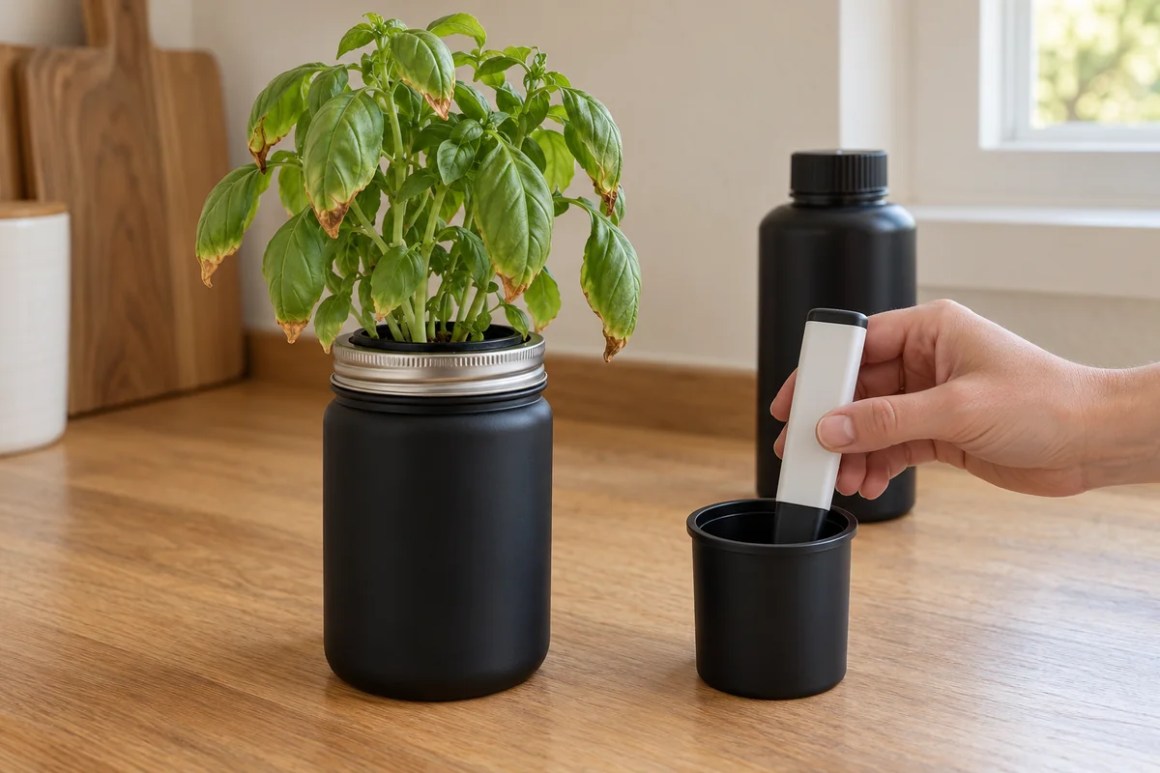
Make the solution much stronger than the crop wants and it starts pulling water back out of the roots, so the plant wilts in a full jar. A hot week can do this quietly, since water evaporates and leaves the nutrients behind. So can a heavy-handed feed. Look for brown, crispy leaf tips alongside the droop.
Test the EC before you change anything. If it reads well above your crop’s range, dilute with plain water, and if it’s way out I’d just change the solution. Most herbs and greens sit between EC 1.0 and 1.8, with basil at 1.0 to 1.6 and lettuce at 1.0 to 1.4. How to lower EC in a small system walks through a safe dilution, and the hydroponic pH and EC chart lists the range for every crop. Next time, the pH and nutrient calculator gives you the right dose for your volume.
Drowned Air Roots in Kratky
Kratky works because the falling water leaves an air gap, and the roots in that gap breathe. Fill the jar back to the brim and those air roots end up under water. They suffocate, the plant wilts, and it can drown outright. It’s one of the most common Kratky method mistakes, and it nearly always starts with good intentions.
Just refilled a jar, and now it’s wilting? Pour some solution back out until the top band of roots is in air again. After that, never refill a Kratky container to the top once the roots have dropped. A late top-up of an inch at most is my rule.
Transplant Shock
Seedlings often sulk for a day or two after moving into a jar or system, especially if roots got knocked about in handling or the new spot has drier air or stronger light. That’s normal. A small change to the light height or the water level usually settles it. I’d give new transplants softer light for the first few days and make sure the bottom of the cube touches the solution. When to transplant seedlings covers the move itself, plus what to do if leaves droop straight away.
Heat Under the Light
A light hung too close, or a tight shelf that traps heat, can make leaves curl and droop while they stay green. That’s different from light burn, which bleaches the top leaves white, and from nutrient burn, which browns the tips. Put a thermometer at canopy height instead of guessing. For leafy herbs and greens, hang the light about 6 to 8 inches above the leaves. Grow light burn has a side-by-side table for telling heat, light and nutrient damage apart, and grow light heat in apartments covers cooling a hot shelf.
When Basil Wilts
Basil wilts more dramatically than most herbs, so it gets its own note. Soft, drooping stems with yellowing lower leaves are the hydroponic version of “overwatered”. The roots are short of oxygen, usually from warm water, a stopped air stone or the start of rot, so I’d check the roots first and the water temperature second. Cold can do it too. Basil hates a chilly windowsill, and a plant that wilts and darkens after a cold night may be showing cold damage instead, which why basil leaves turn black explains. For everything else about growing it, start with my foolproof hydroponic basil guide.
Wilting Diagnosis at a Glance
| What you see | Most likely cause | Check this first |
|---|---|---|
| Droops at midday, fine by evening | Normal water loss in warm light | Nothing; watch that it recovers |
| Wilts after a few days away | Water fell below the roots | The water level |
| Wilting and yellowing, sour smell | Root rot | Root color and smell |
| Droops on hot days, recovers at night | Warm water short of oxygen | Water temperature |
| Sudden wilt in DWC | Pump or air stone stopped | Bubbles and the airline |
| Wilting in a full jar, brown tips | EC far too high | An EC reading |
| Wilts just after a refill | Drowned air roots in Kratky | How full the jar is |
| Droops a day after moving | Transplant shock | Light and cube contact |
| Curls and droops but stays green | Heat under the light | Air temperature at the canopy |
Where these facts come from
Midday wilting, and wilting from roots drowned by refilling, are described by Bernard Kratky in the University of Hawaii publication on the non-circulating method. The University of Minnesota Extension guide to small-scale hydroponics covers oxygen, temperature and root health in home systems. The water temperatures, EC ranges, light heights and the peroxide dose are this site’s standard figures, the same ones in the crop guides.
One Last Tip
Watch how fast the water goes down. A healthy plant drinks at a fairly steady pace, a bit faster on warm days, and after a week or two of glancing at the level you get a feel for it. When a jar that was dropping steadily suddenly stalls, the roots have slowed down, and that often shows before a single leaf droops. So I’d treat a level that stops falling as the first warning. Lift the lid then, while the fix is still easy, rather than waiting until the plant has flopped.
Frequently Asked Questions
Why are my hydroponic plants wilting when they are in water?
Because the roots have stopped drinking. That happens when the water drops below them, when they rot, when warm water runs short of oxygen, when a pump stops, when the solution is too strong, or when a Kratky jar gets overfilled and drowns the air roots. I’d check the water level, then the roots, then the water temperature.
Is it normal for hydroponic plants to wilt in the afternoon?
A little, yes. Leaves can lose water faster than the roots replace it when the afternoon is warm, and Kratky himself describes midday wilting that clears by late afternoon. Upright by evening? Leave it. Still limp at night? Start checking.
Can you overwater a hydroponic plant?
Not in the soil sense. What you can do is starve the roots of oxygen, and that looks the same: soft, drooping stems and yellowing lower leaves. Warm water, a stopped air stone and rot are the usual reasons, along with Kratky air roots left under water after an overfill.
How do I know if wilting is root rot?
Lift the lid, then look and sniff. Healthy roots are white or cream and firm. Rotting ones are brown and slimy, with a sour, stagnant pond smell. Rot usually travels with yellowing and warm water, and it needs cooling, aeration, trimming and a peroxide treatment rather than more nutrients.
What water temperature stops hydroponic plants wilting?
Keep it at 65 to 75°F (18 to 24°C). Above 72°F the water holds less oxygen and an air stone matters more, and above 75°F root rot becomes likely. Bring a warm reservoir down slowly. Ice is a bad idea, because the sudden swing shocks the roots.
Can too much nutrient make plants wilt?
Yes. Once the solution is far stronger than the crop wants, it pulls water out of the roots instead of feeding them, and brown leaf tips usually show up too. Test the EC, then dilute with plain water or start fresh. Most herbs and greens sit between EC 1.0 and 1.8.
Why did my Kratky plant wilt after I refilled it?
The extra water covered the air roots. Those roots grow in the gap above the solution, and they can’t breathe once they’re under. Pour some back out so the top roots are in air again, and never top up a Kratky jar by more than about an inch.
Why do seedlings wilt after transplanting?
It’s transplant shock. Bruised roots, drier air or brighter light in the new spot can make seedlings droop for a day or two. Soften the light for the first few days and check that the bottom of the cube is touching the solution. Most bounce back within 48 hours.
Can a wilted hydroponic plant recover?
Usually, if you fix the cause fast. A plant that wilted from low water or warm water often stands up within hours. Advanced root rot is slower, and when most of the roots have gone I’d replace the plant instead of nursing it.
Why is my hydroponic basil wilting?
Most often its roots are short of oxygen, from warm water, a stopped air stone or early rot, so look at those first. A cold night on a windowsill can also make basil wilt and darken, and that may be cold damage rather than a root problem.


