
Affiliate disclosure. As an Amazon Associate I earn from qualifying purchases. Urban Hydro Space earns a small commission on purchases made through links on this page, at no extra cost to you. Every pick is researched from published specifications and listings, and I say so plainly. Read my full affiliate policy.

Researched, not tested: every product in this post was chosen from the makers’ published specifications, labels and listings, not tried at home. How we research and choose products.
Finding the best quiet air pump for hydroponics matters more than any other DWC purchase in a small building. A pump from a local fish store can promise gentle bubbling and still fill a studio with a mechanical rattle, and the vibration travels through a wooden shelf into the wall, where the neighbors hear it too. Silence and deep water culture can live together, though, with the right pump and a few cheap mounting tricks.
The pump earns its place because roots sitting in water need dissolved oxygen around the clock; that is how they take up nutrients and stay white. When a pump stops, a DWC plant can start wilting within hours, and warm water shortens the clock, because it holds less oxygen and pushes the risk of root rot up fast. I compared four pumps on what their makers publish: a noise rating where one exists, outlets, flow control and size. If you’re still deciding which system to build first, the complete beginner’s guide to apartment hydroponics covers which setups need aeration before you spend anything on equipment.
Which Pump Fits Your Setup?
Match the pump to the container first, then to the room. The noise figures are the makers’ own claims.
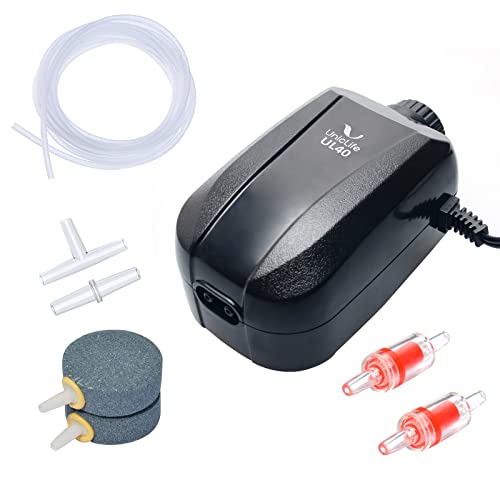
Top pick: Uniclife 64 GPH Dual-Outlet Air Pump
Research pick.
- Fits: two DWC buckets, or one tote with two stones, from one knob that turns the air down.
- Sound: 25 dB on low and 45 dB at full flow (maker’s claim).
- In the box: two air stones, two check valves and 6.5 feet of tubing, enough for two buckets.
- Skip if: your two containers need different amounts of air, since one knob sets both outlets.
Check price on Amazon $11.99
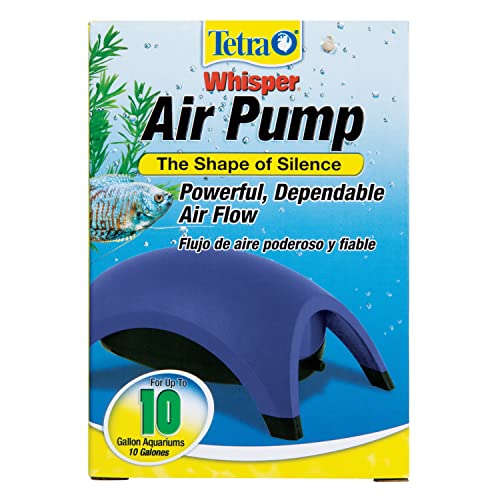
One jar or bucket: Tetra Whisper Air Pump 10
Research pick.
- Fits: one aerated (DWC) jar or a 1 to 3-gallon bucket, with one outlet and fixed flow.
- Sound: no decibel figure published; the motor hangs inside a dome case.
- Skip if: you want to turn the air down or run two containers.
Check price on Amazon $17.39
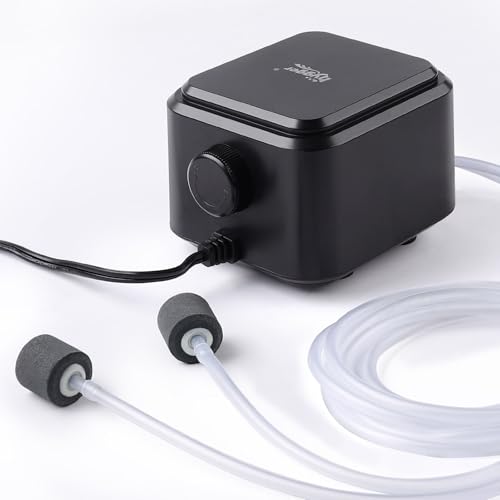
Low-noise pick for a tote: hygger Quiet Dual-Outlet Air Pump (3.5 W)
Research pick.
- Fits: a tote or two small buckets, with two outlets on one knob.
- Sound: under 30 dB (maker’s claim), with a steel motor cover and eight rubber feet.
- In the box: one check valve and one air stone.
- Skip if: you want the full kit in the box; it costs more than the Uniclife and ships from a third-party seller.
Check price on Amazon $22.39

Built for hydroponics: AC Infinity 2-Outlet Hydroponics Air Pump
Research pick.
- Fits: one or two buckets; it moves 2.8 liters a minute, so there is less spare air to turn down.
- Sound: no decibel figure published; a heavy shell and an internal muffler.
- Skip if: you want a published noise number to compare.
Check price on Amazon $23.99
Whichever you pick, set it on a silicone mat and add a check valve above the waterline. Prices are pulled from Amazon and were last checked on 19 November 2026 at 11:45 am. Amazon prices change often, so check the listing before buying.
Why the Best Quiet Air Pump for Hydroponics Matters in an Apartment
An air pump sits outside the water and pushes room air down a hose to a stone in the reservoir. The motor is not the loud part. The case shakes, and whatever it rests on picks the shaking up, so a hollow shelf or a countertop works like the body of a guitar and turns a soft hum into a buzz you hear across the room. For anyone who works from home or sleeps a few feet from the garden, that buzz runs every hour of every day, which is why placement gets its own section further down.
How Loud Is “Quiet”? What the Decibel Claims Mean
However, only some makers print a number. Uniclife gives a range, 25 dB on its low setting and 45 dB at full flow, and hygger says under 30 dB. Tetra and AC Infinity print no figure at all and describe how the pump is built instead: a suspended motor in one case, a muffler in the other. Read every figure as the maker’s claim, measured their way, not on your shelf.
Two habits make the numbers more useful. Compare a pump at the setting you will actually run, which for one or two buckets is low, so Uniclife’s 25 dB matters more than its 45. Beyond that, the surface under the pump changes the sound more than the gap between any two pumps here. A pump on a folded silicone mat almost always beats a quieter-rated one rattling on bare wood.
At a Glance: Picking and Placing Your Pump
Key takeaways
- Size to the container, not the fish-tank rating on the box: a small 2 to 5 W pump with a dial, turned down, aerates a 3 to 5-gallon DWC bucket.
- Isolate the casing from hard surfaces, because the shelf, not the motor, makes most of the noise.
- In the reservoir, a finer air stone trades loud bursting bubbles for a quieter fizz.
- Run the pump 24 hours a day, every day. An active DWC system has no safe off period; a Kratky jar needs no pump at all.
- Warm water holds less oxygen, so above 72°F (22°C) the pump and stone matter more, and above 75°F root rot risk climbs fast.
- Add a check valve just above the waterline. It is one of the cheapest parts of the build and the difference between a pump that survives its first power cut and one that drowns.
Sarah’s Top Pick
Uniclife 64 GPH Dual-Outlet Air Pump
Two outlets on one knob, a published noise range of 25 dB on low to 45 dB at full flow, and two stones, two check valves and tubing in the box. One unit runs two buckets with nothing else to buy.
Top pick for two buckets · 25 dB on low (maker’s claim)
The Four Pumps Compared
| Pump | Best For | Outlets | Noise (maker’s claim) | Pick | Price |
|---|---|---|---|---|---|
| Uniclife 64 GPH Dual-Outlet | Two buckets, or a tote with two stones | 2, one knob | 25 dB low, 45 dB high | Top pick | Check price $11.99 |
| Tetra Whisper Air Pump 10 | One jar or a 1 to 3-gallon bucket | 1, fixed flow | No figure published | Single jars | Check price $17.39 |
| hygger Quiet Dual-Outlet (3.5 W) | A tote or two small buckets, under 30 dB by the maker’s figure | 2, one knob | Under 30 dB | Low-noise pick | Check price $22.39 |
| AC Infinity 2-Outlet | One or two buckets, made for hydroponics | 2, flow dial | No figure published | Made for hydroponics | Check price $23.99 |
Top Picks: The Best Quiet Air Pump for Hydroponics
The gallon figure on an air pump box is an aquarium rating, not a reservoir size, and nearly every pump here is rated for far more water than an apartment bucket holds. That is fine on a pump with a knob or dial: you turn it down. On a fixed-flow pump the spare air has nowhere to go, so it boils the surface, splashes solution and speeds up evaporation. Pick a dial pump for anything bigger than one small container. These are pumps for DWC jars, buckets and totes; a Kratky jar needs none (DWC vs Kratky explains why).
Uniclife 64 GPH Dual-Outlet Air Pump: Top Pick for Two Buckets
Top Pick • 25 dB on low (maker’s claim)
Best for: Two DWC buckets, or one tote with two stones, when you want everything for the job in one box
Watch out for: One knob sets both outlets together, so two very different containers get the same air
Most pumps print one flattering number. Uniclife prints a range: 25 dB on its low setting and 45 dB at full flow, which it compares to a refrigerator hum. That range is the honest way to read any pump, and for one or two buckets you will live near the bottom of it. The pump draws 4 W and moves up to 64 gallons an hour through two outlets, and one rotary knob turns both down together.
The box is the other reason it leads. Two air stones, two check valves, two connectors and 6.5 feet of tubing come with it, so a two-bucket build needs nothing else from the aquarium aisle. The quiet DWC bucket build walks through where each part goes. Like every pump here it is sold as an aquarium pump (Uniclife rates it for 10 to 100-gallon tanks), so start with the knob low and open it only until the stones bubble steadily.
| Why It Made the List | What to Watch |
|---|---|
| Published noise range, 25 dB low to 45 dB high | However, both figures are the maker’s, not measured on a shelf |
| Two outlets, one knob | As a result, one setting covers both outlets |
| Stones, check valves and tubing for two buckets in the box | Even so, it still wants a mat on a hollow shelf |
Read next. How to Build a Quiet DWC Bucket in an Apartment
hygger Quiet Dual-Outlet Air Pump: Low-Noise Pick for a Tote
Low-noise pick • Under 30 dB (maker’s claim)
Best for: A tote or two small buckets in a bedroom or studio, when the build matters more than the box contents
Watch out for: It ships from a third-party seller, costs more than the Uniclife, and includes one stone and one valve
hygger’s case for quiet is in the construction. The listing describes a thickened ABS case, a stainless steel cover over the motor, internal feet that keep the motor off the cover, and eight rubber feet underneath, and it puts the result at under 30 dB. Two outlets share one knob. I link the 3.5 W version, which tops out at 80 gallons an hour; the 5 W model is sold for 150-gallon tanks, which is a great deal of air to throttle back for a bucket.
Two Outlets, Two Containers
With two outlets you skip the gang valve for a pair of buckets: one line each, a check valve on each line above the waterline. The box holds one valve and one stone, so a second line needs a second of each; the 13 ft tubing kit covers both.
| Why It Made the List | What to Watch |
|---|---|
| Under 30 dB claim backed by specific build details | Still, the figure is not independently measured |
| 3.5 W version sized closer to a bucket | However, it ships from a third-party seller |
| Two outlets on one knob | Also, only one stone and one check valve come in the box |
Read next. The 3 Best Countertop Hydroponic Systems for Apartment Beginners (2026)
Tetra Whisper Air Pump 10: Best for Single Jars and Small Buckets
Best for Beginners / One Container
Best for: One aerated jar or a 1 to 3-gallon bucket, and first DWC builds where simple matters more than features
Watch out for: One outlet and no flow dial, and the listing says it is not UL listed
This is Tetra’s actual Whisper air pump, not the Whisper IQ power filter that shares the name, and the difference matters: a filter moves water through a cartridge, while this pushes air down a tube to a stone, which is what DWC roots need. Tetra builds its quiet claim on design rather than a decibel figure: a dome-shaped case, a motor suspended inside it and sound-dampening chambers. The suspended motor is the same idea as the silicone-mat trick later in this guide, so it starts quieter on a hard shelf than a flat-bottomed pump. With one outlet and fixed flow it suits exactly one small container. For a full basil DWC build, the foolproof guide to growing hydroponic basil pairs well with it.
Setup Safety: Avoiding Back-Siphon
One rule: keep the pump above the waterline. If the power cuts while it sits below the reservoir surface, water can siphon back up the airline into the motor. A plastic check valve just above the waterline stops that, and the seed to harvest countdown helps you plan when the roots will fill the bucket and the stone needs its first clean.
| Why It Made the List | What to Watch |
|---|---|
| Suspended motor and dome case built for quiet | One outlet, one container |
| One of the cheapest real air pumps from a major brand | No dial to turn the air down |
| Sold by Amazon itself | Otherwise only the stone needs care, then the diaphragm after a year or two |
Read next. Best Herbs for Small Hydroponics: 7 Varieties That Thrive in Apartments
AC Infinity 2-Outlet Hydroponics Air Pump: Built for Hydroponics
Made for Hydroponics • Flow Dial
Best for: One or two DWC buckets, if you would rather buy a pump designed for growing than an aquarium pump
Watch out for: No decibel figure published, and it costs more than the aquarium pumps
Every other pump on this list is an aquarium pump doing a second job. AC Infinity built this one for hydroponics, and it shows in the sizing: 45 gallons an hour, or 2.8 liters a minute, from two outlets, which is closer to what one or two buckets need than any fish-tank pump here. A turn dial sets the flow, and the listing credits a heavy-duty shell and an internal muffler for the quiet. The tubing comes with a check valve.
What it does not give you is a number. AC Infinity prints no decibel figure, the same as Tetra, so you are trusting the muffler rather than a claim. It is also the brand Google keeps putting in front of people who search for hydroponic air pumps, which is one reason it earns the slot that used to go to the EHEIM Air Pump 100. The EHEIM left this list because its current listing no longer backs up the features I had described.
| Why It Made the List | What to Watch |
|---|---|
| Designed for hydroponics, sized for one or two buckets | On the other hand, there is no published noise figure |
| Turn dial for the flow | In addition, it costs more than the Tetra and Uniclife |
| Muffler and heavy shell; check valve tubing included | Besides that, it comes in a two-outlet version only |
Read next. How To Quiet A Noisy Hydroponic Pump So Your Apartment Stays Relaxing
Also Worth a Look
- Tetra Whisper Air Pump 40: the same suspended-motor design sized for 40-gallon tanks, with one outlet and no dial. It suits a deep multi-plant tote run on one large stone, and nothing smaller, because the extra air cannot be turned down. $25.97
- NICREW Nano Silent Air Pump: a different kind of pump, driven by a thin piezoelectric ceramic plate rather than a diaphragm, which NICREW calls virtually silent. It is rated for tanks up to 10 gallons and comes with a check valve, stone and tubing, so it covers one aerated jar or a small bucket, not a tote. $11.89
The Quietest Setup Has No Pump
If noise is the deciding factor, the quietest hydroponic garden is one without a pump. A Kratky jar or tote is passive: the net cup starts with its bottom in the solution, the plant drinks the level down, and the air gap that opens up feeds the upper roots. Nothing hums, nothing needs a check valve, and a single jar needs no daily top-off. The trade is size and speed, so the Kratky tote setup is the place to start for a few plants, with DWC vs Kratky for the full comparison.
How to Silence Any Air Pump Setup
Even a quiet unit can get noisy, though, if you place it poorly. If yours has already started rattling, my guide to quieting a noisy hydroponic pump covers the same fixes step by step. So, before ordering a replacement, try these physical adjustments first. Most acoustic problems come from surface contact and airflow restrictions, rather than from the motor itself. Because of this, fixing how the device interacts with its environment costs nothing and often solves the problem.

Isolating the Pump from Hard Surfaces
Hard plastic buzzing against wood or laminate turns the whole shelf into a speaker. A thick silicone kitchen mat folded once or twice under the pump breaks that chain. A purpose-made rubber and cork anti-vibration pad does the job better for little more money, because its alternating ribs absorb both light and heavy loads instead of squashing flat. Where a shelf still hums, hang the pump: a short bungee or loop of cord from a sturdy shelf bracket lets it swing free of every surface, and it stays above the waterline either way.
Choosing a Finer Air Stone
Big, uneven bubbles burst loudly at the surface. A stone with finer pores makes smaller bubbles, and smaller bubbles fizz rather than pop, so the reservoir sounds like a soft hiss instead of a pot on the boil. The finer the stone, the sooner salts block it, so treat stones as consumables.
The ten-pack of 1-inch cylinder stones I link are standard sintered mineral stones with medium bubbles, sold for small pumps: each runs at 0.8 L/min, and any nano pump from 2 to 4 W will drive one. They suit jars and small buckets, and at that price a clogged stone gets swapped rather than nursed.
Trimming the Airline Tubing
Long, coiled or kinked tubing makes the motor push against back-pressure, which raises both its volume and its temperature. Cut the line to the direct run from pump to reservoir and take out sharp bends. A short, straight line keeps the motor at the quiet end of its range.
If the hose has gone cloudy or stiff, a 13 ft tubing kit replaces it and adds two spare stones, four connectors and two check valves. While you are rearranging the shelf, the free grow light calculator confirms the right height for the LED over the bucket, and the daily light cycle guide shows how to fit a light, pump and fan around a work-from-home day.
Boxing In a Louder Pump
A pump that stays loud after the mat and the tubing fixes can go in a lined, partly open box. The step-by-step build is in the pump quieting guide; the one rule that matters is airflow, because a fully sealed box traps the pump’s heat.
Troubleshooting Sudden Pump Noise
A pump that was quiet and suddenly is not usually has one of three problems, and none of them needs a new pump.
Clearing Clogged Airstones
Salts from the nutrient solution slowly fill the stone’s pores, and the motor hums louder as it pushes against them. A soak in mild hydrogen peroxide and a gentle scrub buys a cycle or two; the full routine, and when to give up on a stone, is in the pump quieting guide. Keep a spare stone on the line while one is soaking, so the roots never go without air.
Replacing a Worn Diaphragm
Inside a diaphragm pump, a small rubber piece flexes thousands of times an hour. After a year or two of running nonstop it can crack or stretch, and the pump rattles while moving little air. Replacement diaphragm kits are among the cheapest spares for the popular models and take about ten minutes: unscrew the base, lift out the old piece and press the new one in, with nothing more than a small Phillips screwdriver.
Fixing Kinked Airline Hoses
Sometimes the noise comes from outside the pump. Tubing pinched under a lid or squashed behind a shelf creates back-pressure, and the motor grinds. Run a hand along the whole line now and then, and keep a check valve slightly above the waterline so a power cut cannot pull water back into the motor.
When the Power Goes Out
A check valve protects the pump during an outage; it does nothing for the roots. For buckets that cannot sit without air for long, a battery backup air pump switches to its own lithium battery when the mains drop and, by its maker’s figure, runs 15 to 24 hours. It is a backup, not a quiet pick. The power outage guide covers the rest of the plan.
What You’ll Also Need
- pH + EC monitor: KETOTEK pH/EC/Temp Combo Meter, a two-pen kit: a pH pen and an EC, TDS and temperature pen, so you catch the slow pH rise that strong aeration causes before it locks out nutrients.
- pH adjustment: General Hydroponics pH Control Kit. Keeps your reservoir in the 5.5 to 6.5 window even when strong aeration pushes CO2 out of solution and nudges pH upward.
- Check valve: A plastic non-return valve just above the waterline stops nutrient solution siphoning back into the pump during a power cut. Every aquarium shop stocks them, and the Uniclife and the 13 ft tubing kit each include two.
Build your complete DWC setup with the hydroponic shopping list builder.
Helpful references
→ University of Minnesota Extension: Small-Scale Hydroponics
→ University of New Hampshire Extension: Hydroponics at Home
Free tool
Building a DWC setup around your pump?
The shopping list builder shows the whole kit for your crop, experience and budget, split into what to buy first and what can wait, so the pump is not the only thing you get right.
One Last Tip
The mistake I see most with pumped totes is running an aquarium pump flat out because more bubbles sound like faster growth. On a 5-gallon mint tote the opposite happens: the boiling surface splashes solution out and speeds up evaporation, so within days the EC can climb from 2.0 to 2.6 without a drop of fertilizer added, and the mint tips burn.
The fix is boring. Turn the knob to its lowest steady setting, use a finer stone, and keep up the daily top-off with plain pH-adjusted water; the top-off is what dilutes the EC back toward 2.0. After that the routine for a pumped tote is simple: check EC every two days, top off daily, and change the reservoir every 2 weeks. Less air, more steady growth.
Frequently Asked Questions
Do I need to leave the air pump on all the time?
Yes. Roots fully submerged in a DWC reservoir need uninterrupted dissolved oxygen. If the pump stops for several hours, oxygen levels drop, roots become stressed, and the plant declines faster than most beginners expect. There is no safe off period for an active deep water culture setup, so run the pump day and night.
What is the quietest air pump for hydroponics?
No diaphragm pump is silent. Among these picks the lowest published figures are Uniclife’s 25 dB on its low setting (45 dB at full flow) and hygger’s under 30 dB, both makers’ claims; Tetra and AC Infinity publish no figure. A piezoelectric nano pump such as the NICREW is close to silent but only aerates one small jar. Placement does more than the model: a silicone mat, a short straight airline, the pump above the waterline, and buckets kept out of the bedroom.
Do I need an air pump for hydroponics?
For a DWC bucket or tote, yes, and it runs 24 hours a day. A Kratky jar needs none: it is passive, and the air gap that forms as the plant drinks the level down feeds the upper roots. Warm water holds less oxygen, so above 72°F (22°C) aeration matters more in any pumped system, and above 75°F root rot risk climbs fast.
How big of an air pump do I need for hydroponics?
Match the pump to the container rather than the fish-tank rating on the box. A small 2 to 5 W pump with a dial, turned down, aerates a 3 to 5-gallon DWC bucket, with one stone per bucket. Two-outlet pumps such as the Uniclife or the AC Infinity run two buckets, while a single aerated jar needs only a small one-outlet pump like the Tetra Whisper Air Pump 10. Kratky jars, by contrast, need no pump at all.
Can you have too much air in a DWC system?
Yes. Violent bubbling splashes solution out and speeds up evaporation, which concentrates the nutrients, so the EC creeps up. Turn the pump down to a steady stream, use a finer stone, top off daily with plain pH-adjusted water, and change the reservoir every 2 weeks.
Can one air pump run multiple hydroponic containers?
Yes. A dual-outlet pump like the Uniclife, the hygger or the AC Infinity feeds two containers directly, one line and one check valve each. For more containers, split the output with a gang valve and add a check valve on every line; a pump loses pressure as outlets are added, so check that every stone still bubbles steadily.
How long can a DWC system go without air?
Not long. DWC plants can start wilting within hours of the pump stopping, and warm water makes it faster because it holds less oxygen. A check valve protects the pump during an outage, a battery backup air pump keeps the stones running, and the power outage guide covers the rest.
Do bubbles change the pH of my nutrient solution?
Yes. Continuous aeration gradually raises pH as carbon dioxide outgasses from the solution. Check your levels every two to three days and keep the reading between pH 5.5 and 6.5 for most herbs. If it drifts upward between water changes, add a small drop of pH Down after your daily top-off. The free pH and nutrient calculator gives starting numbers.
Can I put my hydroponic air pump on a timer?
No. Never run your aeration on an intermittent timer. The roots need steady dissolved oxygen to take up nutrients, and turning the pump off for even a few hours overnight can show up as wilting or yellowing the next day. Timers belong on grow lights, not air pumps.
Does pushing air into the reservoir change the water temperature?
Slightly. Room air pushed into the reservoir nudges the water toward room temperature. Keep the reservoir between 65 and 75°F (18 to 24°C). Above 72°F (22°C), add aeration, because warm water holds less oxygen; above 75°F root rot risk rises sharply. Keep buckets and totes away from radiators, sunny windows and warm appliances in summer.
Why are my leaves turning yellow even though the air pump is running?
Yellow leaves almost always point to nutrient lockout or deficiency, not an oxygen problem. Check your pH first. If it has drifted above 6.5, iron and manganese lock out even when your EC looks normal. Good aeration speeds up nutrient uptake but cannot fix a reservoir outside the correct pH window. The yellow leaves fix guide covers every cause.
Can I realistically run an air pump in a studio apartment?
Yes. Pick a pump with a low published figure or a quiet build (Uniclife lists 25 dB on low, hygger under 30 dB), run it on its lowest steady setting, and set it on a silicone mat with a short airline. In a studio the bucket and pump go as far from the bed as the room allows; if the hum still bothers you at night, a Kratky jar needs no pump at all.
How often should I change the water in my DWC system?
Top off daily with plain pH-adjusted water, since that replaces what evaporates and keeps your EC from spiking. Do a full reservoir change every 2 weeks to flush out salt buildup and reset the nutrient balance. Good aeration slows root rot between changes, but it does not replace the full change. The full schedule per system is in how often to change hydroponic water.
How often should I replace an airstone?
Every two to three months in a nutrient reservoir, because mineral salts fill the pores far faster than they would in a fish tank. Soaking in peroxide buys a cycle or two, but the pores never fully reopen and the pump keeps straining. Since airstones come cheaply in a multipack, swapping is cheaper than the electricity a laboring motor wastes.
Do I really need a check valve?
Yes, if the pump sits below the waterline, and honestly yes anyway. When the power drops, water can siphon back up the tubing into the motor, which kills the pump and floods the shelf. A small check valve stops it. Mounting the pump above the waterline works too, though a valve costs less than remembering. For the wider outage plan, see my power outage backup guide.
What is the best type of pump for hydroponic systems?
For deep water culture and most small apartment reservoirs, an air pump moving air through a stone is the right tool. It feeds oxygen to the roots around the clock without heating the water the way some submersible pumps can. A quiet water pump only matters once you build a recirculating system with several sites, which most apartment setups never need; DWC buckets and Kratky jars use no water pump at all.


