
Apartment Hydroponics for Beginners
A renter-friendly, numbers-first guide to Kratky jars, DWC buckets and 39 crops, written for homes with no outdoor space.
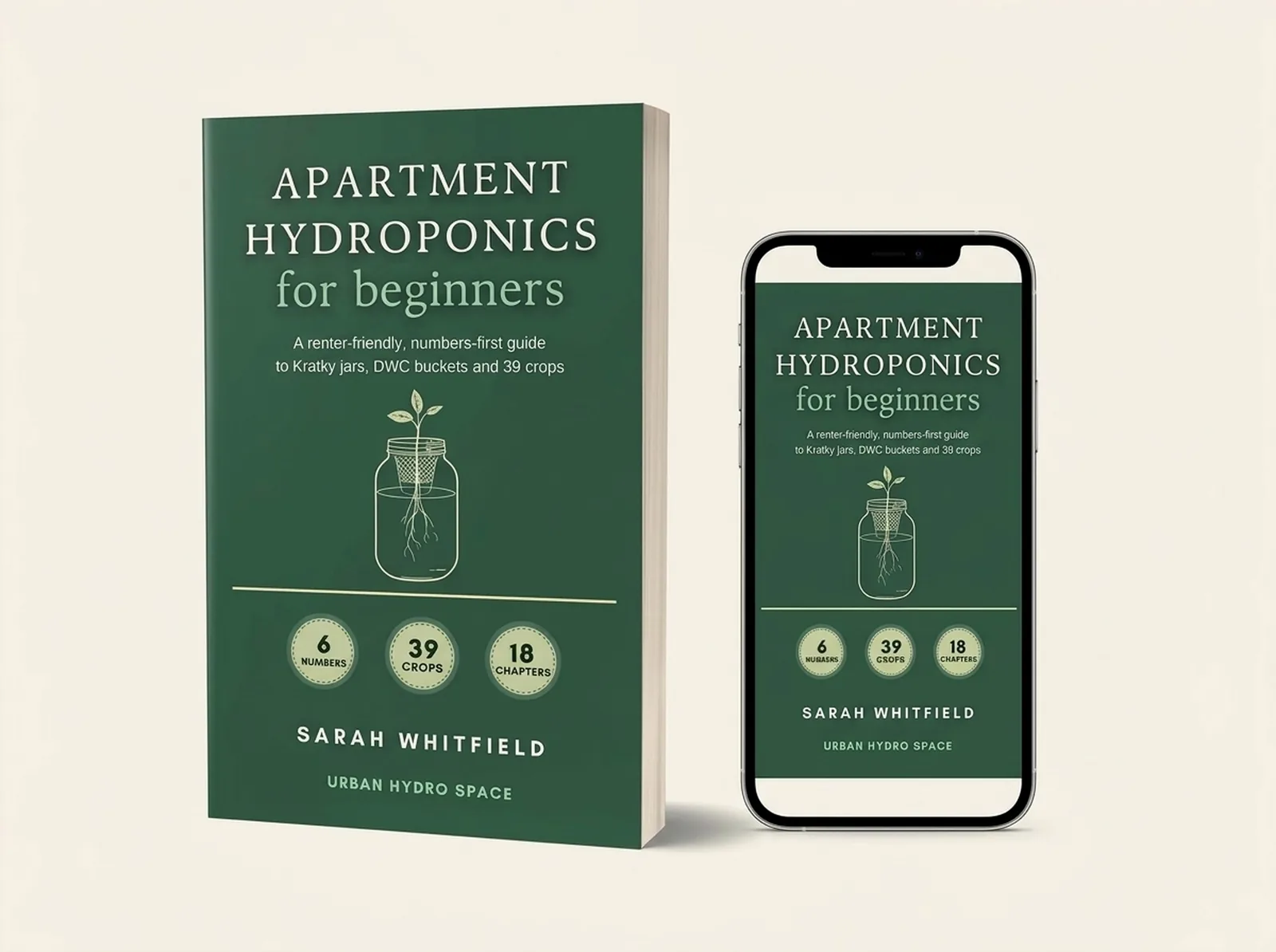
Six numbers, two systems, thirty-nine crops
Most hydroponics advice was written for a greenhouse and a garden hose, then handed to someone with a kitchen counter and a shared electric bill. This book adjusts every number for the difference.
- Build a pump-free Kratky jar for under $20 in parts
- The exact pH, EC, light and timing for 39 crops
- A symptom-first table for the day a leaf turns yellow
Picture the version of this that goes wrong, because it is the most common version. Someone in a 500 square foot studio orders a starter kit at eleven at night. The box shows a sunny farmhouse kitchen, and the instructions inside were written for that kitchen too: run the light 16 hours a day for maximum growth, change the water every week or two, use any liquid plant food you have. Three weeks later the basil is leggy, the water smells wrong, and the whole thing is in a closet.
That failure gets blamed on the person almost every time. It is rarely the person. It is the advice, built for someone with a backyard and handed to someone with one window, with none of the numbers adjusted for the difference.
This book closes that gap with six numbers rather than sixty pages of vibes. Every pH target, EC figure and light schedule is checked against published sources, and Appendix D sets out where each number came from and where the documented research stops. Where something is not reliably documented anywhere, the book says so instead of inventing a figure that sounds confident.
The six numbers the whole book turns on
Chapter 3 puts these up front, as rules rather than a lecture. Nearly every question in the troubleshooting chapter traces back to one of them.
Covers 29 of the 39 crops. Ten reach higher, and the book lists which.
The floor for 31 crops. Eight start lower, each for a stated reason.
18 to 24°C, with aeration above 72°F (22°C). Spinach runs cooler.
Set by crop group, not one blanket number for everything.
Spinach runs 12, and six crops run 16. The book names them.
15 to 20 cm for most herbs and greens, 4 to 6 in for woody herbs, 10 to 12 in for seedlings.
Out-of-range pH locks out nutrients that are already sitting in the water. You can mix a perfect solution and starve the plant anyway. That is why the book checks pH before EC in its troubleshooting, and why every crop in the chart carries its own pH range rather than one number for everything.
Five rows from the 39-crop chart
The same chart the grow planner runs on
EC in mS/cm| Crop | pH | EC, mature | Light height | Air temp | First harvest |
|---|---|---|---|---|---|
| Sweet basil | 5.5 to 6.5 | 1.0 to 1.6 | 6 to 8 in | 65 to 75°F | 5 to 6 weeks |
| Lettuce | 5.5 to 6.5 | 1.0 to 1.4 | 6 to 8 in | 65 to 75°F by day | 4 to 5 weeks, first leaves |
| Mint | 5.5 to 6.5 | 2.0 to 2.4 | 6 to 8 in | 65 to 75°F | 4 to 5 weeks from a cutting |
| Spinach | 5.5 to 6.5 | 1.4 to 1.8 | 6 to 8 in | 60 to 70°F | 35 to 45 days |
| Cilantro | 6.0 to 6.5 | 1.4 to 1.8 | 6 to 8 in | 60 to 70°F | 6 to 8 weeks |
| Plus 34 more crops, each with seedling EC, time to first harvest and the system that suits it. | |||||
Each row in the book carries its seedling EC as well, and Appendix D shows the sources behind every figure. The same numbers drive the public crop sources page.
What is inside
Two systems you can build this weekend
A pump-free Kratky jar for under $20 in parts, and a DWC bucket for faster growth, with the pump noise handled before you build rather than after a sleepless night. Smart gardens get an honest section too, including the pod and sachet costs the sticker price hides.
Thirty-nine crops, each with its own numbers
Twenty-six get a full profile in Part 3 with build notes, timings and a plain verdict on whether they are worth it in an apartment. All thirty-nine sit in the Appendix A chart with pH, seedling and mature EC, light height, air temperature and time to first harvest.
Troubleshooting that reads symptom first
Seven mistakes cause nearly everything else. After those, a diagnosis table you enter from what you can see, then the indoor pests you will actually meet, the smells and crusts that are not diseases, and when to stop rescuing and start over.
A routine that fits a real week
About thirty seconds most days, five minutes once a week, and fifteen minutes every two weeks in a pumped system. Chapter 18 turns that into a realistic first 90 days, including week two, the quiet week where most attempts end.
Read the opening free
Amazon’s free sample opens the book at the start, so you can judge the voice and the approach before you spend anything. On Kindle Unlimited the whole book is included.
Free with the book: a grow planner and a tracker
Two companions that use the same numbers as the book. Both are free, and you can try them today.
The grow planner
Pick a crop and a system, and it lays out every task day by day, from sowing to harvest. It works on your phone with no account and sits on your home screen like an app. The back cover has a code you can scan to open it.
Open the grow planner →The 14-day tracker
One sheet, fourteen days, the whole routine from Chapter 10 with boxes to cross off. Print it and tape it next to the jar. No signup needed.
Get the printable tracker →Who this is for, and who it is not
Written for you if
- You rent, and nothing can be drilled, flooded or left humming at night
- Your growing space is a counter, a shelf or a windowsill
- You have killed a plant already and never found out why
- You want the actual number, not "keep it slightly acidic"
- You want to know what to skip buying, not just what to buy
Probably not for you if
- You have a greenhouse, a garden or a spare room to dedicate
- You are scaling up to sell produce
- You want NFT, tower or ebb-and-flow builds, which this book tells beginners to skip for now
- You already run a tuned system and know your crops’ EC by heart
The site, the book and the planner
Three things, one set of numbers. Each does a different job.
The guides
One question at a time: which light, which nutrient, why the leaves went yellow. Start with the complete beginner guide.
The whole path, in order
From picking a system to a realistic first 90 days, with all 39 crops in one chart and the diagnosis table in one place. Choose an edition.
The grow planner
Day-by-day tasks for the crop you chose, on the same numbers as the book. Open the planner.
Contents
Part 1 · Foundations
- 1. Why This Works in an Apartment
- 2. Pick Your System
- 3. The Six Numbers That Matter
Part 2 · Building Your First System
- 4. Tools, Nutrients and Water
- 5. Build a Kratky Jar
- 6. Build a DWC Bucket
- 7. Understanding Light: PPFD, DLI and the 14/10 Rule
- 8. Choosing and Positioning Your Grow Light
- 9. Starting From Seed: Germination to Net Cup
- 10. The Routine
Part 3 · Growing Your First Crops
- 11. The Easiest Herbs
- 12. Leafy Greens That Rarely Fail
- 13. The Ones That Take a Bit More Care
- 14. Fast Wins: Microgreens and Wheatgrass
- 15. Beyond the Basics: Crops for Later
Parts 4 and 5 · When Things Go Wrong, and Keeping Going
- 16. Troubleshooting
- 17. Your Second System
- 18. A Realistic First 90 Days
Appendices
- A. The Complete 39-Crop Chart
- B. Glossary
- C. Frequently Asked Questions
- D. Where These Numbers Come From
- E. Where to Keep Learning
About the author
Sarah Whitfield
Sarah writes Urban Hydro Space, a site built around one narrow question: what does apartment hydroponics actually require once you strip away the marketing and the one-size-fits-all advice most guides default to?
The book holds to the same standard as the site. Every number is checked against published sources and labeled for how well it is backed, and the sources behind the crop figures are public. More about Sarah.
Choose your edition
Kindle edition
- Searchable, so you can jump to one crop in seconds
- On your phone at the store while you decide what to buy
- Linked contents and color diagrams
- Reads on any phone or tablet with the free Kindle app
Paperback
- The crop chart open beside the reservoir while your hands are wet
- Easy to flip between the six numbers and a crop profile
- A scannable code on the back opens the grow planner
- Ships from Amazon, printed on demand
Both editions carry the same text and the same 39-crop chart. Prices are Amazon’s and can change.
Free tools that pair with the book
📱 Grow Planner (phone app) 📋 Printable 14-Day Tracker 🧪 pH and Nutrient Calculator 💡 Grow Light Calculator ⏳ Seed to Harvest Countdown 📖 Complete Apartment Hydroponics Beginner GuideQuestions about the book
Do I need any experience or outdoor space?
No. The book assumes you have never grown anything hydroponically and that you have no garden, no balcony and possibly one window. Chapter 5 builds a working Kratky jar for under $20 in parts, and every number is set for indoor conditions in a small home rather than a greenhouse.
Is it free on Kindle Unlimited?
Yes. The Kindle edition is enrolled in Kindle Unlimited, so it is included at no extra cost if you subscribe. If you do not, you can buy the Kindle edition outright, or the paperback if you would rather have it on paper next to the jar.
Kindle or paperback?
Paperback if you want the crop chart and the six numbers open beside the reservoir while your hands are wet. Kindle if you want it searchable and with you on your phone while you shop for parts.
Can I read some of it before I buy?
Yes. Amazon's free Kindle sample opens the book at the start, and the six numbers table on this page is the rule set from Chapter 3. The free tracker and grow planner use the same numbers, so they are a good test of whether the approach suits you.
Is this just the free guides from the site in a book?
No. The site answers single questions one at a time. The book is the whole path in order, from picking a system to a realistic first 90 days, with everything in one place: the full 39-crop chart, the symptom-first diagnosis table in Chapter 16, and Appendix D, which sets out where every number came from.
Metric or US units?
Both. Temperatures, lengths and volumes are given in US units with the metric figure beside them. EC is in the standard mS/cm, with the PPM conversion explained in Chapter 3 for meters that read that way.
Does it cover smart gardens?
Yes. Chapter 2 treats a smart garden as one of the three systems worth running in an apartment and is honest about the trade: you pay for convenience and give up some control. It also flags the cost most buyers miss, proprietary seed pods and branded nutrient sachets that can cost more than the unit itself over a year.
Do I need to buy equipment before it is useful?
No. Chapter 4 keeps the starting list to five items and two meters, and tells you which purchases can wait until you know you will stick with it. A first Kratky jar costs under $20 in parts.
I already killed a plant. Will this tell me why?
Start at Chapter 16. It opens with the seven mistakes that cause nearly everything else, then a diagnosis table you read symptom first. Almost every entry resolves back to one of the six numbers in Chapter 3.
Every number, adjusted for your apartment
You do not need a greenhouse or a green thumb. You need the numbers that were built for your home rather than somebody else’s backyard.
For everyone who killed a plant, blamed themselves, and never found out it was the pH.