⏳ 23 min read · Last updated: September 2026
Looking for the best EC meter for hydroponics? This guide compares a combo tester, a dedicated EC pen and a large-batch meter for apartment growers.
Disclosure: As an Amazon Associate, Urban Hydro Space earns from qualifying purchases at no extra cost to you. This post contains affiliate links. The tested products and research picks are labelled below. Thank you for supporting Urban Hydro Space!
🌱 Hands-on tested: the KETOTEK pH, EC and temperature meter and the Apera EC20 Kit. I have used these in my own grows. 🔎 Research pick: everything else in this post, chosen from published specifications and owner reports. How I test and choose products.
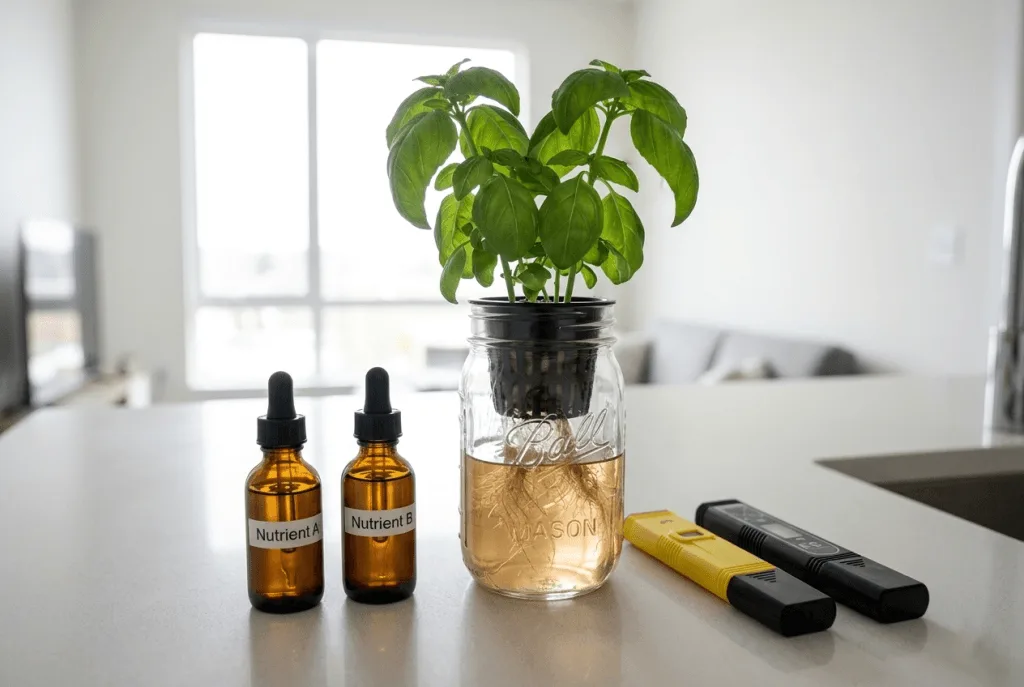
The best EC meter for hydroponics gives you a reading you can check against a known solution, not just a convincing number on a screen. Guessing at fertilizer strength with a spoon is especially risky in a small reservoir.
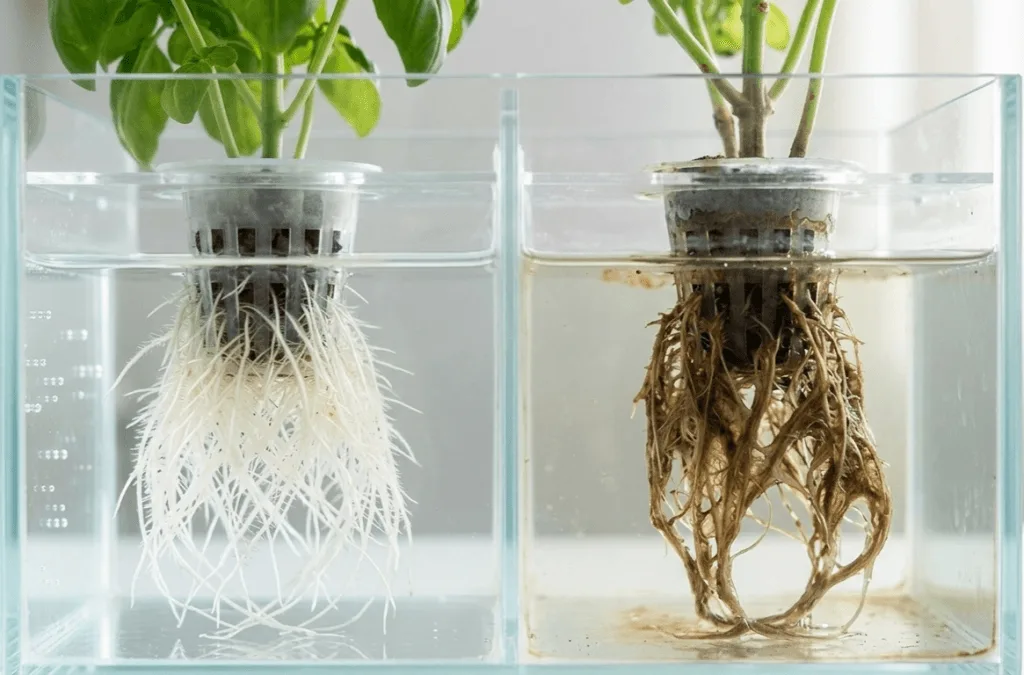
Brown leaf edges can look like a call for more fertilizer. In a small jar, they can also be a sign that the solution is already too strong, or that pH, roots or water level need attention.
Small reservoirs change quickly. An EC meter gives you one useful measurement before you adjust the recipe: the overall concentration of dissolved ions in the water. It cannot identify which nutrient is missing, so use it alongside pH and a look at the roots.
Choosing the best EC meter for hydroponics comes down to one question, and it is not the one most buying guides ask. It is not which meter is most accurate. Rather, it is how much accuracy you need for the size of system you are running.
New here? The complete apartment hydroponics beginner’s guide is worth reading before you spend anything on equipment.
🧪 Best EC and TDS Meters for Hydroponics: Quick Picks
There are two right answers here rather than one, and which applies depends entirely on your setup.
For most people reading this, the KETOTEK combo meter is the sensible buy. It covers pH, EC, TDS and temperature in one kit, which is exactly what someone running one or two jars needs. Buying pH and EC separately costs several times as much, yet gives a beginner nothing extra.
If you are past your first season or run several containers, the Apera EC20 Kit is the stronger dedicated EC instrument on its published specifications. Apera lists ±1% of full-scale accuracy, automatic temperature compensation and an IP67 waterproof body. Its condition still depends on regular cleaning and a check against calibration solution.
- Test every 3 to 5 days on a countertop jar under a gallon, since small volumes swing fastest. Weekly is enough on a larger reservoir.
- Top off daily with plain pH-adjusted water. Then do a full reservoir change every 2 weeks.
- Consider a waterproof model if you measure directly in reservoirs where accidental splashes are likely.
- Check accuracy with a proper conductivity standard on the schedule in the meter’s manual. Tap water is not a reference point.
- Keep water at 65 to 75°F (18 to 24°C) for the roots. Temperature also affects conductivity, so let the probe reach the water temperature and check whether your meter has automatic temperature compensation.
- Learn EC rather than PPM. Brands convert PPM using different formulas, so the same water can read 700 or 1,000 depending on whose pen you hold.
📊 EC Meter Comparison Table at a Glance
- One or two jars, and you also need a pH reading → KETOTEK Combo Meter
- If you want a dedicated EC instrument with a published accuracy specification → Apera EC20
- When you mix in a bucket and hate calibrating → Bluelab Truncheon
⭐ Sarah’s Two Picks for 2026
Best for most apartment beginners
KETOTEK pH + TDS/EC + Temperature Set
★★★★☆ Sarah’s rating: 4 out of 5
Four readings from one budget kit. It has no published waterproof rating, so keep it away from the rim and check its readings against a reference solution.
Amazon price right now: $15.99
Best dedicated EC pen
Apera EC20 Kit
★★★★★ Sarah’s rating: 5 out of 5
Apera lists IP67 waterproofing and ±1% full-scale accuracy. Calibration solution and a case are included. It measures EC and temperature, so you still need a separate pH test.
Amazon price right now: $59.50
Ratings above are my editorial assessment. The KETOTEK and the Apera EC20 Kit are hands-on tested, and every other meter here is a research pick based on published specifications. Links are affiliate links. Prices are pulled from Amazon and were last checked on 27 September 2026 at 12:48 am. Amazon prices change often, so check the listing before buying.
🔍 What to Look for in the Best EC Meter for Hydroponics
Every brand claims to be the top choice, so the marketing copy is useless. In practice, three things separate a pen you will still own next year from one destined for a drawer.
💧 Waterproofing Is Essential
You will drop it. Not maybe, but eventually. A wet hand, a narrow jar mouth, a phone buzzing on the counter, and then the pen goes in.
An IP67 rating means the body survives full submersion. Without it, water wicks past the seam and corrodes the board, sometimes days later, so the pen dies without any obvious connection to the swim it took on Tuesday.
Some models float, which sounds like a gimmick until you are fishing around the bottom of a dark reservoir. This is the one place where the budget pick loses outright, though. The KETOTEK is not rated waterproof. Keep it away from the edge and you will be fine, but know that going in.
☀️ Automatic Temperature Compensation
Warm water conducts electricity better than cold water. The salt concentration has not changed, but the reading climbs anyway.
An apartment that sits at 68°F overnight and 78°F by mid-afternoon will give you two different EC numbers from the same untouched jar. Without automatic temperature compensation (ATC), you read the afternoon number, panic, and dilute a reservoir that was correct. Now the jar really is too weak.
Check for ATC on the box. Keep the reservoir between 65 to 75°F (18 to 24°C) and the correction has almost nothing to do. Heat is behind most readings that look wrong, and small hydroponic system temperature problems walks through why.
🚰 Know What Your Water Starts At
First, though, here is the step almost every guide skips. Before you add a single grain of fertilizer, measure your plain tap water.
For example, tap water might start at 0.4 mS/cm. A starting EC tells you that the water already contains dissolved ions, but the meter cannot tell you whether those ions are useful nutrients, sodium, or something else. If your tap starts at 0.4 and the mixed reservoir reads 2.0, do not call the difference 1.6 of usable plant food.
Measure your source water, record its EC, then mix nutrients according to the product instructions and check the final solution against your crop target. If the starting EC is high or the water behaves unpredictably, a water analysis or a different water source is more informative than arithmetic alone. Compare spring water, distilled water and RO with using tap water in a small system.
📋 Reviewing the Top 3 Best EC Meters for Hydroponics
These three are ranked by who should buy them, rather than by price, with the pen to avoid at the end. The ranking is based on published specs, build quality, and what each one is actually built to do.
💧 KETOTEK Combo Meter (Best for Most Beginners)
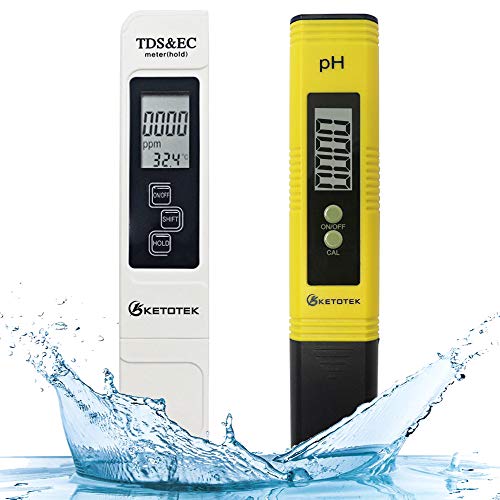
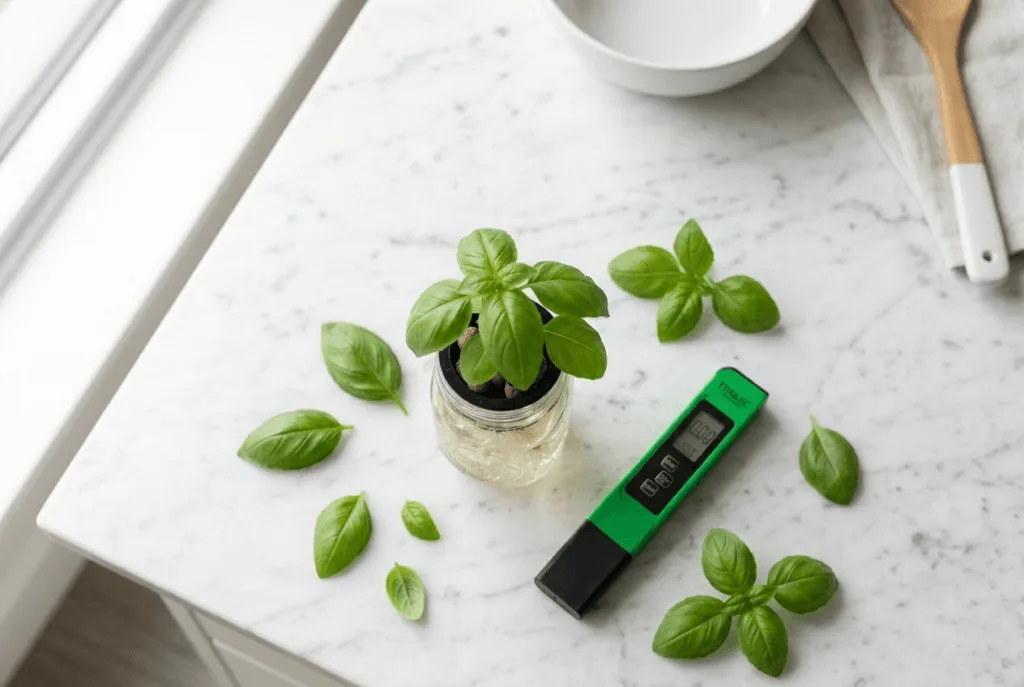
The KETOTEK pH + TDS/EC + Temperature Meter Set is the meter I recommend to almost everyone starting out, because one kit covers pH, EC and temperature for the price of a single decent pen.
The reason is arithmetic rather than engineering. A decent pH pen and a decent EC pen bought separately run to several times the price, whereas this one kit covers pH, EC, TDS and temperature together.
For a beginner that second reading matters more than the first one’s precision. A nutrient-strength problem and pH drift can produce similar symptoms. A meter that only reads EC leaves out one of the first checks to make before changing a recipe.
It is not as tight as the Apera, and it does not need to be. Catching a jar that has climbed from 1.6 to 2.8 does not require laboratory precision, it requires a number on a screen, which is exactly what a first-year budget deserves to pay for.
What you give up at this price:
- No waterproof rating, so keep it off the rim of the jar
- pH probe drifts. Recalibrate monthly or the readings quietly go wrong
- Plastic build that feels like what it costs, so handle it gently rather than treating it like the Apera below
- The probe cap is small and easy to lose. Put it somewhere fixed
Still, none of that outweighs having both numbers from day one.
Amazon price right now: $15.99
✅ Apera EC20 Kit (Best Dedicated EC Pen)

The Apera Instruments EC20 Kit is a dedicated EC and temperature tester I have used in my own grows. Apera specifies ±1% of full-scale accuracy, which is a manufacturer test specification, not a promise that every reading will stay within 1% as the probe ages. Check it with fresh reference solution before relying on a reservoir number.
Its BPB (Brush-resistant Platinum Black) probe is designed to reduce electrode polarization and be easier to clean. The kit includes calibration solutions, a case, a lanyard and four AAA batteries. The EC20 fits the kind of countertop Kratky jars this site covers, but its probe is not replaceable; the EC60 below offers that option.
Why it earns the extra money:
- Waterproof IP67 body that also floats
- Buffer solutions and a carrying case in the box, too
- Auto calibration with buffer recognition and a stable-reading indicator
- Dual LCD showing EC and temperature together
- 1,000 hours of battery life, so batteries last a season
- A two-year warranty, too
The catch is that it only reads EC. Budget for a pH pen alongside it, since that is where the total cost climbs and why it is not my pick for a first purchase. The pH meter roundup covers what pairs well.
Amazon price right now: $59.50
🔁 Other Apera Pens Worth Comparing
If the EC20 is not the right fit, or its listing is unavailable when you shop, three other Apera pens are worth comparing. They are not interchangeable. All three are research picks: I have not used them myself, so everything below comes from Apera’s published specifications.

- Apera EC60 (Premium Series): the closest replacement. It reads EC, switches to TDS or salinity, is waterproof, and the probe can be replaced when it wears out rather than binning the whole pen. It costs more than the EC20. Price: $102.15
- If you would rather own one pen instead of two, the Apera PC60 5-in-1 reads pH, EC, TDS, salinity and temperature. It replaces a pH pen and an EC pen together, which is why the price is higher. Price: $130.77
- Only if you already work in ppm, the Apera TDS20 reads TDS rather than EC. It is waterproof with two-point automatic calibration, but for the reasons in the tip above, EC is the number I would rather you learn. Price: $54.88
On a budget, the KETOTEK combo above already reads EC, so you can start with that and add a dedicated pen later.
⚗️ Bluelab Truncheon (For Large Batches)

The Bluelab Commercial Truncheon is a fat baton that doubles as a stirring stick, so you mix and read in one motion. A row of LEDs down the side reports the range instead of a digital screen.
Bluelab says the Truncheon is factory calibrated and needs no user calibration. It still needs care: Bluelab recommends cleaning the probe and verifying accuracy in 2.77 EC solution monthly.
The trade is resolution: LEDs give you a band rather than a number, so it tells you roughly where you are instead of exactly. For a single jar it is the wrong tool. For filling five gallons before splitting it between containers, it is quick and it works. Pair it with the two-part nutrient mixing guide if you are working at that volume.
Consider it if you:
- Mix a five-gallon batch, then distribute to smaller jars
- Would rather skip routine user calibration, while still checking accuracy monthly
- Want a stir-and-read tool, especially on water change day
Amazon price right now: $104.00
⚠️ Generic Yellow Pen (What to Avoid)
Generic yellow pens vary despite their similar cases. Some have automatic temperature compensation and some do not; many sellers give little detail about their accuracy or calibration method. The colour of the case is not a performance test.
The risk is trusting an unverified number. Before adjusting a reservoir because a cheap pen says EC 1.5, rinse it and check it in fresh conductivity standard. If it cannot return close to the known value, clean or recalibrate it according to its manual, then cross-check with another meter.
A wrong number you trust is worse than no number at all. Buy the KETOTEK if you also need pH, or keep a working EC pen that passes a reference check.
Also worth reading: Best Hydroponic Nutrients for Small Apartment Systems
And finally: 5 Best Hydroponic Accessories That Make Small Systems Easier to Maintain
- Best for most beginners: KETOTEK Combo Meter. pH and EC together in the budget bracket, which is what a first-year grower actually needs.
- Best dedicated EC pen: Apera EC20 Kit. IP67 waterproofing and manufacturer-listed ±1% full-scale accuracy, with reference solutions in the kit.
- Best for large batches: Bluelab Truncheon. Stir and read without user calibration; clean and verify it monthly.
💡 Why Measuring Nutrient Strength Matters for Small Systems
Without a number you are simply guessing at how much food your plants have already taken. Too little and leaves yellow from the bottom up. Too much, meanwhile, and the roots burn.
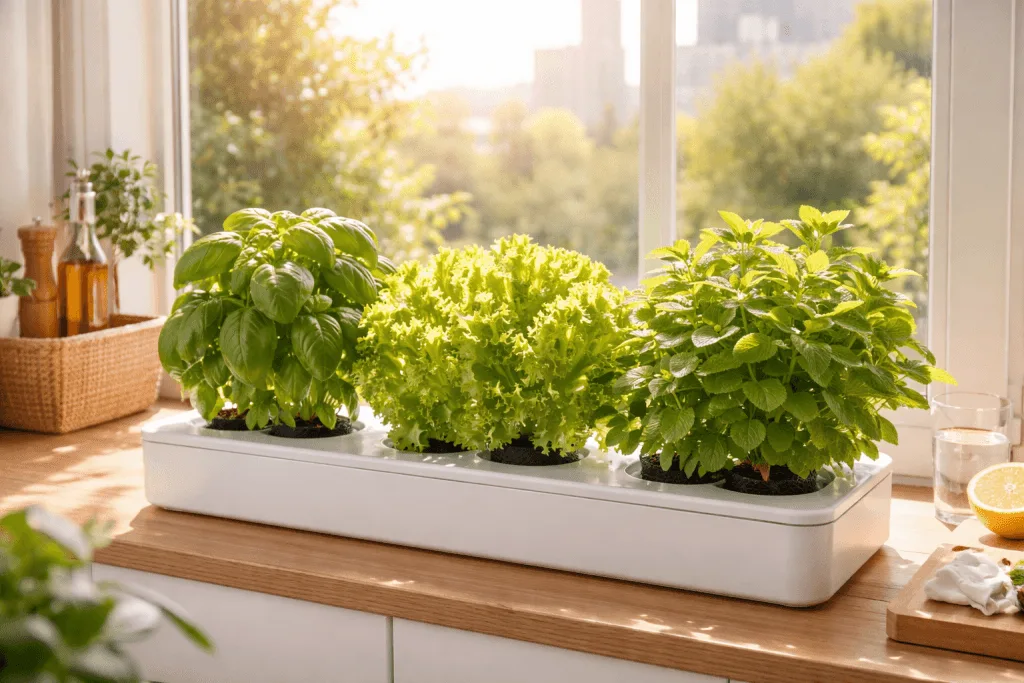
Feeding rates also differ more than beginners expect. Lettuce sips, whereas basil and mint are heavier feeders. One reservoir shared between both is a compromise; EC 1.5 is this site’s practical starting target for mixed shelves, not a universal standard. Per-crop targets are broken down in the EC and nutrient strength guide for apartment herbs and lettuce.
🔗 Preventing Nutrient Lockout
High EC can make it harder for roots to take up water, while out-of-range pH can limit nutrient availability even when EC looks normal. These are different problems, so check both numbers before adding more fertilizer. A stressed plant in a full jar does not prove which one is wrong.
Evaporation is one reason EC can rise: water leaves while dissolved ions remain. In a small jar, check the water level and EC regularly. Top off with plain water when appropriate, then recheck EC and pH. If EC has already climbed too far, follow the steps to lower EC in a small system.
🌿 Target EC by Crop
Match the crop to your patience as well as your target number. These are the figures I test against, and they are the same ones used everywhere else on this site.
| Crop | Difficulty | Seedling EC | Mature EC | Notes |
|---|---|---|---|---|
| Mint | Very forgiving | 1.0 to 1.2 | 2.0 to 2.4 | Heaviest feeder on the shelf, though it recovers fastest |
| Basil | Easy | 1.0 to 1.2 | 1.0 to 1.6 | Forgiving; its flavor tracks light more than feed |
| Chives | Easy but slow | 1.0 to 1.2 | 1.8 to 2.0 | Low maintenance, once established |
| Green onions | Easy | 1.0 to 1.2 | 1.4 to 1.8 | Regrow from grocery cuttings in 2 to 3 weeks, once the white base is in water |
| Spinach | Intermediate | 1.0 to 1.2 | 1.4 to 1.8 | Refuses to germinate above 75°F, so start it somewhere cool |
| Dill | Easy | 1.0 to 1.2 | 1.4 to 1.8 | Fast, but then it bolts, so succession plant it |
| Parsley | Slow to start | 1.0 to 1.2 | 1.4 to 1.8 | 6 to 8 weeks to first cut, though worth the wait |
| Cilantro | Advanced | 1.0 to 1.2 | 1.4 to 1.8 | Our preferred pH is 6.0 to 6.5; try a separate jar if it struggles in a shared reservoir. Often bolts in warmth |
| Arugula | Easy | 1.0 to 1.2 | 1.4 to 1.8 | Peppery, and also ready in 30 to 40 days |
| Oregano | Intermediate | 1.0 to 1.2 | 1.4 to 1.8 | Woody, so it wants light closer, at 4 to 6 inches |
| Thyme | Intermediate | 1.0 to 1.2 | 1.2 to 1.6 | Slowest of the woody herbs, though steady |
| Lettuce | Very forgiving | 1.0 to 1.2 | 1.0 to 1.4 | Lightest feeder, because overfeeding causes tipburn |
🌱 The Seedling Rule: Start at 1.0
Notice how narrow the seedling column is. Most crops on this table start at 1.0 to 1.2 and step up once true leaves appear; basil can take up to 1.6 while young. The 1.0 floor is this site’s practical starting rule for these crops, not a universal lowest safe strength. Microgreens and several other crops in the master crop table have lower documented seedling ranges.
⏱️ How to Use the Best EC Meter for Hydroponics
The whole routine takes about a minute once you know your meter. Pick a regular time for testing so you can compare readings under similar conditions.
Check the water temperature first. Even with ATC, water above 75°F is a problem in its own right, since warm water holds less oxygen and root rot follows.
📋 Step-by-Step Testing Guide
To get a reading you can trust:
- Start with a clean sample cup and a pen checked against the correct conductivity reference solution.
- Stir the reservoir gently after mixing nutrients, then take a sample so you measure the blended solution.
- Dip the probe to the depth marked in your meter’s instructions. A waterproof rating applies to the specified model, not to every pen.
- Wait for the reading to stabilize. If the sample and probe are at different temperatures, give them time to equalize.
- Write down the EC, pH, water level and date. Compare EC with the crop target in the pH and nutrient calculator.
- Rinse the probe and store it as its manufacturer instructs. EC probe care differs from pH probe storage.
🔧 Calibrating Your Meter
Nobody wants to do this. Do it anyway, though.
A conductivity sensor can read incorrectly when residue coats its electrodes. Rinse after use, inspect for deposits and check a suspicious reading against fresh conductivity standard.
Use the standard and calibration steps specified for your model. The Apera EC20 kit includes reference solutions and supports automatic calibration; its published accuracy is ±1% of full scale. The Bluelab Truncheon is factory calibrated, so you clean and verify it in 2.77 EC solution rather than trying to recalibrate it. A monthly check is an easy routine to remember.
- Testing before a new mix is blended. Stir gently, then take a representative sample.
- Submerging past the model’s stated depth. Follow its manual. The Apera EC20 is IP67-rated; the budget combo has no published waterproof rating here.
- Testing before nutrients are fully mixed. Dissolve and stir according to the product instructions, then wait for a stable reading before adding more.
- Putting it away dirty. Rinse away nutrient residue and follow the manufacturer’s storage instructions for that EC probe.
- Calibrating against tap water. Tap water has its own EC and can change over time. Use the conductivity standard specified for your meter.
🧮 Free tool
Know what EC to aim for before you measure
A meter only helps if you know the target. The pH and nutrient calculator gives you the EC range for your crop and the dose that gets you there. Here it is for lettuce in a 10 litre DWC bucket.
🚨 Fixing Common EC Problems in Small Hydroponic Systems
When herbs look unhappy, test the water before you do anything else. Most of what gets blamed on light or pests is chemistry instead.
A full reservoir change every 2 weeks prevents most EC emergencies outright. Lockout comes from strength that is too high, or from pH wandering outside 5.5 to 6.5 and the two look identical from above the waterline.
🔎 Quick diagnosis table
| What you see | Most likely cause | Check this first |
|---|---|---|
| 🟡 Brown crispy leaf tips | Nutrient burn, because EC climbed too high | First dilute the reservoir with plain water, one third at a time |
| 🟡 Pale yellow lower leaves | Nitrogen short, since EC dropped too low | Add balanced nutrients, although only in small steps |
| 🟡 Stunted, twisting growth | pH lockout, so uptake is blocked | Test pH first, before adding any food |
| 🟡 Tips burnt on inner leaves | Calcium delivery, rather than shortage | Lower EC to 1.0, then add airflow |
🔍 What To Do When Readings Are Too High
Do not dump the whole jar. Plants drink water faster than they eat minerals, so the solution concentrates on its own, and a staged dilution stresses the roots far less than a total swap.
- First pour off one-third of the reservoir.
- Then refill that volume with plain, pH-adjusted water.
- Wait ten minutes so it can mix.
- Test again, and repeat if it is still high.
If the old solution is only mildly strong, do not tip it down the sink. Spent reservoir water makes decent houseplant feed.
❓ What To Do When Readings Are Too Low
A target of EC 1.8 showing 0.8 means the plant is running out of food. Vigorous herbs do this in days, especially mint.
- Mix a small concentrated batch in a separate cup, rather than straight into the jar
- Add a splash, then stir well
- Test again, though only after a few minutes
- Repeat in small steps until you land in range
If your readings drop fast on RO or distilled water, the missing piece may be calcium and magnesium rather than overall strength. Whether you need Cal-Mag covers that.
The seed to harvest calculator also helps you anticipate the spike, since demand climbs sharply once a plant hits its main growth stage.
Next: Why Your Apartment Hydroponic Plants Turn Yellow (And Simple Fixes That Work)
Also useful: How To Prevent Root Rot In Small Hydroponic Systems Before It Starts
🚫 When Your EC Meter Is Lying to You (4 Silent Failure Signs)
A meter can look perfectly healthy and still be wrong. This is the worst failure mode there is, because the screen gives you confidence while the jar quietly kills your plants. So here are four signs to watch for.
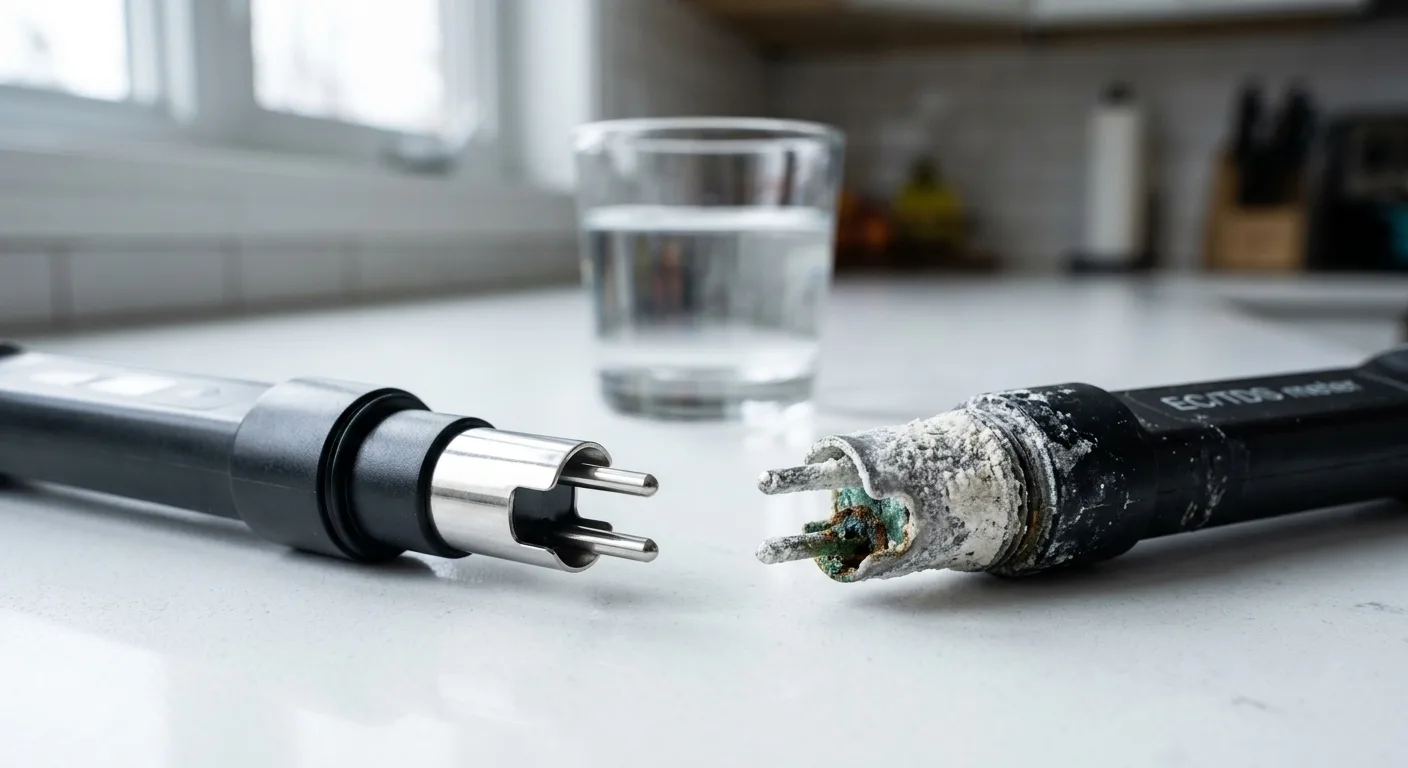
The number jumps between dips. Same sample, same temperature, yet different readings. Rinse the probe and follow its manufacturer’s cleaning method, then verify it against fresh standard. A dirty sensor is one possible cause; a low battery is another.
A reference check fails. If the pen cannot return close to a standard’s stated value after cleaning and the model’s calibration steps, do not use it to adjust a reservoir. Check the standard’s age before replacing the meter.
It reads zero in low-mineral water. That alone does not prove a fault. RO or distilled water may fall below a meter’s useful measurement range. Test the pen in a conductivity standard before calling its contacts dead.
Plants struggle at a plausible EC. A number such as EC 1.4 cannot identify calcium availability, pH, root health or the nutrient ratios. Check pH and roots, then cross-check the EC pen before changing the mix.
💬 A Word From Sarah
I have used the KETOTEK combo meter and Apera EC20 in my own grows. Whichever meter you use, its reading is one piece of evidence. If a plant struggles while EC looks normal, check pH, roots, water level and the meter against a fresh reference solution before changing the nutrients.
❓ Frequently Asked Questions
🔍 What is the difference between TDS and EC?
EC measures how well a solution conducts electricity, which reflects its total dissolved ions. A TDS pen estimates parts per million from that EC reading using a conversion factor. Different 500 and 700 scales can give different ppm numbers for the same water. Use EC when comparing crop targets unless your feeding chart names a specific ppm scale.
📋 How do I measure the EC in hydroponics?
Stir the mixed reservoir, take a clean sample, immerse the probe to the depth in its manual, and wait for a stable reading. Let the probe reach the sample temperature. Record EC in mS/cm, the water level, pH and date. Rinse the sensor afterward. Check the pen against fresh conductivity standard when a reading seems wrong.
💰 What is the best water tester for hydroponics?
For one or two jars, a working combo meter that reads both pH and EC is a practical first purchase. In this roundup that is the KETOTEK. If you already have a pH tester and want a dedicated EC pen, the Apera EC20 has a published accuracy specification and IP67 waterproofing. Verify whichever meter you choose with a reference solution.
⚗️ Do I need to calibrate my EC meter?
Follow your meter’s manual. The Apera EC20 supports automatic calibration with conductivity reference solutions. A factory-calibrated Bluelab Truncheon does not need user calibration, but Bluelab recommends cleaning it and checking accuracy in 2.77 EC solution monthly. A clean probe and a fresh standard matter more than a calibration date on the calendar.
🧪 What is the most accurate TDS meter?
There is no universal winner without comparing specifications on the same basis and testing against known solutions. The Apera TDS20 is a TDS-specific option with a manufacturer-listed ±1% full-scale specification. The Apera EC20 measures EC, not TDS. For hydroponic crop targets, a verified EC reading usually avoids confusion between ppm conversion scales.
🚰 Should I measure my tap water before adding nutrients?
Yes. Note the starting EC so you know the source water already contains dissolved ions. A meter cannot identify which ions are useful nutrients, so subtracting tap EC from final EC does not reveal a plant’s actual nutrient supply. Mix the fertilizer as directed, check the final EC, and consider a water analysis or different source if the baseline is high.
💧 What should TDS be for hydroponics?
It depends on the crop, its growth stage and the meter’s ppm conversion scale. A single TDS number is not a safe target for every jar. Choose the crop’s EC range first, then convert only if your meter displays ppm and you know whether it uses a 500 or 700 scale. Check pH as well; EC alone cannot diagnose a nutrient problem.
🧪 Is an EC meter the same as a pH meter?
No. EC estimates the concentration of dissolved ions in the water. pH measures acidity, which affects nutrient availability. A solution can have a plausible EC but the wrong pH, or the reverse. A combo device reports both values; a dedicated Apera EC20 measures EC and temperature, so it needs a separate pH test.
🔧 How do I clean my EC meter probe?
Rinse it after each test and follow the model’s cleaning instructions when residue appears. Do not use the same cleaning method on every brand’s sensor. Bluelab provides a conductivity probe cleaner and cleaning procedure for the Truncheon; afterward, check it in 2.77 EC standard. For the Apera, follow its supplied manual and recheck with the appropriate reference solution.
🌿 What is the best EC for hydroponics?
There is no single best EC for every plant. This site’s mature-crop targets include lettuce at 1.0 to 1.4 mS/cm and basil at 1.0 to 1.6 mS/cm. For a mixed shelf, 1.5 is a practical starting compromise, not a universal standard. Use the crop table above, then watch plant response, pH and water level.
🌱 What is the best ppm for hydroponics?
Ask which ppm scale the meter uses before choosing a number. At EC 1.5 mS/cm, a 500-scale display estimates about 750 ppm while a 700-scale display estimates about 1,050 ppm. Those are two labels for the same conductivity, not different feeding strengths. Match the crop’s EC target and compare readings using one scale consistently.
❓ Do you need an EC meter for hydroponics?
You can grow without one by following the nutrient label, topping off with plain water and replacing the reservoir every two weeks. An EC meter becomes useful when a small jar changes quickly or leaves show stress: it shows whether overall dissolved-ion strength is rising or falling. It does not reveal which individual nutrient is missing, so check pH and roots too.
If you are running one or two jars and want to stop guessing, buy the KETOTEK combo meter. Both numbers that matter, in one budget kit. If you already know you are staying with this hobby, the Apera EC20 Kit is the stronger long-term instrument on paper, and a waterproof body pays for itself the first time it goes in the water instead of staying on the shelf.
Happy growing! 🌿
Sarah, Urban Hydro Space

Sarah Whitfield is the founder of Urban Hydro Space and an indoor gardening enthusiast dedicated to helping apartment dwellers grow fresh herbs and vegetables in small spaces. She researches hydroponic systems carefully from real specifications and verified buyer feedback, and shares practical tips and honest, clearly labeled product picks to make indoor gardening accessible for beginners.