⏳ 19 min read · Last updated: September 2026
Growing hydroponic cilantro indoors takes a different approach from every other herb on your shelf. I remember my first attempt in a small apartment kitchen. I put the seedlings under a blazing light, mixed the strongest nutrient solution I could find, and waited. Three weeks later the plants shot upward, opened white flowers, and turned bitter. That is a frustrating result when you only wanted fresh garnish for tacos.
What I eventually worked out is that cilantro is the most heat-sensitive crop I grow, and it bolts on a clock of its own. Get the temperature and the rotation right and you buy weeks of tender leaves. Get them wrong and no amount of light tinkering saves the plant. This guide covers the exact settings, plus the rotation that keeps a supply running once the first plant gives up.
Warm water is the trigger. Keep the reservoir under 75°F (24°C) and cilantro stays in leaf for weeks; let it run warm and it flowers within days. Hold pH in the upper half of the usual range, 6.0 to 6.5.
It also means cilantro is best given its own jar, on its own short rotation, so replacing it every few weeks never disturbs the rest of the shelf.
📐 Cilantro At A Glance
Cilantro is rated Advanced here, which surprises people because most sites file it under beginner herbs. The bolting speed in warm rooms puts it well above basil and mint in difficulty, so treat these numbers as tight rather than approximate.
- Hold pH at 6.0 to 6.5, the upper half of the standard band.
- Keep the reservoir at 65 to 75°F (18 to 24°C), since 75°F is the critical ceiling.
- Feed EC 1.4 to 1.8 when mature, though seedlings start at 1.0 to 1.2.
- Run 14 hours on and 10 off like every other herb; heat drives bolting far more than a 14-hour day does.
- Succession plant every 2 to 3 weeks, as bolting is going to happen eventually.
- Top off daily with plain water, then run a full reservoir change every 2 weeks.
🔎 Quick diagnosis table
| What you see | Most likely cause | Check this first |
|---|---|---|
| 🟡 Tall stem and white flowers | Heat stress, therefore bolting | Water temperature, not room air |
| 🍋 Thin slow growth despite feeding | Too little light for a crop that keeps gaining with more | Raise the light toward 250 to 350 PPFD, then check pH sits at 6.0 to 6.5 |
| 🟤 Brown foul-smelling roots | Root rot from warm water | Reservoir temperature and aeration |
| 🍂 Crispy brown leaf edges | Nutrient burn, so EC ran too high | Reservoir EC against 1.4 to 1.8 |
| 💀 Plant collapsed after harvest | The centre crown was cut | Take outer stems only, never the middle |
🌿 Why Growing Hydroponic Cilantro Indoors Is Tricky
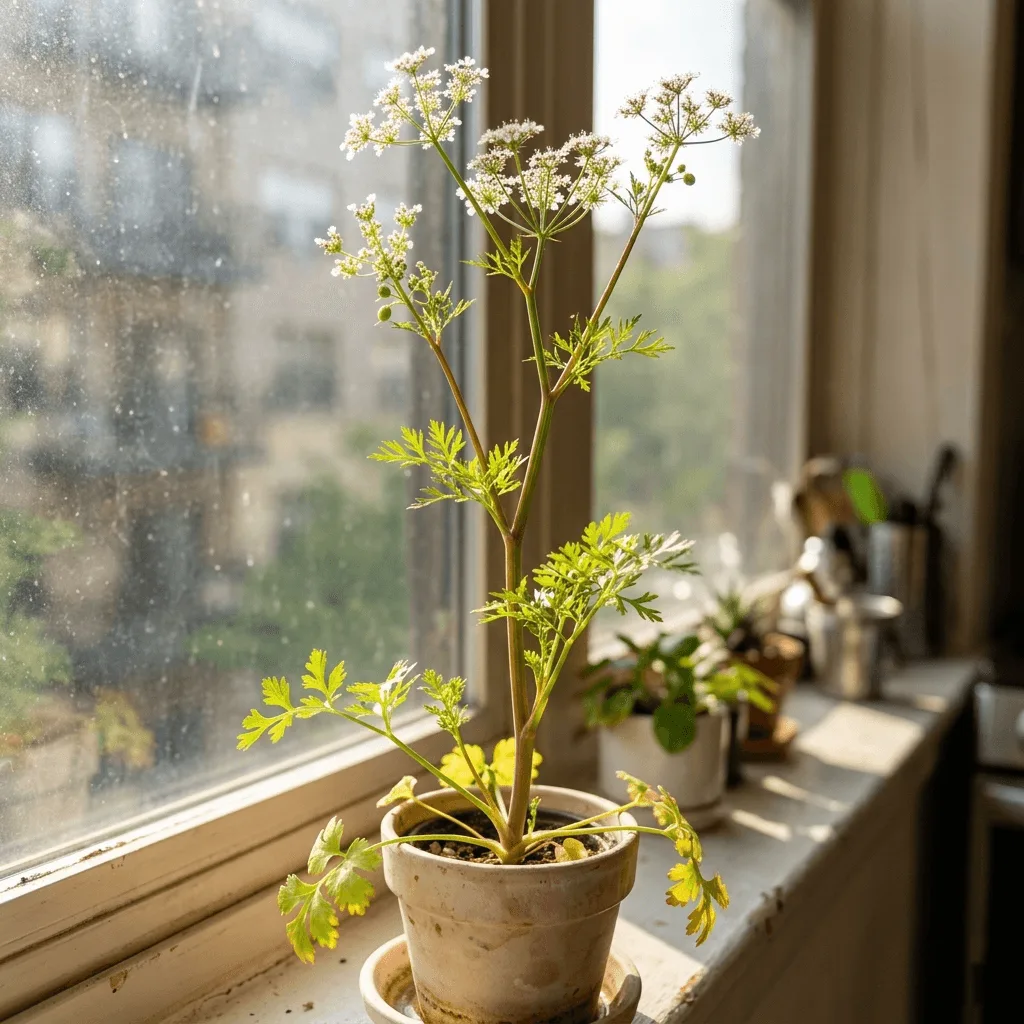
Bolting is the process where a plant abandons leaf production and rushes to make flowers and seed. Outdoors, cilantro does this when summer heat arrives, triggering a survival response to reproduce before conditions turn against it. Indoors, a warm apartment reads as exactly that same signal.
The central stalk thickens, leaves turn sparse and feathery, and the flavour goes soapy. Culinary value drops to nothing once that transformation finishes. The honest framing is worth stating plainly, though: bolting will happen eventually no matter what you do. Your job is delaying it, then having a replacement ready.
For context on where this crop sits against easier options, the guide to the best herbs for small hydroponic systems compares cilantro against basil and mint. If you are starting from zero, the apartment hydroponics beginner’s guide covers every system and concept first.
🌡️ Temperature Is The Real Trigger
Heat drives bolting more than anything else, and water temperature matters more than the number on your wall thermostat. Hold the reservoir between 65 and 75°F (18 to 24°C). The critical ceiling is 75°F (24°C), and above it cilantro bolts almost immediately regardless of how good everything else looks.
Air temperature wants 60 to 70°F (15 to 21°C), which is cooler than basil or mint prefer. Keep the setup out of sunny windows and away from heating vents, since radiant warmth reaches the jar long before it changes the room reading. A small clip fan across the canopy helps carry away heat thrown off by the light, and the roundup of quiet clip-on fans for apartment shelves covers models that stay silent.
In a flat without air conditioning, July and August are hard months for this crop. My guide to small hydroponic temperature problems and fixes covers cooling a reservoir without buying a chiller.
💡 Light Hours And Height
Run 14 hours on and 10 hours off, the standard herb schedule. Days of 16 hours or more push cilantro toward flowering, so do not stretch it. You will see advice elsewhere to shorten the day to 10 or 12 hours to fake autumn, and it is a tempting theory, though it costs you more than it buys. Cilantro is a medium-light crop that needs the photons to build leaf mass, and starving it of light produces pale stretched growth that bolts anyway once the heat arrives.
Hang the panel 6 to 8 inches above the canopy, targeting 250 to 350 µmol/m²/s. Cilantro keeps gaining leaf as light rises, far more than most herbs, so the brighter end pays. The grow light calculator sizes the fixture for your shelf, and how far grow lights should sit from herbs on a shelf covers the margins. If a work schedule makes 14 hours awkward, the light schedule for 9-to-5 growers maps out workable windows, and one of the best compact timers for apartment grow lights keeps it consistent.
Budget fixtures are covered in the roundup of best grow lights for low-light apartments under $50. Watch for bleached or curled tips, because that is grow light burn rather than a heat or feeding fault.
🧬 The Genetics Behind The Rush To Seed
Seed choice buys you real time. Standard packets carry wild traits favouring fast reproduction, so a cheap generic seed means fighting the plant from day one. Breeders have developed strains that hold off flowering considerably longer.
Look for varieties labelled slow-bolt or long-standing, since those give an extra 2 to 3 weeks of leaf production before the stalk appears. Calypso and Cruiser both perform well in indoor water setups. Store spare packets sealed in the refrigerator, where they stay viable for around three years.
Best Setup Options For Hydroponic Cilantro Indoors
Container choice is simpler here than for most crops, because the plant lives a short life and stays small. You need no large reservoir and no plumbing. Modular setups also make the rotation easier, which matters more for cilantro than for anything else on the shelf.
One habit helps more than any other: give cilantro its own container. It runs on a short rotation of its own, so a shared reservoir means disturbing everything else every few weeks.
- Cool shaded corner available → Kratky jar, since it needs no outlet
- Want the fastest root development → deep water culture
- Low-light apartment → countertop smart garden, though set its timer to 14 hours
🫙 The Kratky Method For Small Spaces
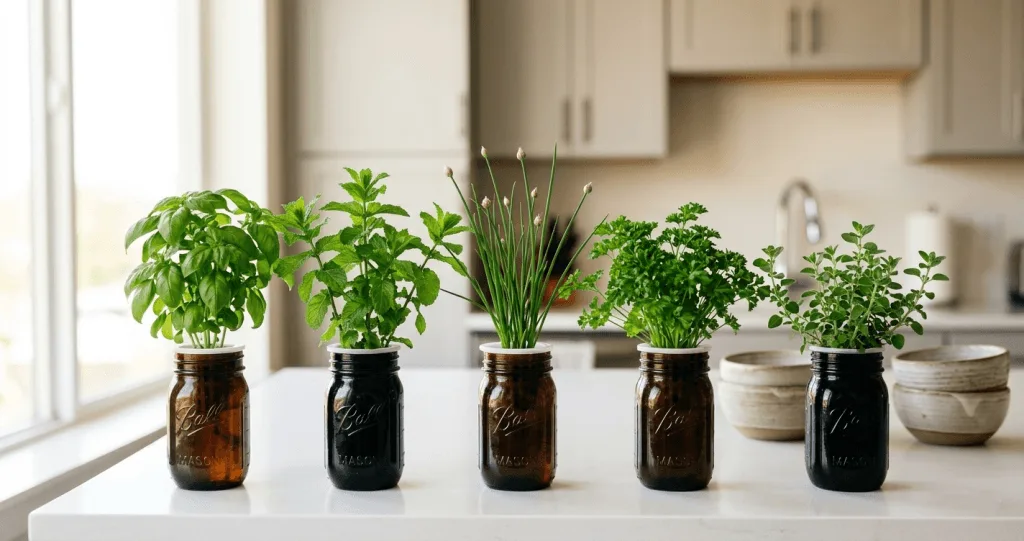
The Kratky method needs no electricity, which suits a crop you will replace every few weeks. You set the net cup so its base sits in the nutrient water, and an air gap of 1 to 2 inches opens as the plant drinks, so the roots can breathe. A 1-quart mason jar with a 2-inch net cup holds enough solution to carry cilantro from seedling to final harvest without a mid-cycle change.
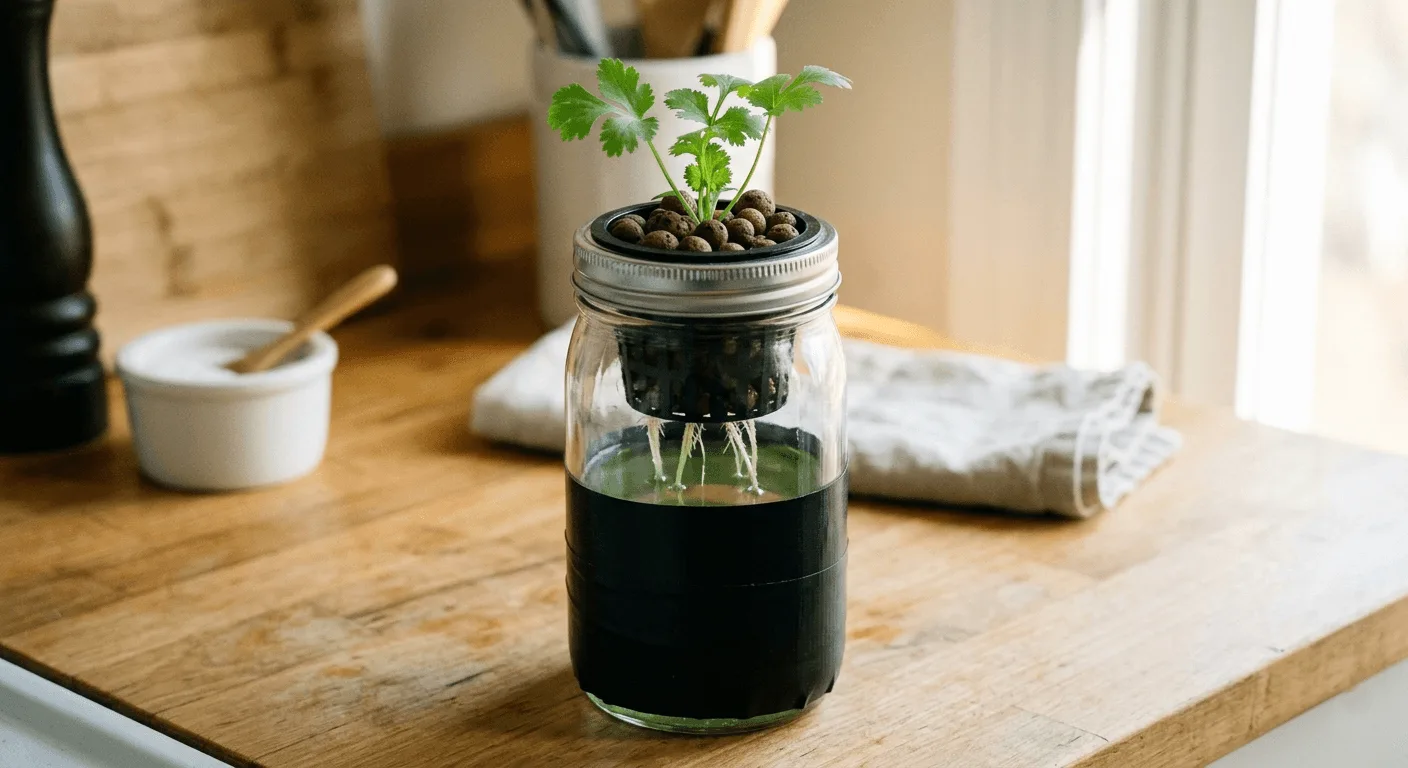
To build one, my guide on simple apartment-friendly Kratky jar setups covers each step with kitchen supplies, and the best mason jar net cups and lids covers the hardware. Deciding between methods is handled in DWC versus Kratky for apartment beginners.
🌊 Deep Water Culture For Faster Roots
Deep water culture pushes oxygen through the reservoir with an air pump, and that oxygen-rich root zone builds mass faster. The trade-off is an outlet plus a low hum, which becomes noticeable in a studio at night.
A dense foam or silicone pad under the pump absorbs most of the vibration, since structure-borne noise rather than the motor is usually what you hear. My guide on quieting a hydroponic pump in an apartment covers the rest, and the roundup of best quiet air pumps for apartment DWC lists the quietest models. Keep the pump above the water line so it cannot siphon during a power cut, which the power outage backup plan covers in full.
🔌 Countertop Smart Gardens
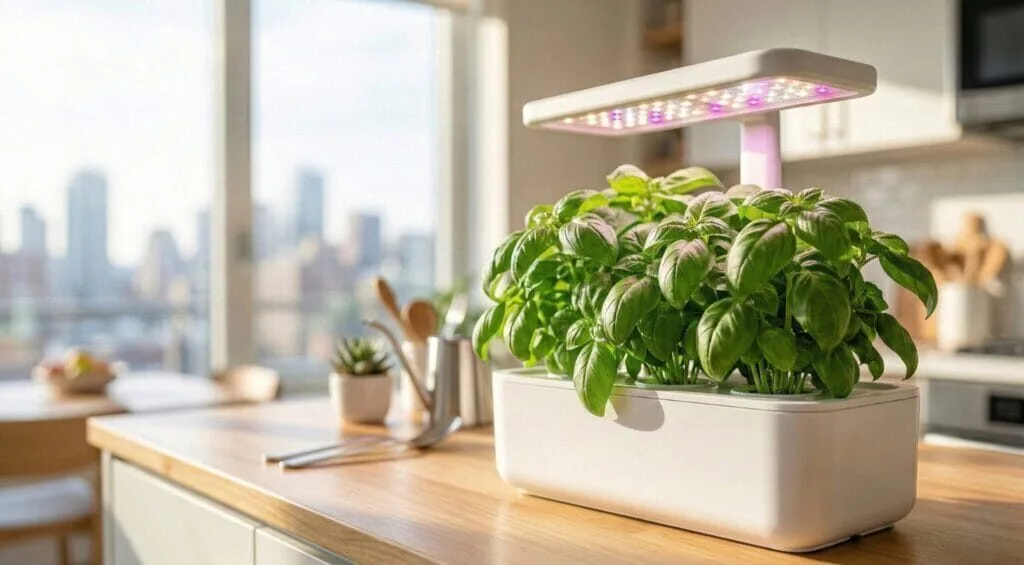
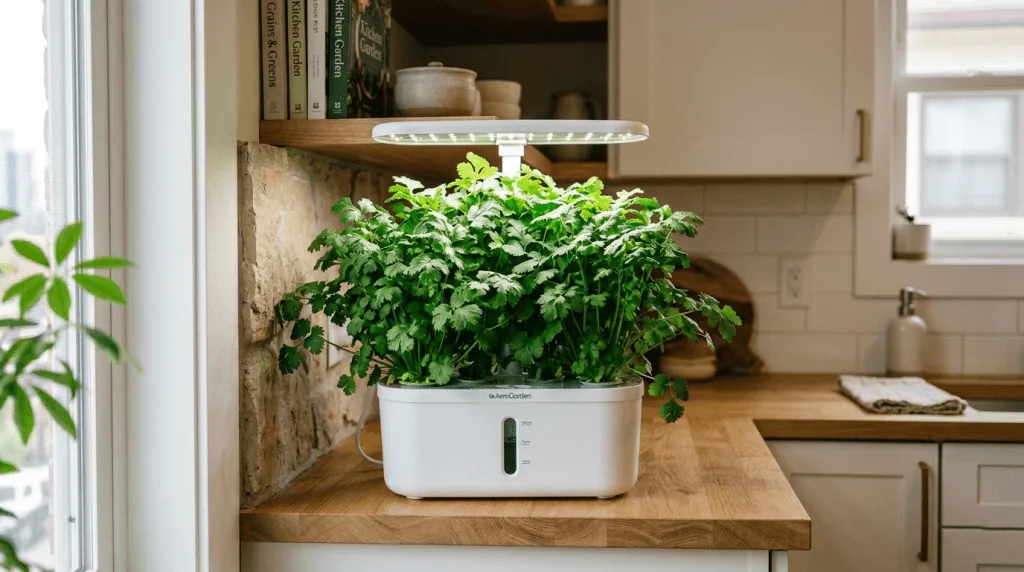
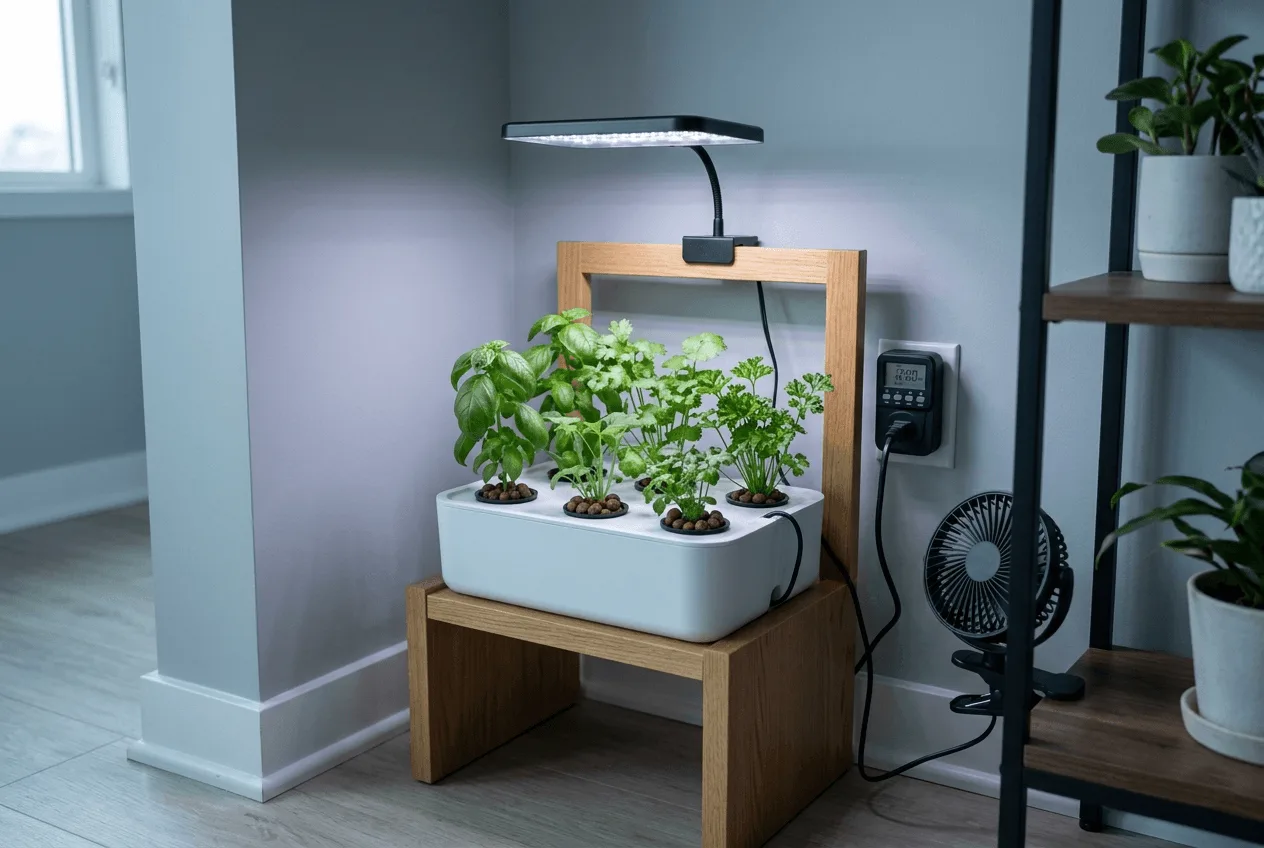
All-in-one units bundle the light, timer and reservoir, so they remove most of the setup work. They also create two specific problems for this crop. Their preset light cycles often run 15 or 16 hours, and their hoods sit close enough to build heat right at the canopy.
Set the internal timer to 14 hours where the unit allows it, then add a small USB fan nearby to move air across the leaves. Check the pH of the tank weekly too, and keep it in the upper half of the standard range, 6.0 to 6.5. Models worth considering are in the guide to the 3 best countertop hydroponic systems for apartment beginners, with a wider comparison at the best countertop hydroponic systems for beginners.
🪨 Choosing The Right Grow Media
Rockwool cubes hold moisture well for germination. Pre-soak each cube in water adjusted to pH 5.5 before seeding, which neutralises the material’s natural alkalinity. Peat sponges also work in smart gardens, since they break down slowly over time.
Keep loose potting soil out of net cups entirely. Organic matter rots when submerged, producing foul smells and bacterial blooms that suffocate roots. Surround the starter plug with expanded clay pebbles instead, which support the fragile stem while letting air reach the upper root zone. Germination detail is in starting hydroponic seeds in rockwool.
⚗️ Perfecting The Nutrient Solution
Water chemistry matters with this crop, though less than temperature does. Cilantro is a light to medium feeder, so the failure mode is almost always too much rather than too little. Keep pH in the upper half of the range and the feed modest.
💧 Keeping pH In The Upper Half
Most herbs sit happily anywhere between 5.5 and 6.5, and cilantro does best in the upper half of that band, 6.0 to 6.5. You may see 6.5 to 6.7 quoted elsewhere; that figure traces to a single grower guide, and every other source I checked uses the standard range. Check pH every other day, because a small drift does more damage than a small feeding error.
Near the bottom of the range the plant can look underfed while sitting in a full reservoir, because pH changes how available some nutrients are. Adding more nutrient at that point usually makes matters worse. Test first, correct the pH, then reassess. If the reading keeps sliding back after every adjustment, why pH keeps drifting in small systems explains the mechanism, and the beginner pH meter guide covers pens that hold calibration.
🧪 Setting EC For A Light Feeder
Electrical conductivity measures dissolved salt strength. Run EC 1.4 to 1.8 once the plant is established, and start seedlings at 1.0 to 1.2 until true leaves appear. Cilantro sits well below mint on the feeding scale, so copying a mint schedule will burn it.
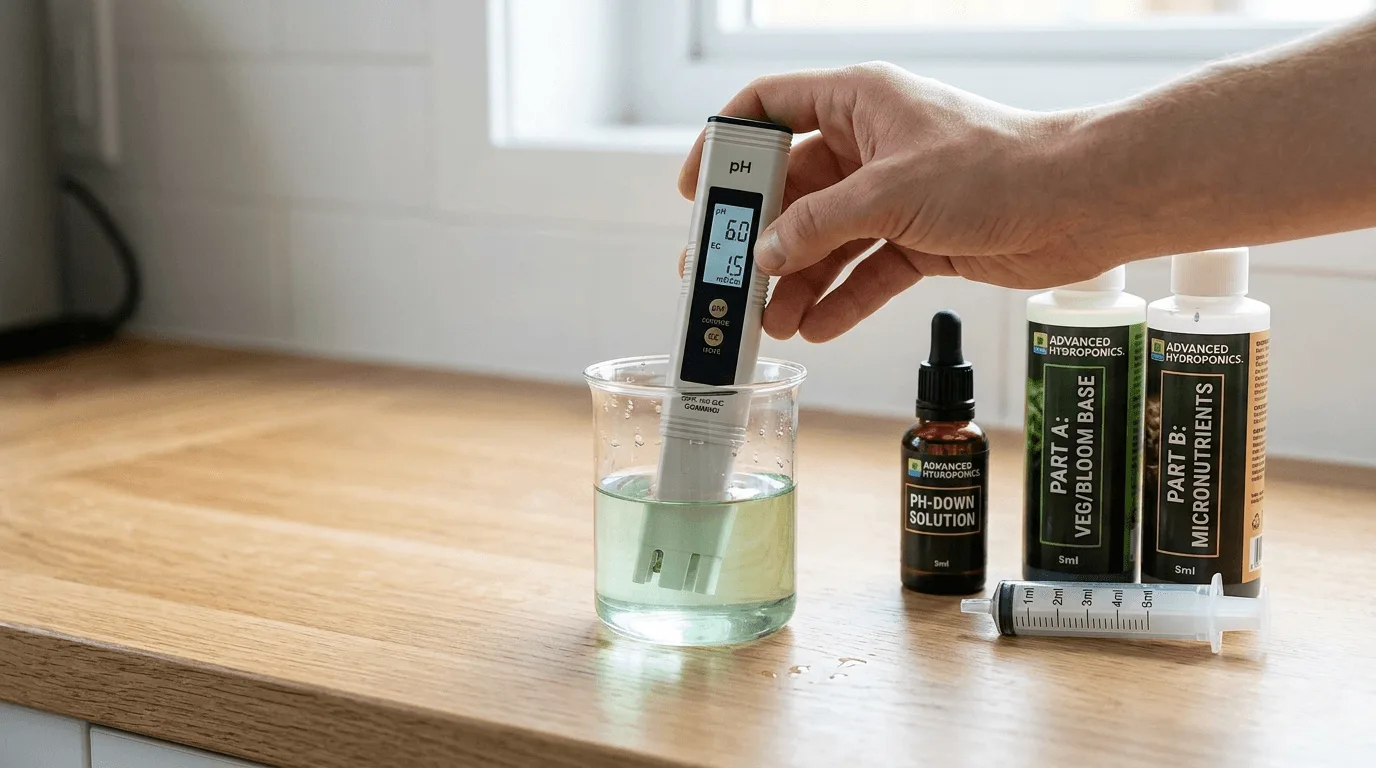
Pushing a young batch to EC 2.4 for bigger leaves backfires, because cilantro’s mature range tops out at 1.8. The roots burn and the plants can wilt within days. My guide on lowering EC safely in tiny reservoirs covers the correction, the best EC and TDS meter for small reservoirs covers the tool, and the EC guide for apartment herbs explains the measurement properly.
🧊 Managing Water Temperature
Warm water holds less dissolved oxygen, so a hot reservoir suffocates roots no matter how hard the pump works. Keep it inside 65 to 75°F, and treat 75°F as the point where you have already lost the plant to bolting.
Wrap the reservoir in reflective insulation if it sits anywhere near a window, and keep it off warm appliances. To cool it on a hot day, freeze a sealed water bottle and rest it against the outside of the container. Never drop ice into the solution itself, because the shock hits the roots directly and the effect fades within the hour.
🧫 Feeding Routine And Reservoir Changes
Use a vegetative formula weighted toward nitrogen, which a standard lettuce or leafy green liquid fertiliser provides. Heavy phosphorus signals the plant toward flowering, and that is the last thing this crop needs encouragement to do.
Plants drink water faster than they consume salts, so concentration climbs through the week even when you add nothing. Top off with plain pH-adjusted water as the level drops, then run a full reservoir change every 2 weeks. My guides on topping off without wrecking your nutrients and how often to change hydroponic water cover both halves of the routine.
🌡️ What To Do If The Mix Goes Wrong
Sometimes the numbers read fine and the plant still droops or the stems purple. Salt buildup has usually locked out the roots by then, and adding fertiliser compounds it. Flush instead.
- Drain the old solution away entirely.
- Rinse the reservoir with warm water to clear crusted deposits.
- Refill with plain water adjusted to pH 6.0 to 6.5 and leave it 24 hours.
- Mix fresh nutrients at EC 1.2 to 1.5 and hold that for 4 to 7 days.
- Return to 1.4 to 1.8 once new green growth appears.
⏱️ Succession Planting For A Continuous Supply
Cilantro bolts eventually even under perfect conditions, because it is programmed to. Productive life runs 3 to 5 weeks from first harvest. Accepting that is what turns a frustrating crop into a reliable one, since a rolling schedule means a replacement is always coming up behind.
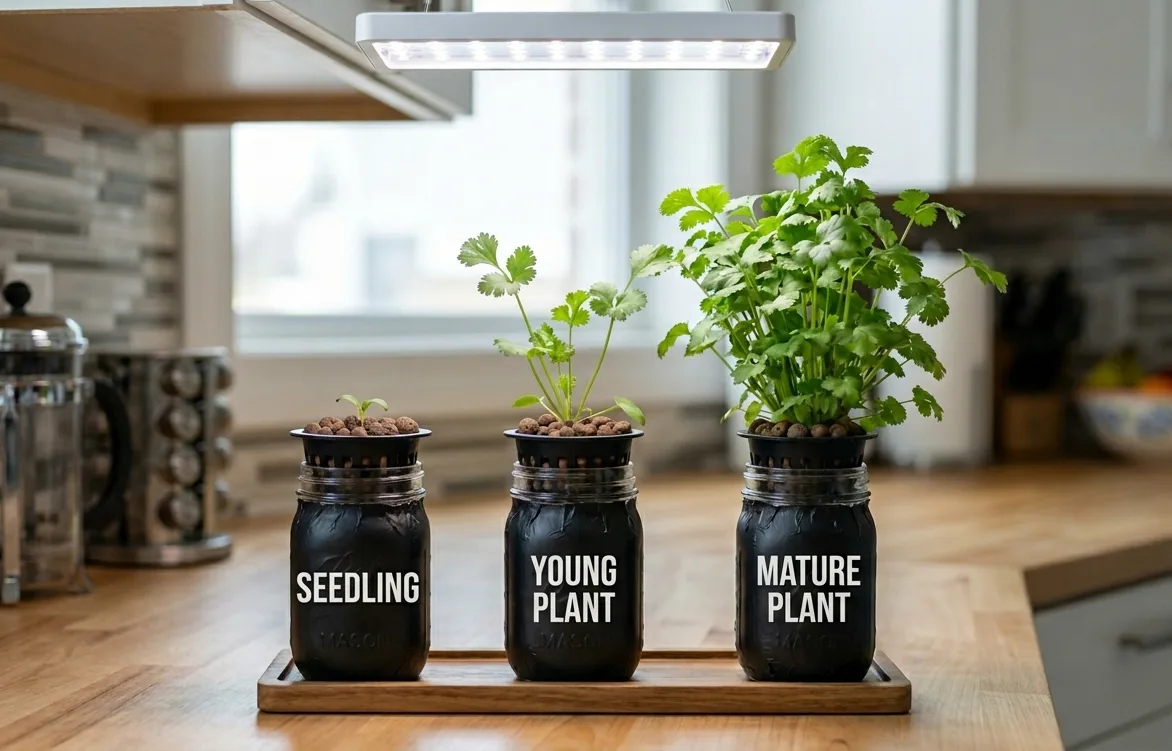
📆 Seeding Every Two To Three Weeks
Prepare a fresh rockwool cube on that cadence. Pre-soak it at pH 5.5, then plant 3 to 5 seeds per hole, since cilantro germinates unevenly and a cluster gives a fuller jar. Germination runs 7 to 10 days, which is slower than most herbs.
Keep the cube moist rather than saturated, because a waterlogged cube rots seeds before they crack. Move seedlings into the main system once true leaves appear. The seed to harvest countdown calculator maps your dates from either seed or transplant, which makes the rotation easy to keep straight.
✂️ Harvesting Without Killing The Plant
Cilantro forms a rosette, so it does not regrow from the middle the way basil does. Cut outer stems only, about an inch above the net cup, and leave the inner crown untouched. Cutting the centre kills the plant outright, and it is the most common way people lose an otherwise healthy jar.
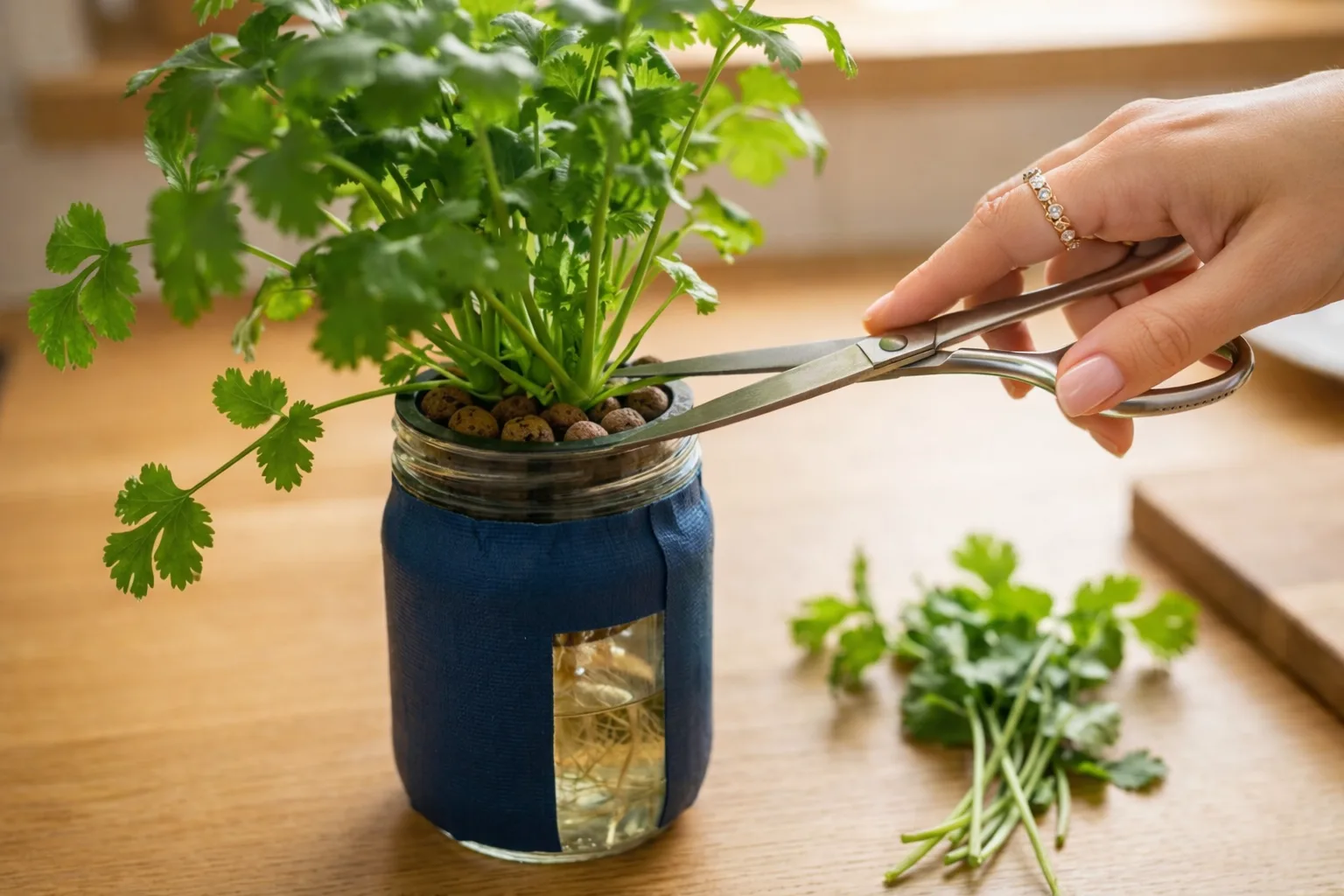
Harvest every 5 to 7 days and never take more than one third at once. Use clean sharp scissors, since tearing stems by hand bruises tissue and invites infection. Flavour peaks just before bolting, so cut hard the moment a centre stalk appears rather than waiting.
🍂 Knowing When To Retire A Plant
Once the central stem thickens and lifts, no more tender leaves are coming. The remaining foliage turns tough and soapy, which is the chemical shift rather than a care mistake. Holding onto it wastes a slot in the rotation.
Pull the whole plant, discard the rockwool and roots, then wash the net cup in hot soapy water to clear organic residue. The slot is then ready for the next seedling. If you want an easier crop alongside it, the hydroponic mint apartment guide and the hydroponic chives apartment guide both cover far more forgiving herbs, while hydroponic spinach in an apartment covers another cool-season option.
🚨 Troubleshooting Common Cilantro Problems
Problems escalate quickly when roots sit in standing water, so early spotting saves the crop. These four cover almost everything that goes wrong in an apartment jar.
🦠 Fixing Root Rot Before It Spreads
Healthy roots are white and smell faintly earthy. Brown slimy roots with a damp-basement smell mean rot has taken hold, usually from warm water rather than poor hygiene. Act before it reaches neighbouring plants.
- Lift the plant out and rinse the roots gently under lukewarm water.
- Clean the empty reservoir with diluted hydrogen peroxide, then rinse it out.
- For badly affected roots, bathe them at 5 ml of 3% peroxide per litre for 20 minutes.
- Refill with fresh cool solution at EC 1.2 to 1.5 to let the plant recover.
- Keep roots wet throughout, because drying them out finishes the job the rot started.
Peroxide degrades fast in water and treats the symptom rather than the cause, so fix the temperature too. My guides on preventing root rot in small systems and using hydrogen peroxide safely give the full dilutions, while cleaning a small hydroponic system covers the routine.
🔍 What To Do When Leaves Turn Yellow
Check pH before you feed, because yellowing often comes from pH drift rather than an actual shortage. When the lower leaves yellow first, the plant is moving nitrogen from old leaves to new growth, so bring the reservoir back to 6.0 to 6.5 before adding nutrient.
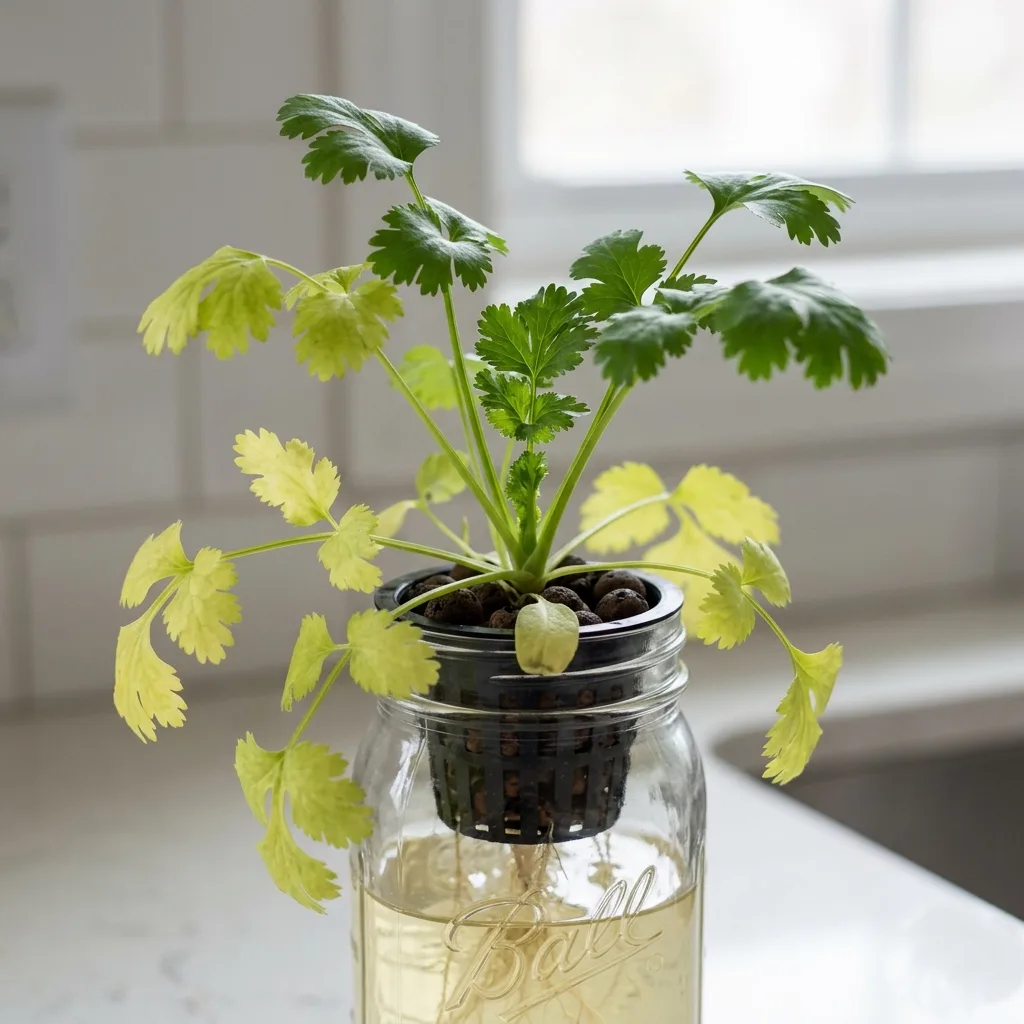
Always test pH before adding anything, since blind feeding risks burning roots that were never hungry. Reading the pattern helps narrow it down further, and fixing yellow hydroponic leaves in apartments covers the full diagnosis.
- Lower leaves yellowing first suggests a mobile nitrogen shortage.
- Yellow between green veins points toward magnesium.
- Pale new growth at the top indicates iron or calcium lockout.
⭕ Stopping Algae In Clear Jars
Algae needs light plus nutrients, and a clear mason jar supplies both. The bloom competes with roots for oxygen, and a clean jar can turn green within three days once it establishes.
Block the light and the problem stops. Wrap jars in foil, slide them into a dark sleeve, or paint the outside matte black. Scrub out an existing bloom before refilling. My guide on stopping algae growth in hydroponic jars covers every method worth trying.
🐛 Beating Fungus Gnats
Gnats lay eggs in damp rockwool even without soil present, and the larvae feed on fine root hairs. Seeing them circling the kitchen counter means they are already breeding.
Yellow sticky traps catch the adults, though the real fix is denying them a moist surface. Cover the exposed top of the cube with dry clay pebbles, which blocks egg-laying. For a heavy infestation, dissolve a piece of mosquito dunk in the reservoir to kill larvae without harming the plant.
📚 Want to see where these numbers come from? The cilantro section of the crop sources page shows the sources behind each growing number, with a label for how well each one is backed.
💬 A Word From Sarah
Cilantro taught me more than any other crop on the shelf, mostly by failing. For a long time I blamed my light schedule and kept shortening the day, which only gave me pale stretched plants that bolted anyway once the kitchen warmed up.
The actual fix was the thing I had ignored. My reservoir was running warm at around 76°F next to a sunny window. Moving the jar to a shaded shelf turned the plant around inside a fortnight.
The other thing I stopped doing was fighting the inevitable. Cilantro bolts. Three to five productive weeks is what it gives, and once I started a new cube every fortnight the shortage disappeared. Do not nurse a bolting plant when a young one is waiting.
❓ Frequently Asked Questions
💧 What pH does hydroponic cilantro need?
Hold it at 6.0 to 6.5, the upper half of the standard 5.5 to 6.5 range. You may see 6.5 to 6.7 quoted, but that figure traces to one grower guide, and no source ties pH to bolting. Warm water and long days are what make cilantro bolt.
🌴 Why does my hydroponic cilantro bolt so fast?
Heat is the main trigger, and water temperature matters more than the room reading. Above 75°F (24°C) in the reservoir it bolts almost immediately. Some bolting is unavoidable though, since the plant only stays productive for 3 to 5 weeks by design.
🧪 What EC should I run for cilantro?
Run 1.4 to 1.8 once the plant is established, starting seedlings at 1.0 to 1.2. Cilantro is a light to medium feeder, a little above basil and well below mint, so a mint-strength solution burns it. Check every few days with a digital meter rather than guessing.
☀️ Should I shorten the light cycle to stop bolting?
No, run 14 hours on and 10 off like every other herb. Cutting to 10 or 12 hours sounds logical, though it starves a medium-light crop and produces pale stretched growth that bolts anyway once heat arrives. Fix the temperature instead, since that is the actual trigger.
🧬 Can cilantro share a reservoir with other herbs?
It can, since cilantro runs in the same pH band as the rest, happiest in its upper half at 6.0 to 6.5. The catch is timing: it bolts and gets replaced every few weeks, so a jar of its own keeps the rotation from disturbing everything else.
🧑🌾 Is cilantro a good beginner herb?
Honestly, no, despite what most sites say. The bolting speed in warm rooms makes it harder than basil or mint. If this is your first crop, start with mint or lettuce to learn the rhythm, then come back to cilantro once your meter routine is habit.
⏳ How often should I start new cilantro seeds?
Every 2 to 3 weeks. Germination alone takes 7 to 10 days and first harvest arrives about 6 to 8 weeks from seed, so a rolling schedule means a mature replacement is always ready when an older plant bolts. That rotation is what makes the crop practical indoors.
🔪 How do I harvest cilantro without killing it?
Take outer stems about an inch above the net cup and leave the inner crown untouched. Cilantro is a rosette crop, so cutting the centre kills it outright, unlike basil. Harvest every 5 to 7 days and never remove more than one third at once.
🍃 Why do my cilantro leaves taste soapy?
The leaf chemistry shifts once bolting begins, turning the flavour harsh and soapy. Flavour actually peaks just before the stalk appears, so harvest hard the moment you spot one. Some people also carry a gene that makes all cilantro taste soapy, which no growing method changes.
🏡 Does cilantro grow well in Kratky jars?
Yes, and the short lifespan suits the method well. A 1-quart mason jar with a 2-inch net cup holds enough solution to carry the plant from seedling to final harvest with no mid-cycle change. Start with the base of the net cup in the solution, let the air gap open as it drinks, and wrap the jar to block light.
🌼 Should I pinch the flowers off?
Pinching early buds buys a few extra days at best. Once the plant commits to flowering, leaf quality declines regardless of what you remove. Relying on the next batch in your rotation beats nursing a plant that has already decided its cycle is finished.
🌡️ Can I grow cilantro through summer without air conditioning?
It gets hard, since the reservoir needs to stay under 75°F. A frozen sealed bottle rested against the outside of the container helps, as does a shaded interior shelf away from windows. Many growers simply pause this crop in July and August and grow mint instead.
Happy growing! 🌿
Sarah, Urban Hydro Space

Sarah Whitfield is the founder of Urban Hydro Space and an indoor gardening enthusiast dedicated to helping apartment dwellers grow fresh herbs and vegetables in small spaces. She researches hydroponic systems carefully from real specifications and verified buyer feedback, and shares practical tips and honest, clearly labeled product picks to make indoor gardening accessible for beginners.