

⏳ 17 min read · Last updated: October 2026
Disclosure: As an Amazon Associate I earn from qualifying purchases. This post contains affiliate links. If you purchase through these links, I may earn a small commission at no extra cost to you. Thank you for supporting Urban Hydro Space!
🌱 Hands-on tested: the KETOTEK pH and EC meter set (a pH pen plus an EC pen that also reads temperature). I have used it in my own grows. 🔎 Research pick: everything else in this post, chosen from published specifications and listings. How I test and choose products.
Finding the best hydroponic nutrients for small systems takes longer than most beginners expect. Any plant food labeled for fast growth looks fine on the shelf, but small reservoirs are much less forgiving than big systems. Since reservoirs are so small, one heavy-handed feeding can throw everything off fast. If you are brand new to growing indoors, the complete beginner’s guide to apartment hydroponics covers everything from system types to your first feeding before you spend a dollar on nutrients.
If you are growing lettuce, basil, mint, parsley, or other compact crops indoors, choosing the right nutrients can make the difference between steady growth and constant nutrient burn. The picks below work best for apartment growers who want something easy to measure, easy to mix, and easy to repeat every week, especially while you are still learning to read your plants.
Quick Picks: Best Hydroponic Nutrients for Small Systems
- 🏆 Best Overall: Dyna-Gro Foliage-Pro 9-3-6 ★★★★☆ for a one-bottle feed that suits jars and countertop gardens alike.
- ⭐ Easiest for Countertop Gardens: AeroGarden Liquid Plant Food (Miracle-Gro) ★★★★☆ with a dispenser cup marked in milliliters.
- 💸 Best Budget Dry Pick: General Hydroponics MaxiGro ★★★★☆ for growers who want a concentrated powder that stores easily.
Also covered below: the three-part GH FloraSeries for growers who want more control, GH FloraNova Grow and a MasterBlend powder kit.
🌱 Key Takeaways
- One-part nutrients are usually the easiest choice for apartment beginners, and Foliage-Pro is the one I’d start with.
- Most herbs and lettuce do well at EC 1.0 to 1.6; a mixed shelf sharing one reservoir runs at 1.5.
- Three-part systems give you more control, but they also give you more room to make mixing mistakes.
- Top off with plain pH-adjusted water daily, and mix a fresh reservoir every 2 weeks.
🔎 Quick-start table
| What to check | Beginner target | Why it matters |
|---|---|---|
| 💧 pH | 5.5 to 6.5 | Helps roots absorb nutrients properly instead of locking them out. |
| ⚡ Feeding strength | EC 1.0 for seedlings; lettuce 1.0 to 1.4; basil 1.0 to 1.6; mixed shelf 1.5 | Small reservoirs also get stronger quickly as the water level drops, so start at the low end. |
| 💧 Full change | Every 2 weeks | Fresh solution resets the balance after the plants have drawn some elements down faster than others. |
| 🧪 Mixing style | Simple and repeatable | A clean routine also makes it easier to avoid overfeeding and beginner mistakes. |
🏆 Sarah’s Top Pick
Dyna-Gro Foliage-Pro 9-3-6
A one-bottle complete liquid that stays simple in a jar or a countertop garden. High in nitrogen for leafy growth; start at half the label dose and work up by EC.
★★★★☆ Best Overall
- Just starting out and not sure what to buy → read How to Choose first
- Want the fastest answer → jump to Side-by-Side Comparison
- Already have nutrients but plants are suffering → go to Feeding Tips
📖 Table of Contents
Best Hydroponic Nutrients for Small Systems Compared
📌 Note: The best nutrient for a small system is the one you can measure the same way every time without making feeding day stressful. Ease of use matters just as much as the formula itself, especially in a tiny apartment setup.
💚 Sarah’s favorite pick
If I were helping a total beginner choose, I would start with Dyna-Gro Foliage-Pro. It’s one bottle, sold as a complete formula, and high in nitrogen, which suits the leafy crops small systems grow best. A quart lasts a small system a long time, because jar doses are tiny.
If you own an AeroGarden or a similar countertop garden, AeroGarden’s own liquid is the easiest choice: its dispenser cup is marked in milliliters for small bowls. You can always move to FloraSeries later if you want more flexibility.
How to Choose a Nutrient for a Small System
Overall, small systems are all about margin for error. In a large reservoir, a slightly strong mix might not show up right away. In a tiny countertop tank, though, it can show up on your leaves almost immediately. For background, the University of Minnesota Extension’s small-scale hydroponics guide is a good primer on running a home system.
Choose simplicity first
If you want a fast weekly routine that feels easy to repeat, a one-part liquid is usually the best fit. If you enjoy tweaking and tracking, a three-part system gives you much more flexibility but also more ways to make mistakes early on. If you are drawn to organic-leaning feeds, the guide to organic nutrients for herbs explains which ones suit a water reservoir. Use the free pH and nutrient calculator to find the right EC target for your specific crop and jar size before you mix your first batch.
Think about storage space
This matters more in apartments than people admit. A small bottle or compact bag is easier to store in a cabinet than several bulky containers, especially if your hydroponic setup already lives in the kitchen or living room. The hydroponic shopping list builder also helps you plan your full kit around your available space and budget before you buy anything.
Start lighter than you think
Tiny reservoirs also become concentrated faster than most beginners expect. So it is easier to add a little more later than it is to reverse nutrient stress after the leaves start burning. Check where your plants are in their growth cycle with the seed to harvest countdown: early-stage plants need lighter feeding than established ones. Also, for a deeper look at EC targets by herb and crop type, the EC guide for hydroponic herbs breaks it down by plant.
The Three Easy Picks Reviewed
Dyna-Gro Foliage-Pro 9-3-6 ★★★★☆

Amazon price right now: $23.80 Prices refresh automatically. Prices are pulled from Amazon and were last checked on 8 October 2026 at 8:53 pm. Amazon prices change often, so check the listing before buying.
⚠ Watch out for: Sold by a single third-party seller, and the label dose is strong for a jar
Foliage-Pro is a one-part liquid that Dyna-Gro sells as a complete nutrition formula, high in nitrogen and low in phosphorus. That balance suits leafy crops, which is most of what a small system grows. One bottle means one measurement, so a jar feed takes a minute.
Dose it by EC rather than by the label. Begin at about half strength for your water volume, stir, read the EC, and work up to your crop’s range: 1.0 to 1.4 for lettuce and 1.0 to 1.6 for basil. A quart goes a long way at jar doses. The site’s guide to replacing AeroGarden pods and plant food uses it the same way in a countertop garden.
AeroGarden Liquid Plant Food (Miracle-Gro) ★★★★☆

Amazon price right now: $21.98
⚠ Watch out for: A small bottle, and a label routine that feeds at every watering
This is Miracle-Gro’s hydroponic formula for AeroGardens: a one-part 4-3-6 liquid with a dispenser cup marked in milliliters and what the listing calls an organic pH buffering system. For a countertop garden it’s the least fiddly option here.
One note on the label: it says to add nutrients whenever you water. In a small reservoir that pushes the strength up a little with every top-off, so the routine on this site is plain water for top-offs and plant food only when you mix fresh solution. I like this pick most for herbs, baby greens and countertop gardens where convenience matters more than fine-tuning.
General Hydroponics MaxiGro ★★★★☆

Amazon price right now: $16.14
⚠ Watch out for: Dissolve it fully in a cup of water before adding it to the reservoir
MaxiGro makes sense for growers who want strong value without taking up much space. It’s a dry, water-soluble concentrate, so a single bag goes a long way compared with small liquid bottles. Dissolve it fully in a cup of water first, then add it to the system slowly. That extra step is the only real trade-off.
I like this one for repeat growers who don’t mind one extra step. Note that the Amazon listing carries no feeding chart or analysis, so follow the bag and confirm the strength with a meter.
💡 Pro Tip: In a small hydroponic system, topping off with plain pH-adjusted water before adding more nutrients can save you from a lot of crispy leaf tips and nutrient burn.
More Nutrients Worth Considering
These three fit narrower needs: more control, a single General Hydroponics bottle, or the lowest cost per gallon if you own a scale. All three are research picks, based on what each maker lists.
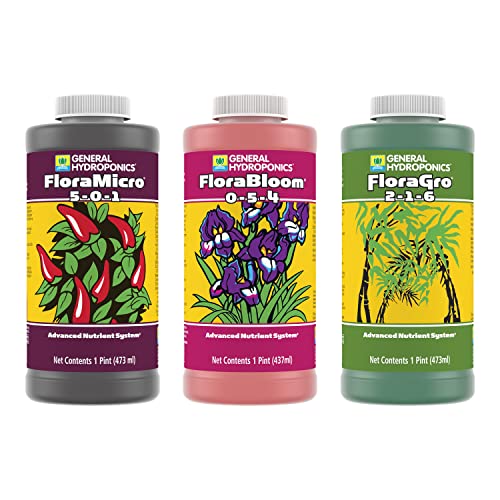
General Hydroponics FloraSeries Advanced Nutrient System ★★★☆☆
Amazon price right now: $29.11
⚠ Watch out for: Three bottles to measure and mix, more room for early mistakes
FloraSeries is the pick for growers who want more control. Instead of one bottle, you get FloraMicro, FloraGro and FloraBloom, which lets you shift the feed toward leafy growth or toward flowering and fruiting. General Hydroponics describes FloraMicro as rich in nitrogen, calcium and micronutrients, with magnesium in the other two.
It’s not the most beginner-proof option, but it is the most flexible. Each part goes into the water separately, never together in the cup, and the two-part mixing guide shows the order.
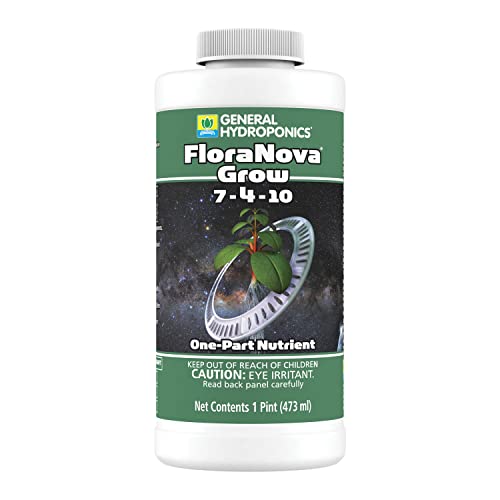
General Hydroponics FloraNova Grow ★★★★☆
Amazon price right now: $24.07
⚠ Watch out for: Very concentrated, so small doses; the listing says it isn’t sold in Illinois
FloraNova Grow is General Hydroponics’ one-bottle option, a super-concentrated liquid that GH lists at 7-4-10 and pitches for the leafy, structural stage of growth. A small amount mixed into fresh water makes the feed, which suits jar volumes.
Amazon sells and ships this pint itself. Start below the label strength and bring it up by EC, as with any concentrate in a small reservoir.
MasterBlend 4-18-38 Complete Combo Kit ★★★☆☆
Amazon price right now: $24.99
⚠ Watch out for: Three powders, each dissolved separately, and tiny weights for a jar
The kit is three bags: MasterBlend 4-18-38, calcium nitrate and Epsom salt, enough for 95 to 114 gallons by the listing’s count. Its leafy-greens recipe calls for 2.0 g of each of the first two powders and 1.0 g of Epsom salt per gallon.
By my arithmetic, that’s about 0.5 g, 0.5 g and 0.25 g for a 1-quart jar, so a scale with 0.01 g steps is a must. Dissolve each powder in its own water before combining them. It’s cheap and complete, but it’s the least casual option here.
🧮 Free tool
Work out your dose in seconds
A bottle label gives one full-strength dose; small jars and young plants usually need less. Whichever nutrient you pick, the pH and nutrient calculator then tells you how much to add for your crop and your water volume. For example, here it is for basil in a 10 liter DWC bucket.
How to Use Hydroponic Nutrients in Small Systems Without Overfeeding
You do not need a complicated routine to grow healthy herbs and greens indoors. Instead, you just need a routine that stays consistent. Tiny systems reward simple habits more than anything else.
Check the water level before adding more food
If the water level has dropped, the remaining solution may already be stronger than you think. Instead of automatically adding more nutrients, topping off with plain water first is smarter in most small systems. Understanding how often to change your hydroponic water is one of the single biggest factors in keeping nutrient levels stable over time.
Watch the leaves, but confirm with pH and EC
Yellowing leaves do not always mean your plants are hungry. Sometimes the nutrient is already in the water, but the pH drifted enough that the roots cannot use it properly. Always test pH before adjusting the feed. Use the free pH and nutrient calculator to get the exact pH and EC target for your crop. A meter set like the KETOTEK pH and EC pens I use (a pH pen plus an EC pen that also shows temperature) checks both in a couple of minutes. If pH drifts out of range, the GH pH Control Kit brings it back without stress.
Keep your routine boring
For most apartment growers, the nutrient that works best is the one you can measure the same way every time, without turning feeding day into a chemistry project. Use the same measuring spoon, cup, or syringe every time, and you will learn your plants much faster. The grow light calculator can help you confirm whether your light setup is properly matched to the nutrients you are running, especially if growth seems slow despite good EC readings.

| Task | Simple routine |
|---|---|
| Check pH | Every 2 to 3 days |
| Top off with plain water | Daily, pH-adjusted (Kratky jars excepted) |
| Refresh the reservoir | Every 2 weeks |
📚 Read next
- pH + EC monitor: KETOTEK pH and EC meter set: a pH pen plus an EC pen that also reads temperature, the set I use myself, so you know what your solution is doing before every feeding
- pH adjustment: GH pH Control Kit: pH Up, pH Down and a test indicator for keeping your solution in the 5.5 to 6.5 window where nutrients are actually available to the roots
- Measuring: small syringes, 1 to 10 ml: a jar dose is only a few milliliters, and a small barrel reads it clearly
Build your full apartment grow kit with the hydroponic shopping list builder.
A Word From Sarah
The nutrient mistake I see most in small systems is buying for strength instead of for measurability. A three-part line gives you control you cannot use until you can read EC and pH with confidence. A one-part formula, dosed with a syringe and checked with a meter, keeps a jar in range with far less guesswork. So start simple, learn what your plants look like at the right EC, and only then move to a line that lets you fine-tune each stage.
Frequently Asked Questions
What are the best hydroponic nutrients for small systems?
For most apartment growers, a complete one-part liquid such as Dyna-Gro Foliage-Pro is the easiest place to start: one bottle, measured into fresh water, checked with a meter. AeroGarden owners can stay with AeroGarden’s own liquid, and MaxiGro powder is the value choice if you don’t mind dissolving it first.
Is FloraSeries better than a one-part nutrient for apartment hydroponics?
It can be, but only if you actually want the extra control. FloraSeries suits growers who enjoy adjusting feeding by growth stage and don’t mind measuring three separate bottles. For pure ease of use and fewer chances to make mistakes, a one-part formula is usually the better choice for small apartment setups and complete beginners.
Is MaxiGro a good choice for lettuce and leafy greens in hydroponics?
Yes, MaxiGro can be a strong value option for leafy growth, especially if you grow regularly and want a dry nutrient that stores easily in a small kitchen cabinet. Dissolve it fully in a cup of water before adding it to the reservoir, and start with a gentle mix rather than full strength in small systems. Lettuce runs at EC 1.0 to 1.4.
How do I avoid nutrient burn in a small hydroponic system?
Start below the label’s full strength, top off with plain pH-adjusted water daily, and check pH every two to three days. Overfeeding shows up much faster in a tiny reservoir than most beginners expect. If you see crispy brown leaf tips, check EC first. For a small spike, swap out roughly 30 percent of the water for plain pH-adjusted water; my guide to lowering EC in a small system covers bigger ones.
How often should I change the nutrient solution in a small hydroponic system?
Every 2 weeks, with a full reservoir change. Between changes, use plain pH-adjusted water for top-offs. Never add more nutrients when topping off, because the nutrients stay in the water while only the water evaporates, so the concentration is already rising without anything extra. A Kratky jar is the exception, since it’s sized to last the crop.
Can I use regular plant fertilizer, like Miracle-Gro, in a hydroponic system?
Not soil fertilizer. An all-purpose plant food dissolves, but it’s the wrong food for a water-only system. Miracle-Gro All Purpose, for example, relies mostly on urea and ammonium for its nitrogen instead of nitrate, and lists no calcium or magnesium on its label, both of which hydroponic formulas include. Use a formula labeled for hydroponics. The AeroGarden liquid in this roundup is Miracle-Gro’s hydroponic formula, a different product from the all-purpose powder.
Are dry hydroponic nutrients harder to use than liquid ones?
Slightly, but not by much. Dry nutrients like MaxiGro need one extra step: dissolving the powder in a small amount of water before adding it to the reservoir. If you skip that step and add powder directly, it can clump and leave the concentration uneven. Once dissolving is a habit, dry nutrients are just as easy as liquids and cost less per gallon of feed.
What can I use instead of AeroGarden plant food?
Any complete one-part hydroponic nutrient works, such as Foliage-Pro, FloraNova Grow or MaxiGro. Switch at a full water change rather than mixing brands in one bowl, start at half the label dose, and bring it up by EC to your crop’s range. My pod and plant food swap guide covers the switch.
What EC should a small hydroponic system run at?
Seedlings start around EC 1.0. Lettuce runs at 1.0 to 1.4, basil at 1.0 to 1.6 and mint at 2.0 to 2.4, and a mixed shelf sharing one reservoir runs at 1.5, with pH 5.5 to 6.5 throughout. Mix below label strength, read the meter, and add a little at a time. The pH and nutrient calculator suggests a starting dose for your volume.
Do I need Cal-Mag with these nutrients?
Usually not with tap water, since most city tap water already carries calcium and magnesium. Consider it with soft, filtered, RO or distilled water, or if a deficiency keeps coming back. My guide on whether a small system needs Cal-Mag goes through the signs.
What grows best in a small hydroponic system?
Leafy herbs and greens: basil, lettuce, mint, chives, spinach and kale all stay compact enough for one- and two-jar systems. Lettuce and basil feed lightest, at EC 1.0 to 1.4 and 1.0 to 1.6, while mint wants more at 2.0 to 2.4. Fruiting crops want more room and food, so grow them only in purpose-built dwarf forms with a bigger reservoir. The best herbs for small hydroponics guide ranks the candidates.
What are three plants that are not recommended for hydroponics in small systems?
Full-size indeterminate tomatoes, sweet corn, and anything with far-reaching root systems such as mature squash. All three outgrow a countertop reservoir, drink it dry between top-offs, and shade everything around them. If you want that harvest on an apartment scale, dwarf varieties exist, and the cherry tomato guide shows what a fruiting crop needs from a small system.
Does mixing order matter with hydroponic nutrients?
With a one-part formula, no: measure, add, stir. Order only becomes critical with multi-part lines like FloraSeries, where each part must go into the water separately, never together in the cup, or the minerals bind into solids the plants cannot eat. Water first, then each part one at a time, stirring between additions. The two-part mixing guide walks through it step by step.
What is an all-in-one hydroponic fertilizer?
It is a one-part nutrient: a single bottle or powder that carries the whole feed, so you measure one product into the water and stir. In this roundup Foliage-Pro, the AeroGarden liquid, FloraNova and MaxiGro are one-part, while FloraSeries splits the job across three bottles for more control and more room for mixing mistakes. One-part is usually the easiest choice for an apartment beginner.
How often should I add nutrients in hydroponics?
In an active system such as DWC or a countertop kit, nutrients go in when you mix a fresh reservoir, and you replace the whole solution every 2 weeks. Between changes, top off with plain pH-adjusted water only, because adding nutrients at every top-off makes the solution creep stronger. A Kratky jar is the exception: size the jar to last the crop, and if a long crop runs low, add a little nutrient solution, no more than about an inch.
Happy growing! 🌿
Sarah, Urban Hydro Space

Sarah Whitfield is the founder of Urban Hydro Space and an indoor gardening enthusiast dedicated to helping apartment dwellers grow fresh herbs and vegetables in small spaces. She researches hydroponic systems carefully from real specifications and verified buyer feedback, and shares practical tips and honest, clearly labeled product picks to make indoor gardening accessible for beginners.


