⏳ 16 min read · Last updated: September 2026
Disclosure: This guide contains Amazon affiliate links. If you buy through them, I may earn a commission at no extra cost to you.
🌱 Hands-on tested: the KETOTEK pH, EC and temperature meter and the standard AeroGarden Harvest. I have used these in my own grows. 🔎 Research pick: everything else in this post, including every nutrient and pod kit, chosen from published specifications and owner reports. How I test and choose products.
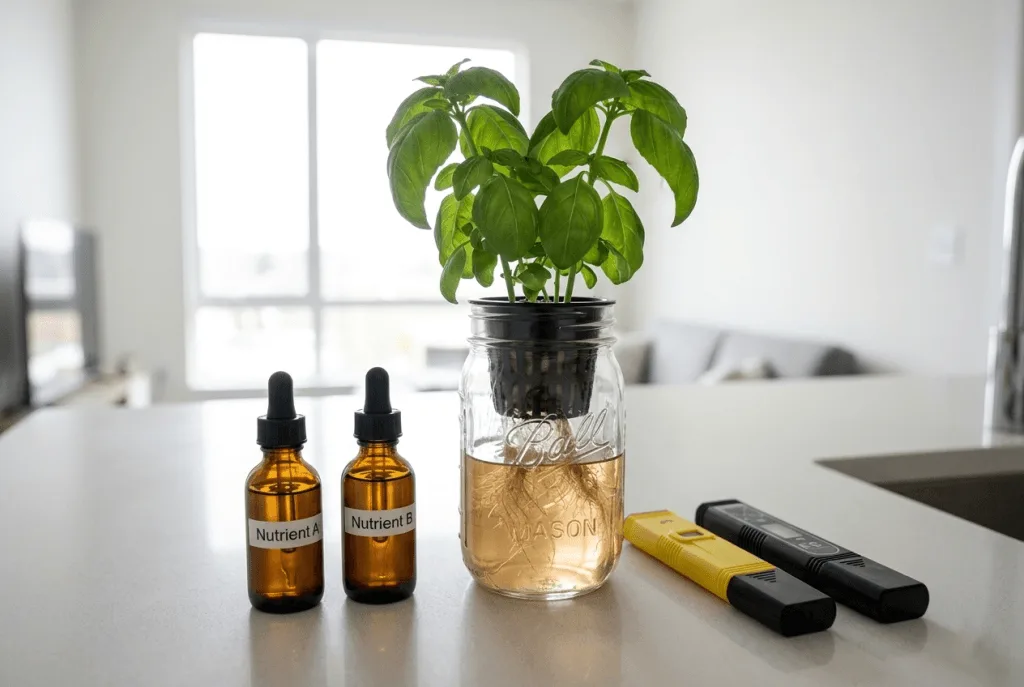
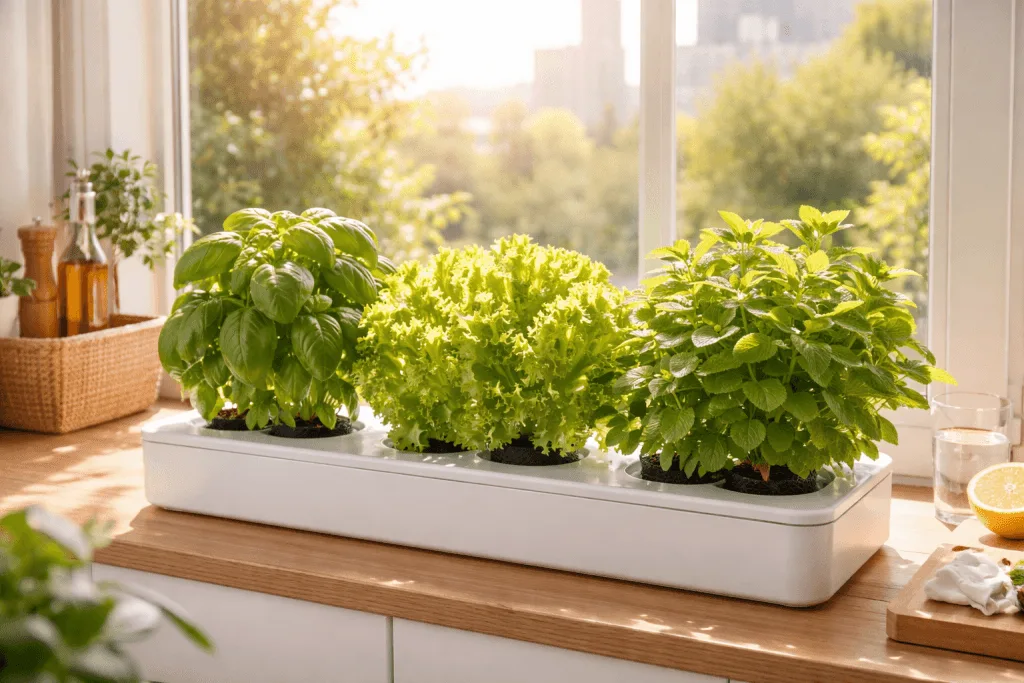
You can replace AeroGarden pods with two cheaper pieces: an empty seed pod kit for the seeds you actually want, and a bottle of hydroponic nutrient for the tank. The branded pods bundle both jobs together. That’s convenient until the kit runs out, or until the herb you want simply isn’t sold as a pod. Once you split the two jobs apart, the garden can grow almost any small herb or green, and the food comes from a bottle instead of a new kit each time.
The usual first mistake is reaching for whatever plant food is under the sink. A houseplant or soil fertilizer isn’t made to dissolve and stay balanced in water, so the tank ends up with the wrong mix while the roots sit in it around the clock. A formula labelled for hydroponics, a cheap meter and one clean water change avoid most of that trouble, and this guide walks through all three.
🌱 The quick answer
- Two purchases, not one: refill the pods with a seed pod kit and your own seeds, then feed the tank from a bottle.
- Simplest refill: the AeroGarden Grow Anything kit, because it includes baskets, sponges, labels and a small bottle of AeroGarden liquid food.
- Longer-lasting food: a one-part hydroponic formula such as Dyna-Gro Foliage-Pro or GH MaxiGro.
- Dose by EC, not by capfuls: start at half the label dose, then work up to your crop’s range at pH 5.5 to 6.5.
- Switch on a clean tank: change brands only on a full water change, top off daily with plain pH-adjusted water, and change the water every 2 weeks.
My practical pick for most herb gardens is a Grow Anything kit plus a quart of Dyna-Gro Foliage-Pro, checked with a pen meter. However, if you’d rather not think about nutrients yet, stay on AeroGarden’s own liquid food and change only the pods.
Which refill fits which job?
| Research pick | Best fit | Sarah’s rating | Amazon price |
|---|---|---|---|
| AeroGarden Grow Anything Seed Pod Kit, 6-pod | First refill in any AeroGarden | 4.5/5 for fit | $17.99 |
| Ahopegarden 50 grow sponges | Reusing the baskets you already own | 4/5 for value | $9.99 |
| AeroGarden Liquid Plant Food, 3 oz | New pods, same food | 3.5/5 for value | $23.99 |
| Dyna-Gro Foliage-Pro, 1 quart | Leafy herbs and greens | 4.5/5 for herb gardens | $23.45 |
| GH MaxiGro, 2.2 lb | Lowest running cost | 4/5 for budget | $17.99 |
| GH FloraSeries, 3-part | Tomatoes and peppers later on | 3.5/5 for herb-only gardens | $29.11 |
Prices are pulled from Amazon and were last checked on 27 September 2026 at 5:45 am. Amazon prices change often, so check the listing before buying. These are Sarah’s editorial fit ratings, based on published specifications and what each product is for, not customer reviews or a side-by-side grow. Prices and availability can change.
- You want the least change → the Grow Anything kit, and keep using AeroGarden liquid food.
- Your deck is mostly basil, mint, lettuce or parsley → the Grow Anything kit or Ahopegarden sponges, plus Foliage-Pro.
- You want the cheapest feed per tank and own a measuring spoon → MaxiGro.
- You plan cherry tomatoes or peppers → FloraSeries, so the ratio can change when flowers appear.
🔍 What an AeroGarden pod really gives you
A branded pod is a plastic grow basket, a pre-seeded grow sponge, a clear dome that holds humidity while the seeds sprout, and a label. Seed pod kits usually come with a small bottle of liquid plant food too, because the plant eats from the water, not from the sponge. So when you replace AeroGarden pods, you’re really replacing two things: the seed holder and the food.
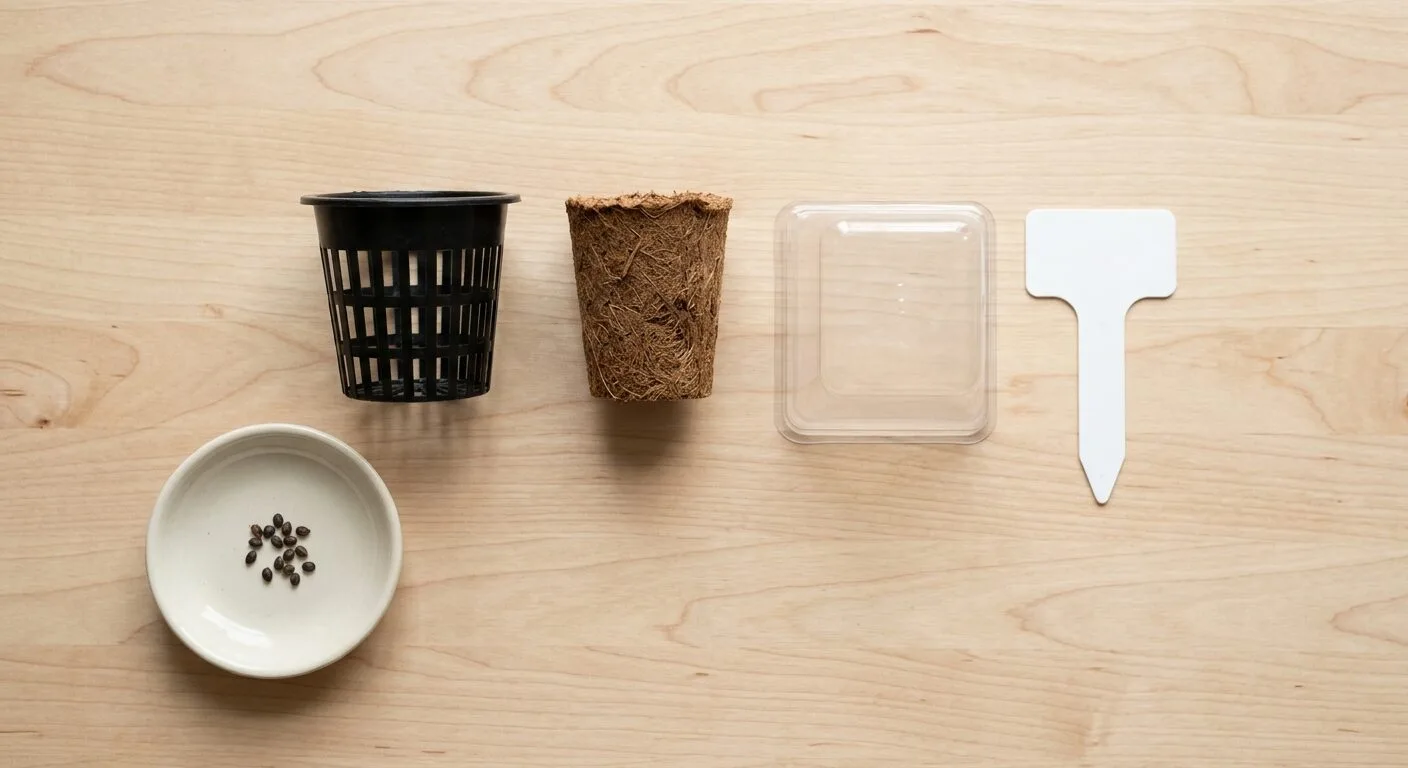
That split is good news. The basket and dome are reusable, so after a harvest you only need a fresh sponge and a few seeds. Meanwhile, the food can come from any formula made for hydroponics, as long as you measure it. If you’re still deciding whether a smart garden suits you at all, my honest look at whether an AeroGarden is worth it covers the running costs. The AeroGarden vs Gardyn vs Click and Grow comparison covers the other brands.
Can you reuse the old baskets and domes?
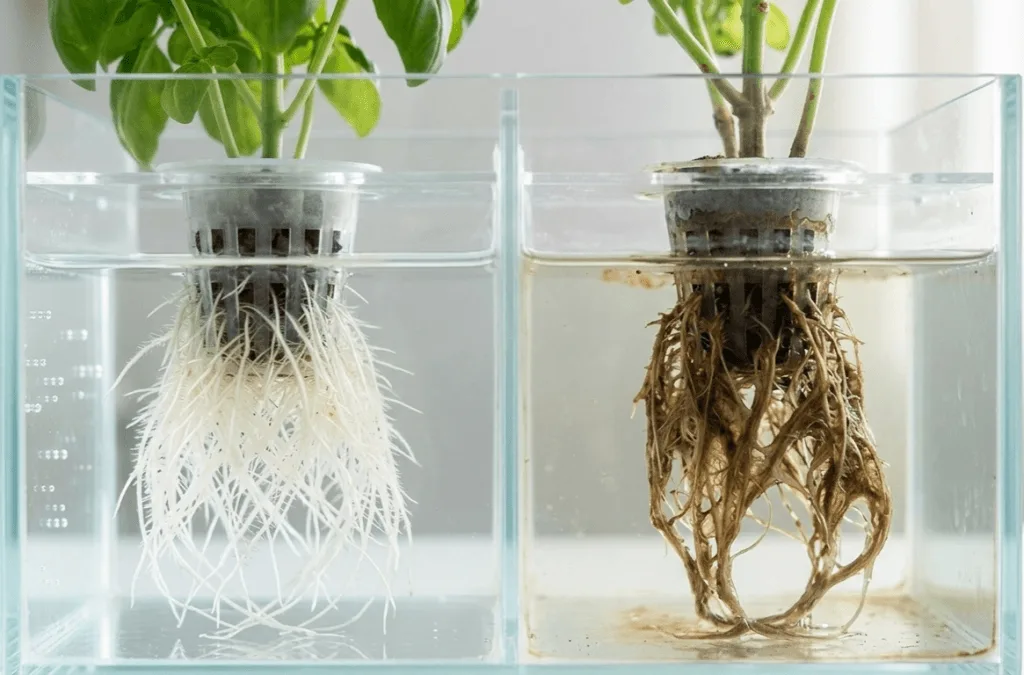
Yes. Pull the spent sponge and roots out after the final harvest, then wash the baskets and domes in warm soapy water and rinse them well. Also check that no root pieces stay stuck in the mesh, since rotting roots feed the same bacteria that make a hydroponic tank smell bad. A last rinse with diluted hydrogen peroxide is a sensible final step, and my hydrogen peroxide guide explains how to dilute it.
🌱 Refill the pods with your own seeds
Refilling a basket is quick, and it lets you grow varieties that never come as a branded pod. For ideas on what suits a small deck, see my list of the best herbs for small hydroponic systems.
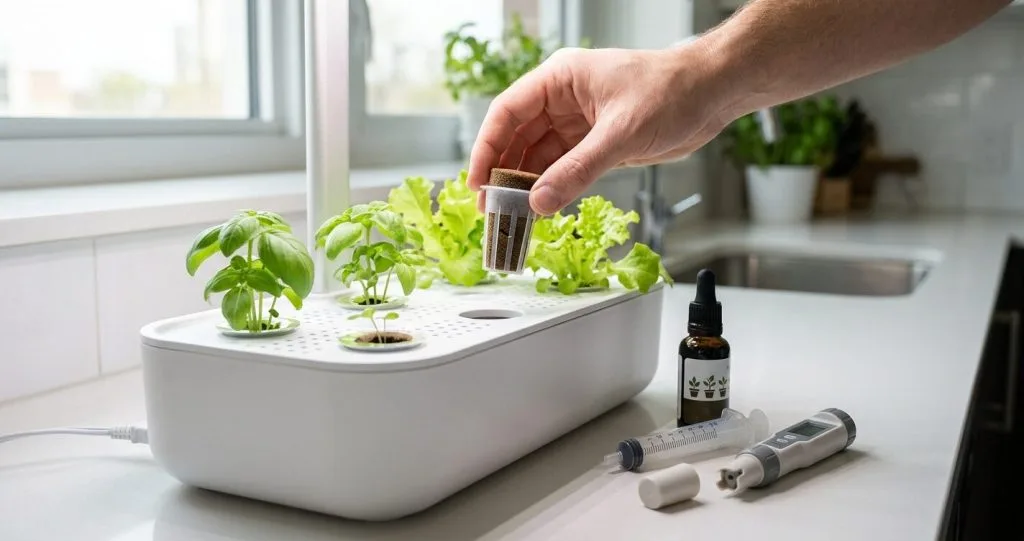
- Soak each grow sponge in plain, pH-adjusted water until it’s wet through, then squeeze out the excess so it’s damp rather than dripping.
- Seat the sponge in a basket and drop two or three seeds into the hole at the top. Beginners often sow a couple of extra seeds to improve the odds.
- Label the pod, set it in the deck and put a dome over it.
- Take the dome off once the seedlings touch it or open their first leaves, then thin each pod to the strongest seedling.
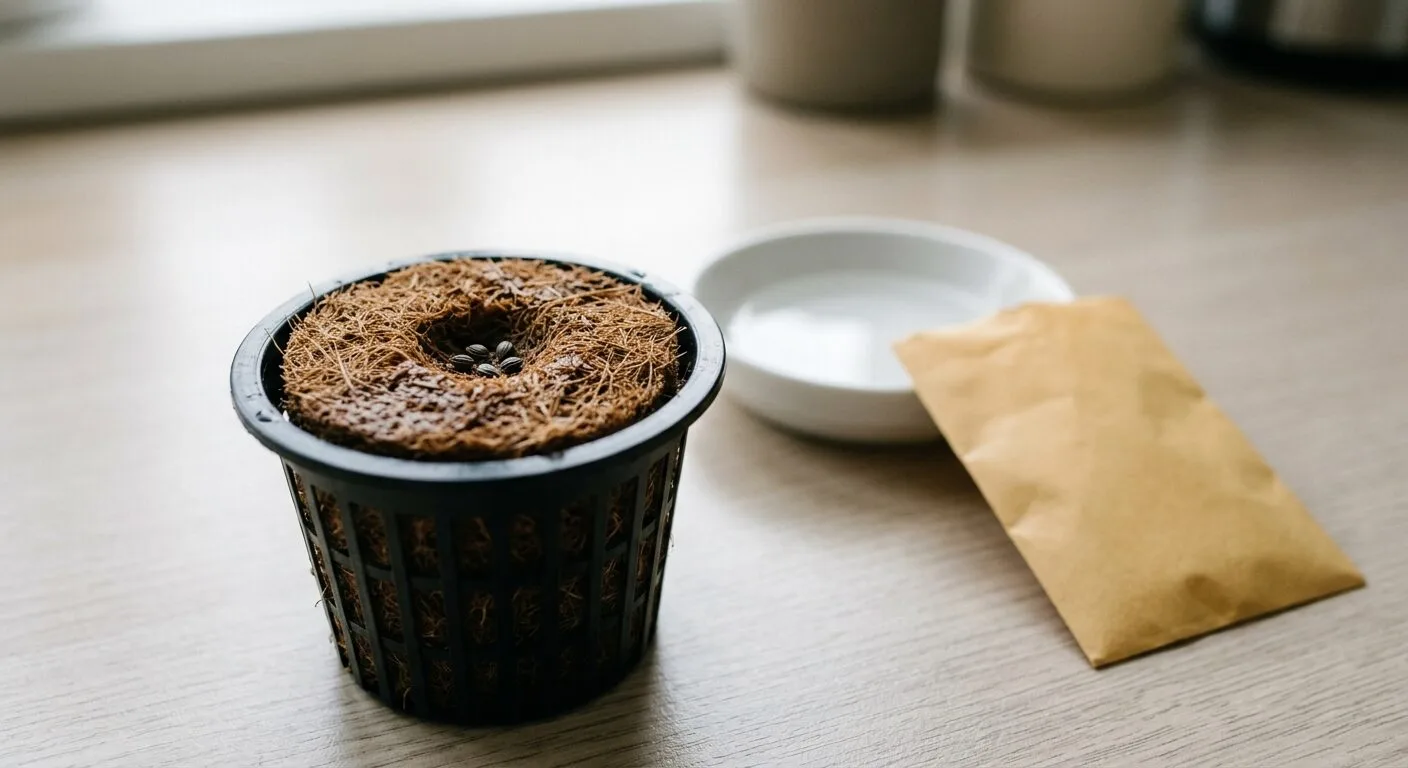
While the seedlings are young, keep the feed light. Most herbs start at EC 1.0 to 1.2 and move up to their mature range as true leaves form. The seed to harvest calculator shows the likely harvest window for each crop, so you can sow pods that finish at about the same time.
AeroGarden Grow Anything Seed Pod Kit: the official refill
The Grow Anything kit is AeroGarden’s own blank pod set. According to the listing, the 6-pod pack includes grow sponges, grow baskets, pod labels, a 3 oz bottle of AeroGarden liquid nutrients and a growing guide, and it works in every AeroGarden model. The sponges are coir rather than peat. Seeds aren’t included, which is the point: you pick them. A 50-pod version exists as well, although it showed low stock when I checked in September 2026.

Check the Grow Anything kit on Amazon. Current Amazon price: $17.99.
Choose it when: this is your first refill and you want parts that are certain to fit, plus a starter bottle of food.
Ahopegarden 50 grow sponges: the budget refill
If you kept your old baskets, a bulk sponge pack costs less per pod. The Ahopegarden kit holds 50 grow sponges and 50 pod labels, and the listing says the sponges fit AeroGarden baskets and most other brands. There are no baskets or domes in the box, so it only suits a garden that already has them. Check that one sponge sits snugly in your basket before you sow a full deck, because a loose sponge can slip lower than the seed needs.
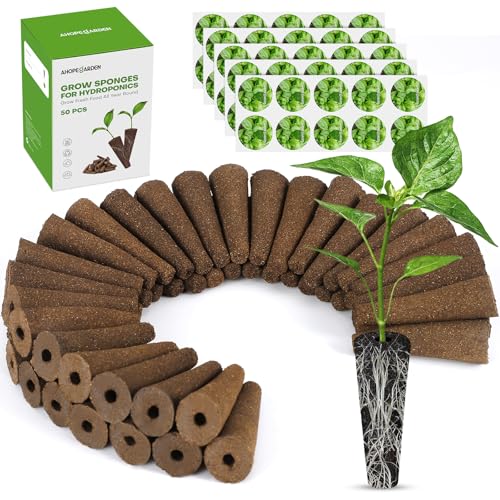
Check the Ahopegarden sponges on Amazon. Current Amazon price: $9.99.
Choose it when: you have spare baskets and domes from earlier kits and want enough sponges for many rounds.
🧪 Choose a bottled nutrient for the tank
Every product below is made for soilless growing, so any of them can replace the food that comes with a branded kit. The differences are how many bottles you handle, how much measuring each one takes, and which crops the ratio suits. For a wider comparison that isn’t specific to smart gardens, see my guide to the best hydroponic nutrients for small systems. If hydroponics is new to you, the apartment hydroponics beginner’s guide explains how the pieces fit together, and the beginner feeding schedule covers the routine.
AeroGarden Liquid Plant Food: new pods, same food
The easiest option is to keep feeding what the garden was designed around. AeroGarden’s own liquid food is listed as a 4-3-6 formula in a 3 oz bottle with a measuring cup, and the listing mentions a built-in pH buffer. It suits anyone who wants to change pods first and nutrients later. Still, 3 oz is a small bottle, so a busy garden goes through it quickly.
One note on the label: it suggests adding nutrients whenever you water. My routine is different, because feeding at every top-off lets the concentration creep up as the plants drink. I top off with plain pH-adjusted water and add fresh food only at the full change. If you follow the label instead, check EC before each addition so it stays inside your crop’s range.

Check AeroGarden Liquid Plant Food on Amazon. Current Amazon price: $23.99.
Choose it when: you’re changing the pods, not the food, or you want to stay on the maker’s formula while you learn to use a meter.
Dyna-Gro Foliage-Pro: my pick for herb gardens
Foliage-Pro is a single-bottle liquid, listed as a complete 9-3-6 formula that is high in nitrogen and low in phosphorus. That ratio favors leaves, which is what most AeroGarden owners grow: basil, mint, parsley and lettuce. Because it’s one bottle, there’s no mixing order to remember. It is concentrated, though, so measure with a small syringe and start low. Also, a leaf-focused ratio suits herbs better than fruiting crops, so move to a multi-part formula if you later grow tomatoes.

Check Dyna-Gro Foliage-Pro on Amazon. Current Amazon price: $23.45.
Choose it when: most of your deck is leafy herbs and greens, and you want one bottle with nothing to mix.
GH MaxiGro: the lowest running cost
MaxiGro is a one-part powder from General Hydroponics. You scoop or weigh it, dissolve it in a jug of water, then pour the solution into the bowl. A 2.2 lb bag is a lot of plant food for a countertop garden, so the cost per water change stays low. The trade-off is handling a powder: always mix it in a jug rather than straight in the bowl, so undissolved grains don’t settle around the pump. If you use soft or filtered water, my Cal-Mag guide explains when extra calcium and magnesium help.

Check GH MaxiGro on Amazon. Current Amazon price: $17.99.
Choose it when: you don’t mind a measuring spoon and want the cheapest feed per water change.
GH FloraSeries: for tomatoes and peppers
FloraSeries is three bottles: FloraMicro, FloraGro and FloraBloom. Changing the ratio between them lets you feed leaves first and flowers later, which matters for cherry tomatoes and peppers. For a deck of herbs, however, three bottles and a mixing order are more work than the plants need. If you do use it, add FloraMicro to the water first and stir before the other two. My guide on how to mix multi-part hydroponic nutrients shows the order step by step.
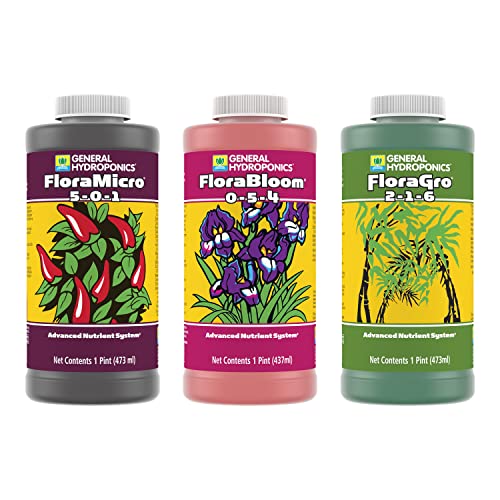
Check GH FloraSeries on Amazon. Current Amazon price: $29.11.
Choose it when: you plan to grow fruiting crops, or you already own it for a larger system.
📏 Dose by EC, not by the capful
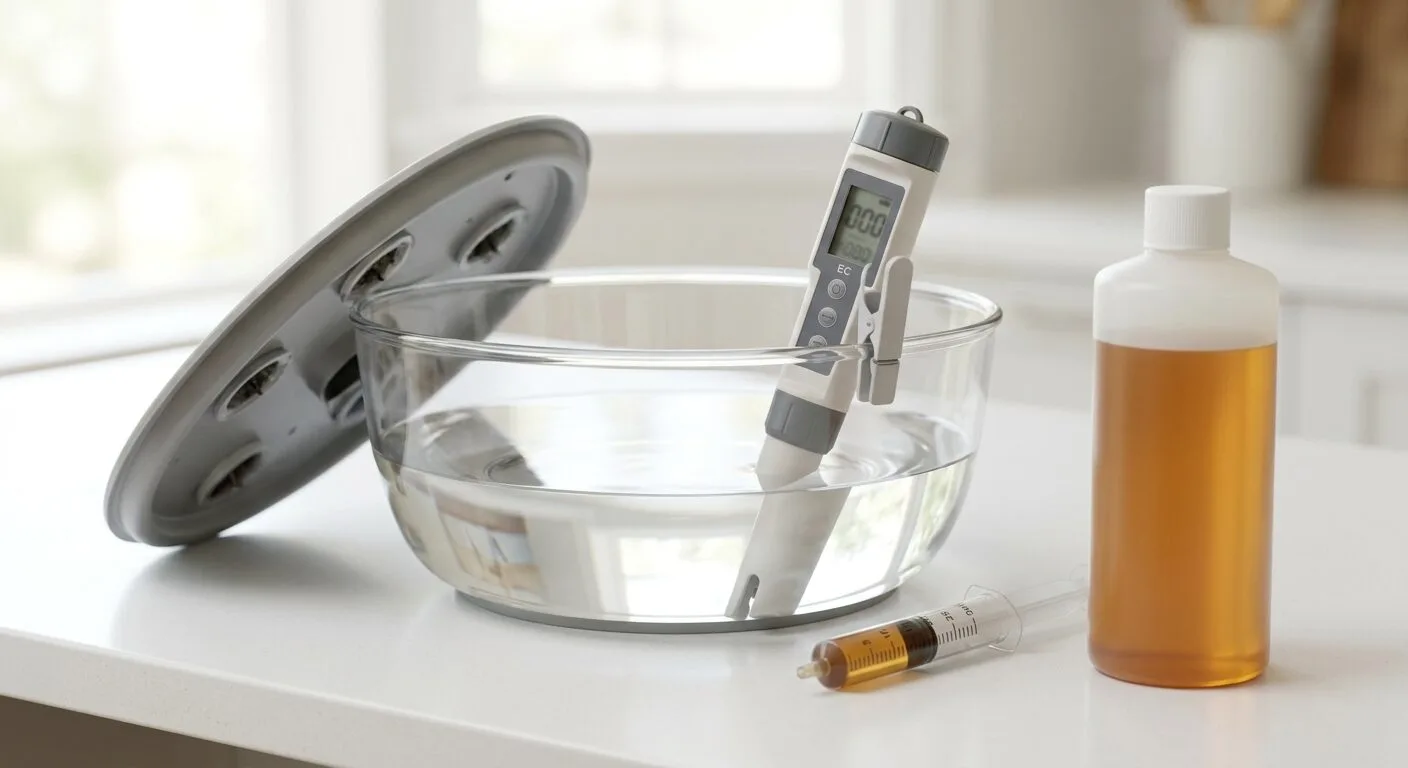
A label dose assumes a certain amount of water, and smart garden bowls vary by model. So measure yours once: fill the empty bowl to the max line with a measuring jug, then write the number on a strip of tape under the deck. From then on, every label dose becomes simple arithmetic.
Start at half the label dose for that volume, let the pump run for a few minutes, then read the EC. After that, add small amounts until you reach the range for your crop. Because a meter reads the whole solution, including minerals already in your tap water, its reading is more reliable than any capful.
| Crop | EC for mature plants |
|---|---|
| Basil | 1.0 to 1.6 |
| Lettuce | 1.0 to 1.4 |
| Thyme | 1.2 to 1.6 |
| Parsley and dill | 1.4 to 1.8 |
| Chives | 1.8 to 2.0 |
| Mint | 2.0 to 2.4 |
Most AeroGardens hold a mix of herbs on one bowl, so no single crop’s range fits everything. In that case I run EC 1.5 as a compromise. That’s my own house practice rather than a published figure, and it sits inside or close to the range for most crops in the table. Mint prefers a stronger feed, so a mint-only garden can run higher. For more on each herb, see my guide to EC for hydroponic herbs.
Check pH after the EC is right, since adding nutrient moves it. Aim for pH 5.5 to 6.5; chives do best in the upper half, 6.0 to 6.5. The free pH and nutrient calculator gives both targets for 22 crops. If the number won’t settle, my post on why hydroponic pH keeps drifting walks through the usual causes.
The meter I use
I check both numbers with the KETOTEK pH, EC and temperature set, which is on my short list of hands-on tested products. It’s a budget pen set, so calibrate the pH pen before the first reading and rinse the tips between samples. For other options, compare my guides to the best EC and TDS meters for small reservoirs and the best pH meters for beginners.
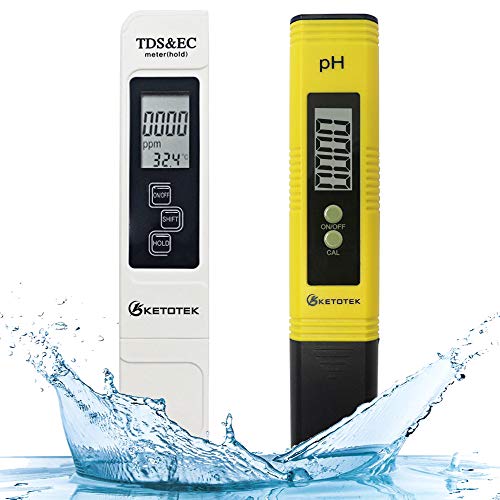
Check the KETOTEK meter set on Amazon. Current Amazon price: $15.99.
Your water matters too. Very hard tap water starts with a higher EC before any food goes in, while filtered water starts near zero. If you’re unsure which to use, compare spring, distilled and RO water for hydroponics.
🔄 Switch over in one water change
Never pour a new brand on top of the old solution. You’d end up with two formulas in one bowl and no way of knowing what the EC reading means. Instead, make the switch on a full water change:
- Unplug the garden and lift the deck out. Rest it over a bowl with a damp towel across the roots, so they never dry out.
- Pour out the old solution and rinse the bowl. Wipe off any film, and clean the pump intake if your model lets you reach it.
- Refill with fresh water to the max line and check its temperature. The target is 65 to 75°F (18 to 24°C).
- Mix in half the label dose of the new nutrient, then work up to your EC target.
- Check pH last and adjust it in small steps.
- Put the deck back and restart the pump.
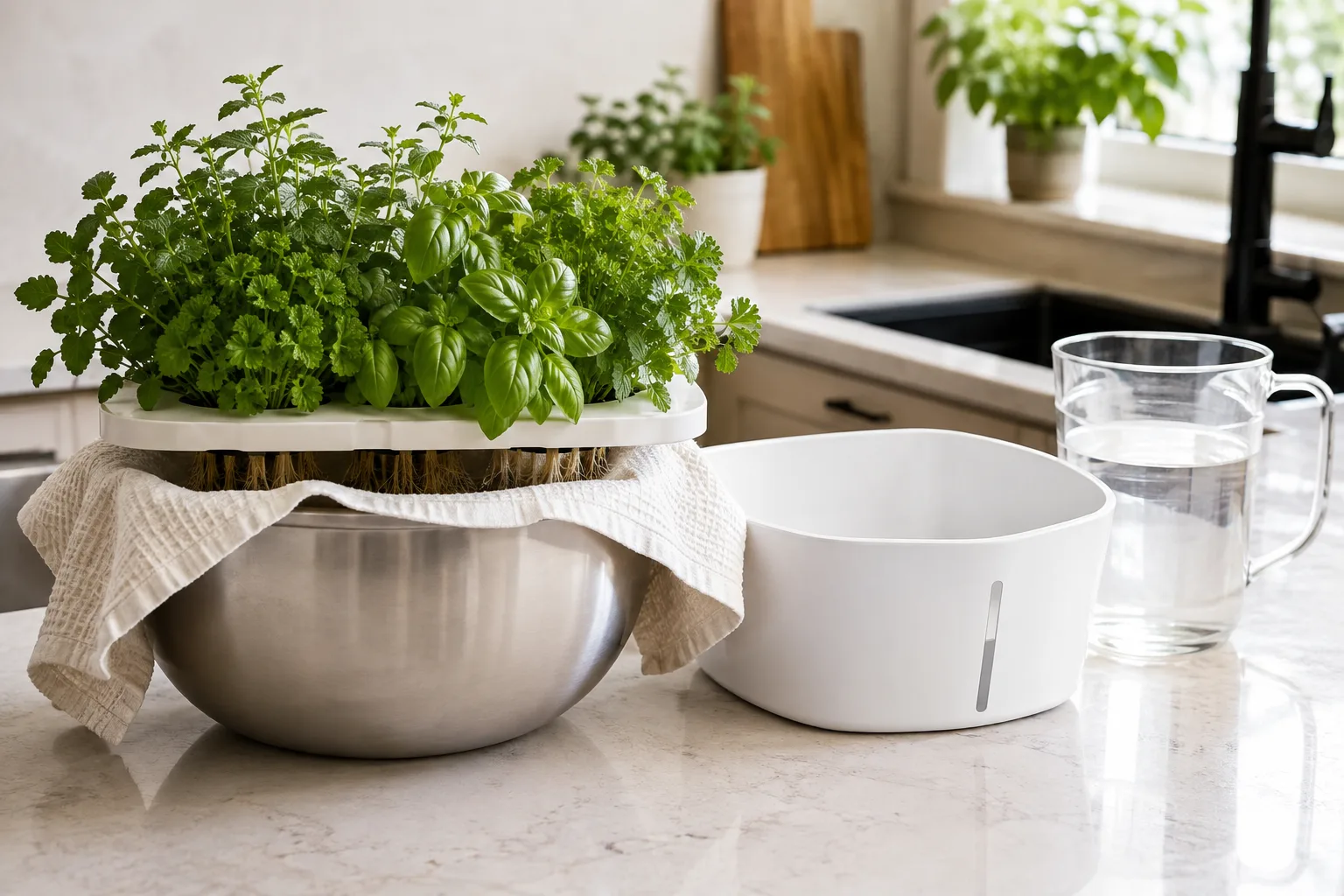
After that, the routine stays the same as with branded food. Top off daily with plain pH-adjusted water, and do a full water change every 2 weeks. When the nutrient reminder comes on, treat it as a prompt to check EC rather than an automatic dose. My guide on how often to change hydroponic water explains why the two-week change matters, and the printable hydroponics tracker gives you a place to log each reading.
Watch the plants closely for the first week. Brown tips or burned leaf edges after a switch usually mean the EC is too high, so dilute with plain water; my guide to lowering EC in small reservoirs shows how. Yellowing has more possible causes, and the yellow leaves fix sorts them in order.
⚠️ Mistakes that stall a new feed
- Soil or houseplant fertilizer. It isn’t made to dissolve and stay balanced in water. Stick to a formula labelled for hydroponics.
- Two brands in one tank. Change brands only on a full water change, so the EC reading still means something.
- Feeding at every top-off. Because the plants drink water faster than they use food, extra nutrient at each top-off pushes the concentration up. Top off with plain pH-adjusted water instead.
- Open holes in the deck. Light on the water feeds algae, and bottled food feeds it just as well as branded food. Keep a spacer or a covered basket in every empty hole; my algae guide covers the cleanup.
- Adding food for a darker green. Pale new growth can come from pH as easily as from hunger, so check pH before you add more nutrient.
Background reading on EC and pH: the Oklahoma State University EC and pH guide for hydroponics and the University of Missouri Extension hydroponics guide. The per-crop sources behind the table are on my crop sources page. The shared-bowl EC 1.5 is my own house practice. Product details come from each Amazon listing, checked in September 2026.
💬 A word from Sarah
Change one thing at a time. If you switch to your own seeds, a new sponge brand and a new nutrient in the same week and something goes wrong, you won’t know which change caused it. I’d refill the pods first while staying on the food you already have, then switch the nutrient at the next full water change with the meter in hand. It costs you two weeks, but every reading after that tells you something.
❓ Frequently asked questions
Can you use an AeroGarden without AeroGarden pods?
Yes. Put a grow sponge in an empty basket, sow your own seeds, cover it with a dome until they sprout, and feed the tank from any nutrient made for hydroponics. The Grow Anything kit and bulk sponge packs both work.
How many seeds should I put in an AeroGarden pod?
Two or three small seeds per sponge is a common starting point. Once they sprout and open their first leaves, thin each pod to the strongest seedling so one plant gets the whole basket.
Are AeroGarden pods still sold?
Yes. Scotts Miracle-Gro, which owns AeroGarden, announced in late 2024 that it would close the line and then reversed course, and seed pod kits are on sale again. Refilling your own pods simply gives you a wider choice of seeds.
Why won’t my seeds sprout in new grow sponges?
Check that the sponge is damp rather than soaked, keep the dome on until sprouts appear, and use fresh seed. Some herbs, such as parsley, are slow to start, so give them longer before you resow.
What can I use instead of AeroGarden liquid nutrients?
A one-part hydroponic formula such as Dyna-Gro Foliage-Pro or GH MaxiGro works well for herbs and greens. Start at half the label dose for your bowl’s volume, then work up to your crop’s EC range with a meter.
Can I use regular plant food in an AeroGarden?
No. Soil and houseplant fertilizers aren’t made to dissolve and stay balanced in water, so the roots end up in the wrong mix. Use a formula labelled for hydroponics.
What EC should an AeroGarden run?
It depends on the crop: basil 1.0 to 1.6, lettuce 1.0 to 1.4 and mint 2.0 to 2.4. Seedlings start at 1.0 to 1.2. For a mixed herb garden on one bowl, EC 1.5 is a practical compromise.
How often should I change the water with my own nutrients?
Top off daily with plain pH-adjusted water and do a full water change every 2 weeks, the same as with branded food. Switch brands only on a full change.
Do I need to check pH with bottled nutrients?
Yes. AeroGarden’s own food lists a pH buffer, but other formulas can push pH out of the 5.5 to 6.5 range. Out-of-range pH locks out nutrients even when the EC reads correctly, so a pen meter or test drops pay for themselves.
Can I reuse AeroGarden pod baskets and domes?
Yes. Remove the old sponge and roots, wash the baskets and domes in warm soapy water, rinse them well, and finish with a rinse of diluted hydrogen peroxide before the next sowing.
Happy growing! 🌿
Sarah, Urban Hydro Space

Sarah Whitfield is the founder of Urban Hydro Space and an indoor gardening enthusiast dedicated to helping apartment dwellers grow fresh herbs and vegetables in small spaces. She researches hydroponic systems carefully from real specifications and verified buyer feedback, and shares practical tips and honest, clearly labeled product picks to make indoor gardening accessible for beginners.