

⏳ 25 min read · Last updated: October 2026
Disclosure: This post contains affiliate links (paid links). As an Amazon Associate I earn from qualifying purchases, at no extra cost to you. Some of the gear here I have grown with myself. The rest I research thoroughly before it earns a place on this page, and I always tell you which is which.
🌱 Hands-on tested: the AeroGarden Harvest (the standard model, my top pick below), the ComSaf 32 oz jars I use for Kratky, and the KETOTEK pH and EC pens. I have grown with all three. 🔎 Research pick: the Harvest Lite, Bounty, Sprout and everything else in this post, chosen from published specifications and listings. How I test and choose products.
If you’ve been asking yourself whether an AeroGarden is worth it for a small apartment, I get it. The usual frustrations are easy to list: yellowing pods, a reservoir that smells odd, a blinking light nobody can decode without digging through the manual. Most of it, however, traces back to a handful of fixable setup mistakes, not the hardware itself. So let me save you the learning curve.
In this guide I compare four AeroGardens: the standard Harvest I grew in, the cheaper Harvest Lite, the 9-pod Bounty and the Sprout, which is on clearance. I also cover a DIY Kratky jar for anyone who’d rather build than buy. You’ll see what each one costs to run, what it grows best and who should skip it, so you can tell whether one is worth it for your counter.
Why These Are the Best Countertop Options for Apartment Beginners
Every option in this guide shares one key trait: they fit on a kitchen counter, don’t require a grow tent, and won’t flood your floors. That matters in a rented apartment. AeroGarden systems look like kitchen appliances, so they won’t alarm a landlord. Kratky jars are even lower-profile. Both also grow the same beginner crops: basil, mint, parsley, chives, lettuce, and cilantro.
However, the real difference is how much you’re willing to spend upfront versus how much you want to tinker. AeroGarden handles the light schedule and pump automatically. Kratky, on the other hand, asks you to mix your own nutrients, check pH, and top off water by hand. Neither is hard, but they suit different types of growers. I use both, depending on what I’m growing and how much attention I can give that week.
Before you choose, check out the complete apartment hydroponics beginner’s guide for a fuller picture of what each system type actually requires day to day.
How an AeroGarden Works
An AeroGarden is a small hydroponic system dressed as a kitchen appliance. Seed pods sit in baskets in a deck over a water bowl, and a small pump moves water and liquid plant food past the roots. The LED light switches on and off by itself on a built-in timer, while a light or panel on the base reminds you when to add water and plant food. There’s no soil, and nothing to mix beyond the plant food dose.
So does it actually work? For herbs and salad greens, yes. The garden handles light and circulation, the two jobs beginners most often get wrong. What it won’t do is test the water or tell you why a pod stalled, so you still need to look at your plants.
- For most apartment growers the standard AeroGarden Harvest is the one to buy: 6 plants, a 20W LED, and a seed kit and plant food in the box. It’s also the model I grew in.
- Skip the Harvest Lite unless you’ll use your own seeds, because it ships without seed pods or plant food and its listing gives no wattage.
- For more room, the standard Bounty adds 9 pods, a 40W LED, Wi-Fi and 24 inches of grow height. Buy a Sprout only discounted, since it’s on final clearance.
- DIY Kratky jars cost the least to run and grow herbs just as well, but you handle nutrients and pH yourself, and they still need a bright window or a grow light.
- The AeroGardens follow the same water rule: top off with plain water daily and do a full reservoir flush every 2 weeks. A Kratky jar is sized to last the crop instead, with the level left to fall.
Quick Model Comparison
The ratings are my editorial assessment, built from published specs and listings plus my own time with the standard AeroGarden Harvest and Kratky jars. They score how well each one suits an apartment, so the biggest machine here is not the highest scored.
- Plug-and-play herbs that just work: AeroGarden Harvest
- Trying hydroponics for the least money: DIY Kratky jars
- Growing from your own seeds anyway: AeroGarden Harvest Lite
- Nine pods, more light and room for tomatoes: AeroGarden Bounty
- The smallest counter and a clearance deal: AeroGarden Sprout
AeroGarden Sprout: Only Worth It on Clearance
Start with the catch. Scotts Miracle-Gro has the Sprout on its final clearance list and says that stock won’t be restocked. Amazon still had it in stock, sold by Amazon itself, when I checked on 8 October 2026. It makes a tidy little starter if you find one discounted, but I wouldn’t plan a long-term herb garden around a model on its way out, so the standard Harvest below is the safer buy.
The Sprout is the smallest AeroGarden here, growing 3 plants up to 10 inches tall under a 10-watt LED. Everything is built in, from the pump to the light. The box includes a 3-pod seed kit and 3 oz of plant food, which AeroGarden says is enough for a full season. You simply fill the reservoir, drop in the pods, and press a button, so setup takes minutes. That’s it for the first few days.
In a studio apartment, noise matters. On older AeroGarden units, check two things before you buy: how loud the pump is at night and whether the status lights make sense to you. The current Sprout lists a new silent pump and a single soft-touch button for the lights and the plant food reminder, which covers both.
Where the Sprout runs into limits is the pod count and the light height. Three pods is enough for one herb you harvest lightly, but if you want fresh basil every week for cooking, 3 pods won’t keep up. The 10-inch max height also rules out large basil plants, which want to grow tall before getting bushy. Compact lettuce, chives and thyme suit it better, and the roundup of best herbs for small hydroponics explains why each one behaves the way it does.
- Best for: First-time growers who find one on clearance and want the smallest possible start
- Plants: 3, up to 10 inches • LED: 10W
- Silent pump, per the listing • Seed kit and plant food included
What the Sprout Gets Right
- Silent pump, as the current listing describes it.
- Clearance pricing makes it a low-risk first purchase, while stock lasts.
- Small footprint, the smallest of the AeroGardens here.
- Built-in light timer, so the lamp switches itself on and off.
- Seed kit and plant food included, enough to start straight away.
- Good for lettuce, chives and compact herbs that don’t grow tall.
Where It Falls Short
- Being discontinued. It is on Scotts’ final clearance list and won’t be restocked.
- 3 pods produces very little. You’ll run out of fresh herb faster than you expect if you cook regularly.
- 10-inch max height limits basil. Basil instead wants at least 12 inches for real production, as the hydroponic basil guide explains.
- Pod kit refills cost money. Branded pod kits are the expensive part of owning any AeroGarden. Buying seeds separately and using blank sponges instead cuts that running cost to a small fraction.
- Small reservoir means more frequent water top-offs. You’ll check it every day or two when plants are growing fast.

Amazon price right now: $25.96 Prices refresh automatically. Prices are pulled from Amazon and were last checked on 8 October 2026 at 9:01 pm. Amazon prices change often, so check the listing before buying.
The AeroGarden I’d buy for an apartment, and the one I grew in. Six plants, each up to 12 inches tall, grow under a 20-watt LED on a built-in timer, with seed pods and plant food in the box. The Harvest Lite looks similar, but it leaves the pods and plant food out and doesn’t list its wattage.
- ✅ 6 plants, each up to 12 inches tall
- ✅ 20W full-spectrum LED with an automatic on/off timer
- ✅ Touch panel that reminds you to add water and plant food
- ⚠️ No vacation mode, so someone tops off the bowl when you’re away for more than a few days
AeroGarden Harvest: My Pick for Most Apartments
The standard Harvest is the AeroGarden I grew in, and it’s the one I’d point most apartment growers to. It grows six plants at once, each up to 12 inches tall, which gives basil room to bush out while parsley and chives share the deck. The 20-watt full-spectrum LED runs on an automatic on/off timer, and a touch panel on the base prompts you for water and plant food.
What tips it over the Harvest Lite is the box. The Harvest ships with a seed pod kit and a 3 oz bottle of liquid plant food, so you can plant the day it arrives. The Lite includes neither, and its listing doesn’t give a wattage at all.
Measure before you order. The listing gives the unit’s height as 17.4 inches, and the light rises as the plants grow, so check the gap under your cabinets with the light at its highest rather than going by the 12-inch plant height.
It has no vacation mode. The bowl needs a daily top-off while plants are growing hard, so if you’re away for more than a few days, ask someone to add water.
- Best for: Most apartment growers who want herbs to cook with, without building anything
- Plants: 6, up to 12 inches • LED: 20W with an automatic timer
- In the box: seed pod kit and 3 oz plant food • Unit height 17.4 inches, so measure first
What the Harvest Gets Right
- Everything to start is in the box: a seed pod kit and a bottle of plant food.
- 20W LED on a timer, so the light runs itself every day.
- Room for six lets basil, parsley and chives grow side by side.
- Touch panel reminders for water and plant food, so nothing relies on memory.
Where It Falls Short
- No vacation mode. Plan for someone to top off the bowl when you travel.
- Branded pod kits add up. After the first kit, switch to blank sponges and your own seeds.
- No app or Wi-Fi. The timer and reminders live on the base, so most people never miss it.

Amazon price right now: $79.99
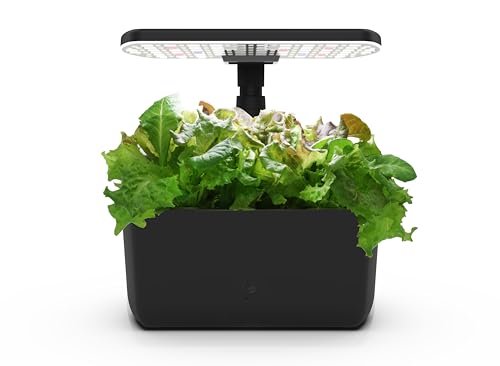
AeroGarden Harvest Lite: Cheaper, but Budget for Pods
The Harvest Lite takes the same six-plant idea, up to 12 inches tall, and strips it back. Its LED is detachable and has a built-in on/off timer, while a simple indicator light stands in for the Harvest’s touch panel. The listing calls the light energy-efficient but gives no wattage, so I can’t tell you how it compares with the Harvest’s 20 watts.
The bigger catch is what’s missing from the box. Pods and plant food are extra, as the listing says plainly. If you already plan to grow from your own seeds, that matters less: AeroGarden’s Grow Anything seed pod kit covers sponges, baskets and a bottle of plant food in one buy. If you want to plant the day it arrives, the standard Harvest is the simpler choice.
- Best for: Growers who’ll start from their own seeds
- Plants: 6, up to 12 inches • LED wattage not listed
- Pods and plant food sold separately • Built-in light timer
What the Harvest Lite Gets Right
- The same six plants, each up to 12 inches tall.
- Built-in on/off timer on a detachable light.
- Indicator light for water and plant food.
Where It Falls Short
- Pods and plant food are extra, so the first order needs a pod kit too.
- No wattage on the listing, which makes it hard to compare.
- Top-offs are on you when you travel, since there’s no vacation mode.
Amazon price right now: $59.47
AeroGarden Bounty: More Pods, More Light
The Bounty is the step up: nine plants, each up to 24 inches tall, beneath a 40-watt LED that switches itself on and off. It connects to Wi-Fi and works with Alexa, and it has a 3-step water level indicator. Pre-seeded pods, plant food and a 6-inch trellis come in the box. It’s wider than the Harvest, so measure your counter first.
The 24-inch height is the reason to choose it. AeroGarden pitches the Bounty for tomatoes and peppers as well as herbs and salads, and compact fruiting plants fit under that light where a 12-inch Harvest would crowd them. If herbs are the whole plan, though, the extra height and pods mostly go unused.
Stock is thin. On 8 October Amazon listed the black Bounty as low in stock; the white Bounty has the same listing details if black runs out. The older Bounty Basic this guide used to cover is currently unavailable.
- Best for: Growers who want 9 pods, more light, or room for compact tomatoes
- Plants: 9, up to 24 inches • LED: 40W with automatic on and off
- Wi-Fi and Alexa • 3-step water level indicator • Wider footprint, so measure first
What the Bounty Gets Right
- Nine plants for real variety, such as four herbs, lettuce and a compact tomato.
- 24-inch height opens up compact tomatoes and peppers.
- 40W LED, also double the Harvest’s 20 watts.
- Seed kit, plant food and a trellis come in the box.
Where It Falls Short
- Wide footprint. On a small counter it takes up a lot of room.
- Nine pods is more than most herb gardens need, so some slots may sit empty.
- No vacation mode on its listing, so plan top-offs as you would with the Harvest.
- Pod kit costs scale up with nine slots to refill.

Amazon price right now: see listing
DIY Kratky Jars: The Cheapest to Run

A Kratky jar is the simplest hydroponic system you can build. You fill a dark jar with nutrient solution, drop a net cup with a seedling into the lid, and leave it alone. As the plant drinks the water down, an air gap forms above the roots. That air gap is what keeps the roots oxygenated without a pump. No pump, no moving parts, no noise and no pod kits. The one thing it still needs is light: a bright window or a small grow light on a timer.
The build is a pair of wide-mouth mason jars, a set of net cup lids, a bag of clay pebbles and a one-part nutrient that lasts for months. After that, each new crop costs a sponge, some seed and a little nutrient, so over a few months a jar runs far cheaper than buying branded pod kits.
The trade-off, of course, is manual work. You mix nutrients yourself, check and adjust pH yourself, and size the jar so the water lasts the crop. You also need to learn the basics: what EC and pH mean, how to check them, and what to do when a plant looks sick. AeroGarden hides most of that behind a pod kit. Kratky surfaces it immediately. If you’re new to hydroponics, start with the step-by-step Kratky jar setup guide before you buy anything.
- Best for: Budget-first growers willing to handle nutrients and pH manually
- Power: none for the jar; a grow light if your window is weak • No pump, no noise
- Ongoing cost: nutrients, sponges and seed • Most vacation-friendly option
- Requires: pH meter, EC meter, nutrient mixing, not plug-and-play
What You’ll Need to Build One
Here’s the basic Kratky setup for a single jar:
- A wide-mouth mason jar (32 oz minimum). I use ComSaf 32 oz jars. They’re clear glass, so wrap or sleeve them up to the lid, since light in the reservoir causes algae.
- A Kratky lid with a 2-inch net cup. It replaces the standard lid and holds the plant in place; my mason jar net cup roundup covers lids and cups.
- Clay pebbles to fill the net cup and anchor the seedling.
- Hydroponic nutrients. GH MaxiGro is the simplest one-part formula for beginners. Mix per package directions, then check the EC with a meter.
- A pH and EC meter. The KETOTEK pen set I use covers both, plus water temperature.
Fill the jar so the bottom of the net cup just touches the nutrient solution. As the plant grows and drinks, the water level drops and the air gap forms naturally. Do not top it off daily: size the jar to last the crop, and if a long crop runs low, add a little nutrient solution, no more than about an inch. Between crops, drain the jar, rinse it, and refill with fresh nutrient solution at the correct EC. That’s the whole maintenance routine.
For a complete shopping list including everything you need to get started, also use the hydroponic shopping list builder.
What to Watch Out For
- Light leaks cause algae. Every hole in the lid, every gap in the jar cover, every spot where sunlight hits the reservoir directly is a potential algae problem. Seal everything.
- pH drift is normal. Check pH every 3 to 4 days and adjust back into the 5.5 to 6.5 range. Out-of-range pH locks out nutrients even when the water looks fine.
- Kratky doesn’t scale as gracefully as AeroGarden. Each jar is its own unit. Growing 9 herbs means managing 9 separate jars.
Head-to-Head: How They Stack Up

Here’s an honest breakdown across the categories that matter most for apartment growing, built from what the listings actually state.
| Category | Harvest | Harvest Lite | Bounty | Sprout | Kratky DIY |
|---|---|---|---|---|---|
| Setup | Plug in; seed kit and food included | Buy pods and food, then plug in | Easy, with optional Wi-Fi setup | Seed kit included; plug in and go | Moderate, since you mix your own |
| Ongoing cost | Pods or your own seeds, plus plant food | The same, from the first planting | Nine slots to refill each time | Three pods at a time | Nutrients, plus power if you add a light |
| Noise level | Small water pump | Small water pump too | Also a small water pump | Listed as a silent pump | Silent |
| Counter space | Medium | Medium | Large | Small | Flexible |
| Herb output | Strong | Good, though light output isn’t listed | Very strong | Light | Strong per jar, with enough light |
| pH and EC | No sensors; reminders only | Same, no sensors | Reminders only, no sensors | None built in | Your job, so budget for a meter |
| Vacation-friendly | No | No | Not on its listing | No | Best (no pump to worry about) |
| Water maintenance | Daily top-off, then a flush every 2 weeks | The same daily top-off and 2-week flush | Also daily top-off, 2-week flush | Same routine, smaller bowl | Let the level fall; fresh solution each crop |
One rule for the AeroGardens, one for the jar
The AeroGardens all share one water routine, and the jar has its own. In an AeroGarden or a DWC bucket, plants drink every day and the solution degrades over time, so top off with plain water daily and replace the entire solution every 2 weeks to prevent salt buildup, algae, and bacterial growth. A Kratky jar works differently: it is sized to last the crop, and if it runs low late on, it gets a little nutrient solution, no more than about an inch. For a full breakdown of why this schedule matters, also see the guide on how often to change hydroponic water.
Even so, keeping an eye on your grow light performance matters with any AeroGarden system. If you notice leggy stems or slow growth, the light arm may be too high. So check out the hydroponic grow light calculator to confirm you’re getting the right output for your setup. And to time your harvests accurately, the seed-to-harvest calculator gives you realistic timelines for every herb in this guide.
What an AeroGarden Costs to Run Each Year
Three things cost money after the garden itself: electricity, plant food and seed pods. Electricity is the smallest. The Harvest’s 20-watt light, on for 14 hours a day, comes to about 8.5 kWh a month. That’s around $1.55 at the US average of 18.2 cents per kWh, or roughly $19 over a year. The Bounty’s 40 watts doubles that, while the Sprout’s 10 watts halves it. Put in your own rate with the running cost calculator.
Plant food and pods are the bigger, less predictable line. The Harvest, Bounty and Sprout each come with a starter seed kit and a small bottle of plant food, but the Harvest Lite comes with neither. AeroGarden’s plant food listing says to add it every two weeks, and branded pre-seeded kits are the expensive part of ownership.
The cheaper route is your own seeds in blank sponges. AeroGarden’s Grow Anything kit fits every model. It has six coir sponges, baskets, labels and a bottle of plant food, with the seeds left to you. Amazon price right now: $17.99. For the Sprout there’s a 3-pod version.
So is it worth it on cost alone? Usually not. Once pods and plant food are in the sum, it takes a long time to beat supermarket herbs, and longer still if you cook with them only now and then. An AeroGarden earns its place on convenience: fresh herbs within reach of the stove, with the light and the watering reminders handled for you.
- The 3 best countertop hydroponic systems for apartment beginners (2026)
- Best herbs for small hydroponics: 7 varieties that always deliver
- How to clean a small hydroponic system in an apartment
- University of Minnesota Extension: Small-Scale Hydroponics
- University of New Hampshire Extension: Hydroponics at Home
A Word From Sarah

The thing that surprised me most after running AeroGarden and Kratky systems side-by-side is that the AeroGarden doesn’t automatically make you a better grower. It handles the light schedule and the pump, but it doesn’t tell you when your plants are overcrowded, when a pod is failing because of poor germination, or when your reservoir is starting to go off. People fail with an AeroGarden in the same ways they fail with Kratky jars: ignoring the water for two weeks, overfilling the reservoir, or trying to squeeze 6 pods of basil into a 3-pod system.
The skill that matters most in any hydroponic setup is learning to read your plants. A yellowing lower leaf on week 3 is probably just the plant shedding old foliage as it focuses energy upward. The same yellowing on week 1 is a pH or nutrient problem, and the guide to pH that keeps drifting covers how to tell them apart. AeroGarden doesn’t teach you that distinction. Kratky forces you to learn it faster because you’re mixing the solution yourself.
In short, the recommendation is simple: start with whichever system is in your budget and treat it as a learning experience, not a guaranteed harvest. You’ll make mistakes regardless of which one you choose. The growers who get good at this are the ones who stay curious when something goes wrong rather than giving up. So start simple, watch your plants carefully, and you’ll have fresh herbs on your counter year-round.
My honest verdict
For most apartment growers, the standard AeroGarden Harvest is the right call, and it’s the one I grew in. Six plants make a real working herb garden, the 20-watt light runs itself, and the seed kit and plant food mean you can start the day it arrives. Measure under your cabinets first. If budget is tight, a Sprout on clearance still works as a small first step, although a Kratky jar costs even less to run. If you want total control over your nutrients and don’t mind the learning curve, build a Kratky jar setup first.
Frequently Asked Questions
Is AeroGarden going out of business?
No. In late 2024 Scotts Miracle-Gro announced it would shut AeroGarden down, then reversed that decision, and AeroGarden is still part of Scotts Miracle-Gro. Gardens, seed pod kits and accessories are on sale again. Some older models are on final clearance and won’t be restocked, the Sprout among them, so check that a model is still in the current lineup before you buy it.
Is AeroGarden actually worth the money compared to buying herbs at the store?
It depends on what you value. As a money saver, usually not: once seed pods and plant food are counted, it takes a long time to beat store-bought herbs. Electricity is small, about 8.5 kWh a month for a 20-watt Harvest on 14 hours, around $1.55 at the US average rate. The real value is convenience and freshness, and the running cost calculator works out your own numbers.
Which is better, AeroGarden or Click & Grow?
They suit different people. AeroGarden pumps water past the roots and makes gardens up to the 9-pod Bounty, with the light timer and reminders on the base. Click & Grow’s smaller gardens wick water up to the pods instead, and their light comes preset to 16 hours on, 8 off. My AeroGarden vs Gardyn vs Click and Grow comparison goes model by model.
Which herb is easiest to grow in an AeroGarden for a total beginner?
Basil and mint are the easy wins. Basil is quick and forgiving, and mint is very hard to kill, though it spreads fast enough to crowd its neighbors. Chives are easy but slow, while parsley is slow to start, so give it time before deciding a pod has failed. Start with basil if you want an early harvest.
Can I use window light instead of the AeroGarden’s grow light?
Not reliably. Herbs need 14 hours of consistent light at a specific intensity, and even a south-facing window in summer won’t deliver that consistently enough for strong growth. Window light works in a pinch for a Kratky jar with a low-demand crop like lettuce, but for AeroGarden-level production you need the built-in LED. Turning off the grow light and relying on a window defeats the main advantage of the system.
How often do I need to change the water in an AeroGarden?
In the AeroGardens, top off with plain water daily to replace what your plants drink, and do a full reservoir change every 2 weeks. The full change means emptying the reservoir, rinsing it, and refilling with fresh water plus new nutrients. Skipping the 2-week flush leads to salt buildup, algae, and bacterial problems that are much harder to fix than they are to prevent. The Kratky jar is the exception: it is sized to last the crop, and if a long crop runs low, it gets a little nutrient solution, no more than about an inch.
Can I grow different herbs together in the same AeroGarden reservoir?
Yes, with some planning. Basil, parsley and chives share a reservoir reasonably well at the compromise value of EC 1.5 and pH 6.0 to 6.5, though each grows a little slower than it would at its own number. Lettuce prefers 1.0 to 1.4, so it is the odd one out in a herb reservoir. The issue, however, is that mint is a fast, aggressive grower and will shade out slower neighbors. Also avoid mixing herbs with fruiting plants like tomatoes, which need a much higher EC (2.0 to 2.5) that will overfeed your herbs and cause tip burn.
Do AeroGarden systems need an air pump, and is it noisy?
AeroGardens use a small water pump to circulate the solution, not an air stone. The Sprout’s listing calls its pump silent; the Harvest, Harvest Lite and Bounty listings don’t rate theirs. Expect a low hum at most, which you’re more likely to notice at night in a very quiet room. A rubber mat under the base stops any vibration reaching the counter.
Do herbs grown in AeroGarden taste the same as soil-grown herbs?
Basil, parsley and chives grown in water taste like the herbs you know, especially when picked minutes before cooking. Some herbs, such as thyme, oregano and mint, can taste a little milder, since part of their flavor comes from oils that build up under stress. Keep the light at the right height, 6 to 8 inches above leafy herbs, and harvest often so growth stays fresh.
How long do AeroGarden herb plants last before I need to replace them?
Basil usually stays productive for 3 to 6 months with regular pruning before it turns woody. Mint runs 3 to 6 months, parsley 2 to 4, and chives 6 months or more. Cilantro is the short one: first harvest 6 to 8 weeks from seed, then 3 to 5 weeks of cutting before it bolts, so plan to resow. When a plant turns woody or stops putting out new leaves, pull it out, clean the pod slot with diluted hydrogen peroxide, and start a fresh seedling.
Can I use my own seeds instead of AeroGarden pod kits?
Yes, and it is the single biggest saving available to an AeroGarden owner. Blank grow sponges drop into the same pod slots: sow your own seed, cover it with a grow dome if you have one, and carry on exactly as you would with a branded kit. AeroGarden’s Grow Anything kit has six coir sponges, baskets, labels and a bottle of plant food, with the seeds left to you. The seed starting guide covers germination in sponges and rockwool.
Why does my AeroGarden reservoir turn green or start to smell?
Green means algae, which needs light to grow, so light is reaching the water. Check that every unused pod slot has its blank cover fitted, because an open slot is an open window. A smell is different: that is bacteria in a reservoir that has gone too long without a change. Drain it, scrub the basin with diluted hydrogen peroxide rather than bleach, rinse, and refill. Then hold the schedule, since topping off daily and flushing every 2 weeks prevents both problems far more easily than fixing them does.
Use these free calculators before you set up any system on this list:
- pH & Nutrient Calculator: dial in the right nutrient mix and pH target for your herbs
- Grow Light Calculator: confirm the right light height for your AeroGarden or shelf setup
- Seed-to-Harvest Calculator: find out exactly how long until your first cut
- Shopping List Builder: build a complete beginner kit matched to your budget and counter space
Happy growing! 🌿
Sarah, Urban Hydro Space

Sarah Whitfield is the founder of Urban Hydro Space and an indoor gardening enthusiast dedicated to helping apartment dwellers grow fresh herbs and vegetables in small spaces. She researches hydroponic systems carefully from real specifications and verified buyer feedback, and shares practical tips and honest, clearly labeled product picks to make indoor gardening accessible for beginners.


