

⏳ 13 min read · Last updated: September 2026
When you need to lower EC in a small hydroponic system you’re usually racing against the clock. A one-liter basil setup can flash a terrifying 3.8 on the EC meter while the leaf tips are already turning papery and brown. The panic move is to dump the whole jar in the sink, which risks the delicate roots too.
Fixing a high electrical conductivity reading doesn’t require a chemistry degree. You’ll just need plain water, a reliable meter, and a basic understanding of how small reservoirs behave. In small countertop jars, even a tiny bit of evaporation creates a big spike in nutrient concentration, because there is so little water to absorb it. If you’re new to managing water chemistry, the complete apartment hydroponics guide for beginners covers the full foundation before you start chasing numbers.
Key Takeaways
- Dilute minor spikes by replacing 30 percent of the water with plain pH-adjusted water.
- Top off daily with plain pH-adjusted water never with nutrient solution, so minerals do not build up.
- Perform a full reservoir change every 2 weeks so the nutrient balance resets.
- Keep water between 65 to 75°F (18 to 24°C) to slow evaporation and reduce EC spikes.
- Fix EC concentration first, then adjust pH, never the other way around.
- Not sure what is wrong yet → start with Why EC Spikes In Small Hydroponic Jars
- You know the cause → jump to the relevant section below
Why EC Spikes In Small Hydroponic Jars
Understanding why salts build up also helps you fix the problem and prevent it from returning. In a small jar, the water volume drops fast while the plant transpires. However, the plant leaves the heavy mineral salts behind in the remaining water. When this happens, the nutrient concentration skyrockets in a matter of days. That hits apartment growers far harder than greenhouse farmers because there’s so little water acting as a buffer.
🔎 Quick diagnosis table
| What you see | Most likely cause | Check this first |
|---|---|---|
| 🟡 Crispy brown leaf edges | Nutrient burn (EC too high) | Test reservoir with a calibrated EC meter |
| 🟡 Entire leaf turning pale yellow | Nutrient lockout from pH drift | Test pH level before touching EC |
| 🟡 Wilting despite full jar | Osmotic pressure from extreme EC | Test EC immediately, do a partial dilution |
The Salt Buildup Effect

When electrical conductivity gets too high, your plant goes into defensive mode. It pushes excess salts to the tips of the leaves, which causes the classic nutrient burn look that confuses many beginners. This is a stress response, not a feeding problem.
Distinct plant stress symptoms when the EC spikes include:
- The very tips of the leaves turn brown and brittle
- Dark green leaves start curling downward at the edges
- New growth stalls entirely for several days
- The root mass takes on a dark, stained appearance
If the browning has already started, the guide on why apartment hydroponic plants turn yellow covers the full range of visual symptoms and their causes, which helps you confirm EC is actually the culprit before you start diluting.
How Jar Volume Affects the EC Spike Rate
A one-liter mason jar experiences a faster EC spike than a five-gallon bucket because there’s so little water to absorb the salt concentration. If your apartment runs warm, the evaporation rate increases further. Keeping your water at the optimal 65 to 75°F (18 to 24°C) slows this evaporation and buys you more time between corrections. For a full breakdown of how temperature affects small systems, the guide on small hydroponic system temperature problems and apartment fixes covers every cooling method worth trying.
When To Act: Reading Your Meter Against Crop Targets
You can’t lower EC in a small hydroponic system correctly without measuring your baseline first. Many beginners still guess their nutrient strength based on leaf color alone, which leads to endless frustration and wasted fertilizer. Instead, you need to check your reading against the specific target for your crop. An EC of 2.2 is perfect for a mature basil plant, but that same reading will burn delicate lettuce seedlings within two days.
| Crop Type | Ideal Target EC | Act If Reading Exceeds |
|---|---|---|
| Lettuce | 1.0 to 1.4 | 1.6 |
| Spinach | 1.4 to 1.8 | 2.0 |
| Thyme | 1.2 to 1.6 | 1.8 |
| Parsley / Cilantro / Oregano | 1.4 to 1.8 | 2.0 |
| Basil | 1.0 to 1.6 | 1.8 |
| Mint | 2.0 to 2.4 | 2.6 |
For a full explanation of why these ranges are set where they are and how each herb responds to nutrient strength changes, the EC and nutrient strength guide for apartment herbs and lettuce is the most detailed reference on the site.
Matching Your Crop to the Chart
Always base your actions on the specific herb you’re growing. When you share a reservoir among different herbs, keep a safe middle ground at EC 1.5. Before adding plain water to dilute, confirm the actual volume of your jar. You don’t want to overshoot and cause a nutrient deficiency. Use the free pH and nutrient calculator to determine your dilution ratio based on your current reading and jar volume.
Reading Your Meter Accurately
A dirty meter gives you false high readings. Rinse your probes in distilled water before every single use, then shake off the excess droplets so you don’t dilute the sample. Dip the meter into the middle of the jar, rather than at the bottom where salts settle. Give the water a gentle stir with the probe to ensure an even reading before recording the number.
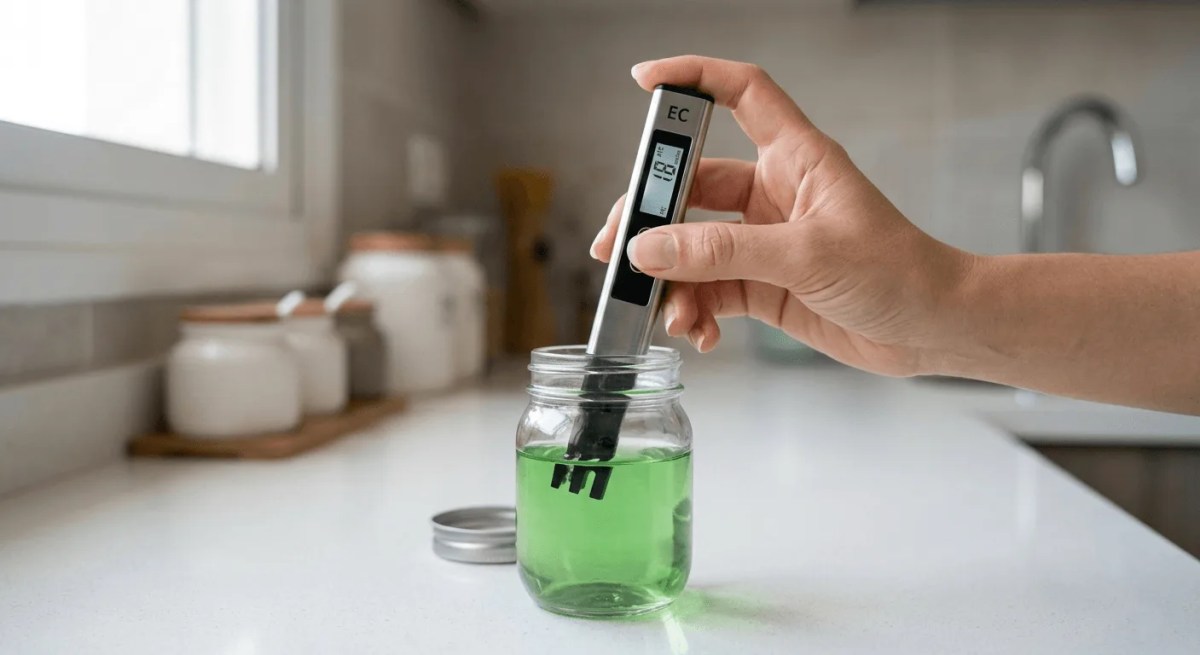
When the numbers keep jumping around, your battery might be dying or the probe needs calibration. That is why a monthly calibration routine using a standard buffer solution keeps your readings trustworthy. The guide on the best EC and TDS meters for small hydroponic reservoirs covers which probes hold calibration longest and which budget models drift within a week.
How To Lower EC In A Small Hydroponic System
Once you have your readings, it’s time to act. There are two main methods to lower EC in a small hydroponic system: a partial dilution for minor drift, or a full reservoir reset for extreme spikes.
Your choice depends on how far the numbers have drifted since the last change. If your target is EC 1.8 and you read 2.1, a partial dilution works best. If your meter flashes a shocking 3.5, however, you need a full reset.
Partial Dilution for Minor Drift
This is the best method for small, daily corrections. It’s gentle on the roots and keeps the baseline stable. You’ll need a clean measuring cup and plain water that has been adjusted to pH 5.5 to 6.5.
To safely perform a partial dilution:
- Remove 30 percent of the existing nutrient solution with a clean cup and set it aside.
- Pour plain pH-adjusted water slowly down the side of the jar to avoid splashing the roots.
- Wait ten minutes so the solution mixes naturally without stirring.
- Dip your meter back into the reservoir to check the new reading.
- If the reading is still above your crop’s action threshold, repeat the process once more.
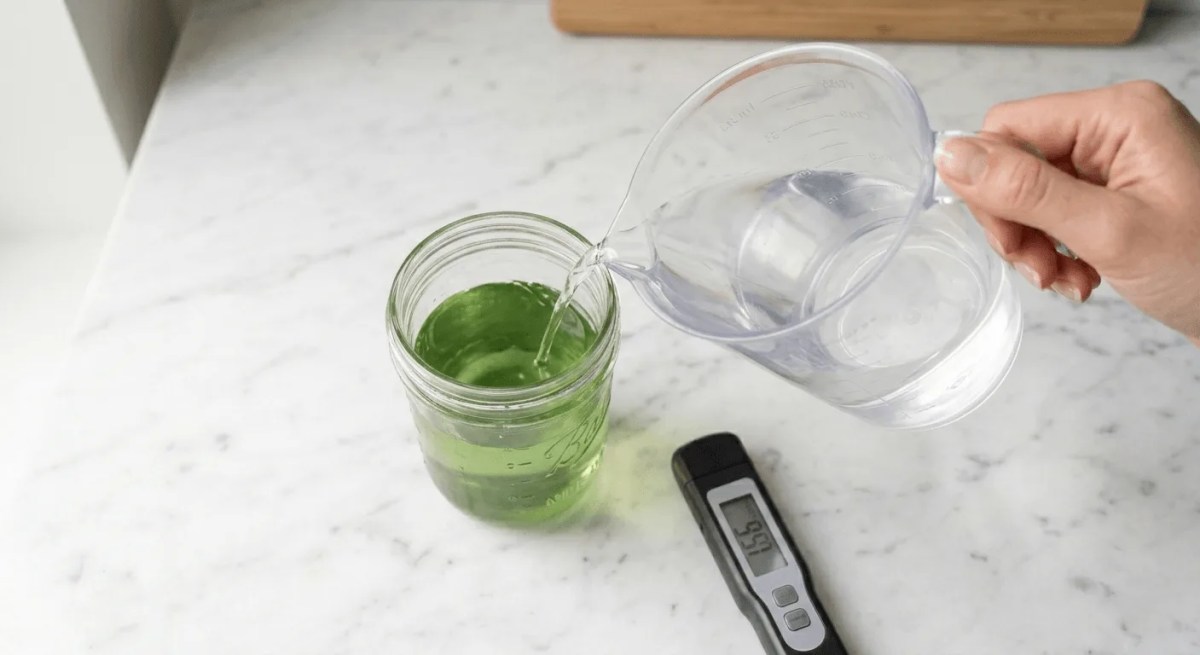
Diluting in small stages is still safer than overshooting and washing away all the plant food. After each dilution, check the pH as well, since adding plain water can shift the balance slightly.
Full Reset for Extreme Spikes
When levels drift well above the safe zone, partial dilution becomes mathematically inefficient in a tiny jar. A complete reset is also necessary for routine maintenance regardless of your readings. You must do a full reservoir change every 2 weeks to prevent pathogen buildup and toxic salt accumulation.
To perform a full reset on a spiked jar:
- Lift the plant gently out of the container and set it in an empty cup with the roots protected.
- Drain the old nutrient water down the sink. The guide on whether you can reuse old hydroponic nutrient solution explains when it’s safe to repurpose drained water for houseplants rather than pouring it straight down the drain.
- Rinse the root mass under lukewarm tap water to wash away clinging salts from the root surface.
- Clean the jar to remove any algae film or mineral crust on the glass walls.
- Refill with a fresh batch of balanced nutrients mixed to your target EC, pH adjusted to 5.5 to 6.5.
- Confirm the roots touch the bottom quarter of the new solution before returning the plant.

- Spike is less than 0.5 above your crop’s target → partial dilution first
- Spike is greater than 0.5, or the water smells bad → full reservoir reset
- Two weeks have passed regardless of EC reading → full reservoir reset regardless
Helping Roots Recover After a Spike
After correcting the EC, the plant needs a few days to push out new healthy root tissue. Don’t rush back to full nutrient strength. Start the fresh reservoir at the low end of your crop’s target range, around EC 1.2 for most herbs, and let the plant rebuild its root mass before increasing it again.

If the roots turned dark or slimy during the high-EC period, the spike may have triggered the early stages of root rot. The guide on preventing root rot in small hydroponic systems covers how to tell whether the roots can recover or whether the system needs a full sterilization before the next plant goes in.
Preventing EC Spikes Before They Start
The smartest way to manage nutrient burn is to never let the salts concentrate in the first place. Consistent maintenance keeps the numbers locked in their target range without emergency corrections. Your environment plays a massive role in how fast those numbers climb. Heat, intense light, and low humidity all force the plant to drink water faster than it processes salts, and every degree of extra warmth accelerates the problem.
→ University of New Hampshire Extension: Hydroponics at Home
Daily Top-Off Routine
Most beginners make the mistake of topping off their jars with more nutrient water. This is a guaranteed recipe for a toxic spike. As the water level drops, top off with plain pH-adjusted water only, never with nutrient solution. Build a habit of checking the water lines every morning when your lights turn on. A healthy basil plant in a warm apartment can drink half a liter of water in two days, so gaps appear fast.
The guide on how to top off small hydroponic systems without messing up nutrients explains the exact daily process, including how to pre-prepare a standing jug of plain water so you’re never tempted to grab the nutrient bottle when the level drops. For the broader water management schedule, the guide on how often to change hydroponic water in a small system gives the full weekly and biweekly rhythm.
Managing Light and Temperature to Slow Evaporation
Excessive heat drives evaporation and pushes the plant’s water intake into overdrive. Keep your room air temperature between 60 to 70°F (15 to 21°C). If your grow light sits too close to the jar, the radiant heat will warm the water past the safe zone and accelerate EC spikes independently of room temperature.
Keep your light height for leafy herbs at 6 to 8 inches above the canopy and run your schedule at the standard 14 hours on, 10 hours off. If you suspect your panel is generating too much heat at that distance, use the grow light calculator to confirm the correct hanging height for your wattage. The guide on grow light burn in small indoor setups explains how to distinguish heat damage from nutrient burn, since the two look nearly identical on the leaves.

Starting With the Right Nutrient Baseline
Most EC spikes begin at mix time, not during the grow. If you mix a fresh batch without measuring, you’re starting from an unknown position. Always use a calibrated EC meter before the jar gets a plant in it. Use the free seed to harvest countdown calculator to plan when each reservoir change falls in your plant’s growth cycle, and adjust your EC target upward slightly as the plant matures from seedling to established herb.
The guide on the beginner hydroponic nutrients guide and feeding schedule covers exactly how to build a mixing routine that prevents spikes from the first day.
→ Why Hydroponic Herbs Taste Weak And How To Fix Light, Feed, And Harvest Mistakes
→ Why Hydroponic pH Keeps Drifting In Small Systems (And How To Calm It Down)
A Word From Sarah
A fresh batch for countertop chives mixed at EC 2.0 can creep up fast: four days later, with the water level two inches lower, the meter can read 2.9 and the chive tips turn brittle and yellow. The fix is to drain the jar, rinse the tangled roots under lukewarm water and refill inside the chive range of 1.8 to 2.0. The habit that prevents it is simple: measure the baseline before any top-off, and keep a pre-filled jug of plain water under the sink so there’s no temptation to reach for the nutrient bottle.
Frequently Asked Questions
How do I lower EC in a small hydroponic system jar?
The easiest method is partial dilution. Remove one third of the existing nutrient water from your reservoir and replace it with plain tap or filtered water that has been pH-adjusted to 5.5 to 6.5. Wait ten minutes, then test your levels again. This gentle approach prevents sudden shock to the delicate root system and gives you control over how far you dilute.
Why does my EC keep rising even after I top off?
Plants absorb water faster than they consume nutrient salts in warm, dry apartment air. This leaves behind a concentrated mineral pool that grows with every top-off. If you top off with nutrient solution instead of plain water, you accelerate the spike significantly. Top off with plain pH-adjusted water every day and the EC will stay stable between your biweekly full reservoir changes.
What is the correct EC for basil?
Basil thrives at an EC of 1.0 to 1.6 in a hydroponic setup, a little higher in winter. If your reading climbs above 2.2, the plant will experience nutrient burn and show brown, papery leaf edges within a day or two. Dilute the reservoir immediately if you see those margins forming, and confirm the reading with a calibrated EC meter before assuming the cause.
Can I lower EC by adding pH Down to my reservoir?
No. pH-adjusting acids don’t lower electrical conductivity. In fact, adding any acid or base increases total dissolved solids slightly. You must add plain fresh water to dilute the mineral salts and drop the EC reading. Always correct the salt concentration first, then adjust the pH once the EC is back in the safe range for your crop.
How often should I change the water in a small hydroponic jar?
Perform a full reservoir change every 2 weeks regardless of your EC reading. Empty the jar completely, rinse the roots gently under lukewarm water, and refill with a fresh nutrient solution at your crop’s target EC. This biweekly routine also clears out any pathogen buildup that a partial dilution can’t address.
Will high EC permanently damage my herbs?
Prolonged high EC causes severe root stress and leaf burn, but most common apartment herbs recover well if you act within the first few days. Drop the levels back into the safe range, trim away the dead foliage above a leaf node, and give the plant a week at a lower EC to rebuild its root mass before increasing nutrient strength again.
Is an EC of 3.0 too high for lettuce?
Yes, lettuce requires a gentle EC of 1.0 to 1.4. An EC of 3.0 will cause immediate tip burn and bitter tasting leaves. Perform a full reservoir reset immediately and refill at EC 1.2 to give the plant room to recover. Fruiting plants like tomatoes tolerate higher ranges, but all leafy greens are far more sensitive to salt concentration.
Should I use cold water to dilute my reservoir?
Always use room temperature water when topping off or diluting. The optimal root zone is 65 to 75°F (18 to 24°C). Adding cold water shocks the root system and causes further stress to an already struggling plant. Let your replacement water sit out overnight to reach ambient temperature before pouring it into the jar.
Happy growing! 🌿
Sarah, Urban Hydro Space

Sarah Whitfield is the founder of Urban Hydro Space and an indoor gardening enthusiast dedicated to helping apartment dwellers grow fresh herbs and vegetables in small spaces. She researches hydroponic systems carefully from real specifications and verified buyer feedback, and shares practical tips and honest, clearly labeled product picks to make indoor gardening accessible for beginners.


