⏳ 14 min read · Last updated: September 2026
Hydroponic strawberries indoors are the crop most beginners want first and should probably grow third. Basil forgives a missed top-off. A strawberry crown in warm, still water rots within days. Even a plant that survives gives you nothing unless someone moves the pollen by hand. So before you buy bare-root crowns, it helps to know what you are signing up for.
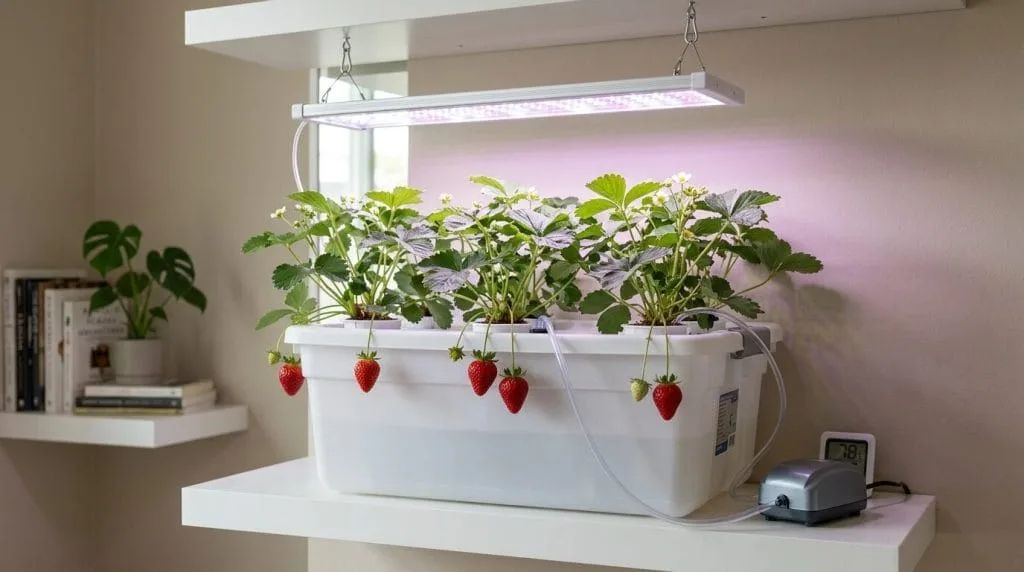
The good news is that none of it needs a greenhouse. A small bubbler tote, a strong light, a paintbrush and a steady feeding routine will fruit day-neutral strawberries on a shelf. This guide gives you every number, the setup that works, and the problems that usually end a first attempt.
📐 Hydroponic Strawberries at a Glance
- Choose day-neutral varieties such as Albion or Seascape, because they flower without seasonal cues.
- Grow in an aerated tote with 2 to 3 gallons per plant, since passive jars rarely supply enough oxygen.
- Start crowns at EC 1.0 to 1.2, then hold EC 1.6 to 2.0 once they flower, at pH 5.5 to 6.5.
- Run the light 16 hours on, 8 off, hung 8 to 12 inches above the leaves.
- Top off daily with plain pH-adjusted water, and do a full reservoir change every 2 weeks.
- First grow ever → start with basil and come back in a month
- Already keeping herbs alive and ready for a challenge → build the bubbler tote below
- Only a passive jar and no pump → read the Kratky section before buying crowns
🍓 Choosing Plants for Hydroponic Strawberries Indoors
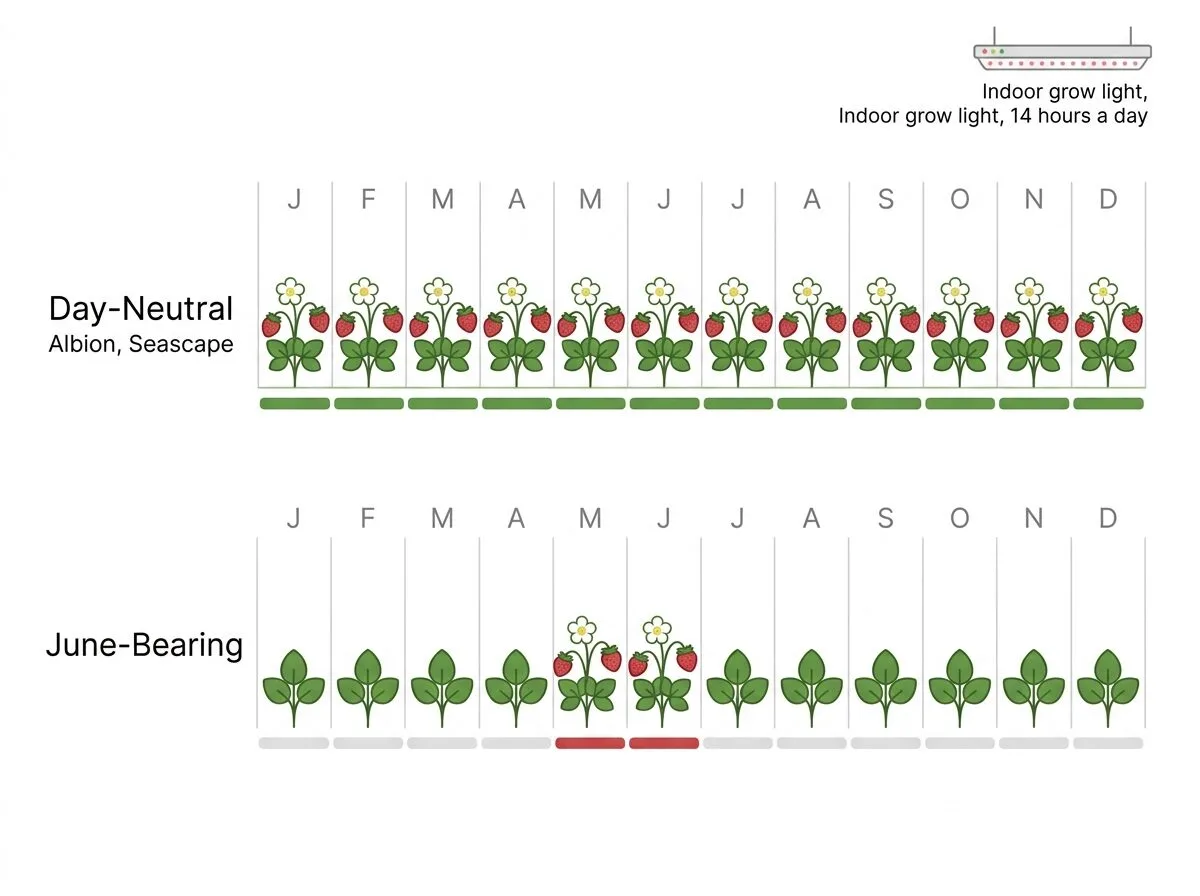
Variety matters more with strawberries than with almost any other crop on this site, because the wrong type can grow healthy leaves for months and never flower. Strawberries fall into three groups, and only one of them suits a shelf with no seasons.
⏱️ Day-Neutral, Everbearing and June-Bearing
June-bearing strawberries flower after short autumn days and a cold spell, so they fruit once a year. Indoors under a steady 14-hour light, they tend to sit there producing leaves. Everbearing types crop in two or three flushes a season, which is better but still uneven.
Day-neutral varieties, however, flower whenever the temperature stays moderate, whatever the day length. That makes them the right choice for a grow light on a timer. Good options include:
- Albion, a firm, sweet berry that is widely sold as bare-root crowns
- Seascape, which copes with the warmer end of the air temperature range
- San Andreas, a close relative of Albion with similar habits
Alpine strawberries are another route. They grow from seed, stay compact and rarely send out runners, although the berries are small and the plants take longer to reach cropping size.
📦 Crowns or Seed
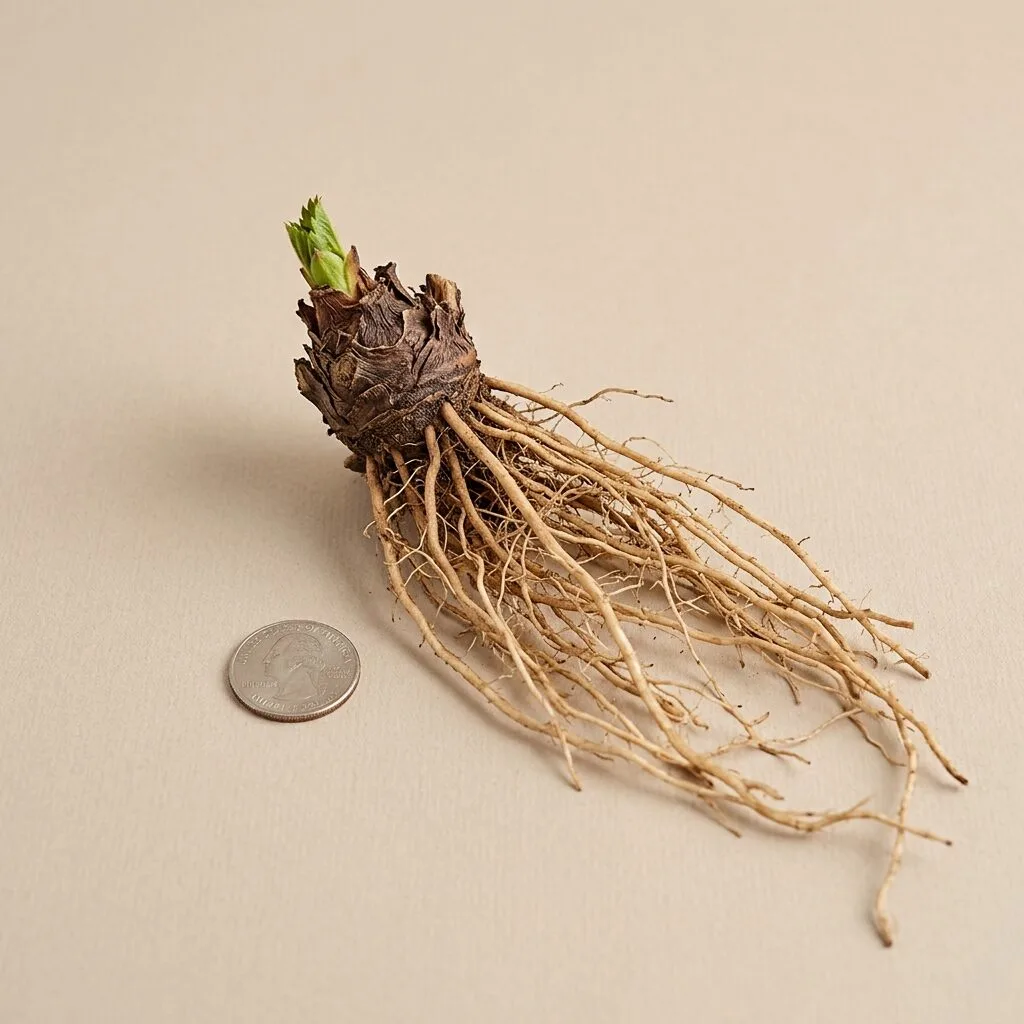
Buy bare-root crowns if you want fruit this season. They look like dead roots with a bud on top. They are simply dormant, though, and can flower within 4 to 8 weeks of planting.
Seed takes months longer, so it only makes sense for alpine types. If you do start from seed, the method in starting hydroponic seeds in rockwool works, and the seedlings stay at EC 1.0 to 1.2 until they have several true leaves.
💧 The System: Why Strawberries Need Air
A strawberry plant carries a dense root mass under a woody crown, and those roots use a lot of oxygen, especially once the plant is flowering. In still water, oxygen runs down faster than it is replaced, so the roots brown and the crown follows. That is why the system choice decides most first attempts before the plant ever flowers.
⚗️ Can You Use the Kratky Method?
You can, with caveats. Kratky works when the plant drinks the level down slowly and roots grow into the air gap. A large strawberry plant, however, drinks a jar dry fast and then sits in a warm puddle. A quart jar is simply too small.
If you want to try passive growing anyway, use an opaque container of at least 2 to 3 gallons per plant, keep the room cool, and watch the roots closely. The Kratky tote setup shows how to size and fill a bin so the air gap forms properly. For most beginners, however, a bubbler is the safer route, and the DWC vs Kratky comparison explains the trade-off in more detail.
🪴 Building a Small Bubbler Tote
Deep Water Culture fixes the oxygen problem by pushing air through the solution all day. For one to three strawberry plants you need:
- An opaque tote or bucket holding 2 to 3 gallons per plant
- 3-inch net cups, spaced 8 to 12 inches apart
- A small air pump, tubing, a check valve and an air stone
- Clay pebbles to hold the crown steady in the cup
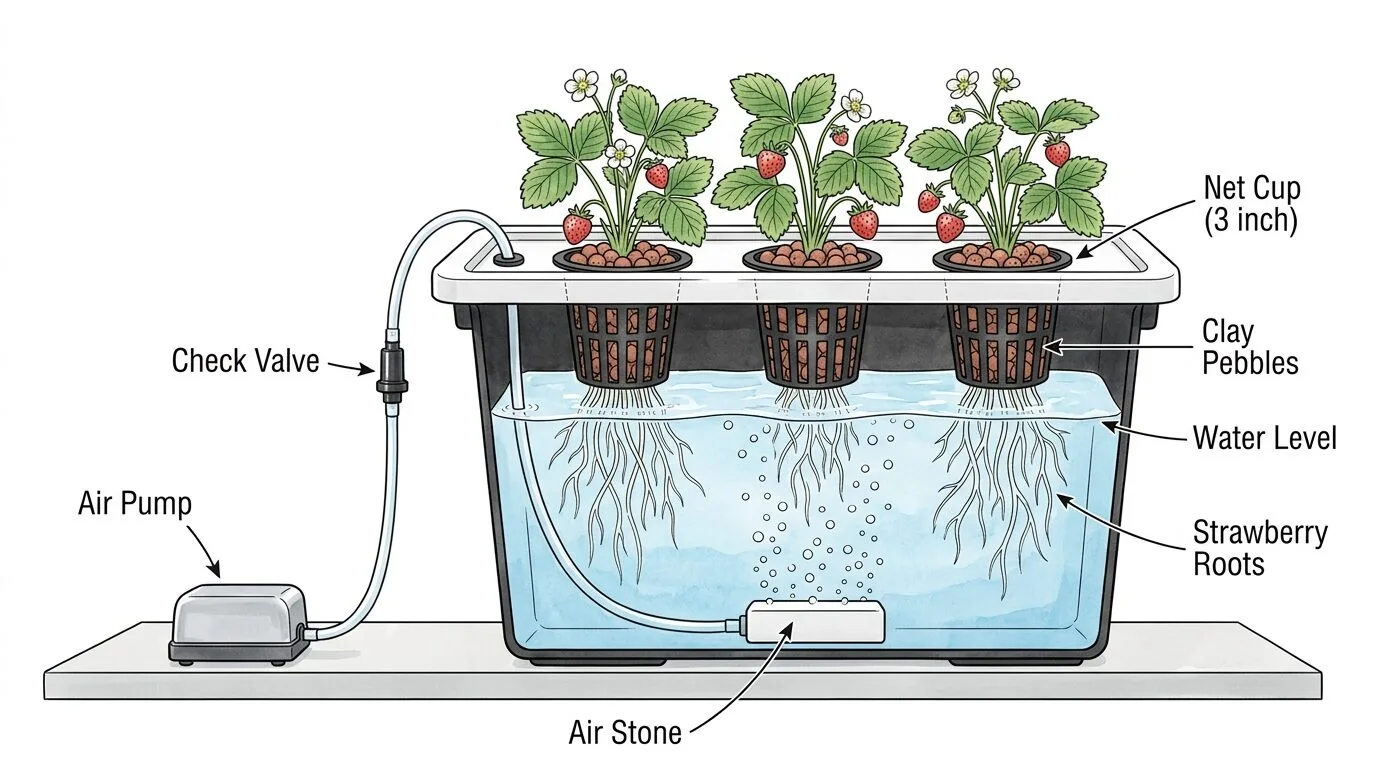
The quiet DWC bucket build walks through drilling the lid and placing the stone. Since a pump will run next to your bed or sofa, it is worth choosing one from the quiet air pump roundup and resting it on a folded towel so the hum does not travel through the shelf.
A vertical tower is another option once you want more than three plants, because strawberries trail nicely from tower pockets. The apartment vertical tower guide covers the sizes that fit indoors.
🌱 Planting Bare-Root Crowns
The crown is the most vulnerable part of the plant. When it sits wet, it rots, so almost every planting decision is about keeping it dry while the roots below stay in contact with the water.
- Soak the bare roots in plain water for about 30 minutes so they rehydrate.
- Trim any roots that are black, mushy or much longer than the net cup is deep.
- Thread the roots through the cup and pack clay pebbles around them, with the crown sitting just above the pebbles.
- Fill the tote until the water touches the bottom of the net cup, then switch on the air pump.
- Mix the first solution at EC 1.0 to 1.2 and pH 5.5 to 6.5.
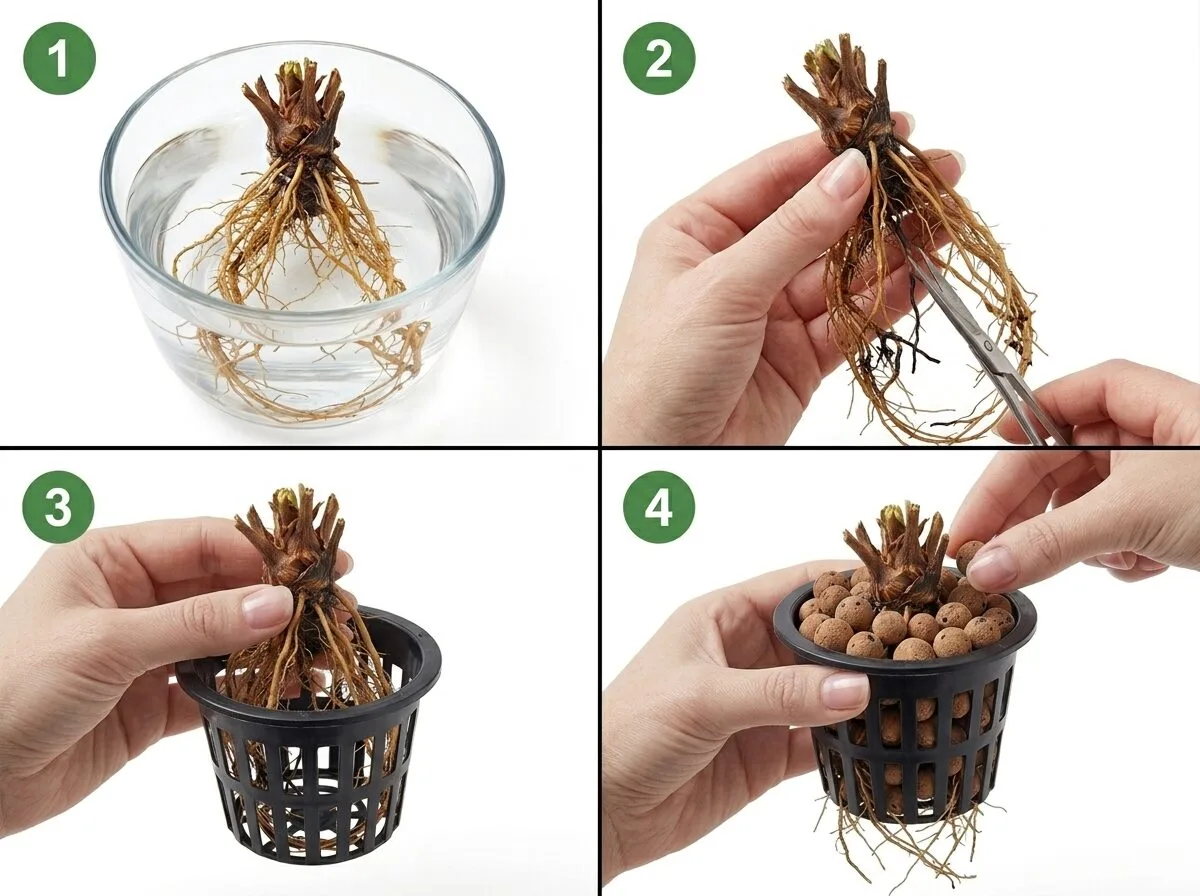
New leaves usually appear within two weeks. When they do, the roots have taken hold, so you can let the water level settle an inch or so below the cup while the bubbler keeps the lower roots wet.
✂️ Removing Runners
Healthy strawberry plants send out runners, long stems that root new plants wherever they land. Indoors those runners pull energy away from flowers, so clip each one at the base as soon as it appears. Day-neutral types produce fewer runners than June-bearers, but you will still see some, especially in the first two months.
💡 Light for Fruiting Plants
Strawberries need far more light than herbs, because building fruit costs the plant much more energy than building leaves. A clip-on lamp that keeps basil bushy will grow strawberry leaves and very little else. So the light is usually the biggest purchase in this project.
☀️ Intensity, Height and Timer
For fruiting, aim for roughly 300 to 450 µmol/m²/s at the top of the canopy on a 16-hour day, well above what leafy herbs need. If those units are new to you, PPFD vs PAR vs lumens explains what they measure, and the grow light calculator estimates the wattage for your shelf.
- Hang the fixture 8 to 12 inches above the leaves, rather than the 6 to 8 inches used for herbs.
- Run it 16 hours on and 8 hours off on a timer. Day-neutral strawberries at 16 hours gave several times the fruit of 12 hours in a 2023 trial, and they still need the dark period.
- Raise the light as the plant grows, so the gap stays in range.
Budget fixtures from the grow lights under $50 roundup can work for one or two plants when placed carefully. For a whole tote, though, a larger panel is usually worth it. A plug-in timer from the compact timers roundup keeps the schedule steady without any effort from you.
🔆 Too Close or Too Far
Leaves that turn pale, curl or crisp at the edges are too close, so raise the light by two inches and check again in a few days. Long, thin leaf stalks and few flowers, on the other hand, mean the light is too weak or too far away. Because a strong panel also warms the air, watch the reservoir temperature after any upgrade, and read grow light heat management if the shelf runs warm. If the glow keeps you awake, blocking grow light leak covers simple fixes.
🧪 Feeding, pH and the Reservoir Routine
Strawberries are medium feeders. They need more than lettuce, yet far less than tomatoes, and too strong a solution burns leaf edges and stalls flowering. Keep the numbers inside a narrow band and change them with the growth stage.
📊 EC by Growth Stage
Measure with a meter rather than trusting the bottle dose, because tap water already carries some EC of its own. The pH and nutrient calculator gives you a starting dose for your tote size, and the EC meter roundup compares pens that suit a small reservoir. If a reading overshoots, lowering EC safely shows how to dilute without shocking the roots.
💧 Keeping pH Steady
Hold the solution at pH 5.5 to 6.5, ideally around 5.8 to 6.2. Outside that band, iron and calcium become harder for the roots to take up, so young leaves pale between the veins even though the tote is full of food. Test every few days, because a busy plant shifts pH quickly in a small reservoir. A pen from the pH meter guide is faster than drops, and why pH keeps drifting explains readings that will not settle.
🔁 The Daily and Two-Week Routine
Top off daily with plain pH-adjusted water, since strawberries drink faster as they fruit and the salts they leave behind concentrate. Then do a full reservoir change every 2 weeks:
- Switch off the pump and lift the lid with the plants onto a towel.
- Pour the old solution away, or use it on soil houseplants.
- Rinse the tote with warm water to clear salt crust.
- Refill, mix to your stage EC, adjust pH, then replace the lid and restart the pump.
How to top off without upsetting nutrients and how often to change hydroponic water cover both habits in more depth.
🎨 Hand Pollination and Harvest
Strawberry flowers are self-fertile, which means one flower can pollinate itself. Outdoors, wind and insects shake the pollen around. Indoors nothing moves it, so flowers often drop without setting fruit, or they set small, lumpy berries. That is why the paintbrush becomes part of your routine.
🖌️ The Paintbrush Method
- Wait until a flower is fully open and the yellow ring of stamens looks dusty.
- Swirl a soft, dry paintbrush around the ring to pick up pollen.
- Brush gently over the whole green or yellow dome in the centre, because every seed on that dome needs pollen.
- Repeat on each open flower every day or two while it stays open.
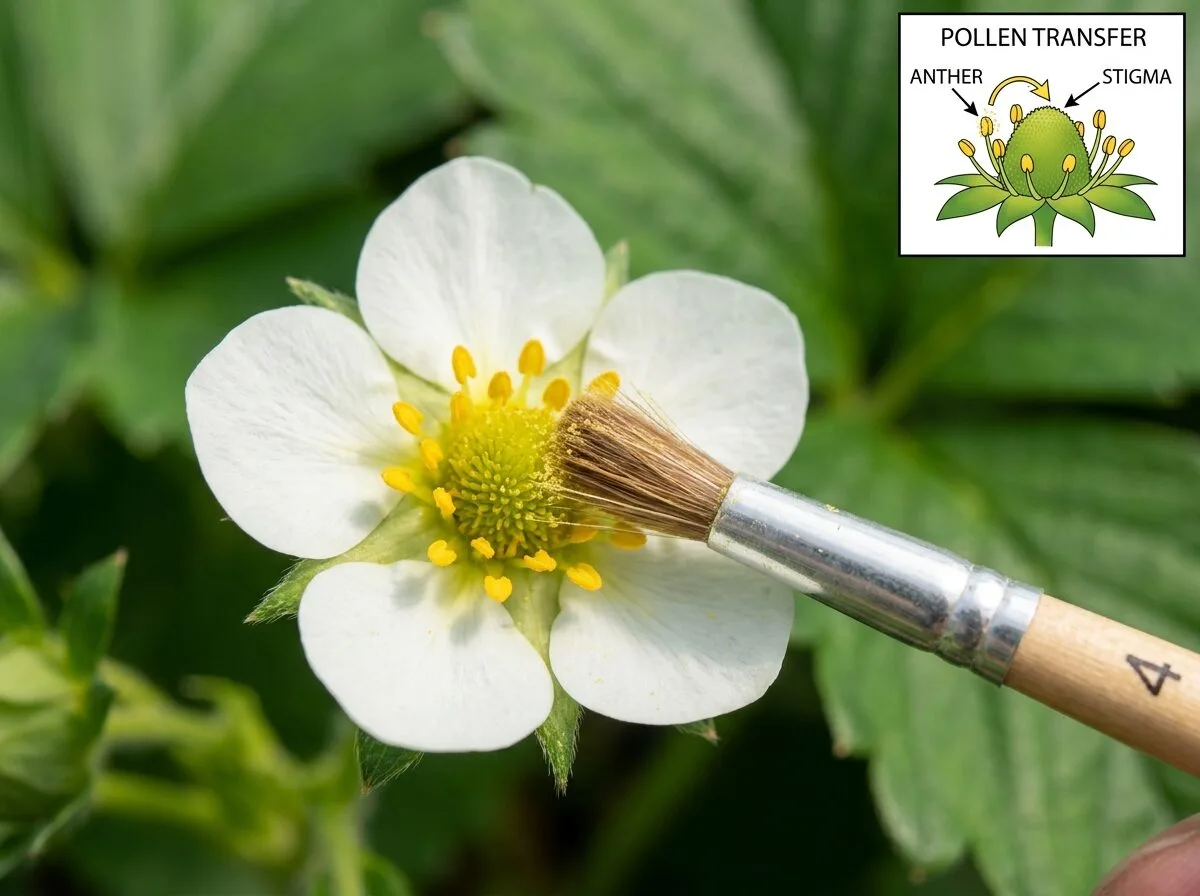
A small fan helps too. When air moves across the plant, pollen shifts on its own and mould has less chance to settle. Point a clip fan from the quiet clip-on fan roundup across the canopy, rather than straight at the flowers.
🍓 When to Pick
Expect the first ripe berries 60 to 90 days after planting crowns. Pick when a berry is red all the way to the shoulders, since strawberries do not sweeten after picking. Cut the stem rather than pulling, so the plant is not disturbed.
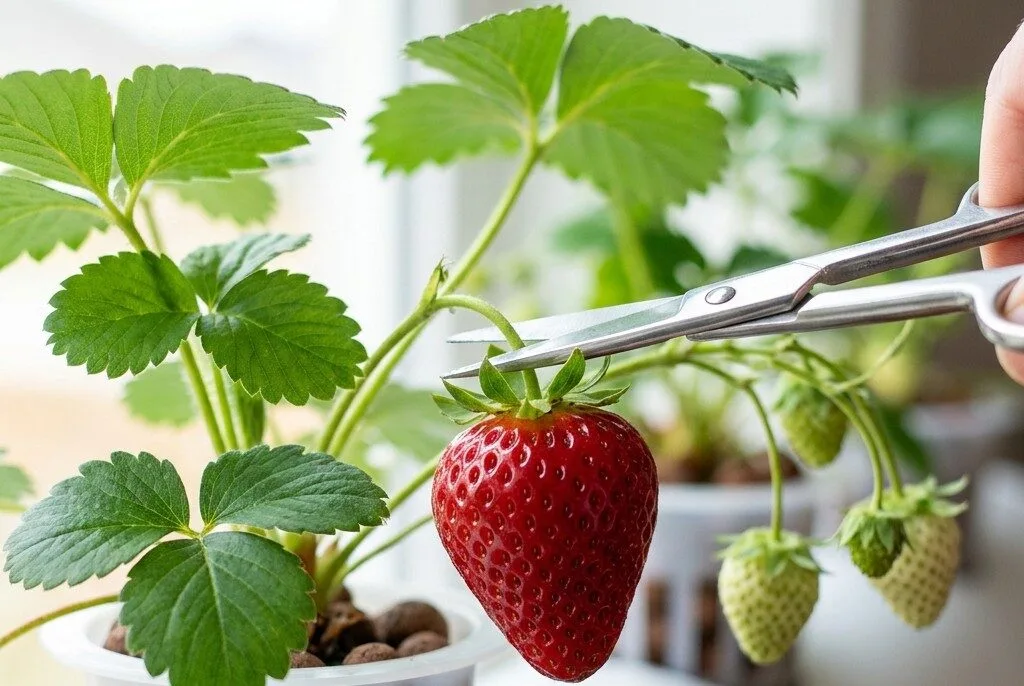
With good care, day-neutral plants keep cropping in waves for 6 to 12 months, and the seed to harvest calculator helps you plan when to start a replacement crown.
🚨 Troubleshooting Indoor Strawberries
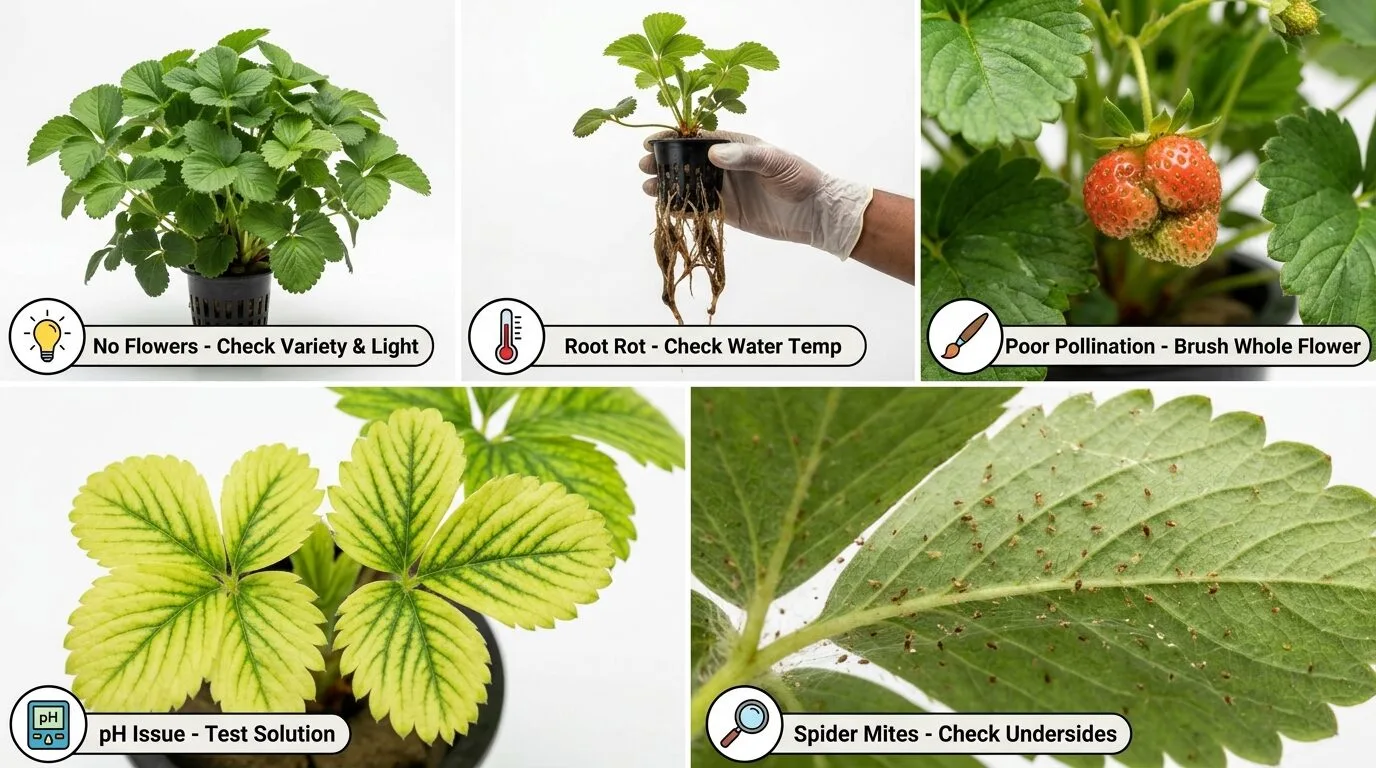
Most problems with hydroponic strawberries indoors show up on the leaves first, although the cause usually sits in the water or the air. Start with the table, then read the section that matches.
🩺 Root Rot and Crown Rot
Warm water holds less oxygen. Roots brown quickly above 75°F, and above 75°F the risk climbs sharply. Keep the water at 65 to 75°F (18 to 24°C), shade the tote from the light, and check that the air stone is still bubbling.
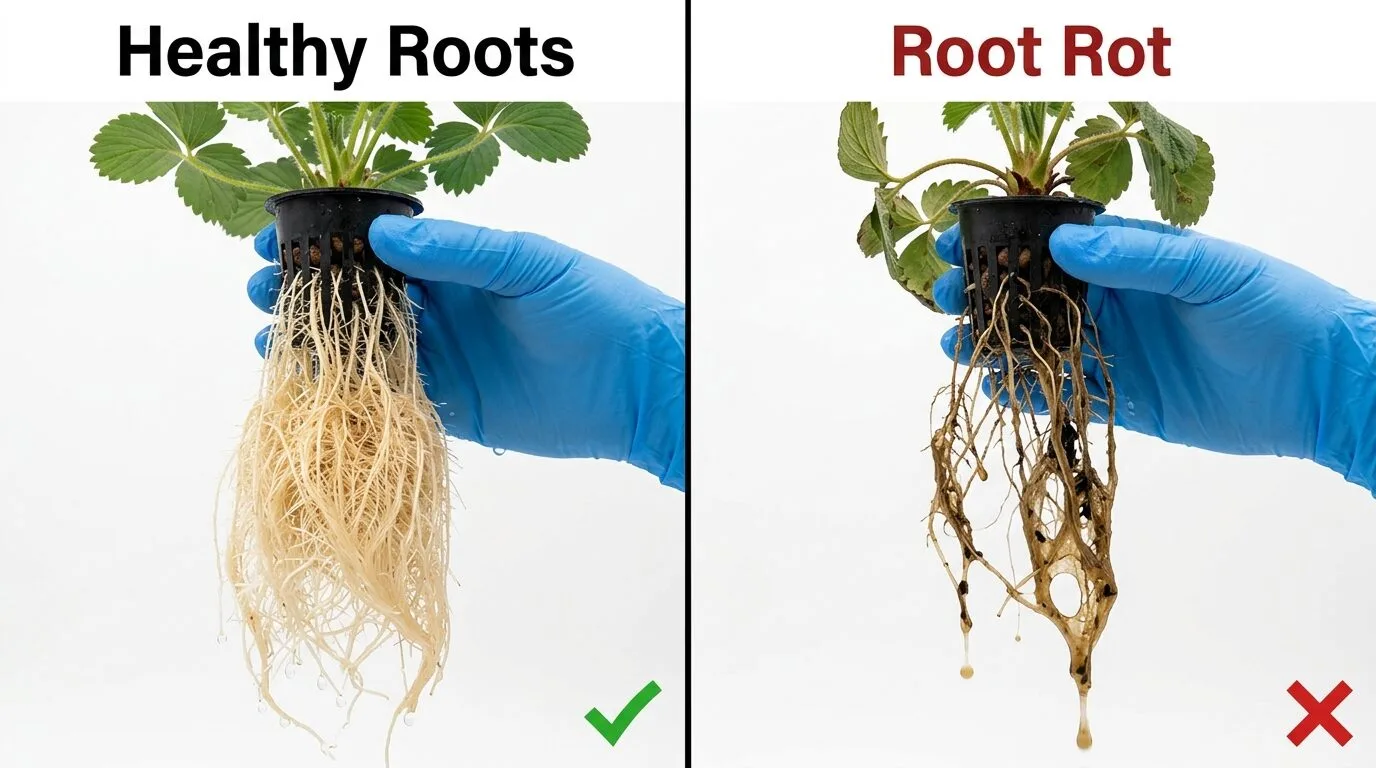
When roots do turn slimy:
- Lift the plant out and rinse the roots under lukewarm water.
- Trim the brown, mushy strands with clean scissors.
- Clean the tote with diluted hydrogen peroxide, then rinse it well.
- Refill with fresh solution at EC 1.0 to 1.2 until new white roots appear.
The dilutions are in using hydrogen peroxide for root rot, and preventing root rot in small systems covers the habits that stop it returning. Crown rot is different, because it starts above the water when the crown stays wet. So pour top-off water near the edge of the tote, never over the plant, and if summer heat is the trigger, small system temperature fixes will help.
🕷️ Spider Mites and Grey Mould
Dry indoor heating suits spider mites, and strawberry leaves are one of their favourite hosts. Check the undersides weekly, wipe infested leaves with a damp cloth, and follow treating spider mites in hydroponics if they spread. Keep any spray well away from the reservoir.
Grey, fuzzy mould on flowers or berries, on the other hand, points to still, damp air. Remove affected fruit, run the fan, and keep humidity inside 50 to 70 percent. The airflow advice in stopping powdery mildew indoors applies to strawberries as well.
→ University of Minnesota Extension: Small-Scale Hydroponics
→ University of Missouri Extension: Hydroponic Nutrient Solutions
📚 Want to see where these numbers come from? The strawberry section of the crop sources page shows the sources behind each growing number, with a label for how well each one is backed.
💬 A Word From Sarah
If I could change one habit in people starting strawberries, it would be buying crowns before the light. The plant forgives a lot, but it will not flower in shade, and a disappointing first grow usually traces back to a lamp that was fine for basil. So get the light and the bubbler running first, then order day-neutral crowns. And if you are brand new to all of this, spend a month with herbs from the apartment hydroponics beginner’s guide first. By the time your crowns arrive, checking pH and topping off will already be automatic.
❓ Frequently Asked Questions
🍓 Can you grow strawberries hydroponically indoors?
Yes, although they are harder than herbs. Choose a day-neutral variety, grow it in an aerated tote with 2 to 3 gallons per plant, give it a strong light for 16 hours a day, and pollinate the flowers by hand. With that setup, the first berries usually ripen 60 to 90 days after planting crowns.
🌱 Which strawberry variety is best for indoor hydroponics?
Day-neutral varieties such as Albion, Seascape and San Andreas are the best fit, because they flower whatever the day length. June-bearing types need seasonal cues, so they often produce only leaves under a grow light. Alpine strawberries also work from seed, although the berries are small.
🧪 What EC do hydroponic strawberries need?
Start new crowns at EC 1.0 to 1.2, move to 1.2 to 1.6 during leafy growth, and hold 1.6 to 2.0 once the plants flower and fruit. Keep pH at 5.5 to 6.5. Brown, crispy leaf edges usually mean the solution is too strong.
⚗️ Can I grow strawberries with the Kratky method?
Only with caveats. A strawberry plant drinks a small jar dry quickly and its roots need plenty of oxygen, so a quart jar rarely works. An opaque container of at least 2 to 3 gallons per plant in a cool room can succeed, but an aerated tote is the safer choice for a first grow.
💡 How much light do indoor strawberries need?
Run the light 16 hours on and 8 hours off, hung 8 to 12 inches above the leaves. For good fruiting, aim for about 300 to 450 micromoles per square metre per second at the canopy on a 16-hour day, well above what leafy herbs need.
🎨 How do I pollinate strawberries indoors?
Use a soft, dry paintbrush. Swirl it around the ring of stamens on an open flower, then brush it over the whole centre dome, and repeat every day or two while the flower stays open. Berries that come out small or lumpy usually had part of the dome missed.
🤷 Why are my indoor strawberries not flowering?
The usual causes are a June-bearing variety, a light that is too weak or too far away, or runners draining the plant. Check the variety label first, then move the light to 8 to 12 inches above the leaves and clip every runner at the base.
✂️ Should I cut off strawberry runners indoors?
Yes. Runners pull energy away from flowers and fruit, and indoors you rarely have room for the new plants they start. Clip each runner at the base with clean scissors as soon as it appears.
💧 How often should I change the water for hydroponic strawberries?
Top off daily with plain pH-adjusted water, then do a full reservoir change every 2 weeks. Keep the water at 65 to 75 degrees Fahrenheit, because warmer water holds less oxygen and raises the risk of root rot.
⏱️ How long do hydroponic strawberry plants keep producing?
Day-neutral plants can crop in waves for 6 to 12 months with good care. When a plant slows down and the crown looks tired, start a fresh bare-root crown so a replacement is ready before the old plant stops.
Happy growing! 🌿
Sarah, Urban Hydro Space

Sarah Whitfield is the founder of Urban Hydro Space and an indoor gardening enthusiast dedicated to helping apartment dwellers grow fresh herbs and vegetables in small spaces. She researches hydroponic systems carefully from real specifications and verified buyer feedback, and shares practical tips and honest, clearly labeled product picks to make indoor gardening accessible for beginners.