⏳ 18 min read · Last updated: September 2026
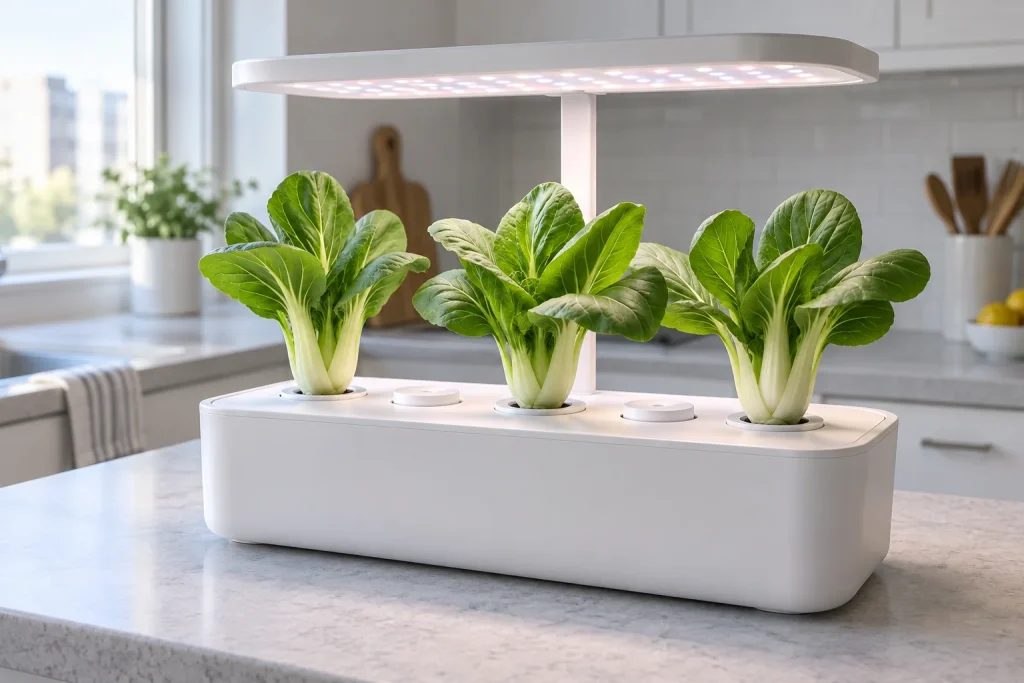
A countertop kit looks like the easy way into hydroponic bok choy, and for baby heads it mostly is. The catch is height and heat. Bok choy is a cool-season brassica, so a warm kitchen pushes it to flower early, and a full-size variety outgrows most kit lamp arms long before it is ready to eat.
This guide is built around those two limits. You’ll pick a variety that fits under your light, set pH and EC for this crop rather than for basil, keep the water cool without ice, and plan around a plant that usually gives one main harvest. Every figure below matches the numbers I use across the site, and the sources are listed near the end. If you’re brand new to growing in water, my apartment hydroponics beginner’s guide covers the basics first.
📋 Bok Choy at a Glance
- Grow baby or dwarf bok choy in a kit, because full-size heads outgrow most lamp arms.
- Hold pH 6.0 to 7.0, or 6.0 to 6.5 when herbs share the kit.
- Feed seedlings at EC 1.0 to 1.2, then EC 1.5 to 2.0 once the plant is leafing out.
- Keep the water at 65 to 75°F and the room near 60 to 70°F, since heat is what makes bok choy bolt.
- Expect baby heads 25 to 35 days from seed, so sow the next pod before you cut the first.
- Own a countertop kit with a tall lamp arm? → sow baby bok choy in every other pod
- After full-size heads? → use a 1 to 2 gallon DWC bucket per plant instead of a kit
- Prefer no pump at all? → try a Kratky container, but for baby heads only
📊 The Numbers in One Table
- Can a Countertop Kit Grow Hydroponic Bok Choy?
- Choosing Seeds That Fit Under the Light
- Spacing and Layout in a Kit
- Sowing and Germination
- Nutrients and pH for Bok Choy
- Keeping Bok Choy Cool So It Doesn’t Bolt
- Light Height, Hours and Heat
- The Weekly Routine
- Harvesting Baby Bok Choy
- Growing Bok Choy Outside a Kit
- Troubleshooting Tip Burn, Rot and Bolting
- A Word From Sarah
- Frequently Asked Questions
🥬 Can a Countertop Kit Grow Hydroponic Bok Choy?
Yes, with two conditions: a baby variety and a cool spot. Hydroponic bok choy grows fast and is often cut as a whole head, so it fits the rhythm of a kit better than most brassicas. But it is also heat sensitive and prone to bolting in warm apartments, and that is the main way a kit crop fails.
📏 The Height Check Before You Sow
Do this sum first. Baby bok choy reaches 8 to 12 inches, and the lamp should sit 6 to 8 inches above the top leaves. So the light needs to rise to roughly 14 to 20 inches above the deck by harvest day.
Measure how high your kit’s arm actually goes. When it tops out below that, sow a smaller variety or plan to cut the heads while they are still short. Full heads grow 12 to 18 inches tall. Add the same gap on top and the arm has to reach roughly 18 to 26 inches, which many compact kits cannot do. So a full-size variety belongs in a bucket, not a pod.
📅 Plan for One Main Harvest
Bok choy isn’t basil. It usually gives one main growing cycle of 4 to 6 weeks, and some partial regrowth is possible after a light leaf harvest. So think in sowings rather than in one plant that lives on the counter for months.
A fresh pod every couple of weeks keeps bok choy coming. The seed to harvest calculator gives you a harvest date for each sowing, so you can stagger them without guessing.
🌱 Choosing Seeds That Fit Under the Light
The seed packet decides more than anything else you do. Look for “baby”, “mini” or “dwarf” on the front, and check the mature height printed on the back. Toy Choy and Extra Dwarf pak choi are two mini types sold under those names, but read the packet either way, because seed companies describe size differently.
🔍 Baby Versus Full-Size Types
Here is how the two compare in a small setup:
- Baby types stay at 8 to 12 inches, so they suit kits, tote lids and smart gardens.
- Full-size heads reach 12 to 18 inches, which is why they want a bucket and plenty of headroom.
- Either type is edible at any size, so a full-size plant cut young is still dinner.
Any of them will crowd a neighbouring pod if you let it, so spacing matters as much as the variety.
⏱️ If You Already Sowed a Full-Size Variety
Nothing is lost. When a full-size plant starts pressing on the lamp, work through these steps:
- Raise the lamp arm as far as it goes.
- Give the plant the space of the pods around it, so leave those holes empty next round.
- Check the water level daily, since a big plant drinks a small reservoir down fast.
- Cut the whole head as a baby head before the leaves touch the light.
🗂️ Spacing and Layout in a Kit
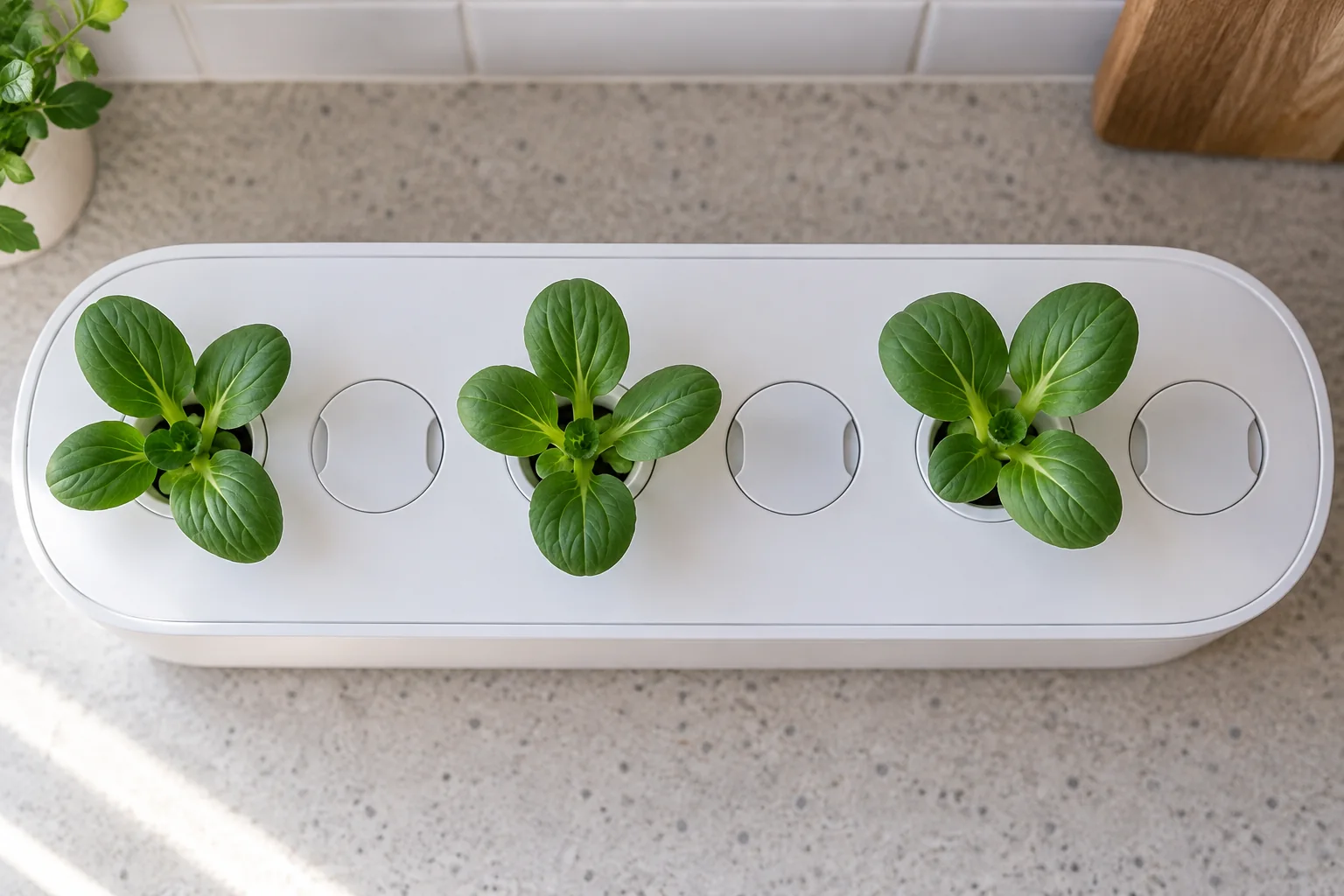
Bok choy wants 6 to 8 inches between plants. Pods in a small kit usually sit closer than that, so the simplest fix is to plant every other pod. Fewer plants with room to spread give you more usable leaves than a full deck of crowded, shaded ones.
- Sow bok choy in every other pod, and put it on the side away from tall herbs.
- Cover unused holes with the kit’s caps or light-proof tape, so no light reaches the water.
- Leave a little air between leaves, because crowded, humid canopies invite rot.
🤝 Sharing a Kit With Herbs
Most kits run one reservoir for every pod, so bok choy has to share. Its pH range is 6.0 to 7.0, while most herbs sit at 5.5 to 6.5. So hold a shared kit at pH 6.0 to 6.5, the part both ranges have in common.
For strength, my house compromise for a mixed reservoir is EC 1.5. It sits at the bottom of bok choy’s range, so the plant grows a little slower but stays healthy. The better pairing is other cool-season greens, such as the ones in my hydroponic spinach guide and my hydroponic arugula guide, because they like the same cool room.
💧 Sowing and Germination
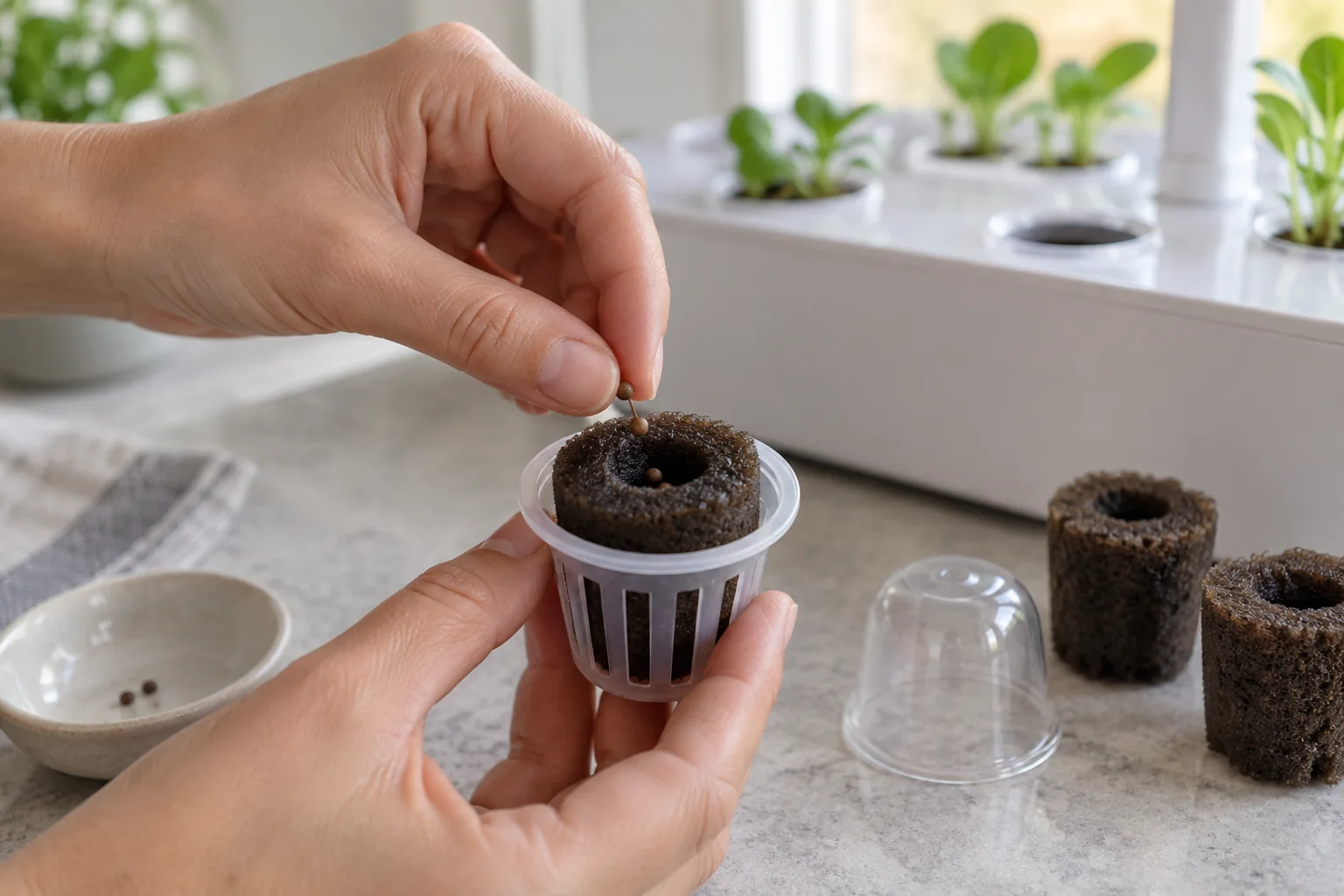
Bok choy seeds sprout well when the sponge stays evenly moist. Sow straight into the kit’s sponges when you can, so you skip a transplant altogether.
- If you use rockwool, pre-soak it at pH 5.5, a touch below range, because the cube pulls the number up as it absorbs.
- Drop 2 to 3 seeds into the sponge hole.
- Seat the pod and fit the kit’s clear dome if it came with one.
- Set the timer to 14 hours on, 10 off from day one.
- Expect sprouts in 5 to 10 days.
- Once they are up, snip the weaker seedlings at the base rather than pulling them, so the keeper’s roots stay intact.
Start the reservoir at EC 1.0 to 1.2 while the seedlings are small. If you start seeds outside the kit, my guide on when to transplant seedlings into a countertop system explains the timing.
🔎 When Seeds Don’t Come Up
An empty sponge usually means it dried out under the lamp. Push the sponge down until it touches the water, and keep the dome on until the sprouts show. If nothing appears by about day 10, sow fresh seed rather than waiting longer.
⚗️ Nutrients and pH for Bok Choy
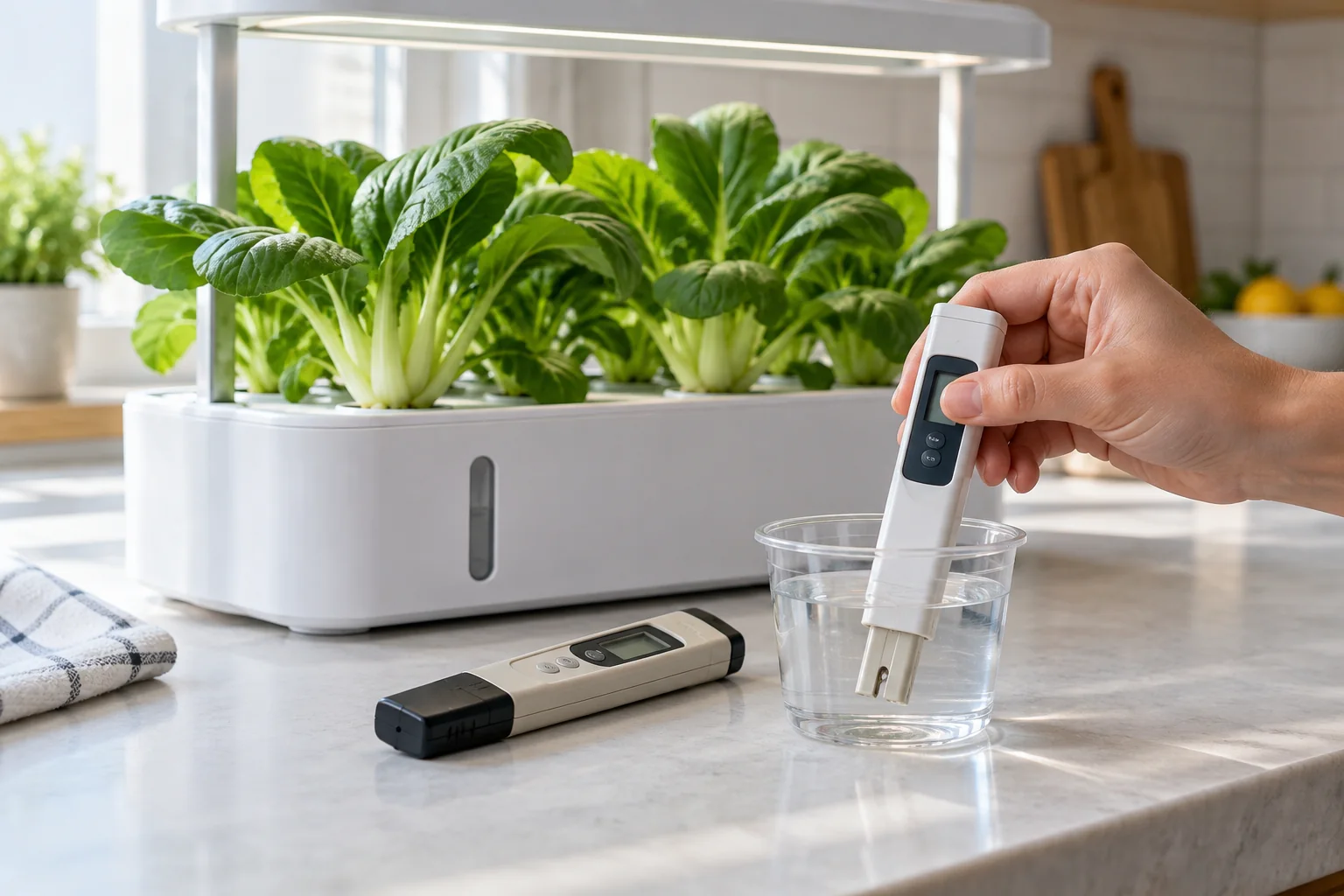
Bok choy is a medium feeder. It wants more than lettuce but less than a fruiting crop, and it reacts quickly when the strength drifts. So measure rather than guess. The pH and nutrient calculator gives you a starting dose for your reservoir size, and a meter tells you where you actually landed.
| Stage | Target EC | What to do |
|---|---|---|
| Seedling | 1.0 to 1.2 | Start gentle so young roots don’t scorch |
| Leafing out | 1.5 to 2.0 | Raise the dose while the leaves broaden |
| Near harvest | 1.5 to 2.0 | Hold the top of the range rather than pushing higher |
For the meters themselves, see my picks for the best pH meter for beginners and the best EC meter for small reservoirs. A few litres of water changes fast, so readings beat guesswork here.
🔬 Why pH Sits Higher for This Crop
Oklahoma State and most growing guides put bok choy at 6.0 to 7.0, a little above the herbs. In practice I’d aim for about 6.0 to 6.5, because that keeps you inside bok choy’s range and the herb range at once. It also sits where the tip-burn advice below points.
Out-of-range pH locks nutrients out even when the EC reads correctly. So check pH before you assume the plant is hungry. If yours keeps sliding, my post on why hydroponic pH keeps drifting walks through the usual causes.
🧪 Kit Plant Food or Bottled Nutrients
Kit plant food works, but it’s dosed by the label rather than by EC. When you move to a bottled hydroponic nutrient, you can dose by the meter instead. My guide to replacing AeroGarden pods with your own seeds and nutrients covers that switch step by step. Never use soil fertilizer, because it doesn’t dissolve or balance correctly in water.
🥛 Cal-Mag in Soft Water
Bok choy is prone to calcium-related tip burn, like other brassicas. When your tap water is soft, or you use filtered water, a Cal-Mag supplement helps. Hard tap water usually carries enough calcium already, so test before adding it. My post on whether a small system needs Cal-Mag helps you decide.
☀️ Keeping Bok Choy Cool So It Doesn’t Bolt
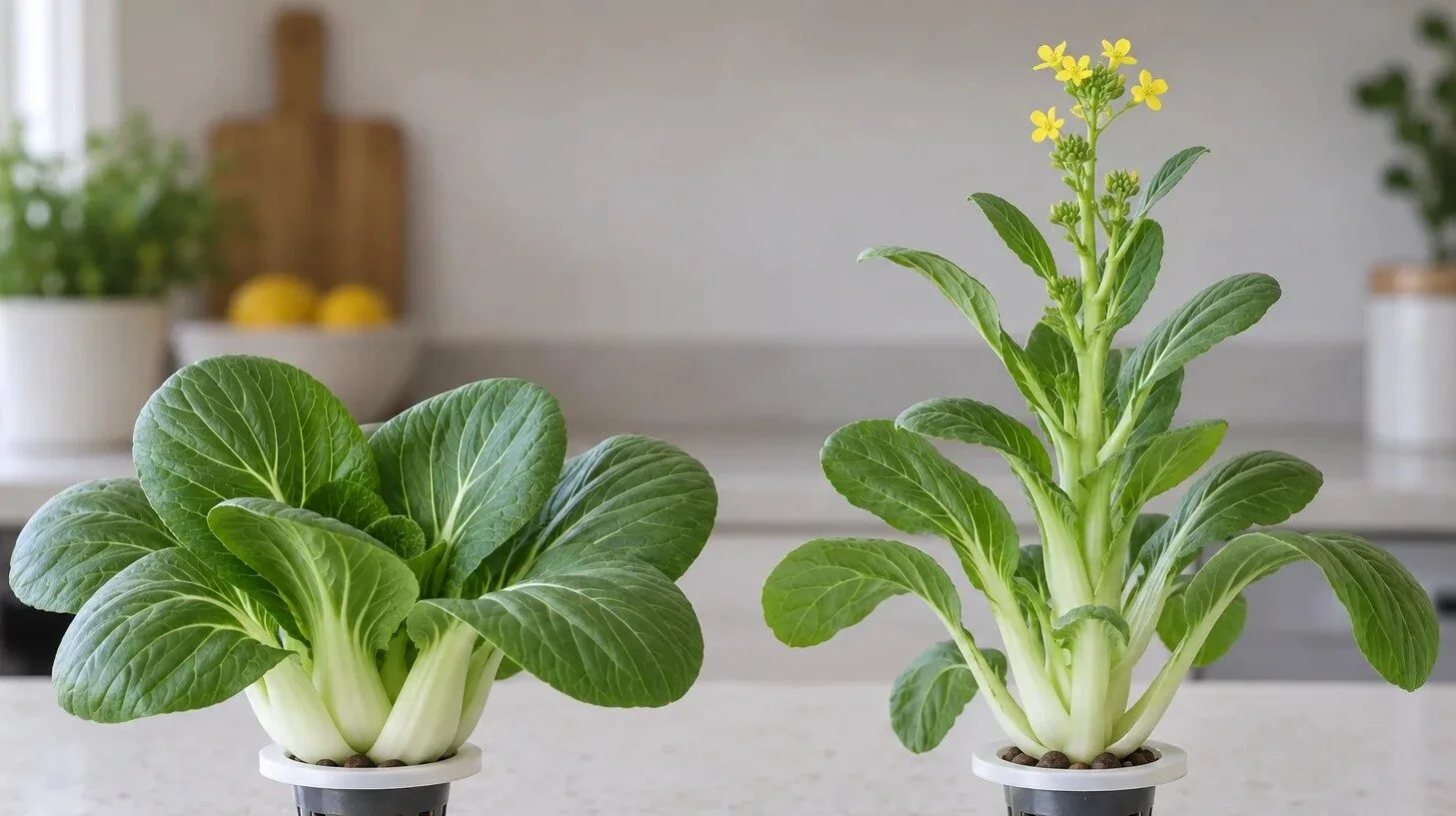
Bolting means the plant sends up a flower stalk from the centre. Once it starts, the leaves turn tougher and more bitter. For bok choy the triggers are heat and very intense light, so a warm apartment kitchen is the biggest risk you face.
🌡️ Water Temperature
Keep the reservoir at 65 to 75°F (18 to 24°C). Above 72°F, aeration matters more, because warm water holds less oxygen. Most kits circulate their water with a small pump, which helps. Above 75°F, though, root stress and disease risk climb fast.
Never drop ice into the reservoir. The swing shocks the roots, and the effect is gone within an hour anyway. Instead, press a frozen water bottle against the outside of the reservoir, or move the kit away from the oven, a sunny window or the fridge’s warm exhaust. My guide to fixing small system temperature problems has more cooling options for summer.
🏠 Room Temperature
The air around the plant matters just as much. Bok choy does best at 60 to 70°F (15 to 21°C), which is cooler than most kitchens run. Put a cheap thermometer next to the kit for a few days before you sow. If the spot runs warm, choose a cooler room, or save bok choy for autumn and winter when the apartment cools down.
✂️ If a Flower Stalk Appears
Cutting the stalk off doesn’t reverse bolting. So harvest the whole plant now, while the leaves are still worth eating. Then fix the cause before the next sowing: a cooler spot, an earlier harvest date, and a lamp that isn’t set closer than 6 inches.
💡 Light Height, Hours and Heat
Run the light 14 hours on and 10 off, and keep it 6 to 8 inches above the top leaves. Bok choy is a medium-light crop, with a PPFD around 200 to 300 µmol/m²/s. So a kit’s built-in lamp is usually enough, provided you raise it as the plant grows. If you’re adding a separate light, the grow light calculator helps you size it.
Leaves that touch the lamp turn brown and papery at the tips. My post on grow light burn shows how to tell it apart from nutrient burn. The dark period matters too, and my guide to why plants need a dark period explains why 24 hours of light is not a shortcut. If your kit’s timer is unreliable, one of the best compact timers for grow lights takes it over.
🛠️ The Weekly Routine
A kit isn’t set-and-forget, but the routine is short. Here is what each day, week and fortnight looks like:
- Daily: check the water level and top off with plain, pH-adjusted water.
- Weekly: test pH and EC, then raise the lamp if the plant has grown.
- Every 2 weeks: do a full reservoir change, even when the plant looks fine.
Topping off with plain water rather than nutrient mix keeps the EC from creeping up. My guide on how to top off hydroponic water covers the method. The printable hydroponics tracker gives you a sheet to log each reading.
🌊 The Two-Week Reservoir Change
- Unplug the kit so the pump stops.
- Lift the deck and rest the roots in a clean bowl.
- Pour the old solution down the sink and wipe the reservoir.
- Refill, adjust pH, and mix nutrients back to your target EC.
- Seat the deck again before you plug the kit back in.
My post on how often to change hydroponic water explains why two weeks is the rhythm.
🧼 Cleaning the Pump and Reservoir
Root bits and mineral film collect on the pump intake over time. So rinse the intake screen during each reservoir change. When you clean the reservoir between crops, use diluted hydrogen peroxide rather than bleach, because bleach leaves residue unless it is rinsed perfectly.
✂️ Harvesting Baby Bok Choy
Baby heads are usually ready 25 to 35 days from seed. Full heads take 6 to 8 weeks from seed. Cool temperatures and a timely cut keep the stems tender, while a late harvest in a warm room turns them tough and bitter.
🍃 Whole Head or Leaf by Leaf
You have two ways to harvest, and both work in a kit:
- Whole head: cut at the base, just above the roots, when the head looks full.
- Outer leaves: take a few of the largest leaves near the base every 3 to 7 days during peak growth.
- Either way, clean scissors keep the cuts neat.
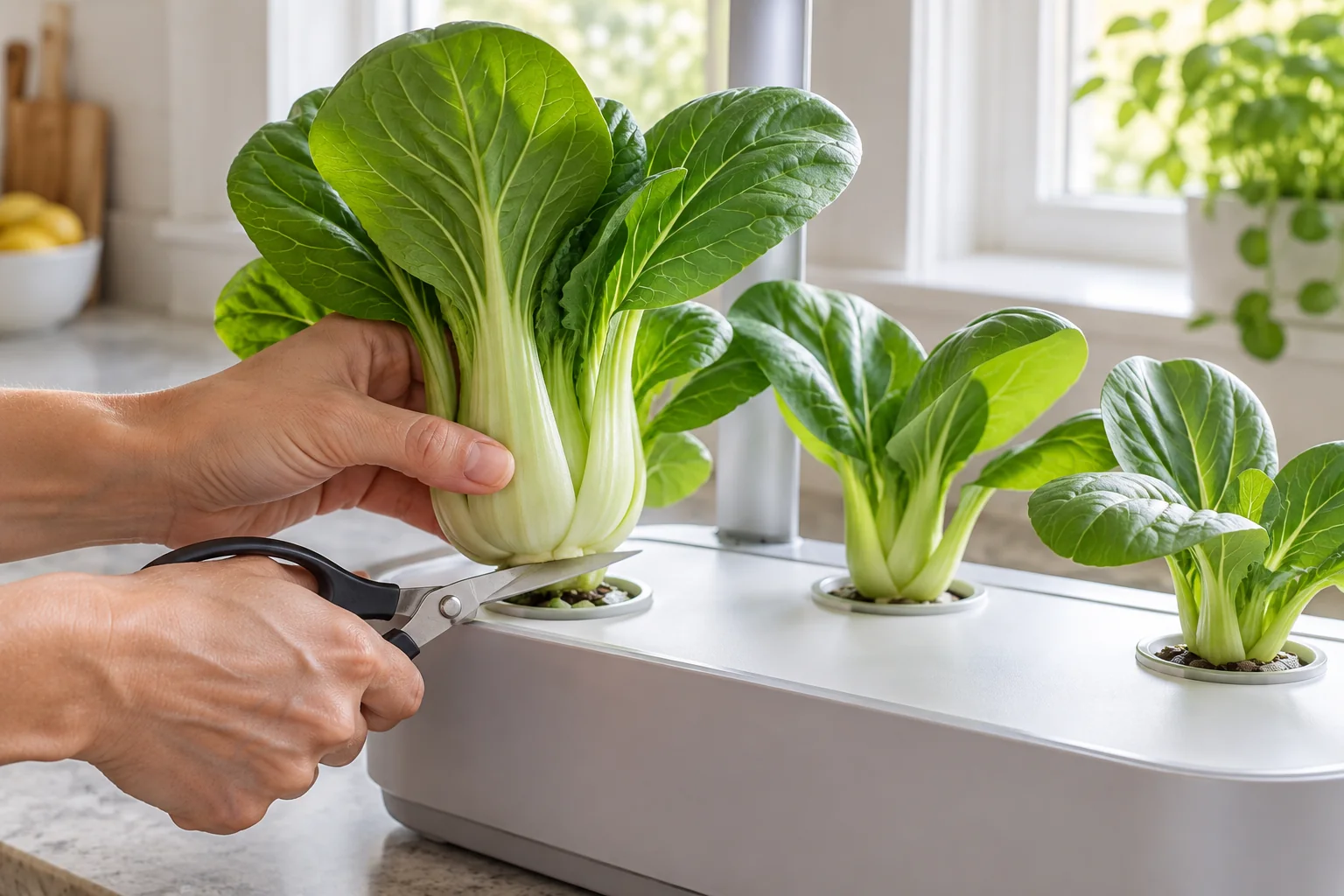
Leaf harvesting stretches the plant for a while, but it rarely doubles its life. So once the new leaves come in small and thin, cut the rest of the head and resow.
🔁 After the Harvest
Lift the pod out, discard the old sponge and roots, and wash the basket in warm soapy water. Then sow a fresh pod. Leave bok choy’s roots in the kit and they start to break down, which feeds bacteria in the reservoir. Rinse the leaves just before cooking and keep them cold until then.
🌊 Growing Bok Choy Outside a Kit
A kit suits baby heads. For anything bigger, or when you’d rather not share a reservoir with herbs, two other setups work.
🪣 A DWC Bucket for Full Heads
Deep water culture is the reliable choice for full-size bok choy. Allow 1 to 2 gallons per plant, a 2 to 3 inch net cup, and an air stone. The air stone matters most once the water passes 72°F. My comparison of DWC vs Kratky for apartment beginners helps you pick. When noise is a concern, see my quiet air pump picks.
💧 Kratky for Baby Heads Only
Kratky works for baby bok choy, but large heads use up the oxygen in a passive container quickly. Keep the container opaque, and start the net cup bottom in the solution so the air gap forms by itself as the plant drinks. Size the container to last the whole crop, since a Kratky container is never topped back up to the brim. My Kratky tote setup shows a container big enough for several baby heads.
🩺 Troubleshooting Tip Burn, Rot and Bolting
Most bok choy problems trace back to three things: EC, pH and heat. So check those numbers before you reach for any treatment.
🔎 Quick diagnosis table
| What you see | Most likely cause | Check this first |
|---|---|---|
| 🟤 Brown, papery edges on inner leaves | Tip burn from calcium shortage or salt stress | EC, then pH |
| 🟡 Pale new growth while old leaves stay green | pH out of range, so nutrients are locked out | pH |
| 🟡 Older leaves yellowing all over | Underfeeding | EC, since it may sit below 1.5 |
| 🟫 Brown, slimy roots and a limp plant | Root rot, often when warm water meets high EC | Water temperature |
| 🌼 A tall stalk rising from the centre | Bolting from heat | Room temperature |
🔥 Fixing Tip Burn
Tip burn shows up as dry, brown edges on the youngest leaves, because calcium isn’t reaching them fast enough. Brown edges don’t turn green again, so the goal is protecting new growth.
- Keep EC inside 1.5 to 2.0, and dilute with plain water if it reads higher.
- Hold pH near 6.0 to 6.5.
- Add Cal-Mag if your water is soft.
- Aim a small clip fan across the plants, so moving air helps the leaves pull calcium up.
Room humidity of 50 to 70 percent also helps, while very dry winter air makes tip burn more likely.
🚨 Fixing Root Rot
Healthy roots are white. Brown, slimy roots with a swampy smell mean rot, usually from warm water and too strong a feed together. Act as soon as you notice it:
- Lift the plant and trim away the slimy roots with clean scissors.
- Empty and clean the reservoir.
- Refill with fresh solution and add 3% hydrogen peroxide at 3 ml per litre, the dose for an active infection.
- Cool the water back into the 65 to 75°F range.
- Run a gentler EC 1.2 to 1.5 for 4 to 7 days, then return to 1.5 to 2.0.
My guide to hydrogen peroxide for root rot covers dosing in more detail. Still, a badly rotted bok choy seldom comes back strong, so often the better move is to harvest what’s good, clean everything and resow.
The bok choy pH range of 6.0 to 7.0 follows the Oklahoma State University EC and pH guide for hydroponics. For general background, see the University of Missouri Extension hydroponics guide. The per-crop sources behind the table are listed on my crop sources page. The lamp height in inches, the EC 1.0 seedling floor and the shared-kit EC 1.5 are my own house practice.
💬 A Word From Sarah
Treat bok choy as a quick crop, not a houseplant. Sow one pod, sow the next a couple of weeks later, and cut each head while it’s young and tender. When the kitchen warms up in summer, give that slot to basil and bring bok choy back when the evenings cool. Fighting the season in a small kit is the one battle I’d skip.
❓ Frequently Asked Questions
⏳ How long does hydroponic bok choy take to grow?
Baby bok choy is usually ready 25 to 35 days from seed, and full heads take 6 to 8 weeks from seed. Germination takes 5 to 10 days of that. A cool room keeps it on schedule, while heat pushes it toward bolting before it is ready.
🌿 Can I grow full-size bok choy in an AeroGarden?
Only if the lamp can rise well above the plant. Full heads grow 12 to 18 inches tall. The lamp also needs to sit 6 to 8 inches above the top leaves, and many compact kits cannot rise that far. Baby varieties, or a DWC bucket for full heads, are the easier route.
🔬 What pH does hydroponic bok choy need?
Bok choy grows at pH 6.0 to 7.0, a little above most herbs. When it shares a kit with herbs, hold the reservoir at 6.0 to 6.5, where both ranges overlap. Check pH before feeding more, because out-of-range pH locks nutrients out.
⚗️ What EC is best for bok choy?
Start seedlings at EC 1.0 to 1.2, then run 1.5 to 2.0 once the plant is leafing out. Hold the top of that range for firm stems rather than going higher. Above 2.5 in a small system, especially a warm one, the roots and leaf edges suffer.
☀️ Why is my hydroponic bok choy bolting?
Heat is the usual cause, with very intense light as a second. Keep the water at 65 to 75°F and the room near 60 to 70°F. Once a flower stalk appears, harvest the whole plant, because cutting the stalk does not reverse bolting.
🔥 Why are my bok choy leaf edges turning brown?
Brown, papery edges on the youngest leaves are usually tip burn, which comes from calcium not reaching new growth or from salt stress. Keep EC within 1.5 to 2.0, hold pH near 6.0 to 6.5, add Cal-Mag in soft water, and keep air moving over the plants.
🌙 Does bok choy need a dark period?
Yes. Run the light 14 hours on and 10 hours off, with the lamp 6 to 8 inches above the top leaves. Leaving the light on around the clock does not speed the crop up, and a plug-in timer keeps the schedule steady.
💧 Can I grow bok choy with the Kratky method?
Yes, for baby heads. Large heads use up the oxygen in a passive container quickly. Use an opaque container sized to last the whole crop, and start the net cup bottom in the solution so the air gap forms by itself.
🤝 Can bok choy share a countertop kit with herbs?
Yes. Hold the shared reservoir at pH 6.0 to 6.5 and an EC around 1.5, which sits at the bottom of bok choy’s range. Plant it in every other pod on the side away from tall herbs, and keep the kit somewhere cool.
🔁 Will bok choy grow back after cutting?
Only partly. Taking a few outer leaves every 3 to 7 days during peak growth stretches the plant for a while, but bok choy usually gives one main cycle of 4 to 6 weeks. After a whole-head cut, resow a fresh pod.

Sarah Whitfield is the founder of Urban Hydro Space and an indoor gardening enthusiast dedicated to helping apartment dwellers grow fresh herbs and vegetables in small spaces. She researches hydroponic systems carefully from real specifications and verified buyer feedback, and shares practical tips and honest, clearly labeled product picks to make indoor gardening accessible for beginners.