⏳ 20 min read · Last updated: September 2026
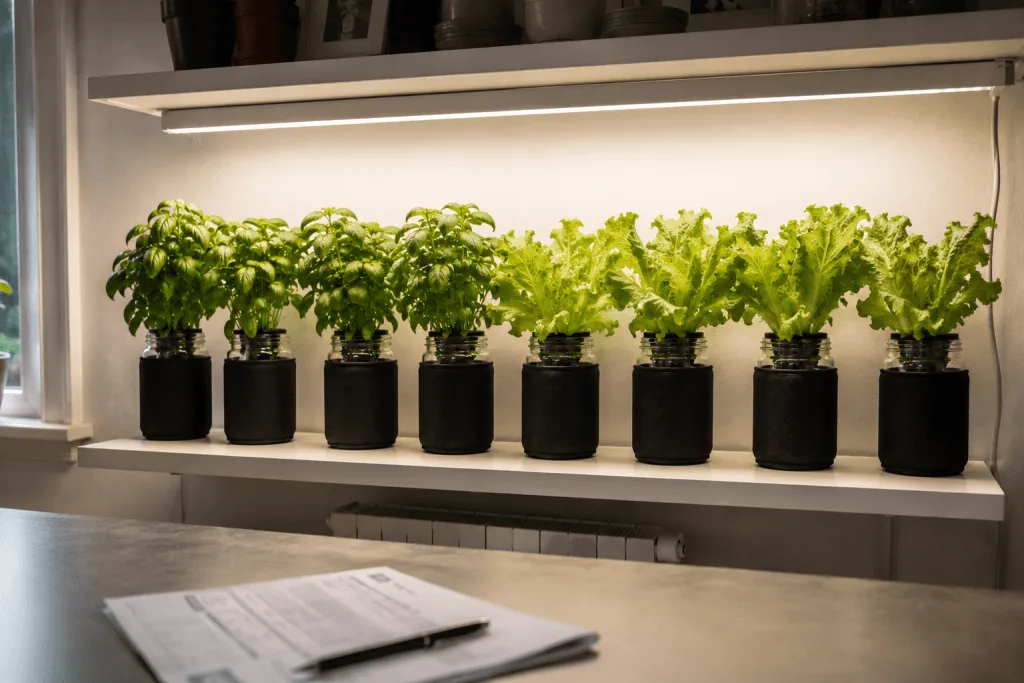
I worked out my hydroponic basil cost per harvest on the back of an envelope in March, mostly to prove to my partner that the jars on the kitchen shelf were not a money pit. Eight jars, one 24 watt light strip, and a bottle of two part nutrient I had been refilling from since January. The number came out at about fifty cents a plant. I did not believe it, so I did it again properly with the electricity bill open next to me.
It was still about fifty cents. Not because hydroponics is magic, but because a countertop jar holds a quart of water and a 24 watt light draws about what a phone charger left on all day draws. The expensive parts are the ones you buy once. Below is the whole calculation, the assumptions under it, and the places where beginners quietly leak money without noticing.
💰 What A Basil Harvest Actually Costs
Three things cost money every month: electricity, nutrients, and the little rockwool cube a seed starts in. Everything else is hardware you have already paid for. Since the light is the only thing plugged into a wall, most people assume it dominates the bill, and per shelf they are right. Spread across eight jars it stops mattering.
- The hydroponic basil cost per harvest lands at $0.40 to $0.90 per plant, once the gear is paid for.
- Electricity is the biggest ongoing line, although it splits eight ways under one panel.
- Lettuce comes out cheapest at about $0.40, and basil near $0.50, because basil from seed takes about a week longer to its first cut.
- Nutrient waste, rather than nutrient price, is what pushes the number up.
- Redo the arithmetic with your own power rate in about two minutes.
📊 Hydroponic Basil Cost Per Harvest, Crop By Crop
Every figure assumes one 24 watt panel over eight jars, 14 hours a day, at $0.16 per kWh, plus one rockwool cube per plant. Slower crops cost more per cycle because they sit under the light longer, not because they eat more.
- Want the arithmetic → Running The Numbers Yourself
- Wondering whether it beats the shop → Versus Store-Bought
- Costs feel too high already → Where The Money Actually Leaks
🧮 Running The Numbers Yourself
Working out your own hydroponic basil cost per harvest fits in four lines, so there is no reason to take my word for any of it. Swap in your own wattage and your own utility rate and the answer changes, which is exactly the point. Someone in a state with expensive power will land higher than I did, while someone with a smaller panel will land lower.
Start with the light, because it is the only part that touches your electricity bill:
- Find the true draw of your LED in watts, not the incandescent equivalent printed on the box.
- Multiply by 14, since herbs and greens run 14 hours on and 10 hours off.
- Divide by 1,000 to get kilowatt hours per day, then multiply by 30.
- Multiply by your rate per kWh, then divide by the number of jars sharing the panel.
Mine works out like this. A 24 watt strip for 14 hours is 336 watt hours a day, so 10.08 kWh in a month. At $0.16 per kWh that is $1.61 a month for the whole shelf. Divided by eight jars, electricity costs $0.20 per plant per month. That last division is the step people skip, and it is why you see wildly different numbers quoted online. One jar under one panel does cost eight times more to light than eight jars under the same panel.
🧪 What The Nutrients Really Cost
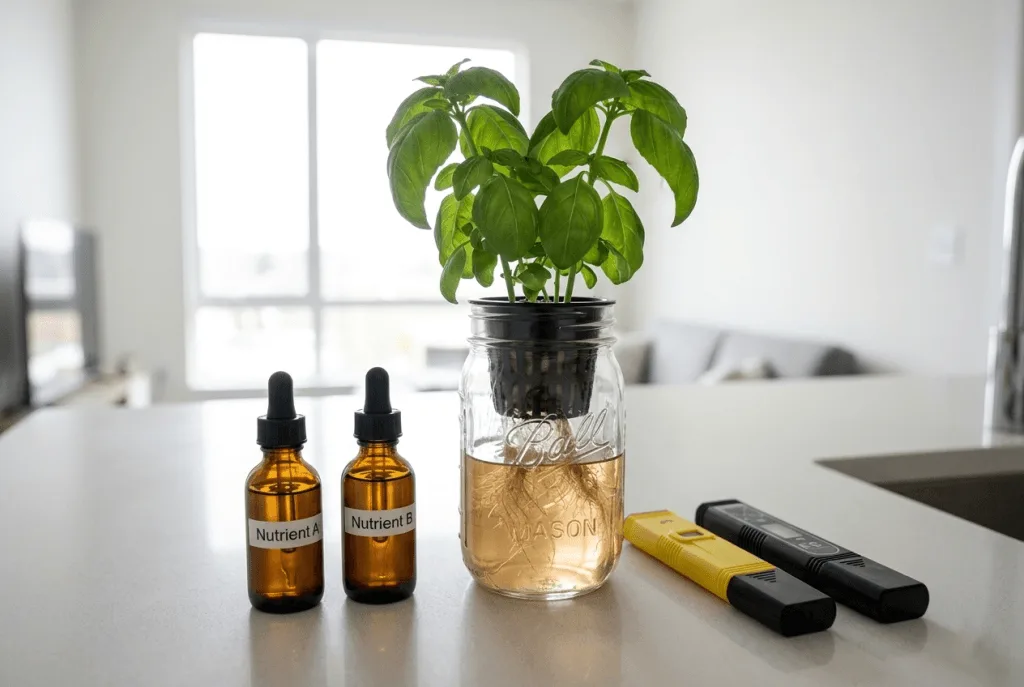
A quart of two part concentrate looks expensive on the shelf and then refuses to run out. You measure it in milliliters, and a countertop jar holds a quart of water, so the bottle stretches across months rather than weeks. At basil strength that works out near $0.10 per jar per month, covering two full changes.
Lettuce runs at EC 1.0 to 1.4, only a little below basil at EC 1.0 to 1.6, so its nutrient line is about nine cents against basil’s ten. The bigger difference is time. Lettuce gives a first cut in 4 to 5 weeks, while basil from seed takes 5 to 6, and that extra week under the light is most of why basil lands near fifty cents and lettuce near forty. Time under the light matters more than feed strength, which surprised me more than the total did.
Mix it accurately and the bottle lasts even longer:
- Fill the jar first, then add concentrate. Never the other way round.
- Pull the dose with a cheap plastic syringe rather than eyeballing a cap.
- Stir, wait a minute, then read your EC. A reading taken immediately runs low.
- Basil wants 1.0 to 1.6. Anything above that is money you are about to pour down the sink.
If several crops share one reservoir, settle at EC 1.5 as a middle ground rather than trying to please everyone. The free pH and nutrient calculator will give you a starting dose in milliliters for your jar size, and the guide to mixing two part hydroponic nutrients covers the order of operations properly.
🧾 The Line Items Side By Side
| Line item | Per jar, 30 days | Where the figure comes from |
|---|---|---|
| Electricity, 24W LED | $0.20 | 10.08 kWh split across eight jars |
| Nutrients at basil strength | $0.10 | Two full changes from a quart bottle |
| Nutrients at lettuce strength | $0.09 | Same bottle, lower EC target |
| Seed and rockwool cube | $0.10 | Once per cycle, not per month |
🌱 Seeds Are Almost Free And People Still Overbuy
Seeds are the smallest line on the sheet by a wide margin. A packet of two hundred basil seeds is a couple of dollars, so even sowing three to a cube to improve the odds costs about a cent. Store the packet somewhere dry and cool and it stays viable for years.
What people actually overbuy is rockwool. A sheet of cubes runs to roughly a hundred plugs and there is no version of a countertop shelf that gets through a hundred plugs in a year. Buy the small sheet. Then use the seed to harvest calculator to work out when you will actually need the next one, because guessing leads to a drawer full of media you paid for and never opened.
🥬 Versus Store-Bought Basil And Lettuce
Set the hydroponic basil cost per harvest against a supermarket pack and the comparison is not quite the one you expect. A pack holds well under an ounce of usable leaf, and it wilts in the fridge inside a week whether you touch it or not. A jar on the shelf holds a plant you cut from for a month or more. So the fair comparison is not price against price, it is price against price plus everything you threw away.
That waste line is the one nobody counts. When I tracked it for two months, the bin was where most of my old herb spending had actually gone, not the till.
🛒 The Part Of The Bill That Goes In The Bin
Cut herbs are already dying when you buy them, since they left the field days earlier and spent that time in a truck. A growing plant is not, which is the whole structural advantage, and it has nothing to do with hydroponics being clever.
Shop greens fail along a predictable path:
- Temperature swings across a long shipping route.
- Crush damage from stacking, which you cannot see through the packaging.
- Ethylene building up inside a sealed clamshell until the leaves go translucent.
- And the ordinary one. You bought it for a recipe on Sunday and it is Thursday.
Growing your own removes the fourth item, because you cut what you need on the day. That single change did more for my herb budget than any efficiency trick in this post.
🥗 The Lettuce Version Of The Same Sum
Lettuce is the easier crop to justify financially, though not for the reason most people assume. It is not that lettuce is cheap to feed, even though it is. It is that a lettuce head you cut leaf by leaf keeps producing while a bagged salad is a single purchase that starts degrading the moment it is opened.
The full method is in the beginner guide to growing hydroponic lettuce in a countertop system, and the basil equivalent is covered in the foolproof guide to growing hydroponic basil in a small apartment. If you have one bright window and want to cut the light bill to nothing on sunny days, the roundup of best beginner plants for a single bright window is the place to start.
🔎 When Your Power Rate Goes Up
Utility rates move, and when they do the electricity line is the only part of this that moves with them. Since it is $1.61 a month for a whole shelf, even a steep increase is measured in cents. That is worth knowing before you panic and unplug everything.
If your bill jumps, work through these in order:
- Confirm the timer is actually holding 14 hours, since a knocked pin or a reset clock is the usual culprit.
- Check whether the panel has a dimmer, then drop it to roughly 80 percent and watch for stretching.
- Consolidate loose jars under one panel instead of running two lights half empty.
- Stand white card behind the shelf so stray light goes back to the leaves rather than the wall.
A reliable timer is the cheapest insurance here, because a light left on overnight wipes out a month of careful savings. The three best compact timers for apartment grow lights covers the quiet options, and the grow light calculator will tell you whether your panel is the right size for your shelf before you buy a second one.
🛠️ The Gear You Buy Once
None of the figures above include hardware, because hardware is not a running cost. It is a one time purchase spread across every harvest that follows. Your first cycle therefore looks dreadful on paper and your tenth looks free, while the truth sits somewhere between.
A jar setup starts under twenty dollars all in. A light and timer add most of the rest. Everything after that is optional, whatever the shopping guides imply.
🩴 Kratky Jars Against A DWC Bucket
Your system choice sets your upfront spend more than any other decision. Kratky needs no pump and no electricity beyond the light, which makes it the cheapest way in and the quietest. Deep Water Culture grows faster, though it adds an air pump, an airstone, and a low hum you will hear at night.
- Kratky runs silent and costs under twenty dollars to build.
- DWC adds a pump, so budget for the hardware and the noise together.
- Kratky water sits still, which means you watch the level rather than the pump.
- DWC buys you a buffer against a hot apartment in August, and in a top floor flat that matters more than the extra yield.
Start with jars unless you already know noise does not bother you. The full comparison lives in deep water culture versus Kratky for tiny apartments, while the apartment Kratky jar build walks through the parts. For the jars themselves, the best mason jar net cups roundup keeps the reusable side cheap, and the shopping list builder totals a whole starter kit for you.
- Silence and the lowest possible spend → a Kratky mason jar
- Faster growth, and a faint hum is fine → a small DWC bucket
⏱️ Spreading The Light And Timer Across Two Years
A decent small LED panel and a timer are the two purchases worth making properly, and both last for years rather than seasons. Divide that spend across two years of harvests and the monthly share disappears into the noise of the numbers above.
Clay pebbles are the clearest example of the principle. They wash clean, they never wear out, and the bag you resent buying in month one is still working in year three. Compare that against rockwool, which is consumable and cheap, and you can see why the one time costs stop mattering so quickly.
Start here: Penn State Extension: Nutrient Solution Programs and Recipes
For the crop side: Cornell CEA Hydroponic Lettuce Handbook
📊 Where The Money Actually Leaks
Almost nobody overspends on hydroponics by buying expensive things. They overspend by growing plants badly, because a struggling jar draws exactly the same electricity as a thriving one and hands you a third of the leaf. Yield is the real cost lever, so the fastest way to lower your hydroponic basil cost per harvest is to stop losing plants.
Two numbers control most of it. Keep pH inside range and keep the light close enough, and the rest tends to follow.
🔎 Quick diagnosis table
| What you see | Most likely cause | Check this first |
|---|---|---|
| 🟡 Yellowing leaves | Lockout, not hunger | Verify pH sits at 5.5 to 6.5 |
| 🟤 Crispy brown leaf tips | EC too high | Confirm EC stays under 2.2 |
| 🌿 Leggy pale stems | Light too far away | Drop the panel to 6 to 8 inches |
| 🧂 White crust on the rim | Salt building up | Do a full change, then retest |
☀️ Photons You Paid For And Did Not Use
A panel mounted two feet above a countertop throws most of its output at your living room. You pay for all of it while the plant receives a fraction, which is the least visible waste in the whole setup because nothing looks wrong.
Bring leafy herbs to 6 to 8 inches below the panel and the same wattage does considerably more work. Oregano and thyme want to sit closer still, at 4 to 6 inches, since they are woody and low. If stems are stretching and flavor is thin, why hydroponic herbs taste weak works through the light, feed and harvest side of that.
🧪 The Expensive Habit Of Guessing
Adding more fertilizer to a struggling plant is the single most expensive reflex in this hobby. If pH has drifted out of range the roots cannot take up what is already dissolved, so the extra concentrate goes straight down the drain at the next change. You paid twice: once for the nutrient, once for the lost growth.
Keep the reservoir between pH 5.5 to 6.5 and the problem mostly disappears. Above 6.5 iron uptake stalls first, which is why yellowing shows in new growth before anywhere else. A basic dropper test kit costs less than one wasted bottle of concentrate, though a pen you can trust is easier to live with. The pH meter roundup for beginners compares the options honestly, and the EC and TDS meter roundup covers the other half of the pair.
📋 Catching A Weak Jar Early
A jar that yields a handful of leaves costs the same to run as one that fills a bowl. Because the electricity and nutrients are already committed, spotting a failing plant in week one is worth far more than any saving on supplies.
Watch for these:
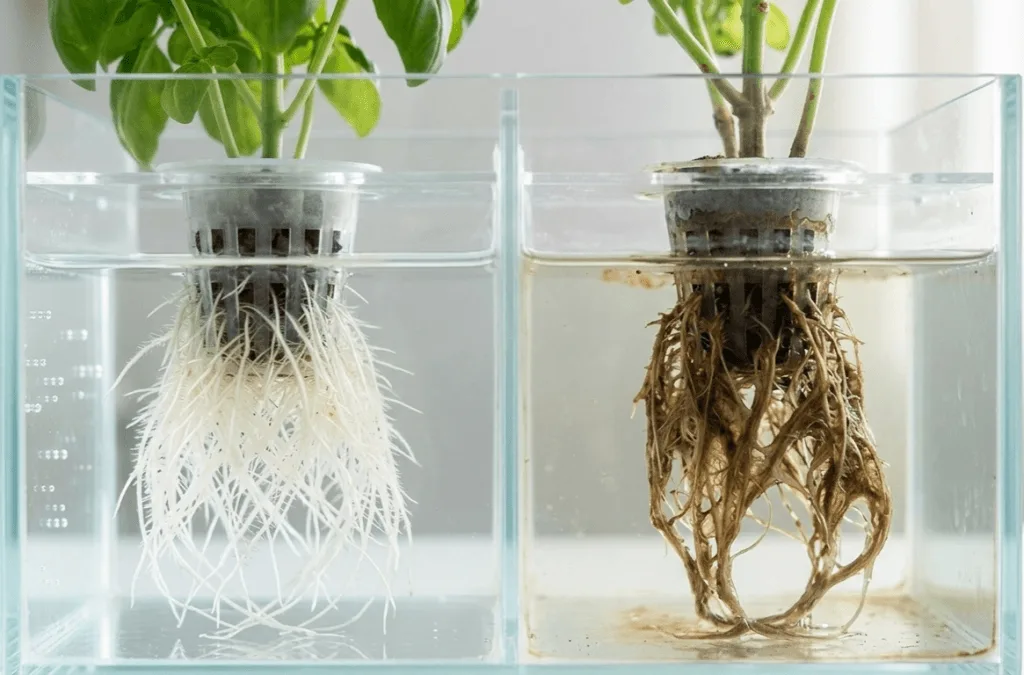
- Roots going brown and slimy, which means the water is too warm.
- Algae greening the rockwool, so light is reaching moisture it should not.
- Leaves curling under at the edges while EC reads high.
- A plant that simply stops. No yellowing, no wilting, just no new growth for ten days. That one fooled me for a fortnight before I thought to test the pH, which had crept to 7.1.
Where salt has built up, do a full change rather than topping off, and use how to lower EC safely so the correction itself does not shock the roots.
🧹 Cleaning And Upkeep
Upkeep barely touches the hydroponic basil cost per harvest, costing almost nothing in money and a little in attention. The supplies are household items, so the ongoing line is small enough that I have never bothered adding it to the table. Skipping it, though, is expensive, since a pathogen carried into the next crop can cost you a whole cycle.
💧 Water, And Whether To Buy It
Tap water costs a fraction of a cent per jar and works fine for basil, mint and lettuce provided you correct the pH. Bottled distilled water costs many times more and is only worth it when your tap reads unusually high before you have added anything.
- Top off daily with plain pH-adjusted water, never with nutrient solution.
- Do a full reservoir change every 2 weeks to clear accumulated salts.
- Let tap water stand overnight before mixing so chlorine can gas off.
- Only buy distilled if your tap EC is high enough to eat into your nutrient headroom.
Topping off with nutrients instead of plain water is the classic way to drive EC up without noticing. The two week rule explained in full covers why that interval is the one to hold.
⚗️ Cleaning Between Crops
Clean the jar before the next seed goes in, every time. Diluted hydrogen peroxide handles it, costs very little, and rinses away without residue. Bleach does not, so it stays out of the reservoir entirely.
The method and the dilution are in using hydrogen peroxide safely in hydroponics. Old nutrient solution, meanwhile, is fine poured on a potted houseplant even though it has no place near new seedlings, and whether you can reuse hydroponic nutrient solution goes through when that is worth doing.
🚨 The One Failure That Actually Costs Money
Root rot is the expensive disaster, because it takes the plant rather than a few cents of nutrient. Roots turn brown and slimy, the leaves wilt while sitting in water, and the smell is unmistakable once you have met it. Water above 75°F (24°C) is nearly always the reason.
- Lift the plant out and look at the roots in daylight.
- Rinse them gently under lukewarm tap water.
- Sterilize the jar with diluted hydrogen peroxide before it goes back.
- Refill with fresh solution at EC 1.2 to 1.5 and hold there for four to seven days while it recovers.
Cooling the water matters more than any additive. A frozen bottle stood against the outside of the jar works. Ice into the reservoir does not, since the swing shocks the roots and the effect is gone within the hour.
📌 Getting Cheaper As You Add Jars
The hydroponic basil cost per harvest improves as the shelf fills, which is the opposite of what most people expect. Because the panel is already lit and already paid for, the second jar under it costs almost nothing to light and the eighth costs less again. Your hydroponic basil cost per harvest falls as you scale, right up until you need a second panel.
💡 Arranging A Shelf So Nothing Is Wasted
Running a separate light over every jar is the most common way to spend money for no yield. One panel over a cluster does the same job, as long as nothing tall is shading anything short.
Put mature basil at the back where it can be tallest, and keep chives and young lettuce toward the front. Set the panel 6 to 8 inches above the tallest canopy rather than the average one. The apartment herb shelf lighting layout shows the spacing, and if you are considering enclosing the shelf, the compact grow tent roundup covers whether that is worth doing in a rented room.
🔗 Crops That Should Not Share A Jar
Different crops want different feed strengths, and a shared reservoir has to compromise on all of them. Mint sits at EC 2.0 to 2.4 while lettuce wants 1.0 to 1.4, so putting them together means one is underfed or the other is burning. Cilantro is awkward for a different reason: it bolts within weeks and gets replaced on its own schedule, and it is an advanced crop for exactly that reason.
- Keep light feeders together. Lettuce, basil and thyme get along.
- Keep heavy feeders together. Mint and chives belong on their own.
- Give cilantro its own jar or accept that it will bolt on you.
- Separate jars are the cheap solution here, because a jar costs a few dollars and a shared reservoir mistake costs a crop.
The full picture for choosing what to put where is in the complete apartment hydroponics beginner guide.
❓ When Buying In Bulk Stops Making Sense
Bulk nutrients look like an obvious saving until you notice liquid concentrate has a shelf life. A large jug only pays off if you are running a multi tier shelf year round, and most apartment growers are not.
For a handful of jars, quart bottles keep the mix fresh and the waste at zero. Dry powdered salts are the real long term saving, since they keep more or less indefinitely, though they demand a scale and a little more care in a humid kitchen. I moved to dry after two years. I would not have wanted to start there.
💬 A Word From Sarah
The part of the hydroponic basil cost per harvest that took me longest to see was the one that never appeared on a receipt. For most of my first year I ran the shelf without a pH pen, correcting by dropper test and guesswork, and I lost roughly one plant in four to problems I could not diagnose. Nothing dramatic. Just jars that underperformed and got composted. When I finally worked out what those quiet failures had cost me in electricity, nutrients and time, the pen looked absurdly cheap by comparison. The gear that saves money is rarely the gear that looks like a saving.
❓ Frequently Asked Questions
💰 Is a herb garden worth it in 2026?
For herbs, yes, because supermarket packs are small, expensive per ounce and often wasted before you finish them. A jar produces for weeks at roughly forty to fifty cents per cycle. For staple vegetables the sums are far less convincing in an apartment footprint.
💧 Does the hydroponic basil cost per harvest include water bills?
Water is small enough to ignore. A countertop setup uses one or two gallons a month including top-offs and full changes, which is a fraction of a penny per harvest on any normal metered supply.
💡 How much electricity does a grow light use?
A 24 watt LED running 14 hours a day uses about 10 kWh a month, which is roughly $1.61 at $0.16 per kWh. Multiply your own wattage by 14, divide by 1,000, then multiply by 30 and your rate.
🔌 Do LED grow lights use a lot of electricity?
Not at apartment scale. A small panel draws less than a laptop charger and runs for 14 hours rather than all day. Large multi-panel setups are a different question, though almost nobody starts there.
⚗️ Are hydroponic nutrients expensive?
The bottle looks expensive and then lasts for months, since a quart jar needs milliliters rather than capfuls. Per plant the nutrient line works out near ten cents a month at basil strength and about nine at lettuce strength.
🩴 Which hydroponic system is cheapest to run?
Kratky, because it uses no pump and therefore no electricity beyond the grow light. Your only running costs are light, a small amount of nutrient concentrate and tap water. It is also the quietest option for a bedroom.
🌱 What is the most affordable grow light setup for a small apartment herb garden?
One modest LED panel over a cluster of jars, on a timer, at 6 to 8 inches above the canopy. Lighting eight jars with one panel costs the same as lighting one, so cluster first and buy a second light only when you run out of room.
⚠️ Can I use soil fertilizer to save money?
No. Soil fertilizer relies on microbes to break it down and those do not exist in a water reservoir, so it will not dissolve or balance correctly. The result is lockout and a dead plant, which costs far more than the bottle saved.
⏱️ Should I run grow lights 24 hours a day?
No, plants need a dark period to respire properly. Running lights around the clock burns electricity and stresses the plant at the same time. Set the timer to 14 hours on and 10 hours off and leave it alone.
⏳ How often should I change hydroponic water?
Top off daily with plain pH-adjusted water and do a full reservoir change every 2 weeks. Stretching past two weeks to save nutrient concentrate invites salt buildup and pH swings, which costs you the plant rather than the solution.
🌿 Do hydroponic herbs taste the same as soil grown?
They taste the same or better, mostly because you cut them minutes before eating. Weak flavor is almost always a light or feeding problem rather than anything to do with growing in water.
Happy growing! 🌿
Sarah, Urban Hydro Space

Sarah Whitfield is the founder of Urban Hydro Space and an indoor gardening enthusiast dedicated to helping apartment dwellers grow fresh herbs and vegetables in small spaces. She researches hydroponic systems carefully from real specifications and verified buyer feedback, and shares practical tips and honest, clearly labeled product picks to make indoor gardening accessible for beginners.