⏳ 15 min read · Last updated: September 2026
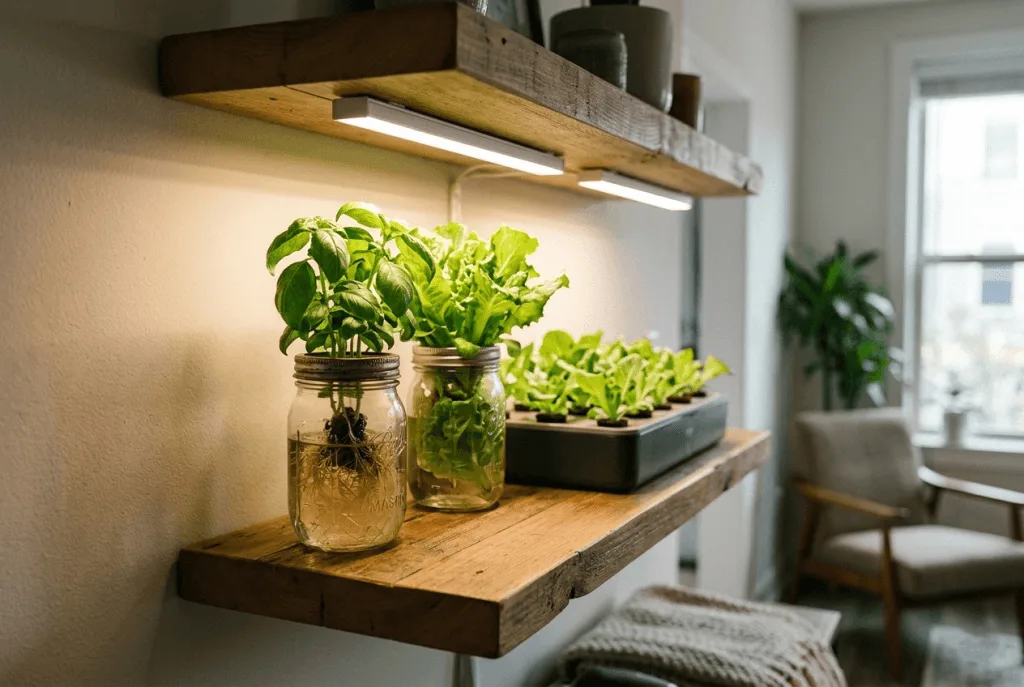
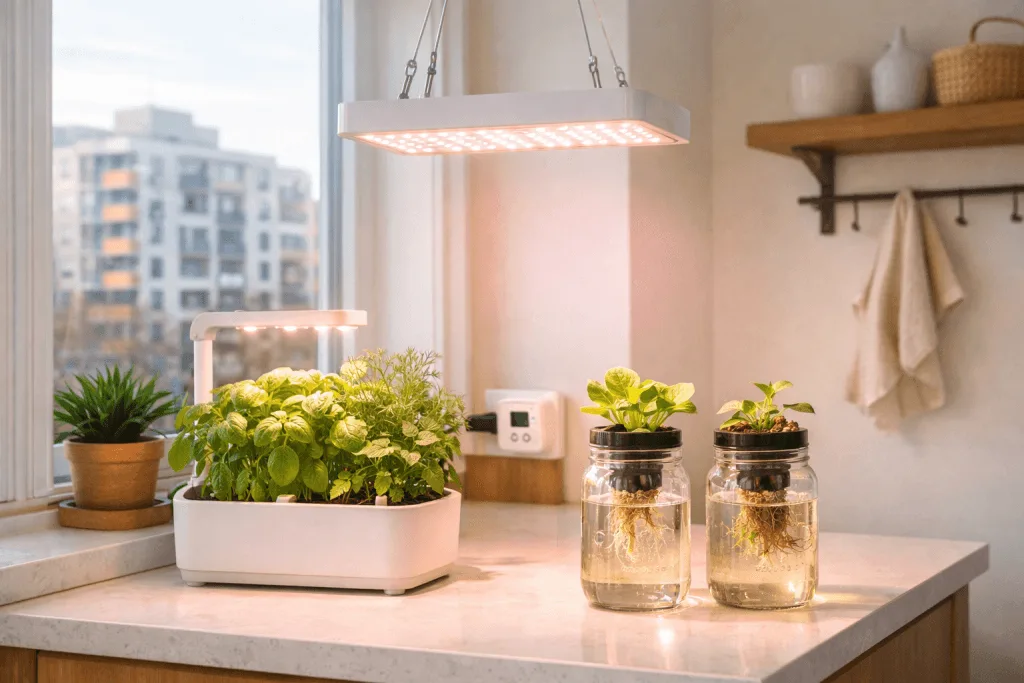
Learning how to share one grow light across multiple systems is what kept my kitchen counter from turning into a bright little airport runway. I was running four separate lamps, one for each Kratky mason jar plus a small Deep Water Culture (DWC) bucket, so my power strip ran out of plugs by the second day. The extension cords snaked across the floor in a tangle thick enough that I had to step over them just to open the fridge.
Instead of buying a second power strip, I looked at what one strong LED panel could actually cover. Height and rotation turned out to matter more than wattage, though. If you’re brand new to growing without soil, start with the complete apartment hydroponics beginner guide first; this post assumes you already have at least one jar or bucket running and want to fit more under the same light.
📐 One Grow Light, Three Systems, At A Glance
A typical 24 to 36 watt LED panel throws a bright zone directly under the diodes, while a softer zone spreads across the edges. Matching each crop, and each system, to the zone it can actually use is the whole trick. Here’s how eight common apartment herbs line up.
- Rotate jars and buckets every two days so each plant gets center-light access for at least 6 hours.
- Mix one shared nutrient batch at EC 1.5 for Kratky jars and a DWC bucket alike, then adjust upward for whatever just rotated into the center hot zone.
- Keep water temperature between 65 to 75°F (18 to 24°C) in every container, Kratky and DWC included, too.
- A DWC bucket needs a running air pump, unlike a Kratky jar, so plan for the noise difference before you combine the two.
- Prop up shorter Kratky jars so they sit 6 to 8 inches below the light, matching the DWC bucket’s canopy height.
- If you want fast harvests for sandwiches → grow hydroponic lettuce
- When steady growth that forgives a missed top-off matters more → grow basil or mint
- Still limited on light spread → stick to chives
💡 Why Share One Grow Light Across Systems
Buying a new clamp lamp every time you start a jar seems easiest until the outlets run out. Multiple fixtures clutter a small kitchen and still eat the cord space you need for the kettle. When you share one grow light multiple systems, you get the counter back and cut the cord clutter near the sink.
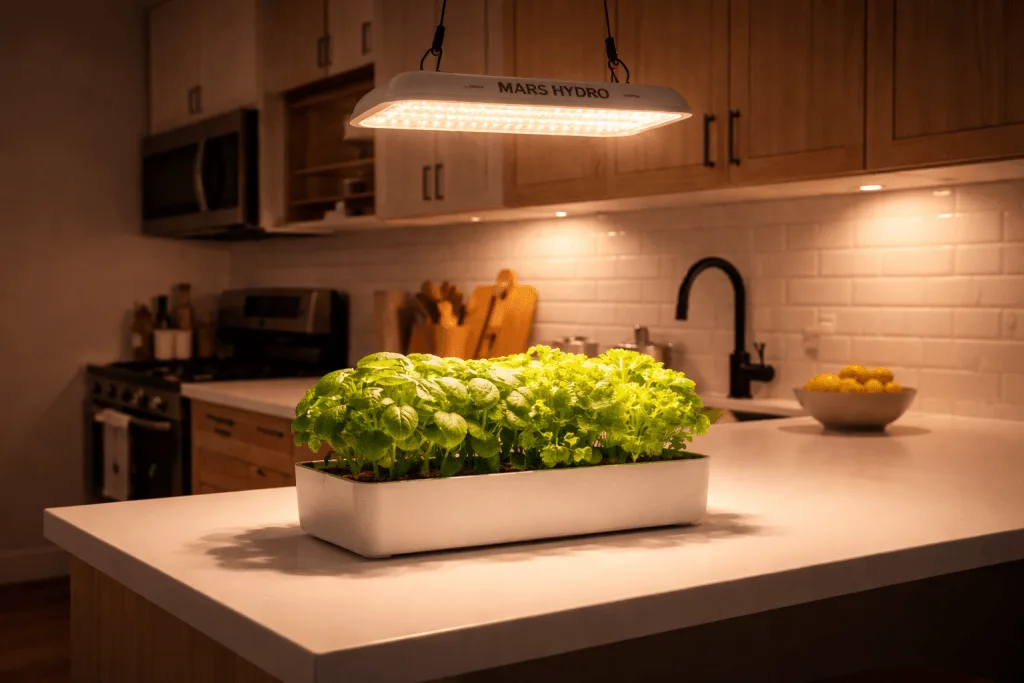
Most panels throw a wider footprint than one jar needs, though. Even so, the outer edge of that beam usually goes to waste. Put the shorter, more forgiving crops out there instead, and the panel you already own suddenly covers three systems instead of one.
🔌 The apartment outlet struggle
Finding an empty plug in a kitchen is an ongoing battle, since you need your outlets for the blender and the coffee maker too. Reducing your garden down to one panel means you don’t have to unplug the microwave to run a grow light. If you haven’t settled on Kratky versus DWC yet, our full DWC vs Kratky comparison walks through the tradeoffs before you combine the two.
To pull this off, you need to understand your light’s output zone. The center spot directly under the diodes is the hot zone. The outer ring is the ambient zone. Balance the two with the grow light calculator, which finds the spread for your specific wattage.
→ Grow light electricity cost on your small apartment bill
→ Full spectrum vs red blue LED grow lights compared
🔊 Managing pumps and timers
Mixing passive Kratky jars with an active DWC bucket means living with a pump. An air pump running 24 hours a day in an open layout will still irritate anyone trying to watch TV nearby. Keeping the noisy bucket in a central spot and grouping the silent jars around it isolates most of the hum, though not all of it. If you already own a pump and it runs louder than you’d like, our guide on how to quiet a hydroponic pump you already own covers the cheap fixes. Shopping for a new one, the quietest air pumps for apartment DWC roundup has the models that actually stay under the radar.
Good ways to dampen pump noise in a shared space include:
- Placing a folded silicone mat under the air pump
- Suspending the pump from a small bungee cord
- Keeping the air tubing as short as possible
- Moving the entire shared footprint away from your sleeping area
☀️ Organizing Your Footprint by Crop Height
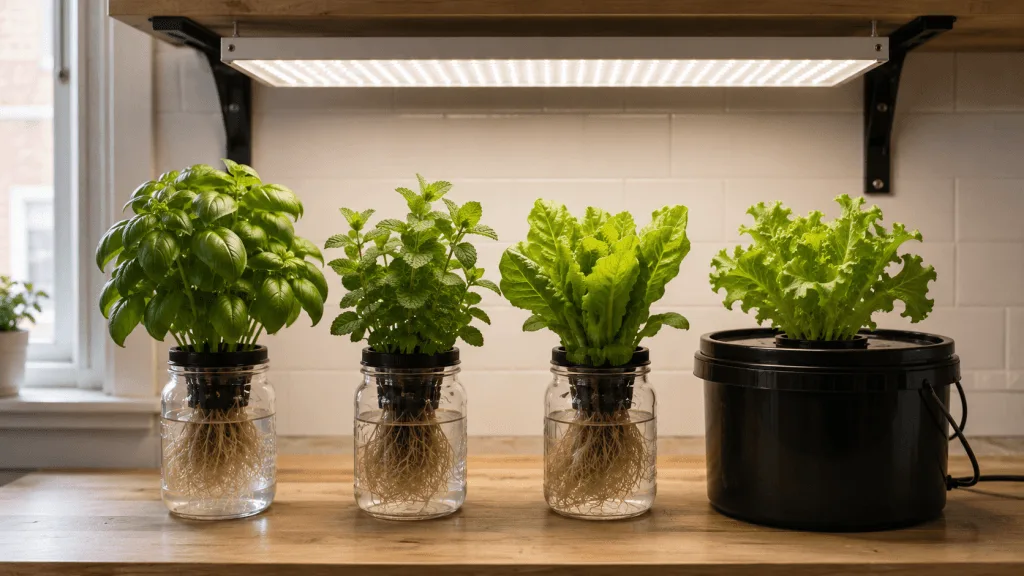
When you share one grow light multiple systems, height becomes your biggest challenge. A DWC bucket sits taller than a pint-sized Kratky jar, though. Raise the light to clear the bucket and the small jars won’t get enough energy. You have to equalize the canopy instead.
I build pedestals from an overturned tupperware container for my smaller jars. A stack of wide-mouth mason jar lids and net cups works just as well if you’re setting up a new jar from scratch. Once the canopy is level, the light distributes evenly across every system, so nothing gets shortchanged.
📏 The distance adjustment trick
You still need specific distances to prevent leggy stems. Keep the panel 6 to 8 inches above your leafy herbs; basil, mint, chives, lettuce, parsley, and cilantro all use this range. Oregano and thyme are different. Both are woody Mediterranean herbs that want more intensity, so raise the canopy closer, to 4 to 6 inches, or give them their own shelf where they won’t shade a taller neighbor. Our grow light distance guide covers the exact math for your panel’s wattage.
To align multiple systems under one panel:
- Place your tallest system in the center of the light footprint.
- Measure the distance from the tallest plant to the LEDs.
- Adjust the hanging hardware until you hit the 6 to 8 inch mark.
- Position your shorter jars around the center system.
- Place blocks or sturdy books under the jars until their top leaves match the center canopy.
🍃 Pairing herbs by light needs
Some herbs tolerate lower light better than others. Chives and lettuce grow fine on the ambient edges of your footprint. Basil needs the intense center beam to stay bushy. Map your shelf to this natural gradient instead of fighting it, the same logic behind a two-tier grow shelf once your footprint outgrows one level.
Plan your harvests with the seed to harvest calculator. Knowing when a plant will finish helps you swap in new seedlings without wasting light space.
🔄 How to Share One Grow Light Multiple Systems
Physical rotation is the secret to making this work. You can’t leave the same jar in the dim corner forever. If you want to share one grow light multiple systems effectively, you have to shuffle the jars and the bucket throughout the week.
Moving a plant doesn’t harm it. In nature, the sun moves across the sky. Indoor lighting is static, so moving the plant mimics a changing sun angle and stops it from leaning toward the center beam.
| Day of week | Center hot zone | Outer ambient edge |
|---|---|---|
| Monday / Tuesday | Kratky Basil Jars | DWC Lettuce Bucket |
| Wednesday / Thursday | DWC Lettuce Bucket | Kratky Basil Jars |
| Friday / Weekend | New Seedlings | Established plants (rotate 180 degrees) |
⏱️ The alternating days method
Set a timer to run your shared light 14 hours on, 10 hours off. This is still the standard schedule for indoor herbs. Every two days, swap the positions of your main systems so the plants on the edge get their turn in the bright spot.
If you forget a rotation, it’s fine. The outer edge still provides enough PPFD (Photosynthetic Photon Flux Density) to keep leafy herbs alive. Our guide on PPFD vs PAR vs lumens reviews the exact numbers, and the University of Minnesota Extension’s guide to lighting indoor plants is a solid primer on how plants actually use the light hitting them.
🩴 Fixing slow growth during rotation
Sometimes plants lag when moved frequently. If your chives stall out, check the air temperature around the outer edge. The center zone runs warmer from diode heat, so the ambient air should stay between 60 to 70°F (15 to 21°C).
If growth stalls across the board, your light timer might be the flaw. Manual plugs still fail more often than people expect. Still, digital control is worth the upgrade, and our breakdown of the 3 best compact timers for apartment grow lights covers which ones hold a schedule reliably.
⚗️ Managing EC and pH Across Kratky and DWC
When you share one grow light multiple systems, the plants in the dimmer zones process nutrients differently than the ones parked under the diodes. I still keep every container on its own separate reservoir; nothing is physically plumbed together between a Kratky jar and the DWC bucket. Instead, what I do share is the mixing jug.
Early on I still filled the DWC bucket straight from the same batch I had mixed for the Kratky jars sitting on the dim edge that week, at EC 1.5. The bucket happened to be holding a basil plant that had just rotated into the center hot zone, and at that lower EC it drank through the solution in under two days. New growth had gone pale by day three, too. Mixing a second, slightly stronger batch just for whatever is living in the center zone that week fixed it, and I’ve checked which container is “hot” before topping off ever since.
💧 Finding a safe middle ground
You still need an EC level that supports the center plants without starving the ones you just moved out. A shared middle ground of EC 1.5 keeps chives and lettuce happy while giving basil enough to work with on a normal rotation day. Check your number with a reliable EC or TDS meter rather than guessing from the label on the bottle.
To keep the balance stable:
- Top off daily with plain pH-adjusted water to replace what the plants drink.
- Perform a full reservoir change every 2 weeks to clear out salt buildup.
- Use the pH and nutrient calculator to check your ratios before mixing.
- Keep water temperature at 65 to 75°F (18 to 24°C) to prevent root suffocation.
🧪 Controlling pH swings during light changes
Your pH drifts as plants drink water. General herbs and greens thrive at pH 5.5 to 6.5. Out-of-range pH causes nutrient lockout even when plenty of fertilizer sits in the jar. Check pH every three days using drops or a reliable meter.
In a small jar, though, pH swings harder and faster. Our guide on how to mix two-part hydroponic nutrients in small jars covers this exact problem. Always add pH adjusters one drop at a time.
🔍 What to Check First When Rotation Fails
When you share one grow light multiple systems, issues tend to compound. A light leak on the edge of the panel might cause algae in one jar while the center jar suffers heat stress at the same time. You have to diagnose the exact location of the problem before fixing anything.
- Not sure what is wrong yet → start with Quick diagnosis table
- You know the cause → jump to the relevant section below
🔎 Quick diagnosis table
| What you see | Most likely cause | Check this first |
|---|---|---|
| 🟡 Thin, pale stems stretching upward | Light is too far away or weak | Drop light to 6 to 8 inches above canopy |
| 🟡 Brown crispy leaf tips | EC is too high for the dim zone | Dilute reservoir down to EC 1.5 |
| 🟡 Brown or slimy roots | Water temp above 75°F (24°C) | Move reservoir away from heat sources |
🩹 Fixing leggy growth
If your outer plants look stretched, they aren’t spending enough time in the center zone. Adjust your rotation schedule. If seedlings refuse to thicken up, read our breakdown on why hydroponic seedlings stay small under grow lights.
Sometimes you just need to prune. Pinching off the top leaves forces the plant to grow bushier instead of taller, which saves space under a crowded shared light.
🚨 Dealing with algae in shared setups
When you rotate jars, you might accidentally expose a bare glass side to the strong center beam. Light hitting nutrient water grows algae fast. Keep reservoirs light-proof, so blooms don’t steal oxygen away from the roots.
To clean out an infected reservoir:
- Remove the affected plant from the jar.
- Rinse the roots gently under lukewarm tap water.
- Sterilize the reservoir with a mild enzyme cleaner.
- Refill with fresh pH-balanced nutrient solution at EC 1.5.
→ How to Lower EC Safely in Tiny Hydroponic Reservoirs
→ Closet Hydroponic Garden Setup For Renters Without Windows
💬 A Word From Sarah
I moved a DWC lettuce bucket and three Kratky basil jars under a single 36-watt panel last winter to free up a kitchen outlet. I parked the basil jars on the far outer edge of the footprint, where they still pulled about 80 μmol/m²/s for five straight days through a cold snap that kept me from checking on them as often as I should have. By day five the stems had gone thin and pale, leaning hard toward the center of the panel like they were trying to walk there. I’ve rotated the jars into the center zone for at least four hours every afternoon ever since, so the stems have stayed thick.
❓ Frequently Asked Questions
💡 Can you really share one grow light between multiple systems?
Yes. Rotate jars and buckets so the plants that need the most light spend real time under the center of the panel, and let the slower feeders sit on the dimmer outer edges. This still works well in small apartments where outlets and floor space run out fast. Prop up shorter containers so every canopy sits at roughly the same height.
🌱 Which plant should I start with under a shared light?
Lettuce and basil are still the most forgiving choices for a first shared setup. Lettuce tolerates the dimmer outer edge without stalling, while basil bounces back quickly from a missed top-off. Save chives for a second round once you’ve got the rotation habit down, since it grows slowly and rewards patience more than speed.
💨 Do I need an air pump if I’m only running Kratky jars?
No. Kratky is a passive method that relies on an air gap above the water line rather than a pump, which is exactly why it pairs well with a shared light setup and no extra noise or plugs. You only need a pump once a Deep Water Culture bucket joins the shelf, since DWC roots sit fully submerged and need constant aeration to avoid drowning.
📏 How much distance should be between plants and the light?
Leafy herbs and lettuce still sit 6 to 8 inches below the LED panel. Oregano and thyme want it closer, around 4 to 6 inches, since both need more intensity. Measure from the top of the highest leaf to the diodes, not the container rim, or you’ll underestimate how close the canopy actually sits.
☀️ Can I use window light instead of running the panel longer?
Window light can supplement a shared panel, but it rarely replaces it in an apartment that doesn’t face south. Most windows deliver a fraction of the 14 hours a day these crops want, while light also drops off fast with distance from the glass. Our guide on combining window light and a grow light covers how to treat a bright window as a bonus zone rather than a stand-in for the panel.
🌿 Do rotating plants stress their growth cycle?
Moving plants on a schedule doesn’t harm them as long as total daily light stays sufficient. Going too many consecutive days on the dim edge is what causes stretching, so a consistent every-other-day swap works better than an irregular one. If new growth looks pale, move that plant back to the center zone right away.
⏱️ What is the best schedule for moving hydroponic jars?
Still, every two days works well for most apartment growers. Swapping a jar from the dim edge to the bright center on a set day still keeps every plant fed without letting the closer leaves scorch. A recurring phone alarm is the easiest way to actually remember it, since the rotation is easy to forget once the week gets busy.
💧 Can I mix a Kratky jar and a DWC bucket under the same nutrient plan?
You can run them on the same nutrient batch even though each container keeps its own separate reservoir. Mix one jug at a shared middle ground of EC 1.5 and use it to fill everything, then adjust upward for whichever plant just rotated into the center hot zone, since it will drink faster there.
🔌 Does a single shared light really cost less than three separate ones?
Yes, though the savings go beyond the electricity bill. A single 24 to 36 watt LED panel run 14 hours a day costs a small amount to operate, still well under running three separate fixtures on three separate outlets. Our grow light electricity cost guide walks through the exact math for a range of panel sizes.
🍅 Can I mix fruiting plants and herbs under one lamp?
It’s difficult but not impossible. Fruiting plants like dwarf cherry tomatoes need intense central light and a much higher EC than any herb here tolerates, while leafy greens prefer the cooler outer edges. Give the fruiting plant the center position permanently rather than rotating it, and circle the shorter herbs around its base instead.
🔎 How do I know if my shared light is strong enough?
Watch the stems, not just the leaves. Thin, pale stems reaching upward mean the light is too weak or too far away for whatever is sitting in that zone. Thick, sturdy growth still means the shared footprint is doing its job. If you spot stretching, lower the panel by an inch or shorten the time that plant spends on the outer edge.
Happy growing! 🌿
Sarah, Urban Hydro Space
Sarah Whitfield is the founder of Urban Hydro Space and an indoor gardening enthusiast dedicated to helping apartment dwellers grow fresh herbs and vegetables in small spaces. She researches hydroponic systems carefully from real specifications and verified buyer feedback, and shares practical tips and honest, clearly labeled product picks to make indoor gardening accessible for beginners.