
Affiliate disclosure. As an Amazon Associate I earn from qualifying purchases. Urban Hydro Space earns a small commission on purchases made through links on this page, at no extra cost to you. Full disclosure.

Researched, not tested: every product in this post was chosen from the makers’ published specifications, labels and listings, not tried at home. How we research and choose products.
The best grow light for seedlings isn’t the brightest one you can afford. Seedlings want gentle, even light from directly above, about 14 hours a day, at a height you can raise as they grow. I’d take slim LED strips that run the length of a seed tray over one bright panel, because a panel leaves the corners dim. Strips beat a winter windowsill by a mile, too, since seedlings there stretch toward the glass and topple.
First, work out how much light a tray of seedlings needs. Then come five lights, from one tray up to a full shelf, and how to hang and time them. My numbers come from the same table the grow light calculator uses, so you can check any light you already own. If you’re buying for older plants rather than seedlings, the countertop LED grow light roundup covers lights for herbs and greens.
The Best Grow Lights for Seedlings at a Glance
Match the light to how many trays you start. Wattage and features are the makers’ own figures.

Top pick, two trays: Barrina T5 2ft, 4-Pack
Research pick.
- Fits: a 2 foot shelf with two standard trays side by side; 40 W across four bars.
- Setup: 5000K white, a switch on each bar, linkable, with clips, ties and magnetic strips.
- Skip if: you start one tray at a time, since the 1 foot set is enough.
Check price on Amazon $44.99

One tray: Barrina T5 1ft, 4-Pack
Research pick.
- Fits: one standard tray or a short cabinet shelf; 20 W across four 1 foot bars.
- Setup: the same 5000K bars and mounting kit as the 2 foot set.
- Skip if: you want room to grow, because the 2 foot set covers twice the space.
Check price on Amazon $28.31

Built-in timer: FECiDA Flat Panel Grow Lights
Research pick.
- Fits: shelves and seed trays; 12 W of actual power per thin panel, linkable.
- Setup: a built-in timer with 4, 8, 12, 16 and 20 hour settings.
- Skip if: you want exactly 14 hours; its timer has no 14 hour setting, so use an outlet timer.
Check price on Amazon $23.99
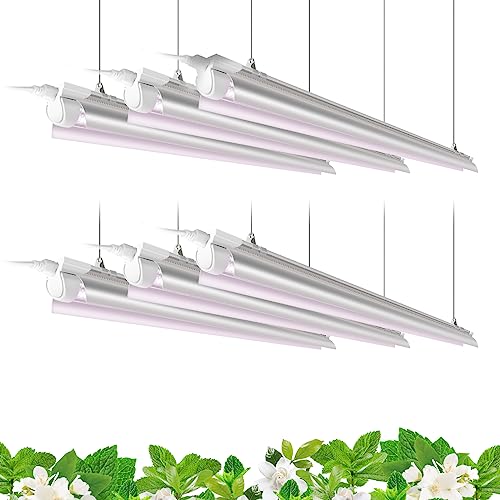
A full seed shelf: Barrina T8 4ft, 6-Pack
Research pick.
- Fits: a 4 foot rack of trays, such as spring starts for a balcony; 42 W per bar.
- Setup: links up to six bars in a row, with tape, clips and ties included.
- Skip if: you start a tray or two, because this is a seed station, not a windowsill light.
Check price on Amazon $74.99

Kitchen shelf, warm light: Soltech Grove Light Bar
Research pick.
- Fits: one tray on an open kitchen shelf; an 18 inch, 11 W bar in warm 3000K white.
- Setup: touch dimming on the bar, and an outlet timer is included for US and Canada orders.
- Skip if: you’re on a budget, since it costs far more per watt than the Barrina strips.
Check price on Amazon $104.00
Whichever you pick, I’d hang it 10 to 12 inches above the seedlings and run it 14 hours on a timer. Prices are pulled from Amazon and were last checked on 19 November 2026 at 11:45 am. Amazon prices change often, so check the listing before buying.
Key takeaways
- Seedlings need gentle light: about 75 to 150 PPFD, or roughly 4 to 8 true watts per square foot of tray.
- Hang the light 10 to 12 inches above the seedlings, then lower it to 6 to 8 inches once true leaves appear.
- Run 14 hours on and 10 off on a timer, the schedule this site gives for seedlings, and never leave the light on around the clock.
- Long, slim strips over the length of a tray give the even light seedlings need better than one small panel.
- A winter windowsill is rarely enough: seedlings there stretch, lean and fall over.
How Much Light Do Seedlings Need?
Less than grown plants, but more steadily, because they’re building their first roots and leaves. My light table puts seedlings at about 75 to 150 PPFD (micromoles of light per square meter per second), on 14 hours on and 10 off, with the light 10 to 12 inches above them. Leafy herbs and greens want 200 to 400 PPFD once grown, so that’s a gentle start. If PPFD is new to you, PPFD vs PAR vs lumens explains it.
Most people don’t own a light meter, so I plan in watts instead. For seedlings, aim for roughly 4 to 8 true watts per square foot of tray. A standard 10 by 20 inch tray is about 1.4 square feet, so one tray needs only about 6 to 11 true watts. That’s the actual power the light draws, not the “equivalent” figure some listings print in big numbers, and since budget LEDs turn power into light less efficiently, they need a little more.
Once seedlings show their first true leaves, lower the light to the 6 to 8 inch height that suits leafy herbs and greens, since they can take more light from then on. The grow light calculator has a seedling setting that turns your tray size into a wattage range, and it’ll check a light you already own, too.
Why a Windowsill Is Not Enough
In winter, a windowsill gives too few hours of weak light, and all of it comes from one side. Seedlings stretch toward the glass, tall and pale, until their stems can’t hold them up. The University of Minnesota Extension calls the windowsill a poor place to start seeds for exactly this reason, and adds that a sill is often the coldest spot in the home at night and the hottest by day.
A grow light directly overhead fixes all of it, because light from above keeps seedlings straight and a timer gives them the same 14 hours every day. Why seedlings stay small under grow lights covers the opposite problem, when a light is too weak or too far away, while window light and a grow light together explains how to combine them for older plants.
Strips, Panels or Bars?

- T5 and T8 LED strips are long, slim bars that run the length of a tray. Laid side by side a few inches apart, they spread light evenly to the corners and barely warm the plants. They’re cheap per watt, too, which is why they’re the classic seed-starting light and the one I’d buy for most people.
- Flat panels are thin rectangles that sit under a shelf. They cover a tray well when they’re sized to match it, and some include a timer.
- Decor bars such as the Soltech Grove are built to look good on an open shelf, in warm white light. You pay more per watt for that, so I’d only put one over a tray in the kitchen, not a seed station.
- Single round lamps and clip-on spots light a small circle brightly and leave the rest dim, so they suit one pot better than a tray of seedlings. The clip-on grow light guide covers where they do fit.
For seedlings I’d stick with plain 5000K white, because it grows them well and shows their true color, so you’ll spot problems early. Full spectrum vs red and blue grow lights covers the difference.
The Lights Side by Side
Every figure comes from the maker’s listing, checked in October 2026. Prices change, so check the live price on each listing. Light names in the table link to Amazon (paid links).
| Light | Length | Actual power | Color | Timer | Covers |
|---|---|---|---|---|---|
| Barrina T5 2ft, 4-pack | 2 ft bars | 40 W total | 5000K white | No, use an outlet timer | Two trays |
| Barrina T5 1ft, 4-pack | 1 ft bars | 20 W total | 5000K white | No, use an outlet timer | One tray |
| FECiDA flat panels | Flat panel | 12 W per panel | 3000K, 5000K and red mix | Yes, fixed steps, no 14 hour step | A tray per panel or two |
| Barrina T8 4ft, 6-pack | 4 ft bars | 42 W per bar | Full spectrum white | No, use an outlet timer | A 4 ft rack |
| Soltech Grove bar | 18 in bar | 11 W | 3000K warm white | Outlet timer included (US and Canada) | One tray |
The Picks in Detail
Barrina T5 2ft 4-Pack: Top Pick
Four 2 foot bars at 40 W in total cover a 2 foot shelf with two standard trays side by side, about 2.8 square feet of seedlings. That’s roughly 14 W per square foot, comfortably above the seedling range, and I like the headroom, because you can hang the bars at the top of the 10 to 12 inch range or switch one off. Each bar has its own switch, and they link end to end with the included cords, so one plug runs the set.
Barrina supplies clips, cable ties and magnetic strips with double-sided tape. I wouldn’t trust tape on bare wood, so on a wooden shelf use the clips, screws or zip ties instead. The black aluminum housing also looks tidier on an open shelf than white plastic does.
Check the Barrina 2ft set on Amazon $44.99
Barrina T5 1ft 4-Pack: One Tray
The 1 foot version uses four bars at 5 W each, 20 W in all, with 96 LEDs and the same 5000K white. Laid side by side across a single tray, that’s plenty for seedlings, and it also fits under a kitchen cabinet where a 2 foot bar won’t. That’s the main reason I’d pick it. It’s the seedling light in my seed starting kit guide too, so the two posts line up if you buy the kit from there.
Check the Barrina 1ft set on Amazon $28.31
FECiDA Flat Panels: Built-In Timer
FECiDA’s thin panels draw 12 W of actual power each, according to the listing, and mix 3000K, 5000K and red LEDs. They link together, and each set has a built-in timer with 4, 8, 12, 16 and 20 hour settings, so the lights switch themselves on and off every day without an outlet timer. As with any light, I’d run it for a few days while you can still return it.
The catch, though, is the schedule. Its settings jump from 12 to 16 hours, so it can’t run the 14-hour day this site recommends. I’d switch the panel’s own timer off and plug it into an outlet timer set to 14 hours instead.
Check the FECiDA panels on Amazon $23.99
Barrina T8 4ft 6-Pack: A Full Seed Shelf
Six 4 foot bars at 42 W each is a lot of light. I’d only buy them for a rack of trays in late winter, for example seedlings for a balcony or a community garden plot. Use two or three bars per shelf, raise them as the seedlings grow, and link up to six in a row from one plug. For a tray or two of herbs, though, it’s far more light than you need. Check the Barrina T8 set on Amazon $74.99.
Soltech Grove Bar: Kitchen Shelf
The Grove is an 18 inch, 11 W bar in warm 3000K white, built to look like ordinary shelf lighting rather than a grow light. It dims with a touch on the bar and mounts on rotating magnetic brackets, and Soltech includes an outlet timer for US and Canada orders. At 11 W, that’s enough for one tray of seedlings or herbs, so it belongs on an open kitchen shelf where looks matter. You pay far more per watt than for the Barrina strips, though, so I’d buy it for the shelf you look at every day, never for a seed rack. Check the Soltech Grove on Amazon $104.00.
Hanging and Timing a Seedling Light

- Mount it so it can move. Hang strips from the shelf above on chains, hooks or zip ties, or rest them on two stacks of books you can remove, so you can raise or lower them as seedlings grow.
- Start at 10 to 12 inches above the tops of the seedlings, with the strips spread evenly across the tray rather than bunched in the middle.
- Put it on a timer for 14 hours on and 10 off. It’s the seedling schedule from my light table, and it gives them a dark period every night. The grow light timer roundup covers simple plug-in timers.
- Watch the seedlings, not the ruler. Stems that stretch and lean mean the light is too far away or too weak, while pale or curled leaves mean it’s too close.
- Lower it to 6 to 8 inches once true leaves appear, which is when most herbs and greens move to their jars or system anyway. That’s also when feeding starts, and the pH and nutrient calculator gives the seedling strength for your crop.
If you use a heat mat, give it its own plug or thermostat, never the light timer, because seeds need steady warmth day and night. Grow light distance on a shelf has the height for every stage, and starting seeds in rockwool covers the trays under the light. When the seedlings move to their jars, the same strips make a good light for a shelf of herbs, and the beginner’s guide to apartment hydroponics covers what comes next.
What It Costs to Run
Seedling lights are cheap to run, since they draw so little power. At the US average of 18.2 cents per kWh, a 20 W set running 14 hours a day uses about 8.5 kWh a month, which is about $1.55 a month. A 40 W set doubles that to about $3.10. Seedlings only need the light for a few weeks before they move on, as the seed to harvest calculator shows for each crop, so a whole seed-starting run costs a dollar or two. The running cost calculator works it out with your own electricity rate, and grow light electricity cost compares bigger setups.
Where these facts come from
The seedling PPFD of 75 to 150, the 14 hour day, the 10 to 12 inch starting height and the 4 to 8 true watts per square foot are the figures in this site’s light table, the same ones the grow light calculator uses. The University of Minnesota Extension’s guide to starting seeds indoors covers why a windowsill makes poor seedlings and why lights should not run around the clock. Wattage, length, color and timer details come from each maker’s Amazon listing, read in October 2026, and the running cost uses the EIA residential average from this site’s calculator.
One Last Tip
Buy for the shelf you have, not the plants you dream of. Measure it, count how many trays fit, and pick the 1 foot or 2 foot set to match. Then put the money you save into a timer, because a light that runs the same 14 hours every day beats a brighter one you remember to switch on most days. Nobody remembers every day. I’d take a modest strip on a timer over the brightest panel on a wall switch, every time.
Frequently Asked Questions
What is the best grow light for seedlings?
I’d buy slim LED strips sized to the tray, such as the Barrina T5 2 foot 4-pack for two trays or the 1 foot set for one. Strips spread gentle light evenly, stay cool and cost little to buy or run.
How far should a grow light be from seedlings?
Start at 10 to 12 inches and drop to 6 to 8 inches once true leaves appear. After that, let the plants tell you: stretching, leaning stems mean it’s too far, while pale or curled leaves mean it’s too close.
How many hours of light do seedlings need?
Give seedlings 14 hours on and 10 off, on a timer, so they get a dark period every night. Never leave seedling lights on around the clock.
How many watts do I need for seedlings?
Plan on roughly 4 to 8 true watts per square foot of tray. One standard 10 by 20 inch tray is about 1.4 square feet, so 6 to 11 true watts covers it. Go by the actual power on the listing and ignore the bigger “equivalent” number.
Can seedlings grow on a windowsill without a grow light?
Not well in winter. The light is weak, it doesn’t last long enough and it all comes from one side, so seedlings lean toward the glass until they fall over. The sill is often the coldest spot at night, too. A light directly overhead on a 14 hour timer gives straight, sturdy seedlings.
Why are my seedlings leggy under a grow light?
Usually the light is too far away, too weak or not on long enough. I’d lower it toward 10 inches, check that the timer gives 14 hours, and make sure the whole tray is lit, not just the middle. Seedlings that have already flopped rarely straighten, so sow a fresh batch.
Is white or red and blue light better for seedlings?
I’d go with plain 5000K white, since you see the seedlings as they really are and catch trouble sooner. Red and blue lights grow plants too, but they make leaves look odd. Warm 3000K white, like on decor bars, also works and just looks softer.
Are T5 LED strips good for seed starting?
Yes, and they’re what I’d buy for a tray. They run its full length, reach the corners evenly and stay cool. Lay two to four side by side a few inches apart, and zip-tie them instead of trusting the adhesive tape.
How much does a seedling grow light cost to run?
Very little. At the US average of 18.2 cents per kWh, a 20 W light on 14 hours a day costs about $1.55 a month, and a 40 W set about $3.10. You’ll only need it for a few weeks per batch, too.
When should I lower the grow light over seedlings?
When the first true leaves show, bring it down from 10 to 12 inches to 6 to 8 inches. I’d do it gradually over a few days, and raise it again if leaves turn pale or curl.


