⏳ 21 min read · Last updated: September 2026
My first try at hydroponic cherry tomatoes was a ‘Sungold’ seedling jammed into a wide-mouth mason jar on a north-facing sill. It looked healthy for three weeks. Then it started drinking the jar dry between breakfast and dinner, the lower leaves went limp by mid-afternoon, and every flower it opened dropped onto the counter within a day. A fruiting vine living in a pint of water never had a chance.
This guide is the version I wish I had started with. You will get the container size that actually holds up, the light and temperature numbers for a fruiting plant rather than for lettuce, an EC and calcium routine that heads off blossom-end rot, and the two hands-on jobs, pollination and pruning, that decide whether you get fruit at all. I have grown cherry tomatoes in a 5-gallon bucket in a small kitchen. I have not run every variety or nutrient brand named here, so I mark which parts come from my own bucket and which come from the wider growing record.
🍅 Why Cherry Tomatoes Work Indoors, and Where They Fight Back
A cherry tomato is a heavy feeder with a big thirst and a real hunger for light. None of that softens because the plant sits on your kitchen shelf. What does change is that you now control the weather, so a well-run indoor plant can out-produce a shaded outdoor one and keep cropping for months. The trade-off is that a small reservoir punishes mistakes quickly. A pH slip that a lettuce plant would shrug off can stall a fruiting tomato in a day.
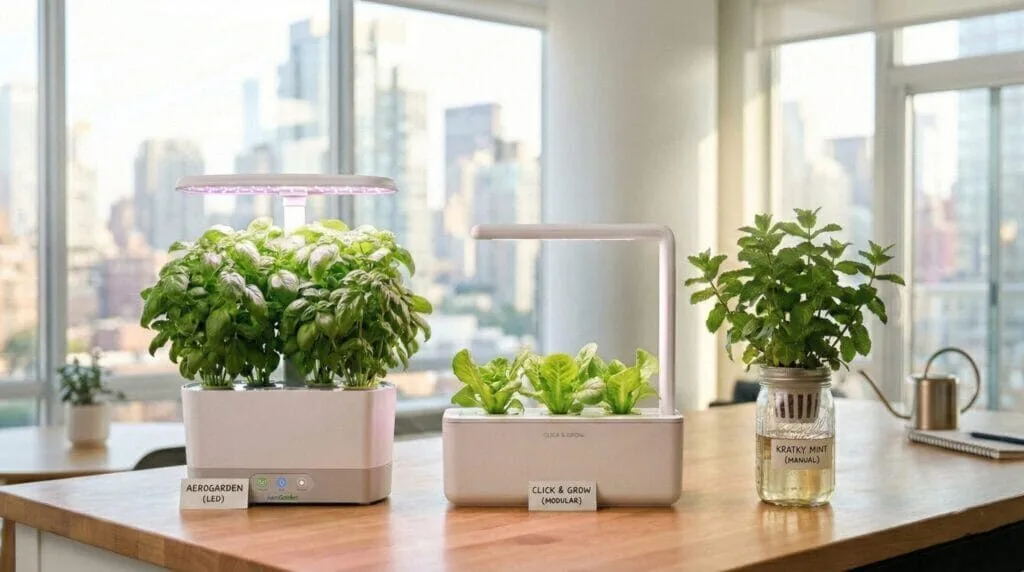
So treat this as a project with a learning curve, not a windowsill herb. If you have never grown anything in water before, start with something forgiving and come back later. The complete beginner’s guide to apartment hydroponics covers the groundwork this post assumes, and the best herbs for small hydroponics are a gentler first crop while you learn the routine.
- One plant needs a 5-gallon bucket, because a jar cannot feed a fruiting vine.
- Run the light 8 to 12 inches above the canopy, then hold a 14 hours on, 10 hours off schedule.
- Once trusses set, hold EC at 2.0 to 2.5 and keep it steady from one day to the next.
- Hand-pollinate every morning, because still apartment air will not move the pollen for you.
- A dwarf variety such as ‘Red Robin’ stays under a foot, while a standard cherry like ‘Sungold’ runs 2 to 4 feet and has to be pruned to a single stem.
- New to growing in water: a jar of lettuce or basil first, then a tomato once the routine is second nature.
- You have a bright corner and a real grow light: a dwarf cherry like ‘Red Robin’ in a 5-gallon bucket.
- Short on headroom or light: skip tomatoes for this round and grow bush basil instead.
- Why Cherry Tomatoes Work Indoors
- Pick a Variety and a System
- Light and Temperature for Fruiting Tomatoes
- Feeding Hydroponic Cherry Tomatoes: pH, EC, and Calcium
- Pollination and Pruning Indoors
- Harvesting Cherry Tomatoes and Keeping the Plant Producing
- What to Check First When Cherry Tomatoes Struggle
- A Word From Sarah
- Frequently Asked Questions
🪴 Pick a Variety and a System
Two decisions shape everything that follows: how tall the plant is allowed to get, and what holds the water. Get the pairing right and the daily work drops to a few minutes. Get it wrong and you spend the season fighting a plant that is too big for its bucket.
🌱 Dwarf, Patio, or Standard Cherry
True dwarfs stay small on purpose. ‘Red Robin’, ‘Tiny Tim’, and ‘Micro Tom’ top out between 8 and 14 inches, set fruit without pruning, and fit under a shelf light. ‘Tumbling Tom’ trails over the rim of a container, which suits a high shelf. These give up some yield and some complexity in exchange for staying manageable.
Standard cherry types are the ones with the reputation for flavour. ‘Sungold’, ‘Sweet 100’, and ‘Sun Sugar’ will run 2 to 4 feet indoors, sometimes more. So they need a tall stake and steady pruning to a single stem. Pick one of these only if you have the height and you are ready to prune every week. If you want fruit with the least fuss, start with a dwarf.
📦 Building the 5-Gallon DWC Bucket
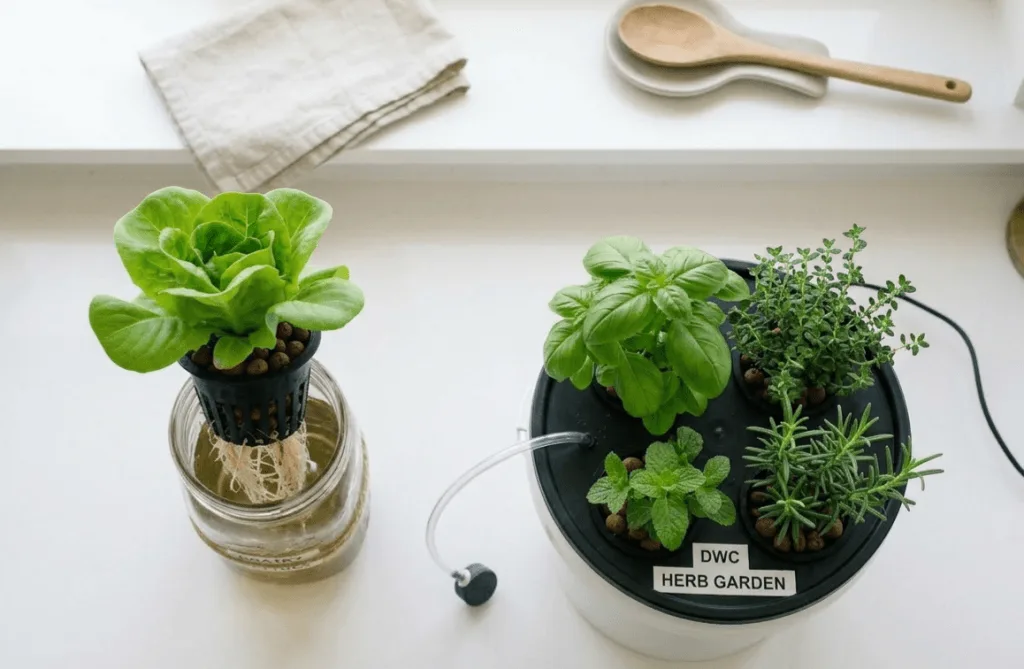
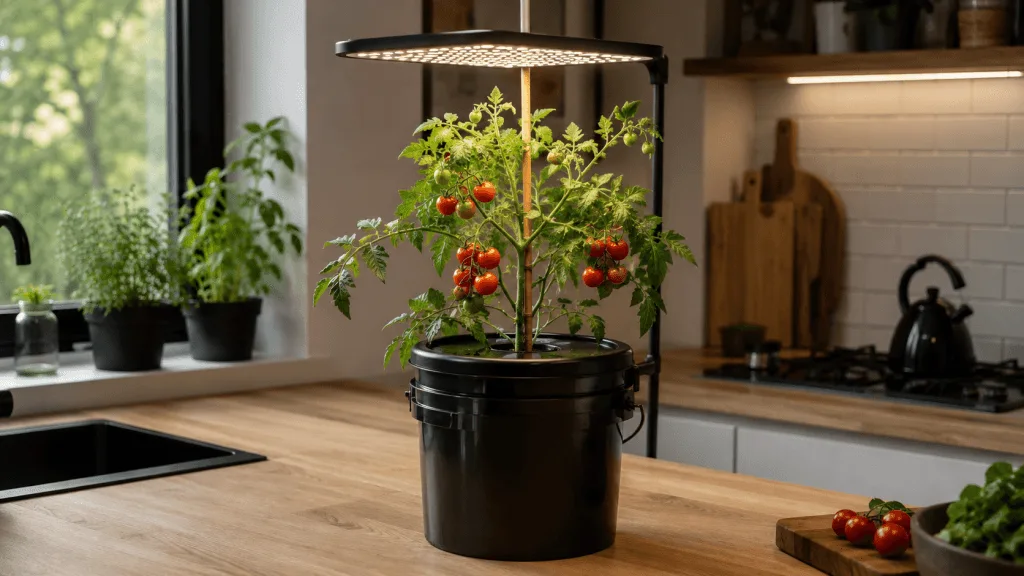
Deep water culture is the setup most apartment growers land on for tomatoes. The plant sits in a net pot in the lid, its roots hang into aerated solution, and an air pump keeps oxygen in the water. Give one plant a full 5-gallon bucket and a 3 to 6 inch net cup. A smaller vessel runs dry and swings in temperature and EC far too fast for a fruiting plant. So size up, even if the bucket looks absurd under a seedling.
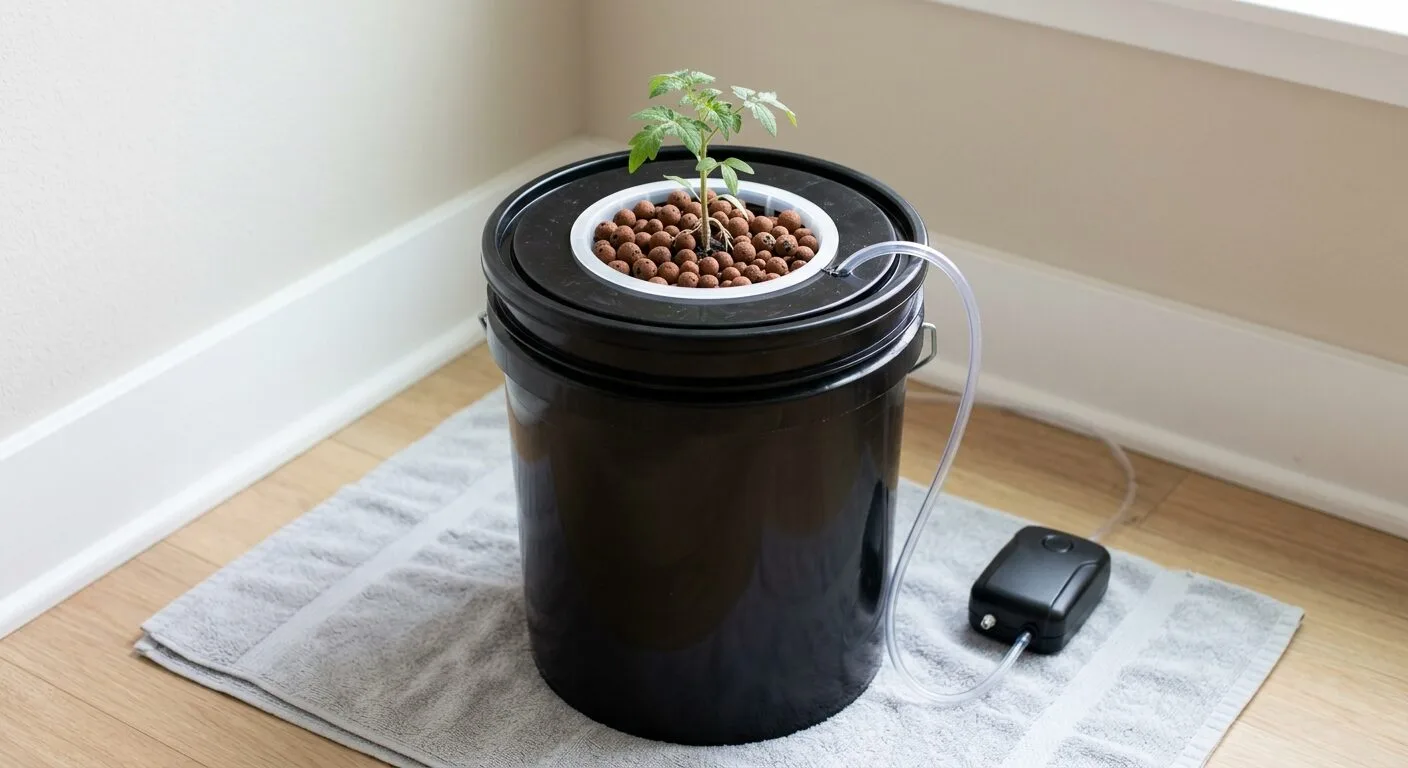
You will need an air pump running around the clock, so choose one built for quiet. The quiet air pump picks for apartment DWC cover the models worth owning. Keep the bucket opaque or wrapped, since any light reaching the water feeds algae that competes with the roots. One more thing worth planning for before you fill the bucket: a power cut leaves DWC roots without oxygen within hours, so know your backup.
💧 Can You Do It Passively with Kratky?
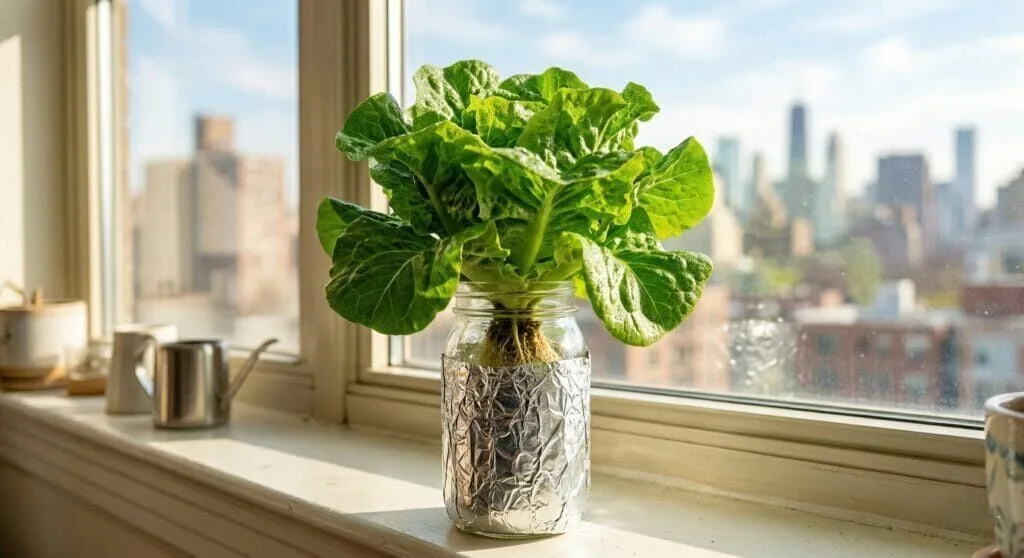
Only with a large container and a close eye, and it is not a first project. The jar-based Kratky method works because a lettuce plant drinks slowly and finishes before the water runs out. A cherry tomato drinks faster than a passive reservoir can keep a safe air gap, so the roots either sit in stale water or hit dry air. If you want to try it, use an opaque tote of at least 10 gallons for a dwarf, check it daily, and accept that a bucket with a pump is the more reliable route. The DWC versus Kratky comparison lays out the trade-off in full.
🛠️ Support Without Drilling the Walls
Even a dwarf gets top-heavy once a truss loads up with fruit. A standard cherry will fold its own stem without a stake. Renters usually cannot put hooks in the ceiling, so lean on freestanding options instead.
- Push a bamboo cane through the net-pot lid, tall enough for the variety, then tie the stem to it with soft twine every 6 inches.
- Set a tension pole between floor and ceiling and clip the stem to it as it climbs.
- Drop a small tomato cage over the bucket, which is enough for any dwarf.
- For a standard cherry grown as a single stem, run soft twine from the lid up to a curtain rod or a shelf bracket, then wind the growing tip around it once a week.
The no-drill setups for renters post covers more ways to hold weight without losing a deposit.
💧 Protecting the Floor
Five gallons of nutrient solution on a hardwood floor is a bad afternoon. Before the bucket goes near carpet, stand it in a deep boot tray. Then fit the air line with a one-way check valve so it cannot siphon backward, and keep a cheap water alarm at the base. Do your reservoir changes over a sink or a tub, never over the floor. I have caught two slow leaks with a cheap tray under the bucket, and that is the only reason I still have my deposit.
☀️ Light and Temperature for Fruiting Tomatoes
Leafy greens forgive a dim shelf. A fruiting tomato does not. Weak light gives you a tall thin plant that flowers late and drops most of what it sets. Light is the single biggest lever on whether you get fruit, and how sweet it is.
☀️ How Much Light, and How Close
Aim for a PPFD of 400 to 600 µmol/m²/s across the canopy. In a home setup that usually means a dedicated LED panel in the 100-watt class of true draw for one plant. A clip lamp or a household bulb will not set fruit. Hang the panel 8 to 12 inches above the highest leaves, then raise it as the plant grows, because a tomato can add an inch of height in a day and will grow into the diodes if you let it.
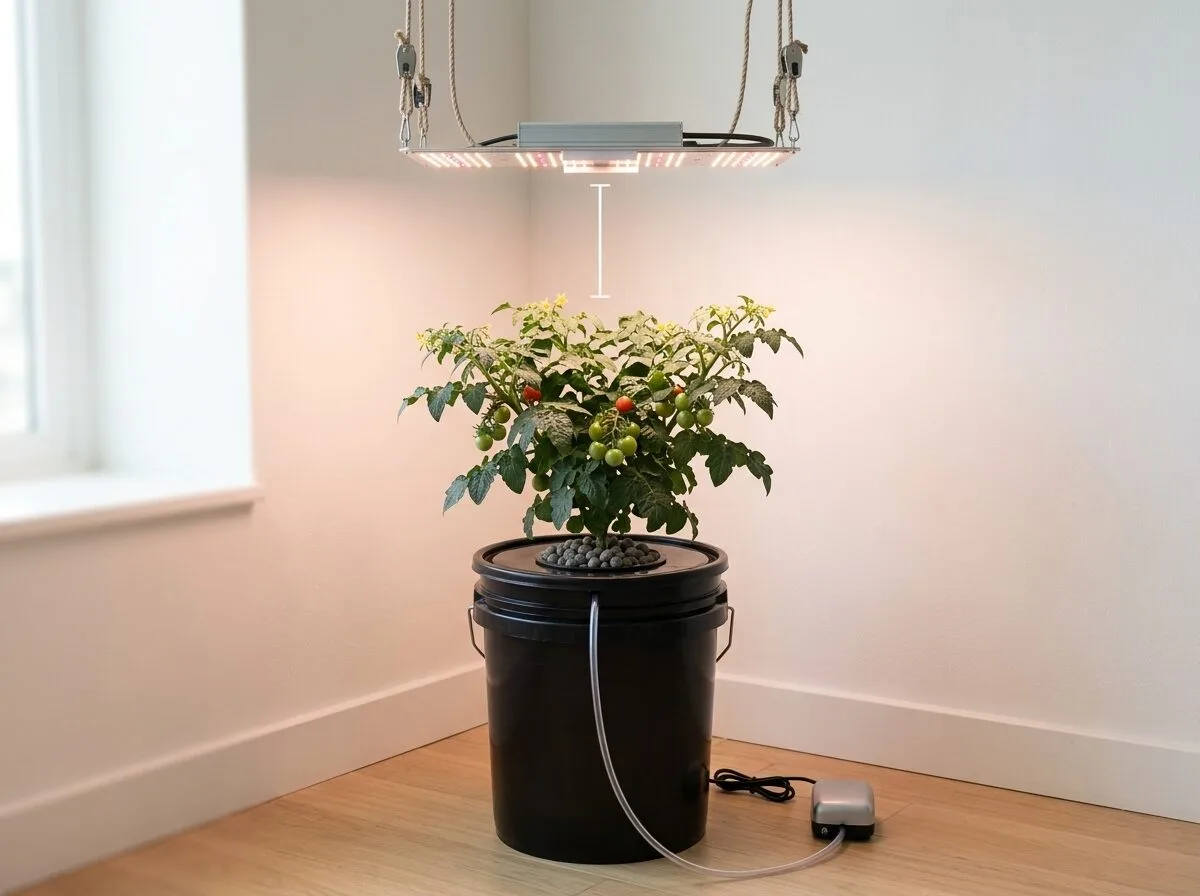
The compact LED panel picks are a sensible starting point, and the grow light calculator maps coverage to your shelf so you are not lighting empty space.
⏲️ The 14/10 Schedule and a Timer
Run the light 14 hours on and 10 hours off. The dark stretch is not wasted time; the plant uses it to move sugars around and rest its photosystems. Put the panel on a timer so the schedule holds while you are at work or asleep, because an hour here and there adds up to leggy growth and uneven ripening. The 9-to-5 light schedule guide covers the setup, and a basic mechanical timer is enough.
🌡️ Air and Water Temperature
Cherry tomatoes set fruit best when the room sits between 70 and 80°F (21 to 27°C). They will hold on from about 65°F, but once nights drop near 60°F the flowers stop setting, and days much above 85°F do the same. Keep relative humidity in the 50 to 70 percent band with a little air movement.
Water temperature matters more, and it is easier to get wrong. Hold the reservoir at 65 to 75°F (18 to 24°C). Above 75°F the water carries less dissolved oxygen and root rot risk climbs; above 75°F (24°C), you are in real danger. A warm apartment in summer is the number one cause of root trouble in a small bucket. The small-system temperature guide has the fixes if your numbers run high.
🌊 Cooling a Warm Reservoir in Summer
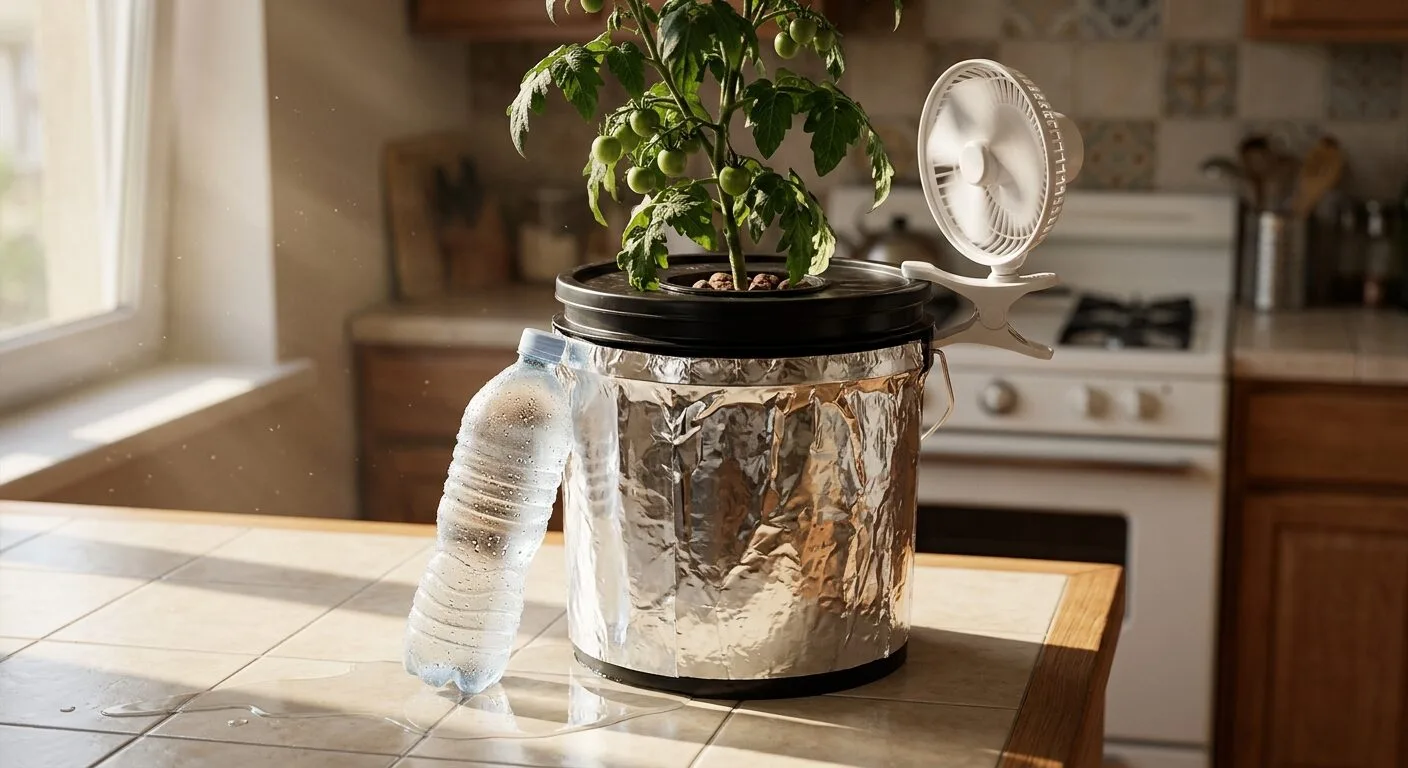
A bucket acts like a thermal store, soaking up room heat and holding it against the roots. Skip the ice cubes; dropping ice straight into the reservoir causes a temperature swing that shocks the roots and fades within the hour. What works instead:
- Stand a frozen water bottle against the outside of the bucket each morning and swap it at night.
- Wrap the bucket in reflective foil or a light towel so it stops absorbing room heat.
- Move the system away from the fridge, the oven, and any sunny window.
- Aim a small fan across the lid so evaporation pulls a little heat out of the surface.
Summer room heat is often the grow light and the weather stacking up, so venting the light itself and cracking a window in the evening both take load off the bucket.
⚗️ Feeding Hydroponic Cherry Tomatoes: pH, EC, and Calcium
Feeding is where a tomato bucket parts ways with a herb jar. Herbs coast on a mild mix. A fruiting tomato wants a strong, calcium-rich solution and a stable one. Use a two-part or three-part hydroponic nutrient made for fruiting plants, and never a soil fertiliser, since soil feeds depend on microbes that a clean reservoir does not have. If you are choosing a line, the nutrient picks for small systems compare one-part and two-part options.
🧪 EC from Seedling to Fruiting
Ramp the strength up as the plant matures rather than starting it strong.
| Stage | Target EC | What the plant is doing |
|---|---|---|
| Seedling | 1.0 to 1.2 | Rooting in, so it burns easily at this stage |
| Vegetative | 1.8 to 2.2 | Building stem and leaf before it flowers |
| Flowering and fruiting | 2.0 to 2.5, so hold it steady near 2.2 | Filling trusses, so it wants extra potassium |
You need a meter to run these numbers, because guessing gets you burned leaves or starved fruit. The EC and TDS meter picks for small reservoirs cover what to buy, and what an EC reading actually means is worth a read if the units are new. Resist pushing past 2.5 in a small bucket. Higher EC does not buy you more fruit; it buys you tip burn.
🧪 pH Target and Why It Drifts
Keep the reservoir at pH 5.8 to 6.5 and aim for 6.0. When pH climbs above about 6.5, iron and a few other nutrients lock out even though they are sitting in the water, and the newest leaves turn pale. Small reservoirs drift more than big ones because there is less volume to buffer the plant’s own activity. Check it daily with the rest of your routine, and if it will not sit still, the guide to pH that keeps drifting walks through the causes. For a pen worth owning, see the beginner pH meter review.
💧 The Daily Top-Off
A big tomato plant pulls water out of the bucket faster than it pulls minerals, so the level drops while the EC creeps up. Top it back to the fill line every day with plain, pH-adjusted water, never with nutrient mix. Let the fresh water sit out overnight so it reaches room temperature first, bring it to pH 6.0, then pour it in slowly. If the EC still reads high after a top-off, that is the signal for a full change rather than a reason to add more water on top. The topping-off guide has the full routine.
🩹 Blossom-End Rot and Calcium
Blossom-end rot shows up as a dark, sunken, leathery patch on the underside of the fruit. It is a calcium delivery problem. The plant can have calcium in the water and still fail to move it into the fruit fast enough. That happens when the solution runs low on calcium, when heat stresses the roots, or when moisture and EC lurch around from one day to the next.
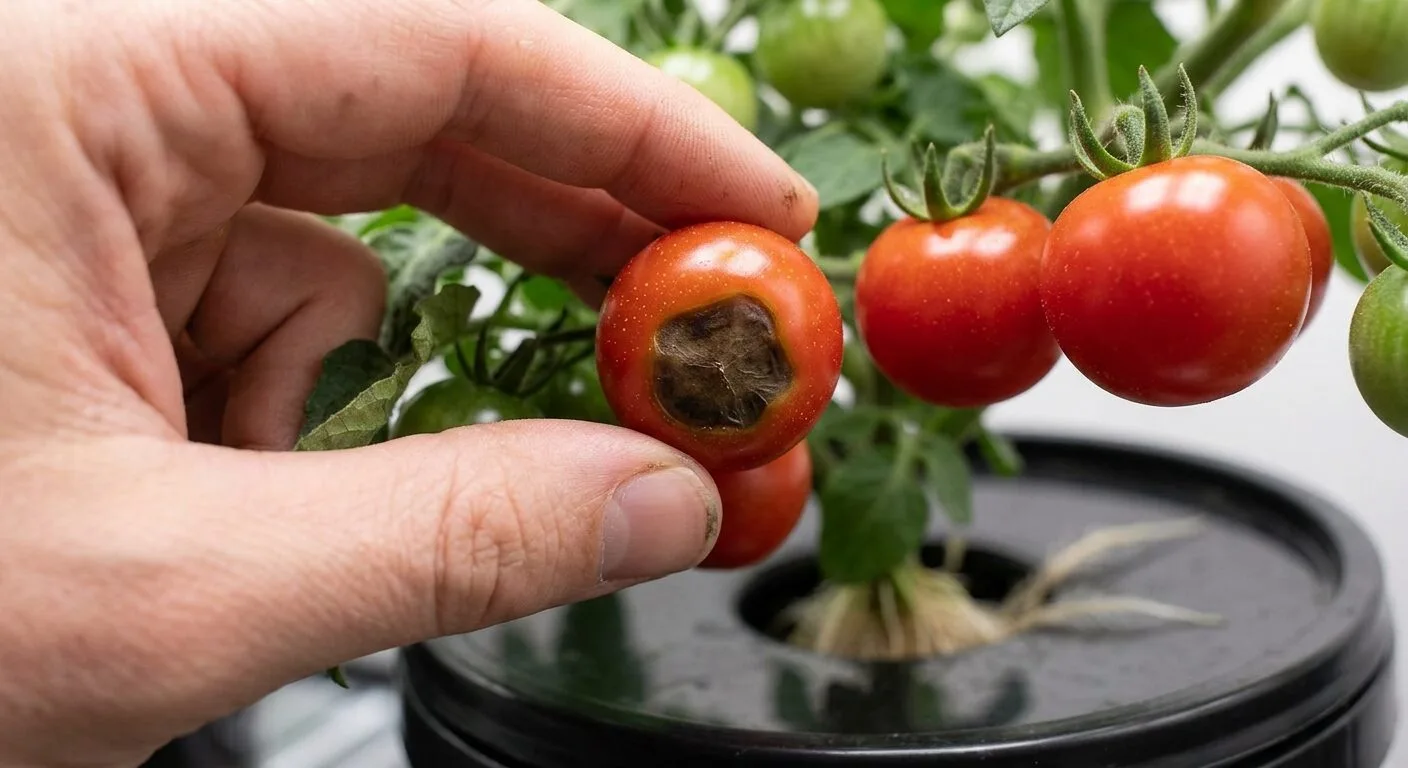
Three things keep it away. Use a nutrient with real calcium in it, and add a Cal-Mag supplement if you mix with RO, distilled, or soft tap water, since those carry almost none. The Cal-Mag guide for small systems covers when it is worth adding. Hold EC steady near 2.2 rather than bouncing between 1.9 and 2.8. And keep the water temperature down, because stressed roots stop moving calcium first.
Start with the nutrient chemistry: Penn State Extension on hydroponic nutrient solutions.
For a small-scale overview: University of Minnesota Extension, small-scale hydroponics.
On the plant itself: RHS growing guide for tomatoes.
💧 The Two-Week Reservoir Change
Daily top-offs keep the level up but let unused salts and imbalances build. So do a full reservoir change every 2 weeks: empty the bucket, rinse it, and refill with fresh solution mixed to the right stage. Clean any film with diluted hydrogen peroxide rather than bleach, which leaves residue. The two-week water change rule explains why the interval is fixed, and the pH and nutrient calculator gets your mixing ratios right for the new batch.
✂️ Pollination and Pruning Indoors
Outdoors, wind and bees handle pollination and keep the canopy moving. Your kitchen has neither. These two jobs are small, and they take a few minutes a day. Yet skipping them is the most common reason an indoor tomato throws a lot of flowers and sets almost nothing.
👉 Hand Pollination, Every Day
Tomato flowers are self-fertile, so each one holds both parts. Indoor strawberries ask for the same daily habit, although they want a soft brush rather than a flick. The pollen just needs a shake to fall from the anther onto the stigma. Once a day, while the light is on, do one of these:
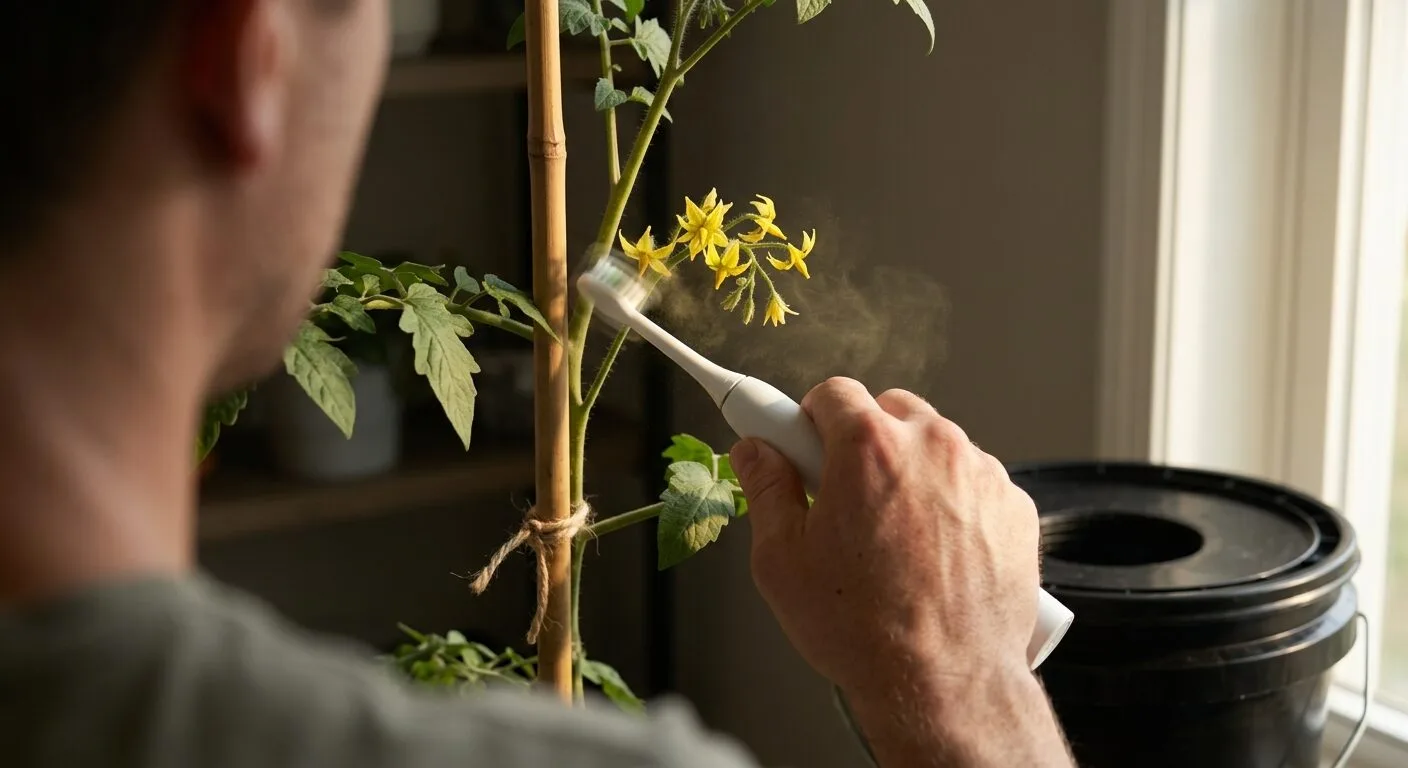
- Flick the back of each open flower cluster with a finger.
- Hold an electric toothbrush to the stem just behind a truss for a couple of seconds, which mimics a bumblebee well.
- Run a small clip fan on the plant for a few hours a day so the flowers are always moving.
You will know it worked when the flower shrivels and a tiny green bead swells behind it. A quiet clip-on fan does double duty here, moving pollen and cutting fungal risk. To estimate when those green beads turn red, run the numbers through the seed-to-harvest calculator.
✂️ Pruning Suckers on a Standard Cherry
A standard cherry throws side shoots, called suckers, from the V between the main stem and each leaf. Left alone, every sucker becomes a second vine, and indoors that is a light-blocking tangle in a month. Once a week, pinch out the small suckers with your fingers and cut the thicker ones with clean scissors, keeping the plant to one or two main stems. Leave the flower trusses and the large shade leaves. Dwarf varieties are the exception: they are bred to branch, so let them. The idea of steering a plant’s energy by cutting is the same one behind pruning hydroponic basil, just on a bigger plant.
🍃 Clearing the Lower Leaves
As the plant gains height, the bottom leaves fall into shade and stop earning their keep. Worse, they trap still air against the stem near the waterline, which is where fungal trouble starts. Strip the lower 4 to 6 inches of leaves once the plant is established, and take off any leaf that is yellowing from the bottom up or resting on the lid. It also makes your daily pH and EC checks far less of a fight through foliage.
🍅 Harvesting Cherry Tomatoes and Keeping the Plant Producing
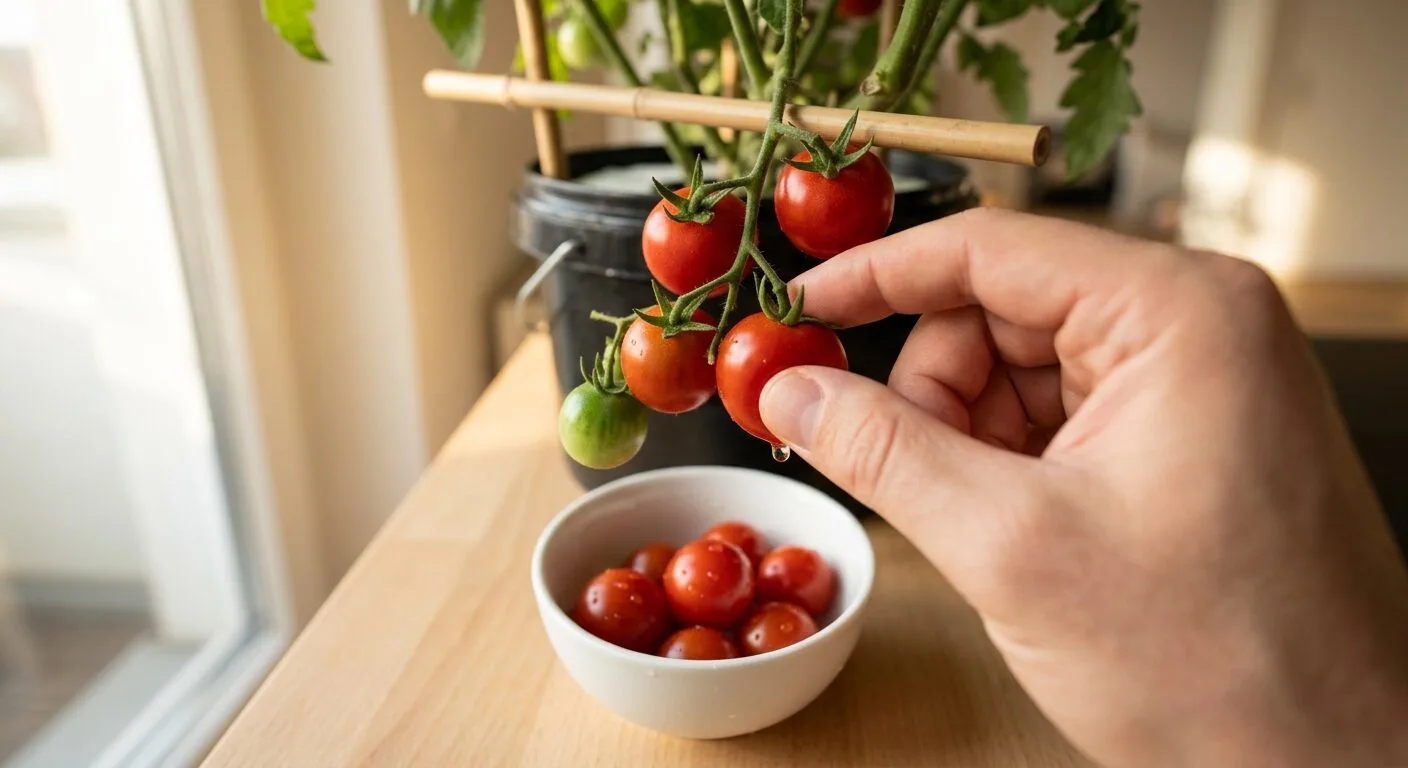
A well-run plant crops in rolling waves for months rather than all at once. First ripe fruit lands roughly 8 to 12 weeks after transplant, about 12 to 16 weeks from seed, with flowers showing 4 to 6 weeks after transplant. After that, expect to pick every 2 to 3 days.
🍅 Knowing When a Tomato Is Ripe Indoors
Under LED light, the skin can colour up before the inside is done. So judge by feel as much as by colour. A ripe cherry tomato is evenly coloured, gives slightly when you press it, and parts from the truss with a light twist. Taste the first one off a cluster before you strip the rest. If it is red but rock hard, leave it two more days, because the plant keeps pushing sugar in until the moment you pick.
📌 Why Fruit Splits, and How to Stop It
A split runs around or down the fruit when the inside swells faster than the skin can stretch. In a bucket, that almost always traces back to the water level dropping and then being refilled in one big slug, or to a sharp EC change at a reservoir swap. Keep the daily top-off consistent so the plant never gets a flood after a drought, hold humidity steady, and pick any fruit that shows a hairline crack that same day before it draws fruit flies.
❌ Keeping the Area Clean
An indoor tomato sheds spent flowers, leaf bits, and the odd split fruit every day. Left on the floor or the lid, that debris turns into a pest nursery. Sweep under the light every few days and wipe the bucket lid with a damp cloth when you do your checks. In a small space it is the difference between a tidy corner and a fungus gnat problem.
🛠️ What to Check First When Cherry Tomatoes Struggle
Problems move fast in a small bucket. An imbalance that would take a week to mark lettuce can stall a fruiting tomato in a day, so look at the roots and the newest leaves every time you top off. Healthy roots are white to tan and smell of almost nothing. A sour smell or pale new growth means act now, not tomorrow.
🔍 Quick diagnosis
| What you see | Most likely cause | Check first |
|---|---|---|
| Dark sunken patch on the fruit base | Blossom-end rot, because calcium is not reaching the fruit | Steady the EC near 2.2, then add Cal-Mag and cool the water |
| Flowers open, then drop with no fruit | Heat, weak light, or no pollination | Room temperature first, then light distance, then your daily shake |
| Pale new growth at the top | pH above 6.5, so iron locks out | Test pH, then bring it back to 6.0 |
| Crispy brown leaf tips on older leaves | EC too high, so the bucket over-concentrates | Dilute with plain water until it reads near 2.2 |
| Wilting even though the bucket is full | Root rot, because the water is warm and low on oxygen | Smell the roots, then check the pump and the water temperature |
⚠️ Flowers Drop Without Setting Fruit
This is the classic indoor tomato complaint. Work through it in order. Is the room drifting below 60°F at night or above 85°F by day? Is the light far enough back that the plant looks stretched and pale? Are you actually pollinating every day, or did you miss a few? Fix whichever one is true, and the next truss usually sets. Very dry air, under about 40 percent, also drops flowers, which is where the clip fan and a stable room help.
🚨 Brown, Slimy Roots
Brown, slippery roots and a swampy smell mean pythium or a relative has moved in, and it thrives in warm, poorly aerated water. Pull the plant, rinse the roots under cool water, and trim the mush away with sterile scissors. Clean the bucket, refill with cool fresh solution, and make sure the air stone is running hard. A bacterial root inoculant helps crowd the pathogen out. The root rot prevention guide covers the recovery and how to keep it from coming back.
🔍 Yellow Leaves and Leaf Bumps
Yellowing that starts on the lower leaves and creeps up is usually a feeding or pH issue, and pH comes first: above 6.5 the roots cannot take up what is already in the water. Correct pH to 6.0 and wait 48 hours before touching the nutrients. The yellow leaf fix guide runs the full checklist. Small crystal-like bumps on the underside of a leaf are edema, which is water going in faster than it leaves through the foliage; more airflow and a slightly drier room clear it.
📚 Want to see where these numbers come from? The cherry tomato section of the crop sources page shows the sources behind each growing number, with a label for how well each one is backed.
💬 A Word From Sarah
The first indoor truss I ripened, on a ‘Tiny Tim’, came out with brown leathery patches on the underside of nearly every fruit. I read that as a calcium shortage and poured in more Cal-Mag. It kept happening. What actually fixed it was dull: I had been topping the bucket up with half-strength nutrient on some days and plain water on others, so the EC wandered between roughly 1.9 and 2.8 across the week. Once I switched to plain water only for top-offs and held the reservoir at a flat 2.2, the next truss set clean. In a small bucket, blossom-end rot is usually an EC-stability problem wearing a calcium costume.
❓ Frequently Asked Questions
☀️ Can I grow hydroponic cherry tomatoes indoors without any sunlight?
Yes, with a dedicated LED grow light. A fruiting tomato needs a PPFD of 400 to 600 across the canopy, a DLI of 20 or more, roughly a 100-watt panel for one plant, run 14 hours on and 10 off. Ambient room light or a clip lamp will not set fruit. Keep the panel 8 to 12 inches above the leaves.
📦 What size container does one cherry tomato plant need?
Give one plant a full 5-gallon bucket in a deep water culture setup, with a 3 to 6 inch net cup in the lid. Anything smaller runs dry between top-offs, because a fruiting plant drinks fast, and it also swings in temperature and nutrient strength far too quickly to stay healthy.
💧 How often do I change the water for hydroponic tomatoes?
Top the reservoir off every day with plain, pH-adjusted water, never with nutrient mix. Do a full reservoir change every 2 weeks: empty it, rinse it, and refill with fresh solution. Heavy feeders like tomatoes leave imbalances behind between changes, so the fixed interval matters.
🔊 Do I need an air pump, and how loud is it in an apartment?
A deep water culture bucket needs an air pump running around the clock to keep oxygen in the water. A quality diaphragm pump makes a low hum, close to a small aquarium. Set it on a foam pad or a folded towel to stop the vibration carrying into a desk or floor.
💡 How much will a grow light for tomatoes add to my power bill?
A 100-watt LED panel run 14 hours a day uses about 1.4 kWh daily, or roughly 42 kWh a month. At common electricity rates that works out to about 5 to 8 dollars a month. The fruit you pick over a season usually more than covers it.
⚠️ Why are my tomato flowers falling off without setting fruit?
Flower drop is a stress signal. The usual causes are a room below 60°F at night or above 85°F by day, light too weak or too far away, dry air under 40 percent humidity, or no hand pollination. Shake the flower trusses daily and steady the room temperature, and the next set usually holds.
🧪 What EC and pH do hydroponic cherry tomatoes need?
Hold pH between 5.8 and 6.5, aiming for 6.0. Start seedlings at EC 1.0 to 1.2, move to 1.8 to 2.2 in the leafy stage, then hold 2.0 to 2.5 once trusses set. Keeping the fruiting EC steady near 2.2 matters more than the exact figure.
⏳ How long until the first ripe cherry tomato?
Plan on 8 to 12 weeks from transplant, or about 12 to 16 weeks from seed, to the first ripe fruit indoors. Flowers usually appear 4 to 6 weeks after transplant, and fruit takes several more weeks to colour and sweeten. After the first pick, a healthy plant produces every 2 to 3 days for months.
🍅 Do hydroponic cherry tomatoes taste as good as soil-grown?
They can taste excellent, and a well-lit indoor plant often beats a shaded outdoor one. Flavour tracks light and ripeness more than the growing method. Give it strong light, hold EC steady in the fruiting range, and leave fruit on the truss until it is fully coloured and slightly soft.
🪴 Can I grow cherry tomatoes in a studio or one-bedroom apartment?
Yes, if you pick a dwarf variety like ‘Red Robin’ or ‘Tiny Tim’ that stays under about 14 inches. A 5-gallon bucket and a shelf light fit in a corner. Standard cherry types run 2 to 4 feet and need vertical space plus weekly pruning, so they are a harder fit in a small room.
🌱 Can I move a soil tomato seedling into a hydroponic bucket?
You can, while the plant is small. Soak the root ball in lukewarm water and tease the soil away gently until the roots are bare, then set it into a net cup with clay pebbles. Expect a week of sulking. Starting from seed in rockwool is cleaner and avoids importing soil pests.
Happy growing! 🌿
Sarah, Urban Hydro Space

Sarah Whitfield is the founder of Urban Hydro Space and an indoor gardening enthusiast dedicated to helping apartment dwellers grow fresh herbs and vegetables in small spaces. She researches hydroponic systems carefully from real specifications and verified buyer feedback, and shares practical tips and honest, clearly labeled product picks to make indoor gardening accessible for beginners.