⏳ 20 min read · Last updated: September 2026
My first basil plant grew tall, reached the grow light, burned its top leaves, and shaded everything else in the system. I had never learned how to prune hydroponic basil so I kept waiting for it to look ready while it raced upward toward the diodes. When the top leaves turned crispy and brown, I tipped the whole jar into the compost and assumed I had made some fundamental mistake with the water chemistry. The real problem was far simpler. I had not made a single cut.
Pruning feels counterintuitive at first, because cutting a plant to make it grow more sounds like bad logic. However, once you understand what drives vertical growth, the technique makes immediate sense. This guide covers the core node-cutting method, the correct approach for six other apartment herbs, and how to adjust your reservoir after each harvest. If you are still setting up, start with the complete apartment hydroponics beginner’s guide.
- Always cut just above a node so the plant branches outward rather than climbing.
- Start trimming when herbs reach 6 to 8 inches tall.
- Drop EC to 1.2 to 1.5 temporarily after a heavy harvest so stressed roots can recover.
- Keep lights 6 to 8 inches above the canopy after cutting so new branches get real intensity.
- Never take more than one third of the foliage in one session, however overgrown the plant looks.
- Top off daily with plain pH-adjusted water and run a full change every 2 weeks.
📐 Pruning Method By Herb
Not every herb takes the same cut, and the method you use to prune hydroponic basil suits only some of them. Match your plant to its growth structure below before you pick up the shears, because using the basil method on a rosette herb removes the crown and ends production entirely.
Harvest windows above match my guide to the 7 best herbs for small hydroponics which carries the full growing detail for each crop. Cut difficulty here refers to the pruning technique only, rather than to how hard the plant is to grow.
- Never pruned anything before → sweet basil, which forgives mistakes fastest
- Want a cut you cannot really get wrong → chives
- Ready for the trickier method → parsley or cilantro, cutting outer stems only
- Pruning Method By Herb
- Why Pruning Matters in Small Spaces
- The Core Technique: How to Prune Hydroponic Basil
- When Not To Prune
- Managing Your Reservoir After a Major Harvest
- Pruning Other Common Apartment Herbs
- Lighting and Spacing for Bushier Herbs
- What to Do With Your Cuttings
- Identifying Plant Stress After Pruning
- A Word From Sarah
- Frequently Asked Questions
🌿 Why Pruning Matters in Small Spaces
Learning to prune hydroponic basil matters most in a small apartment, where vertical space is your scarcest resource. After all, most countertop setups offer only a foot or two of clearance between the water surface and the light. So if basil races upward unchecked, it burns against the diodes, shades the plants below it, and becomes unstable under the weight of its own canopy.
An unpruned herb also pours all its energy into a single stalk, producing what gardeners call leggy growth: wide gaps between leaves, sparse foliage, and a weak centre stem. When you cut the top, that energy redirects into side branches. One stem becomes two, then prune those two a few weeks later and you have four leaders. That is how a dense canopy fits in a jar on a shelf.
👑 The Apical Dominance Concept
You prune hydroponic basil above a node because of apical dominance. The highest growing tip produces hormones called auxins, which travel down the stem and suppress the side buds. Without a cut, the main stem can keep climbing rather than branching.
Removing that tip therefore eliminates the source of the suppressing hormone. As a result, the dormant side buds respond within a few days and push outward into new branches. This is not a side effect of pruning, it is the entire point, and understanding the mechanism makes it far easier to cut with confidence rather than hesitation.
📏 Keeping Plants Away from the Grow Lights
LED panels put out localised heat at close range even when they feel cool from a distance. Leaves touching the diodes show burn within hours, appearing as crispy bleached patches that ruin flavour and appearance alike. Regular trimming keeps the canopy in the safe zone.
Generally, the standard for leafy herbs is 6 to 8 inches between canopy and panel. If your system has a fixed hood that cannot be raised, pruning is your only lever. After each session, measure from the new highest leaf to the diodes and adjust. The free grow light calculator gives exact hang heights for your setup, and my guide on grow light burn shows what damage looks like.
⚖️ Preventing Top-Heavy Tipping
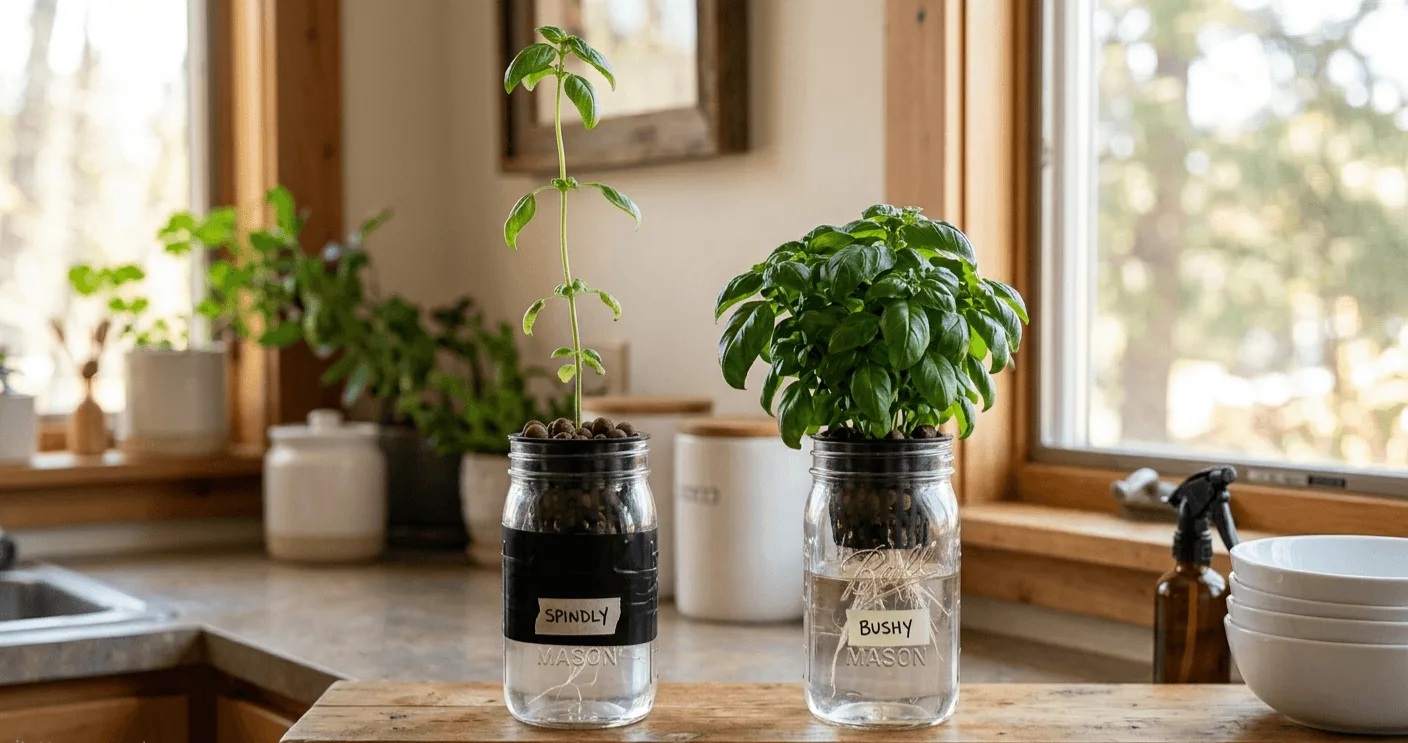
A tall unpruned herb in a Kratky jar on a sunny windowsill acts like a sail near an open window or a fan. It catches the draft, rocks, and tips the jar, and a spilled reservoir on hardwood is both a frustrating cleanup and a total loss of nutrients.
Keeping growth low and compact holds the centre of gravity near the base. A wide bushy plant in a mason jar is considerably more stable than a tall spindly one in the same container, which matters most in studios where jars sit on narrow ledges.
✂️ The Core Technique: How to Prune Hydroponic Basil
Knowing how to prune hydroponic basil starts with plant anatomy. You cannot cut at a random point and expect good results, since the location of the cut decides whether the plant branches or stalls. Thirty seconds of inspection before you touch the shears is worth it every time.
Tool choice matters too. Dull scissors crush stem tissue rather than slicing it, and crushed tissue heals slowly while inviting bacterial infection. Dedicate a small pair of bypass shears to your indoor garden and keep them sharp. Basic clippers from a countertop hydroponic system work to start, though micro-snips make a real difference once you prune regularly.
🔍 Finding the Correct Leaf Node
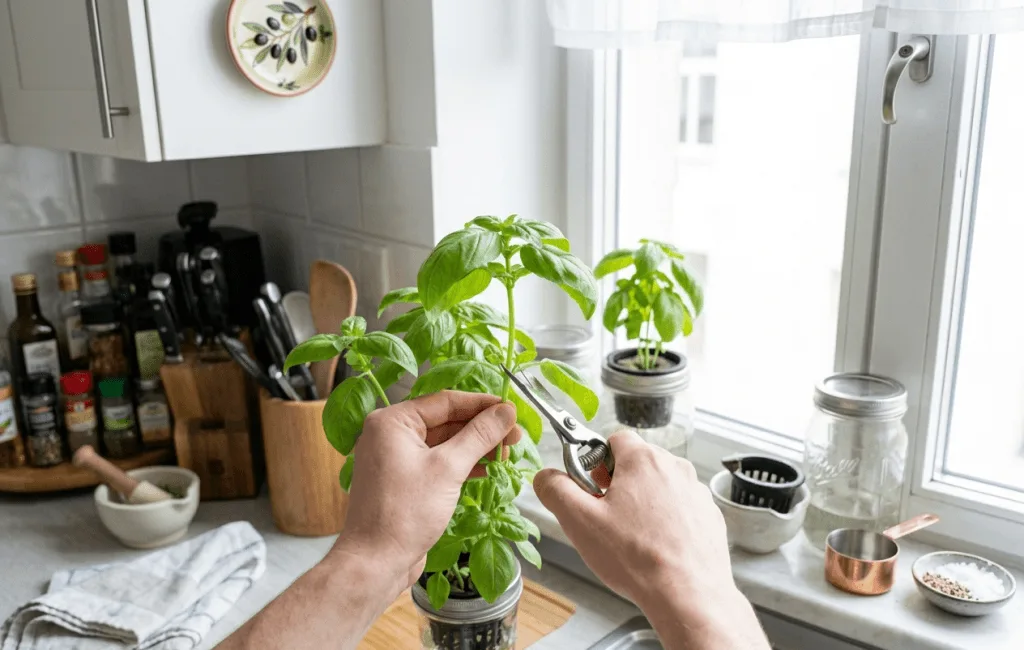
Inspect the main stem closely first. You will see points where large leaves branch off, and those are the nodes. At the base of each leaf, where it meets the central stem, two tiny leaflets sit dormant. Those axillary buds become your new branches after the cut.
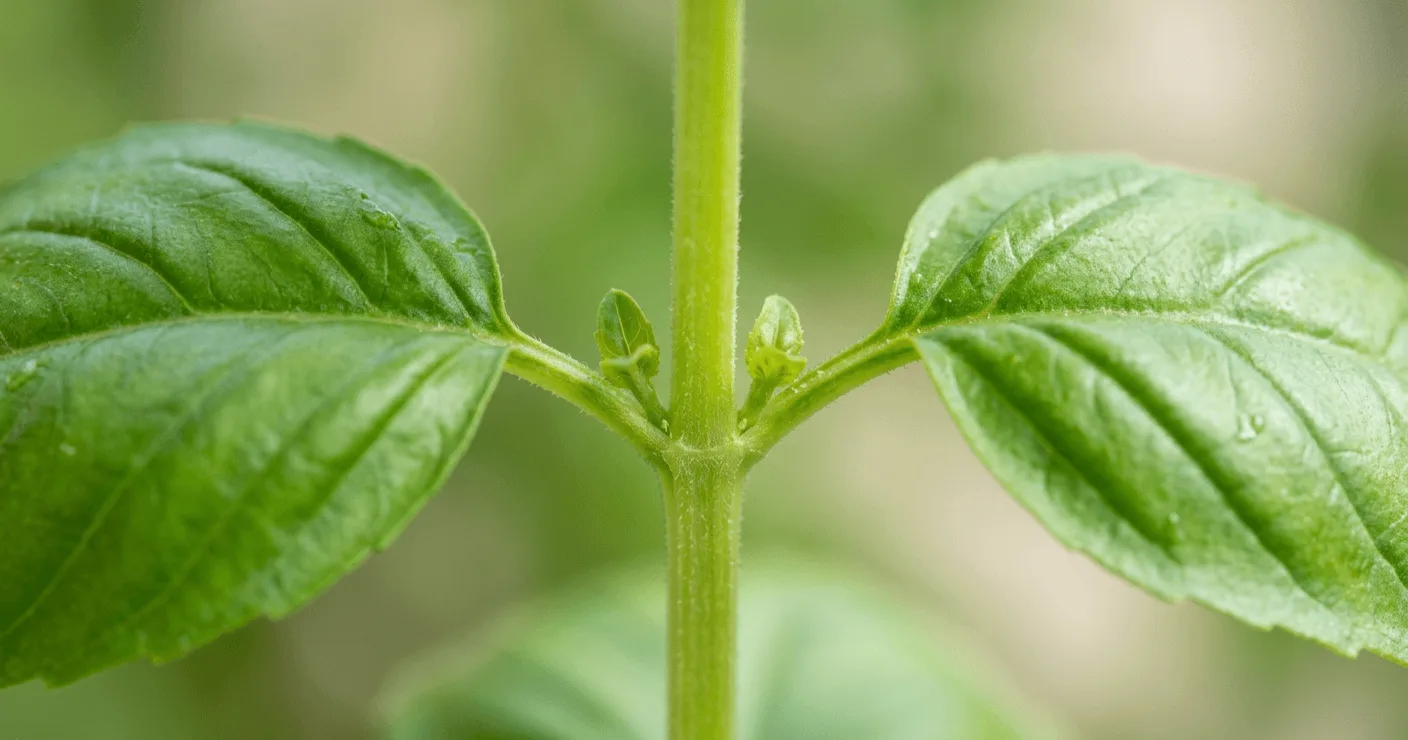
Your target is to cut just above a node roughly a quarter inch above those leaflets. Cut in the middle of bare stem between nodes and the stump below will brown and rot instead. Find a healthy node about one third down from the top and mark that as your point.
📐 Making a Clean Angled Cut
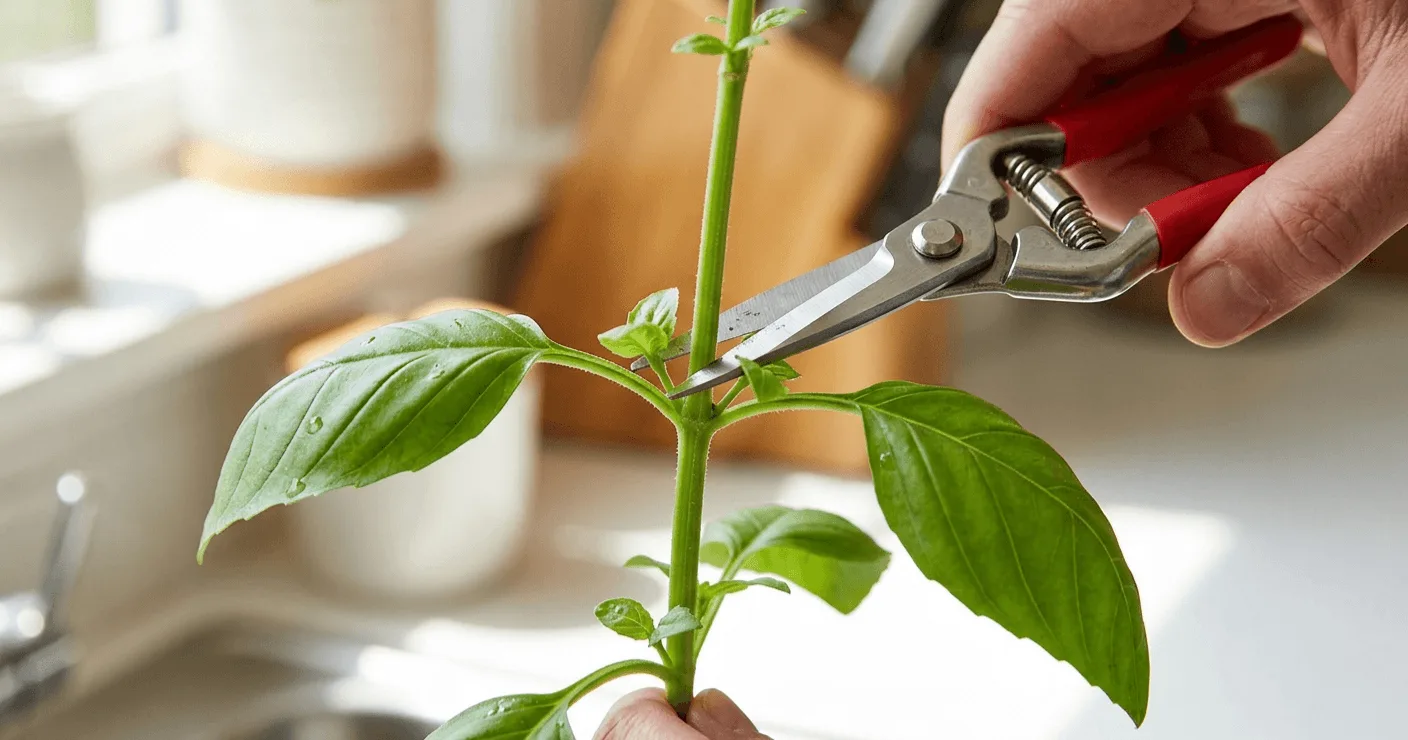
Position the shears a quarter inch above your node and tilt the blade slightly for an angled cut. The angle is practical rather than cosmetic, since water droplets slide off a slanted surface instead of pooling on the wound. Pooled water on a flat cut is one of the faster routes to stem rot in a humid kitchen.
Squeeze once, firmly. You want a single clean slice rather than a sawing motion. Afterwards you will see the two axillary buds sitting just below the cut, and those become your next two leaders within about a week.
🧽 Sterilizing Your Shears
Clean the blades before every session. Isopropyl alcohol or diluted hydrogen peroxide both work, although frequent alcohol use degrades the coating on cheaper blades over time. A safer daily habit is hot soapy water to lift sap and bacteria, then drying before storage. Dry shears do not rust and are ready to go next time.
🩹 What to Do If You Prune Too Much
If you strip most of the canopy preparing a large batch for cooking, the plant struggles to photosynthesise. Roots become stressed when the foliage above drops suddenly, and the plant can decline fast under full-strength nutrients and bright light. Do not panic, but act the same day:
- Move the plant somewhere slightly dimmer to reduce immediate light stress.
- Dilute the reservoir by adding roughly 30% plain pH-adjusted water to drop the EC.
- Check the root mass for any foul smell or slimy texture.
- Wait 3 to 5 days for axillary buds to swell before restoring full light.
🛑 When Not To Prune
You should prune hydroponic basil on a regular rhythm, though there are four moments when cutting is the wrong move. Cutting in any of these situations sets the plant back rather than pushing it forward.
- Before 6 inches. A seedling has too little leaf area to fuel regrowth, so cutting early stunts it instead of branching it.
- Within a week of transplanting. The plant is already spending energy on root establishment, and adding a second stress slows both.
- While the plant is visibly sick. Yellowing, wilting, or root rot need fixing first. Pruning a struggling plant removes the foliage it needs to recover.
- Immediately after a full reservoir change. Give it two or three days to settle into the new solution before you cut.
The one exception is flower buds, which you should pinch off the moment you see them regardless of anything else happening. Once basil bolts, leaf flavour turns bitter and the plant redirects energy toward seed.
💧 Managing Your Reservoir After a Major Harvest
When you prune hydroponic basil hard, the plant’s metabolic rate drops with the canopy. Fewer leaves means less transpiration, less water uptake, and less nutrient absorption. So if you leave the concentration at peak levels, roots take up more dissolved salts than the plant can use, and the result is tip burn and leaf curl on the new growth.
Adjusting the reservoir on the same day you cut is easy to skip, and skipping it is one of the more common reasons a recovery stalls.
🧪 Adjusting EC After Pruning
Mature basil in active growth wants EC 1.0 to 1.6, nudged toward 1.8 in winter. Immediately after a heavy harvest, hold it at the gentle end, EC 1.2 to 1.5, diluting with plain pH-adjusted water if it reads higher. Hold it there until new branches push full-sized leaves, usually 4 to 7 days, then raise it back gradually.
Use the free pH and nutrient calculator to work out dose adjustments without recalculating each time. For which formulas behave well in small reservoirs, see the best hydroponic nutrients for small apartment systems and my beginner feeding schedule.
🚰 Watching for Nutrient Lockout
As a plant recovers it absorbs specific ions unevenly, which shifts reservoir pH. If pH drifts outside 5.5 to 6.5 roots cannot take up iron or calcium even though both sit in the water. The visible sign is new leaves coming in pale yellow with dark green veins, and that pattern means pH drift rather than an actual iron shortage.
Check pH daily for the first week after a heavy harvest. A reliable digital meter makes that quick, and my review of the best pH meter for hydroponics beginners covers the one I use. If pH has drifted badly, replace the reservoir with a fresh balanced batch rather than fighting the existing water. My guide on fixing yellow leaves in apartment hydroponics walks the diagnosis through step by step.
🌊 Keeping the Water Oxygenated
Oxygenated water helps stressed roots recover faster. In an active DWC setup the air pump handles this automatically. If vibration bothers you in a small flat, rest the unit on a thick silicone or folded yoga mat, and my guide to a quiet hydroponic pump in an apartment covers persistent noise. Do not switch the pump off during recovery, since roots under post-pruning stress need more oxygen rather than less.
🎴 Pruning Other Common Apartment Herbs
The method you use to prune hydroponic basil also works on mint and sage, because all three share a central stem with clear apical dominance. Apply it to a rosette herb like cilantro, however, and you cut out the crown where every new leaf originates. Different structures need different approaches, and getting this right decides whether a plant produces for months or stops after one harvest.
| Growth Structure | Examples | Correct Method |
|---|---|---|
| Central stem, apical | Basil, mint, sage | Cut above a healthy leaf node |
| Rosette forming | Cilantro, parsley | Remove outer older stems at the base |
| Grass-like clump | Chives, scallions | Trim leaving 1 to 2 inches standing |
| Woody trailing | Oregano, thyme | Pinch the soft green tips only |
🌱 Taming Aggressive Mint
Mint sends horizontal runners toward neighbouring net cups and tries to root into them. Left alone in a shared reservoir it crowds out slower herbs within weeks. Inspect the base weekly, and when you see horizontal stems reaching outward, snip them at the root crown.
Mint recovers fast, so you can harvest from it often. One rule matters above the rest: never let the roots dry out while it is pushing new foliage, since drying roots mid-flush causes wilting that looks exactly like a nutrient problem but is not.
🔪 Trimming Parsley and Cilantro
Both grow from a central basal rosette, sending leaf stalks up from a tight cluster rather than from one woody stem. Cutting the centre destroys the growing crown and ends production, so harvest from the outside in.
Identify the oldest, largest leaves forming the outer ring. Follow each stem down and cut about an inch above the net cup, leaving the inner younger leaves alone to mature into the next ring. That gives you a continuous supply rather than one big harvest and a long wait. My guides on growing hydroponic parsley and hydroponic cilantro without bolting cover each crop fully.
🌾 Harvesting Chives Without Killing the Crown
Chives grow as a tight cluster of hollow tubes. Like cilantro, cutting flush with the medium usually prevents recovery. Instead, grab a small bunch and snip it, leaving 1 to 2 inches of green standing above the rockwool.
That remaining green keeps photosynthesising while the plant regrows from the cut tubes. New growth appears within 3 to 4 days on a standard 14-hour schedule.
🍃 Managing Oregano and Thyme
Oregano and thyme develop woody stems as they mature and trail over the reservoir edge rather than climbing. Pinch the soft green tips of trailing branches regularly to encourage lateral branching, which also stops the inner stems going bare, a state that is hard to reverse once it sets in.
Both sit closer to the light than leafy herbs, at 4 to 6 inches rather than 6 to 8. My full guide on growing hydroponic oregano indoors covers the rest of their care.
💡 Free tool
Is your light strong enough for bushy basil?
Leggy basil is usually a light problem, not a pruning one. The grow light calculator checks your light against your growing area. Here it is for a 60 by 30 cm shelf under an LED panel.
💡 Lighting and Spacing for Bushier Herbs
Learning to prune hydroponic basil solves the vertical growth problem, though light placement decides whether new branches develop well or stretch upward again hunting intensity. If the panel sits too far away after a cut, the plant senses low light and reverts to reaching, which undoes the work you just did with the shears.
🔆 Dropping the Lights After Cutting
After removing the top few inches, the canopy is suddenly further from the panel than before, and LED intensity falls off sharply over short distances. Lower the hood to restore the 6 to 8 inch gap to the new canopy top. My guide on grow light distance for hydroponic herbs on a shelf covers the numbers for common apartment panels.
⏱️ Light Schedule During Recovery
The site standard of 14 hours on, 10 hours off needs no adjustment during recovery. Consistency matters considerably more than extending the photoperiod, and plants recovering from a cut do best on a predictable cycle. To automate it and stop thinking about it, see my guide on the easiest light schedule for apartment hydroponics.
🌬️ Airflow Around Fresh Cuts
When you prune several plants on a crowded shelf, the canopy opens and airflow changes. Stagnant air around fresh cut sites is exactly what powdery mildew wants. A small oscillating clip fan on low dries cut stems within hours and strengthens the main stalks over time, which is a small addition with a large return in a humid kitchen. My guide on powdery mildew on indoor hydroponic herbs covers treatment if it takes hold.
Pruning only helps if the light is strong and steady enough for the new shoots. These roundups compare the options for a small apartment:
- Budget first: the best grow lights for low-light apartments under $50
- For a quiet countertop panel, the 3 best LED grow lights for countertop hydroponics
- To keep the schedule honest, compact timers that fit a crowded power strip
- And to size the panel, the free grow light calculator
🪴 What to Do With Your Cuttings
Every time you prune hydroponic basil you end up with a pile of healthy green stems on the counter, and binning them wastes both the plant’s energy and yours. Cuttings are useful in two directions, the kitchen and the propagation jar, so knowing which stems suit which purpose means nothing goes to waste.
💧 Rooting Cuttings for New Plants
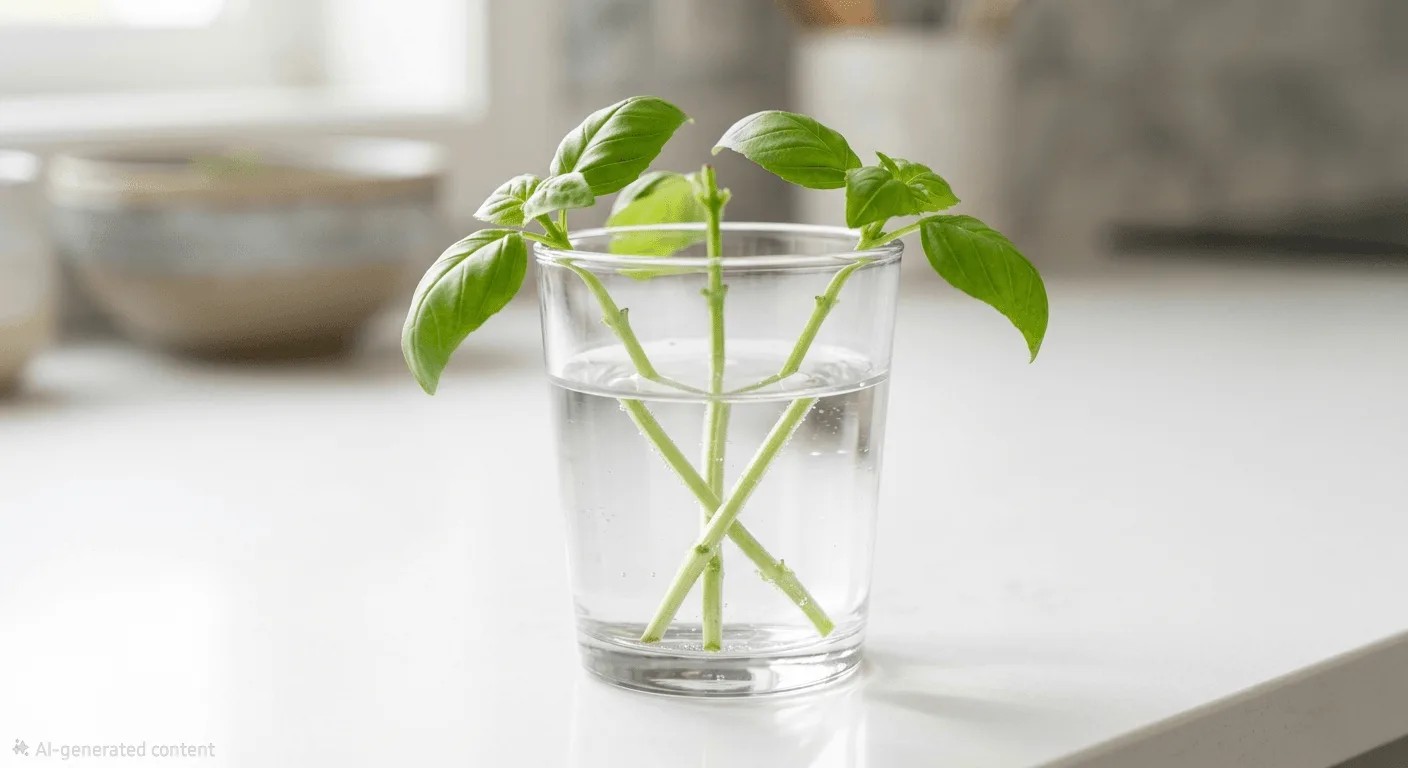
Healthy basil top cuttings can develop roots in water and become new plants. A cutting skips germination, though growth time still depends on light and temperature. To root one:
- Select a strong stem 3 to 4 inches long with at least two leaf pairs.
- Strip the lower leaves so only the top pair remains.
- Stand the bare stem in a small glass of plain tap water, out of direct light.
- Change the water every two days to stop bacteria building on the submerged stem.
- After about a week white roots appear. Transplant into a DWC or Kratky setup at EC 1.0 to 1.2 for the first few days.
❄️ Storing Fresh Basil for Cooking
Fresh basil blackens in the fridge within a day if stored wrong, because cold bursts the cell walls and destroys the aromatic oils. Wrap unwashed leaves loosely in a slightly damp paper towel, put the bundle in a partially open zip-top bag, and keep it in the warmest part of the fridge, usually the crisper drawer. Stored that way the leaves stay green and fragrant for about a week.
🥀 What to Do If Cuttings Wilt
A cutting sometimes collapses within 24 hours of going into water, and the cause is nearly always the same. The stem cannot draw moisture fast enough to support the leaves still attached, so it dehydrates despite sitting in water.
The fix is to remove half the remaining leaves, which cuts the moisture demand, and change the propagation water every two days to prevent slime on the stem. Most cuttings that wilt on day one stabilise within 48 hours once the leaf mass drops.
🦺 Identifying Plant Stress After Pruning
Even a clean, well-placed cut creates temporary stress when you prune hydroponic basil. The plant stays vulnerable for several days, and small reservoir imbalances it would normally shrug off become visible problems. Knowing what to watch for in that first week lets you intervene before damage becomes hard to reverse.
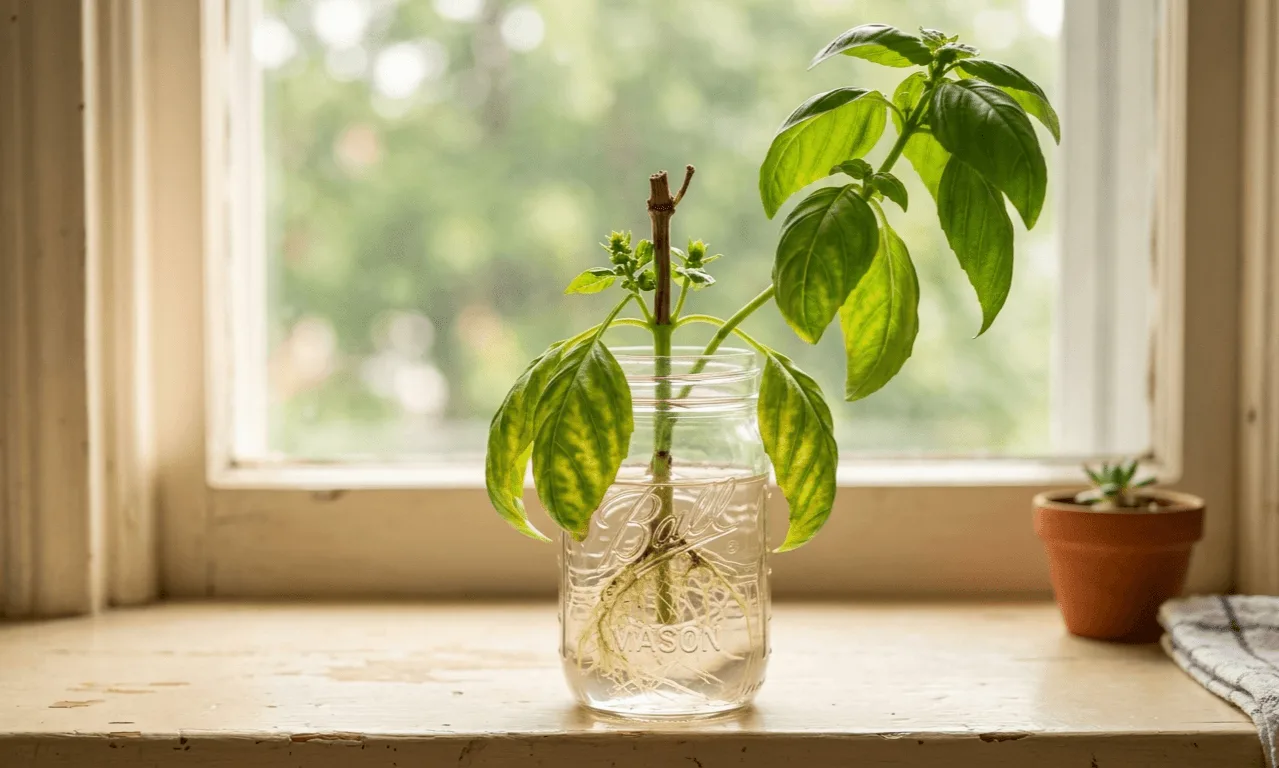
🔎 Post-pruning stress: quick diagnosis
| What you see | Most likely cause | Fix first |
|---|---|---|
| Brown, soft stump at the cut site | Stem rot from dirty shears or a flat cut | Sterilize shears, recut to the next healthy node |
| Yellow lower leaves after pruning | EC too low, plant cannibalising old leaves | Raise EC back to 1.5 if it has fallen below 1.2 |
| Crispy dark tips on new growth | Nutrient burn from excess EC in a smaller canopy | Flush and refill at EC 1.2 for 24 hours |
| No new buds after a week | Cut landed between nodes, not above one | Recut cleanly just above the next node down |
🧫 Spotting Stem Rot at the Cut Site
If you cut flat or used dirty shears, the exposed stump may turn brown and soft. That is early-stage stem rot, and left alone it travels down the stalk toward the roots. Sterilize your shears, cut down to the next healthy node, and make a clean angled cut this time. Catching it within two days keeps it away from the root system, and my guide on preventing root rot in small hydroponic systems covers the wider root-zone picture.
🍂 Fixing Yellow Leaves After a Heavy Prune
If older lower leaves pale a few days after cutting, the plant is pulling nitrogen out of them to fuel new branches. That happens when reservoir EC sits too low after dilution, so the plant cannibalises its oldest foliage instead. Check EC first, and if it is below 1.2, bring it back to 1.5 with fresh solution. The yellowing should stop within a few days.
🛑 Addressing Curled or Blackened Tips
Crispy dark tips on new growth point the opposite way, toward nutrient burn. The reduced canopy is absorbing more dissolved salts than it can process, and the excess concentrates at the tips. Flush the reservoir refill with plain pH-adjusted water for 24 hours, then reintroduce a mild mix at EC 1.2.
Once the plant stabilises and new leaves come in clean, the seed to harvest calculator helps you plan when the next cut is due.
→ University of Minnesota Extension: Small-Scale Hydroponics
→ University of New Hampshire Extension: Hydroponics at Home
💬 A Word From Sarah
The mistake that taught me the most about pruning was not cutting too much or too little. It was timing. I used to wait until the plant looked crowded before making any cuts, which meant I was always reacting to a problem rather than preventing one. The first time I pruned a basil plant at exactly 6 inches, before it showed any real sign of legginess, the result was different from anything I had seen. The two branches that came in were thicker than the original stem, and the plant produced usable harvests every ten days instead of every three weeks. Pruning early, before the plant needs it, beats waiting for a visible reason to cut.
❓ Frequently Asked Questions
📆 How often should I prune hydroponic basil?
Inspect weekly and prune every 2 to 3 weeks once the plant passes 6 inches. Small regular cuts beat one large removal every time. Once two main leaders establish, you will harvest on a steady rotation without any single cut being dramatic.
🛑 When should I not prune?
Skip pruning on plants under 6 inches, within a week of transplanting, while the plant looks sick, or immediately after a full reservoir change. In each case the plant is already spending energy elsewhere. Flower buds are the exception and should be pinched whenever they appear.
🪴 Can I root the cuttings I just took?
Yes. A healthy top cutting 3 to 4 inches long with the lower leaves stripped develops white roots in plain tap water within 7 to 10 days. Change the water every two days. Once roots reach half an inch, move it to a net cup at EC 1.0 to 1.2.
🔍 Why are new leaves coming in small after pruning?
Usually the light sits too far from the shortened canopy, or EC has dropped too low. Lower the panel to restore the 6 to 8 inch gap and confirm EC is still in the 1.2 to 1.5 recovery range. If it has fallen below 1.0, add fresh solution.
🌸 Should I prune if the plant is flowering?
Yes, immediately. Once basil bolts, surrounding leaves turn bitter and the plant shifts energy from foliage to seed. Pinch flower buds off at the node as soon as you spot them, which pushes the plant back into vegetative growth and extends the harvest by several weeks.
🦺 How much can I take in a single harvest?
Never more than one third of total foliage at once. Taking more limits photosynthesis during recovery, which stresses the roots and slows regrowth. If you need a large quantity for cooking, harvest lightly across several plants rather than stripping one.
✂️ Can I just use kitchen scissors?
Kitchen scissors work if they are clean and sharp. Dull blades can crush the stem instead of making a clean cut. Small pruning snips are easier to position above a node, but you do not need to buy a special tool for one basil plant.
🥬 Are the trimmings from pruning still good to eat?
Yes, and that is the point. Everything you cut in a routine prune is fully usable, since you are removing healthy growing tips rather than damaged material. Rinse and use them fresh, or root the strongest stems for new plants instead.
✂️ How to fix leggy basil?
Move the light closer only within its maker’s safe distance and give basil the site’s 14-hour daily light schedule. Once the plant has healthy nodes, cut just above a leaf pair so side shoots can develop. Pruning cannot shorten the old bare stem; new growth is the part you are shaping.
🌱 Does basil do well in hydroponics?
Yes, basil can be a strong small-system crop when it has enough light, room for roots and a suitable nutrient mix. It still needs regular water and pH checks. The pruning steps above help keep a compact plant productive instead of letting one tall stem dominate.
📋 How to prune hydroponic basil?
Find a healthy pair of leaves and cut the main stem just above that node with clean scissors. Leave enough foliage below the cut to keep the plant growing, then let the new side shoots develop before cutting again. Do not remove the growing point from a tiny seedling.
💧 What do overwatered basil leaves look like?
Yellowing, droop and soft growth can occur when roots lack oxygen, but those signs are not specific to overwatering. In hydroponics, inspect the roots, water level and aeration, then check pH and nutrient strength before diagnosing from leaves alone. A Kratky jar needs its air gap as the plant grows.
Happy growing! 🌿 Sarah, Urban Hydro Space

Sarah Whitfield is the founder of Urban Hydro Space and an indoor gardening enthusiast dedicated to helping apartment dwellers grow fresh herbs and vegetables in small spaces. She researches hydroponic systems carefully from real specifications and verified buyer feedback, and shares practical tips and honest, clearly labeled product picks to make indoor gardening accessible for beginners.