⏳ 19 min read · Last updated: September 2026
Hydroponic herb succession planting is the habit of never sowing everything at once. One jar is ready to cut, one is growing on, and one has just been sown. So the shelf hands you a harvest every week, instead of a glut followed by four empty jars. It sounds like extra work. In practice it is one new jar every few weeks and a label on each lid.
This guide gives you the rotation itself. It covers how many jars each herb needs, when to start the next one, how three ages of plant share one light and one feeding routine, and what to do when the schedule slips. It assumes you already have a jar or two running; if you don’t, start with my apartment hydroponics beginner’s guide and come back once the first basil is up.
📋 Succession Planting at a Glance
- Run three jars per herb: one producing, one growing on, one just sown.
- Cut-and-come-again herbs such as basil and parsley need a new jar every 8 weeks or so; short-lived cilantro and dill need one every 2 to 4 weeks.
- All ages share one light at 14 hours on, 10 off; you raise the young jars toward the panel instead of moving the light.
- Seedlings drink EC 1.0 to 1.2, then each crop moves to its own range. Jars that must share a reservoir meet at EC 1.5.
- Kratky jars are sized to last the crop and are not topped off daily; DWC gets plain water daily and a full change every 2 weeks.
- Starting from scratch? → read how the rotation works, then build the sowing schedule
- Jars already running at different ages? → jump to three ages under one light and feeding mixed jars
- Something has stalled? → go straight to when the rotation stalls
🔄 The Rotation in One Table
Every figure below counts from seed unless the cell says otherwise, and each crop’s own guide carries the full numbers. The “start the next jar” column is my scheduling rule, built from how long each crop stays productive.
🌱 How Hydroponic Herb Succession Planting Keeps the Shelf Producing
A single jar of basil gives you one big harvest and then a long wait, because the plant needs weeks to regrow and eventually turns woody. Succession planting spreads that wait across several jars at different ages. While one jar is being cut, the next is already halfway there, so the shelf never goes quiet.
🌿 Two Kinds of Herbs, Two Rhythms
The herbs on a small shelf fall into two groups, and each group wants a different rhythm.
Cut-and-come-again herbs keep producing after every harvest. Basil, mint, parsley and chives all regrow when you cut above a leaf node, so a single jar stays useful for months. For these you sow slowly, one new jar every two months or so, and you only need a second jar coming on when the first starts to slow down.
Short-lived crops give you a window and then quit. Cilantro bolts within 3 to 5 weeks of its first harvest, and dill flowers not long after. Loose-leaf lettuce gives 3 or 4 rounds of outer leaves before it slows or turns bitter. Here the sowing has to be frequent, every 2 to 4 weeks, because there is no long tail to lean on.
🔄 The Three-Jar Rule
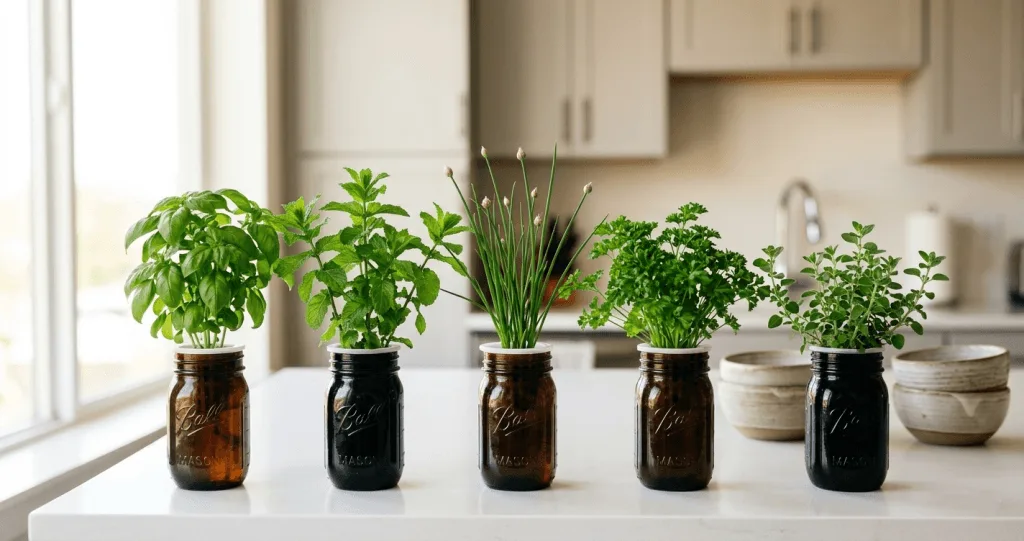
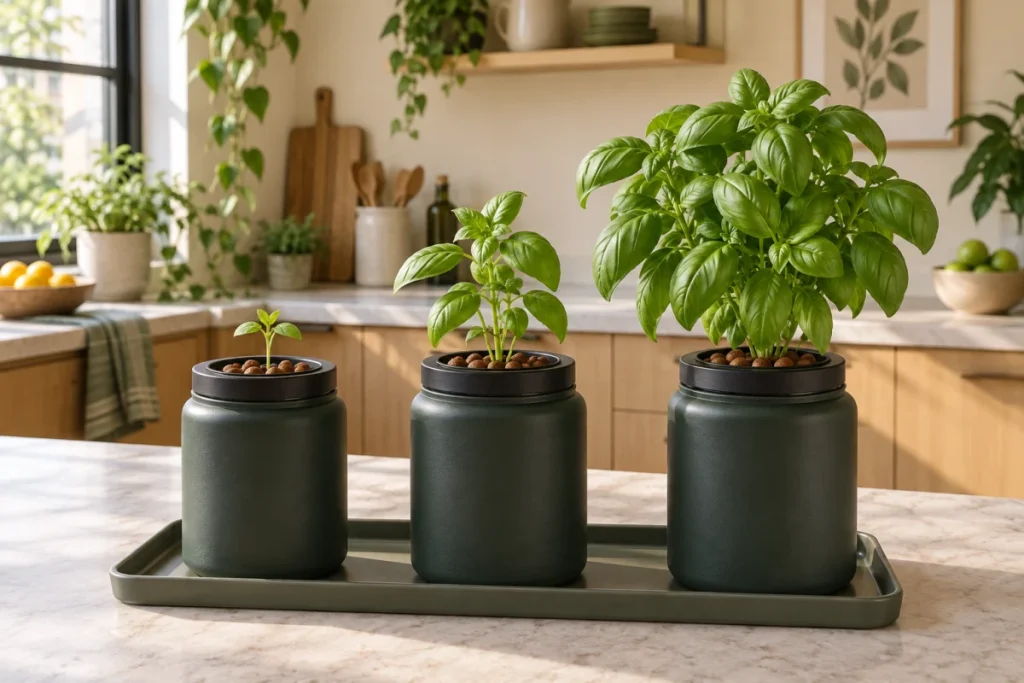
Three jars per herb is the rotation that fits a shelf and a beginner’s patience. One jar is at harvest size. The second is growing on and will take over in a few weeks. The third was sown recently and is still tiny. When the oldest jar gives up, the middle one steps in, the youngest becomes the middle, and you sow a replacement.
Salad growers sometimes run four jars of lettuce, because a fresh bowl every week asks for more overlap than basil does. Beyond four, the shelf turns into a nursery and the light stops being enough for the biggest plants. Instead of more jars, run the same three-jar rule on two herbs.
🥬 Which Herbs to Start With
Basil, loose-leaf lettuce and mint are the forgiving choices. Basil regrows fast once established, lettuce sprouts in days, and mint from a rooted cutting reaches its first cut in 4 to 5 weeks. Parsley works too, although its slow germination means you sow it earlier than feels natural.
Cilantro belongs in the second season, not the first. It is the fastest bolter on the shelf. It wants cooler air of 60 to 70°F (15 to 21°C) and water that never passes 75°F (24°C), and its whole productive life is a few weeks. The rotation handles that fine once you have the rhythm, but learn the rhythm on basil first. My guide to the best herbs for small hydroponics ranks the rest.
📅 Building the Sowing Schedule
A schedule is only useful if it is written down where you will see it. The jars themselves are the best place, and a calendar on the wall beside the shelf is the second best.
⏱️ Set Each Crop’s Clock From Seed
Germination is where most schedules slip, because seeds keep their own time. Basil sprouts in 3 to 7 days in a warm room of 70°F (21°C) or more, and takes up to 2 weeks somewhere cooler. Lettuce needs 2 to 5 days and needs light, so leave the hole in the plug open. Cilantro wants 7 to 10 days, dill 7 to 21, chives 7 to 14, and parsley anything from 14 to 30 days. A 24-hour soak helps parsley along.
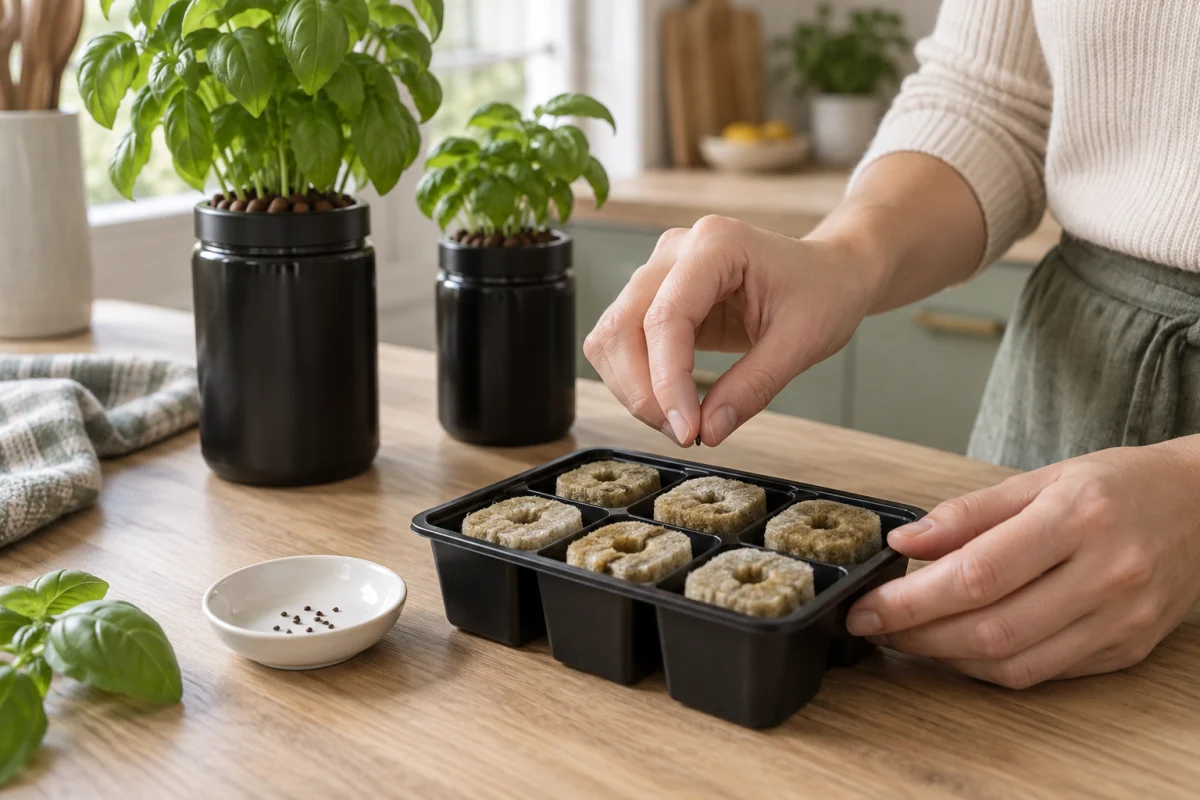
Then comes the run to the first harvest. Basil takes 5 to 6 weeks from seed, lettuce leaves 4 to 5 weeks, cilantro and dill 6 to 8, and chives 7 to 9. Rather than keep those in your head, enter the crop and the sowing date into the seed to harvest calculator. It turns them into dates you can write on a lid. For the seed-starting step itself, my guide to starting hydroponic seeds in rockwool covers the plugs and the pre-soak at pH 5.5.
📆 A 12-Week Calendar for Basil and Lettuce
Here is what the first three months look like with three jars of basil and three of loose-leaf lettuce, both sown from seed. The lettuce runs on a 3-week cycle and the basil on an 8-week cycle, so they rarely need attention in the same week.
Two things stand out in that table. Basil barely needs a second jar in the first three months, since one plant keeps giving cuts. The second jar exists so the shelf is covered when jar A goes woody in month four or five. Lettuce, on the other hand, needs a new jar every 3 weeks from the start, or week 9 arrives with nothing to pick.
🏷️ Label the Jar the Day You Sow It
Every jar gets a strip of painter’s tape on the lid with three lines: the crop, the sowing date, and the first-harvest date from the calculator. Write the date before the seed goes in, not after, because “later” is how two jars of basil end up with no dates at all.
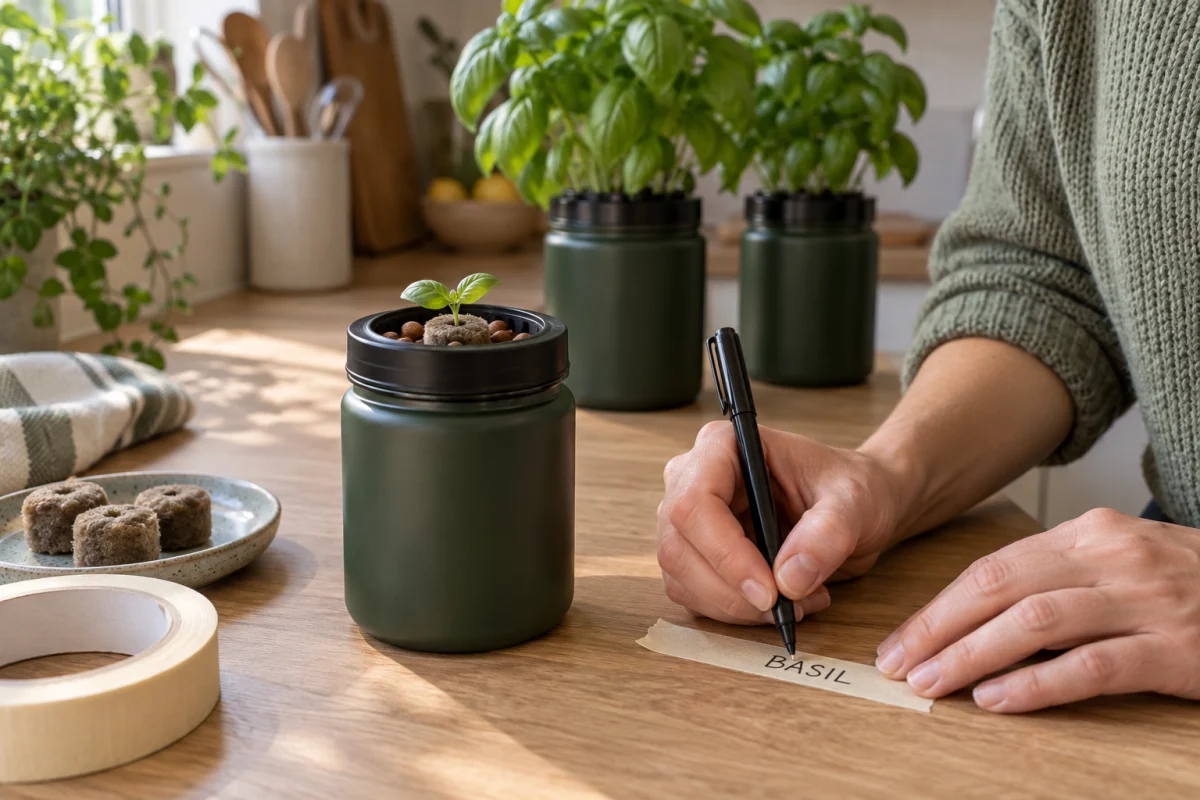
Labels also settle arguments with yourself. When a jar looks tired at week 14, the tape tells you it is at the end of its normal life rather than short of nutrients. So you sow a replacement instead of reaching for the fertilizer. Add a fourth line for the crop’s mature EC and you never have to look it up while mixing.
📏 Keep Two Crops on One Shelf, Not Five
The rotation works because each herb keeps its own lane. Mix five herbs across one row of jars and the timings collide. Parsley is still a speck when mint wants a permanent spot, and cilantro is bolting while the basil beside it is only just ready. So give each crop its own row or its own end of the shelf, and hold the shelf to two herbs until the rhythm is automatic. Then add a third.
💡 Three Ages Under One Grow Light
The awkward part of a rotation is that a two-day-old seedling and a two-month-old bush want the same light at different distances. You solve it with height and pruning, never by changing the schedule.
🕒 One Timer, One Schedule: 14 Hours On, 10 Off
Every jar on the herb shelf runs 14 hours on and 10 off, whatever its age. A mechanical or smart timer removes the human error, and my roundup of the best compact timers for apartment grow lights covers the models that fit behind a shelf. If you work days and want the light to run while you are home, the 9-to-5 light schedule shows how to shift the same 14 hours later without shortening them.
Resist the urge to run the light longer to hurry a late jar. The plants need the dark hours, and longer days are one of the two triggers that push cilantro and dill into flower, along with warm water.
📏 Height Is the Lever
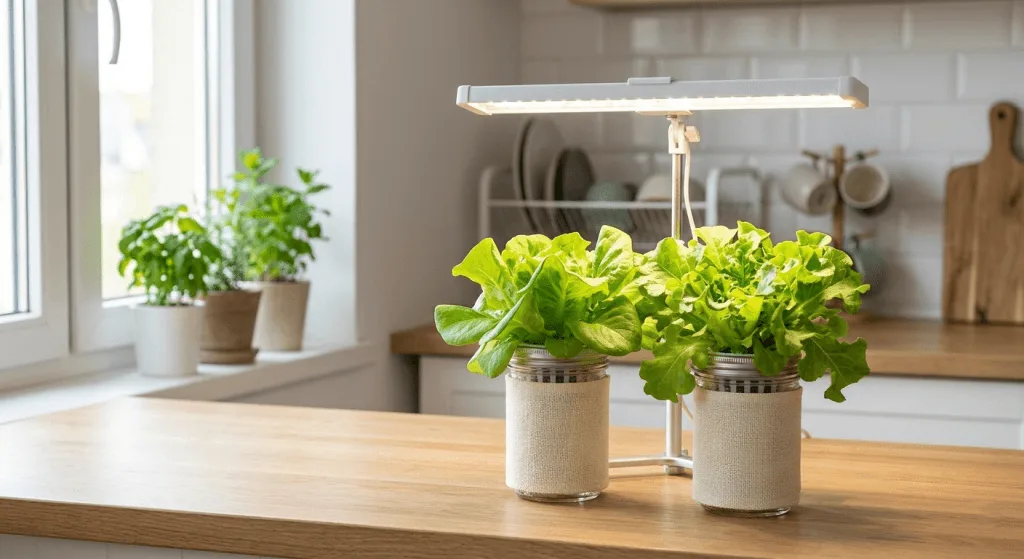
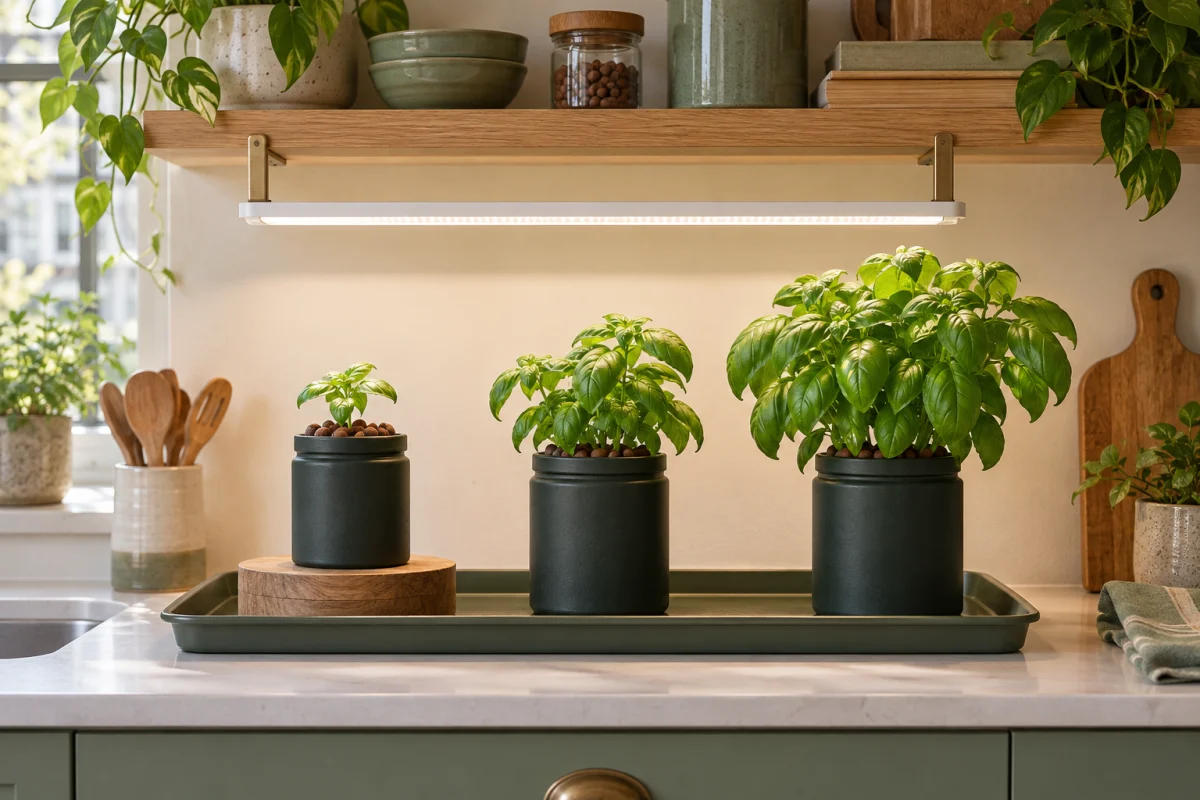
Seedlings sit 10 to 12 inches below the panel until their true leaves show. Leafy herbs and greens then move up to 6 to 8 inches. With one fixed light, you give each jar its distance by lifting the young jars on an upturned bowl or a block. Then you remove the block as the plant grows. The light never moves, so the mature jars stay where they are.
Those inches are a starting point for a typical home LED, not a specification, because a small bar and a big panel throw very different light from the same height. The real target is intensity at the leaves: about 240 to 340 µmol/m²/s for lettuce and 200 to 400 for basil. The grow light calculator turns your fixture and shelf size into a hang height. My herb shelf lighting layout then shows how to place the brightest centre of the panel over the youngest jars, since light falls off toward the edges.
✂️ Prune the Big Ones Before They Shade the Small Ones
By week six the oldest basil is wide enough to shade whatever sits beside it, and a shaded seedling stretches thin and pale within days. Cut the mature plant back first, always a quarter inch above a leaf node, even if you are not ready to use the leaves. My guide on how to prune hydroponic basil shows the cut, and pruning is exactly what keeps that jar producing for months anyway.
If a seedling has already stretched, lift it closer to the light and give it a week. The causes and fixes are in why hydroponic seedlings stay small under grow lights.
💨 Airflow Between Packed Jars
Three ages of plant on one shelf means dense leaves, and dense leaves trap moisture. Keep the room at 50 to 70 percent humidity and clip a small fan to the shelf upright. Aim it just above the canopy, so the top leaves move and the seedlings below are not blasted. The quiet clip-on fans I compared are sized for exactly this.
🧪 Feeding Jars of Different Ages
Feeding is where a rotation asks for a little discipline, because a seedling and a mature plant do not want the same strength. Individual jars make this easy. A shared reservoir makes it a compromise.
💧 Seedling Strength, Then the Crop’s Own Range
Every new jar starts at EC 1.0 to 1.2, whatever the crop. Once true leaves are out and the plant is growing on, it moves to its own mature range. Basil runs at 1.0 to 1.6, raised toward 1.8 in winter. Lettuce sits at 1.0 to 1.4, while cilantro, dill and parsley take 1.4 to 1.8. Chives want 1.8 to 2.0 and mint 2.0 to 2.4. Mint’s appetite is why it always gets its own jar and never shares a reservoir with seedlings.
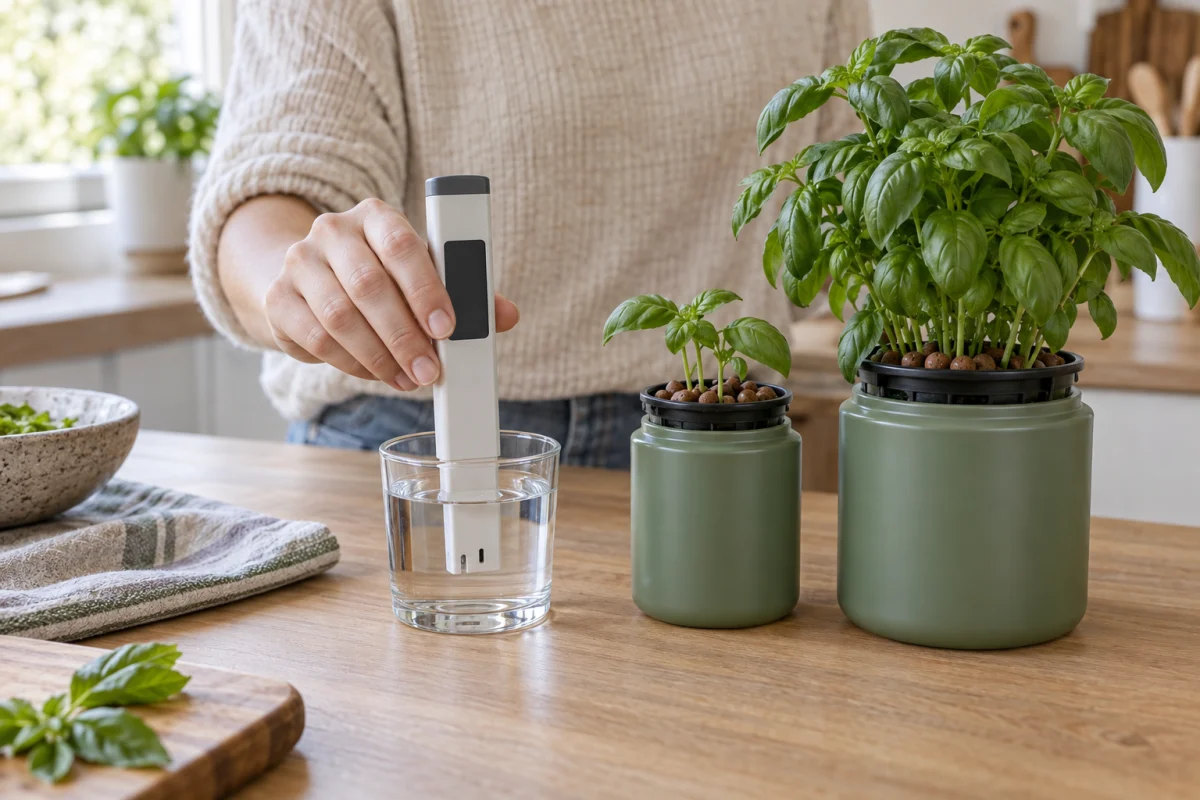
Hold pH at 5.5 to 6.5 for most herbs, and in the upper half of that, 6.0 to 6.5, for cilantro and chives. Check pH before you decide a pale plant is hungry, because an out-of-range pH locks nutrients out even when the EC reads right. The pH and nutrient calculator gives the starting dose for each jar size and crop, and my beginner nutrients guide explains the two numbers. With several jars at different strengths, an EC meter stops being optional; guessing strength across six jars is how tip burn starts.
⚖️ If Jars Share One Reservoir, Mix to EC 1.5
A small DWC tub with several net cups cannot feed each plant separately, so you mix to a middle value. On this site that compromise is EC 1.5: gentle enough for anything past the seedling stage, strong enough for basil and lettuce at full size. Keep mint out of a shared tub, and keep brand-new seedlings in their own jar at 1.0 to 1.2 until they have true leaves, then move them across.
Check the shared reservoir’s pH more often than you would a single jar, since several plants at different ages pull the chemistry around faster. The daily check is pH first, EC second.
🪴 Kratky Jars and DWC Follow Different Water Rules
This matters more in a rotation, because the two systems are often side by side on the same shelf.
A Kratky jar is sized so the solution lasts the crop, and it is not topped off daily. A quart is tight for a herb and a gallon carries a lettuce to harvest. The net cup starts with its bottom in the solution and the air gap forms on its own as the plant drinks. If a long crop runs low, add a little nutrient solution, not plain water, and raise the level by no more than about 1 inch (2 cm). Refilling higher drowns the roots that have started breathing air.
An active system such as a small DWC tub or a countertop garden is topped off daily with plain pH-adjusted water, never with nutrients. It also gets a full reservoir change every 2 weeks. My posts on how often to change hydroponic water and topping off without upsetting the mix go through both routines. In a rotation, put every active jar’s change on the same day of the fortnight regardless of age; one wet afternoon beats three.
🌡️ Keep the Water Cool and Dark
Roots want 65 to 75°F (18 to 24°C). Above 72°F (22°C) an active system needs an air stone, because warm water holds less oxygen, and above 75°F (24°C) root rot risk climbs fast. Cilantro has a hard ceiling at 75°F and bolts almost at once beyond it, so its jars live at the cool end of the shelf, away from the light’s heat. Cool a warm jar with a frozen bottle pressed against the outside of the container, or by moving the setup. Never drop ice cubes into the solution, because the swing shocks the roots and the effect fades within an hour. My post on keeping a small system at the right temperature has the summer routine.
Young jars are also the algae jars. A seedling’s tiny canopy shades nothing, so light reaches the solution and green film follows within days. Wrap every clear jar in tape or a sleeve before it goes under the light, and seat the net cup flush in the lid. If a jar has already turned green, the fix is in algae in hydroponic jars.
🩺 When the Rotation Stalls
Most stalls come down to one jar out of step. Find that jar, fix it, and the rest of the schedule stands.
🔎 Quick diagnosis table
| What you see | Most likely cause | Check this first |
|---|---|---|
| Nothing has sprouted after 2 weeks | Room too cool, or lettuce seed buried in the dark | Room at 70°F (21°C) or more for basil; light on the lettuce plug |
| New seedlings tall, thin and pale | Too far from the light, or shaded by an older jar | Lift the jar to 10 to 12 inches; prune the neighbour |
| Cilantro or dill flowering early | Water above 75°F (24°C), or the light left on too long | Water temperature, then the timer |
| Crisp brown leaf tips on the oldest jar | EC climbed as the plant drank the jar down | Test the EC, then dilute |
| Older jar yellowing while the young ones stay green | pH drifted out of range in the busiest jar | pH first, before adding anything |
🚨 A Jar That Never Sprouts
Give a seed its full window plus one week, then call it. For basil that is about 3 weeks, for parsley closer to 5. Sow two seeds per plug on the retry so one dud cannot cost you another fortnight, and warm the room if it has been sitting below 70°F (21°C). The gap in the schedule is real, but it is one gap, and the middle jar usually covers most of it.
📅 You Missed a Week
Sow the jar now and change nothing else. Running the light longer to make up time shortens the plants’ dark period and nudges cilantro and dill toward flowering, so it trades one problem for another. Accept a thin week and, if it is basil, buy a bunch from the shop that week; the rotation is back on track by the next sowing.
🚨 Tip Burn on the Oldest Jar
The biggest plant in the rotation drinks the fastest, and as the level drops the salts concentrate. Test the jar. If the EC has climbed past the crop’s range, pour out half the solution and refill with plain pH-adjusted water. Then hold the plant at EC 1.2 to 1.5 for 4 to 7 days while it recovers. My post on lowering EC in a small system has the arithmetic for a jar you have already mixed too strong.
✈️ Leaving for a Weekend
Kratky jars need nothing for a weekend, which is half the reason they suit a rotation. For an active system, top the reservoir off before you go and leave the timer alone. Also make sure the air pump sits above the water line or has a check valve. If the power tends to flicker where you live, what to do when hydroponics loses power covers the pump and the light.
Every pH, EC, temperature, light and first-harvest figure here is the one the crop guides on this site use. The crop sources page lists the university and extension source behind each of them. My sowing intervals in the rotation table, the three-jar rule, the EC 1.0 seedling floor and the EC 1.5 shared-reservoir compromise are my own house practice. I chose them because they are simple to keep and hard to get wrong. Light heights in inches are starting points for a typical home LED, not a research figure. For the wider picture of small systems, the University of Minnesota Extension guide to small-scale hydroponics is a good place to read further.
💬 A Word From Sarah
Sow the next jar the day you make the first cut, not the day the old jar gives out. A cut is easy to notice and a slow decline is not, so tie the sowing to the harvest and the rotation looks after itself. Keep the seed packets, a few plugs and a roll of tape in a box beside the shelf. The whole method fails the week the seeds are in a drawer somewhere else.
❓ Frequently Asked Questions
📅 How often should I sow a new jar of herbs?
It depends on how long the herb stays productive. Basil and parsley regrow for months after each cut, so a new jar every 8 weeks keeps you covered. Cilantro, dill and loose-leaf lettuce quit within a few weeks of the first harvest, so they need a new jar every 2 to 4 weeks.
🔄 How many jars do I need for a continuous harvest?
Three per herb is the working rule: one at harvest size, one growing on, one just sown. Lettuce for a weekly salad sometimes wants four. Past that, a small shelf runs short of light, so add a second herb rather than a fifth jar of the first.
🏢 Can I do this in a studio apartment?
Yes. Three quart jars of basil and three of lettuce fit on one shelf under one LED bar. The rotation takes no more room than the jars would anyway; it only changes when you sow them.
💡 Can seedlings and mature plants share one grow light?
Yes, on the same 14 hours on and 10 off. Lift the seedling jars so their leaves sit 10 to 12 inches below the panel, keep the mature herbs at 6 to 8 inches, and prune the big plants before they shade the small ones.
⚖️ Can plants of different ages share one reservoir?
They can once every plant has true leaves. Mix the shared solution to EC 1.5, keep brand-new seedlings in their own jar at EC 1.0 to 1.2 until then, and leave mint out because it wants far more. Check pH daily, since several ages of plant pull it around quickly.
💧 How often do I change the water in a rotation?
Active systems such as DWC get a plain-water top-off daily and a full reservoir change every 2 weeks; put every jar’s change on the same day whatever its age. Kratky jars are different: size them to last the crop and do not top them off daily.
⏱️ When should I start the replacement seeds?
Count back from when the current jar will give out. For basil, sow the next jar at the first cut, because it needs 5 to 6 weeks from seed and the old plant keeps producing meanwhile. For cilantro, sow every 2 to 3 weeks from the start, since each plant only gives 3 to 5 weeks.
🌡️ Why did my cilantro bolt before the next jar was ready?
Warm water and long days. Cilantro bolts almost immediately once the solution passes 75°F (24°C), and running the light past 14 hours pushes it the same way. Keep its jars at the cool end of the shelf and the timer at 14 on, 10 off, and treat cilantro as a 3 to 5 week crop that is always being resown.
🌱 Why do my new seedlings stretch and fall over?
They are too far from the light or shaded by an older plant. Raise the jar so the leaves sit 10 to 12 inches below the panel, prune back the neighbour that is casting the shadow, and give the seedling a week to thicken up.
🔌 Does a continuous rotation raise the power bill?
Not compared with growing the same jars all at once. The light runs the same 14 hours a day whether the jars are the same age or three different ages, and a small shelf LED of 20 to 36 real watts costs a few dollars a month. A Kratky rotation adds no pumps at all.

Sarah Whitfield is the founder of Urban Hydro Space and an indoor gardening enthusiast dedicated to helping apartment dwellers grow fresh herbs and vegetables in small spaces. She researches hydroponic systems carefully from real specifications and verified buyer feedback, and shares practical tips and honest, clearly labeled product picks to make indoor gardening accessible for beginners.