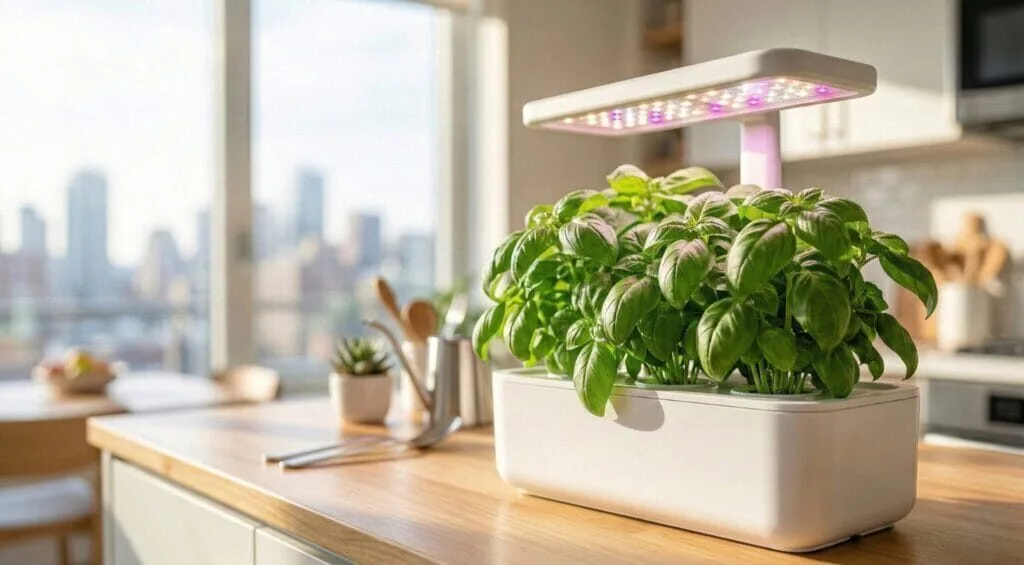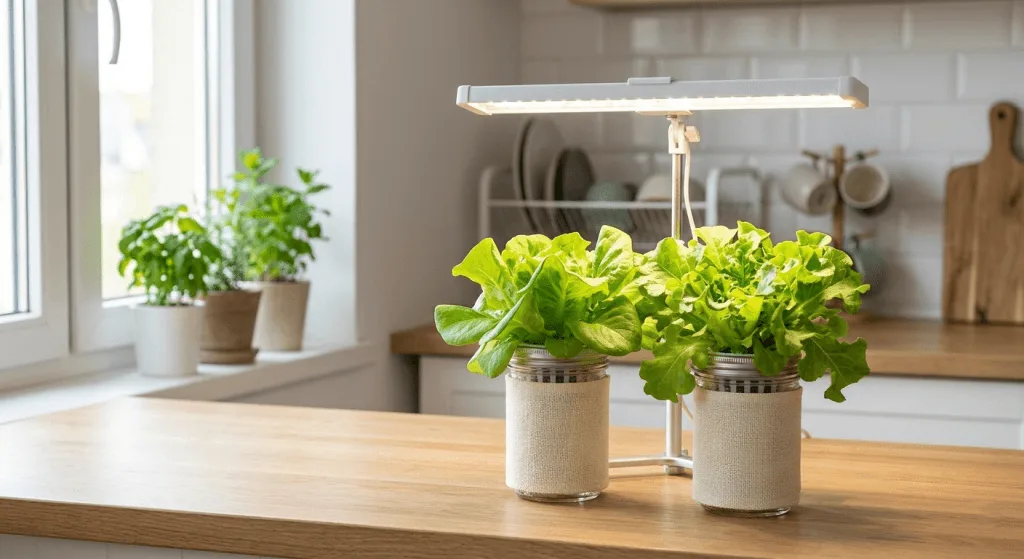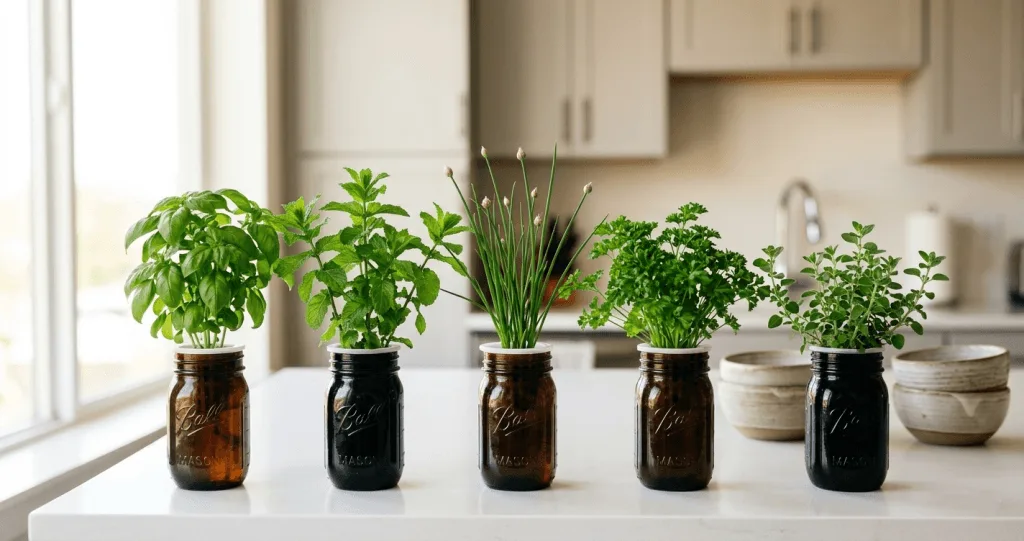
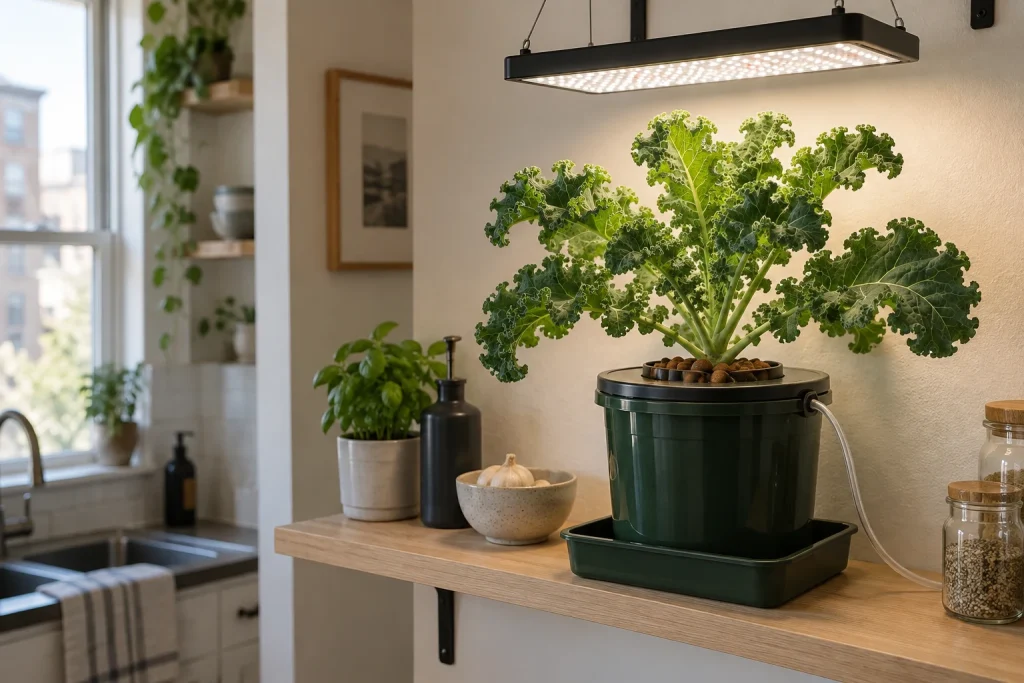
Your hydroponic kale apartment setup can fit on a shelf, but the container has to match the harvest you want. A small jar can raise baby leaves for an early harvest. Meanwhile, a mature cut-and-come-again plant needs more root space, more water, and usually an aerated reservoir.
This guide gives you two practical plans: a quiet Kratky container for baby kale and a 2- to 3-gallon DWC system for a longer-lived plant. You will also get the site-standard pH, EC, light, temperature, and harvest targets, plus a troubleshooting order that starts with measurements instead of guesswork.
- Use a 1-gallon light-proof container for baby kale or a 2- to 3-gallon DWC reservoir for one full plant.
- Keep pH at 5.5 to 6.5. Feed seedlings at EC 1.0 to 1.2 and established plants at EC 1.6 to 2.0.
- Run the grow light 14 hours on and 10 hours off. Start a typical LED about 6 to 8 inches above the canopy, then respond to the plant and the fixture.
- Harvest the oldest outer leaves every 5 to 7 days while leaving the central growing point intact.
- In Kratky, let the level fall to create an air gap. Do not refill the container to the brim.
| Decision | Baby-leaf plan | Full-plant plan |
|---|---|---|
| System | Kratky or DWC | DWC preferred |
| Reservoir | At least 1 gallon | 2 to 3 gallons for one plant |
| First harvest | About 30 to 45 days | About 45 to 60 days |
| Best reason to choose it | Small footprint and early salads | Repeated outer-leaf harvests |
🥬 Choose Your Hydroponic Kale Apartment Plan
Baby leaves or a full plant?
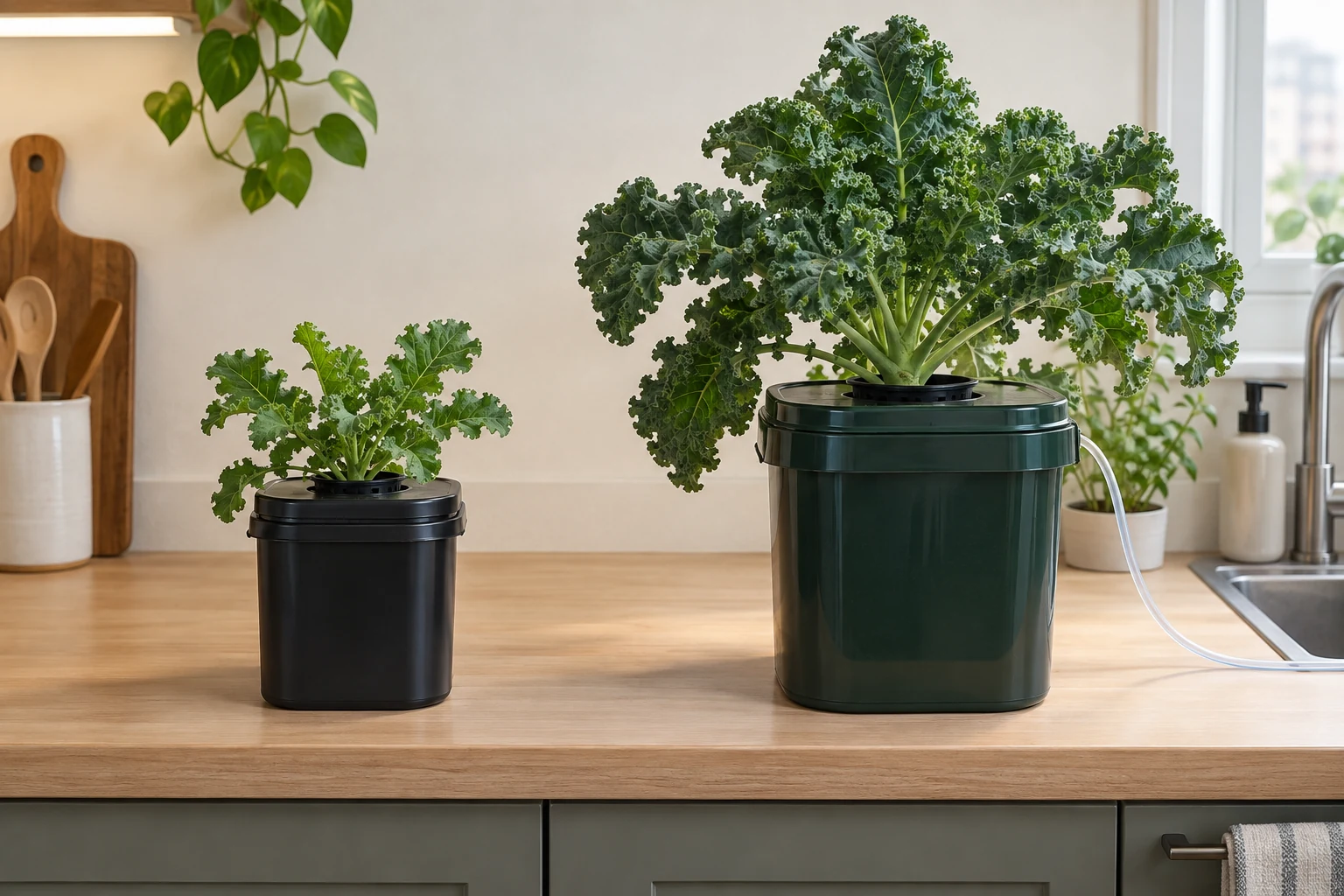
First, decide how you plan to eat the crop. Baby kale gives you tender leaves sooner and keeps both the canopy and roots smaller. Therefore, it is the safer choice when your available space is one small shelf or a quiet countertop.
A full plant takes longer and develops a larger root mass. It can reach roughly 12 to 18 inches indoors unless you harvest it regularly. Because mature kale drinks quickly, a quart jar can run low between checks and can become top-heavy. Choose a 2- to 3-gallon reservoir if repeated harvests are your goal.
If this is your first system, review the complete apartment hydroponics beginner guide. It explains the basic parts and helps you reserve enough room around the plant for maintenance.
Choose seed by leaf shape and harvest style
Dwarf Blue Curled Vates is a sensible compact option. Red Russian and Lacinato can also work when you harvest them young instead of waiting for a large outdoor-size head. In other words, your pruning schedule often controls the apartment footprint as much as the variety name does.
Avoid seed listings that promise a tiny mature plant without naming the cultivar or expected height. Also, read the packet for days to baby leaf and days to maturity. Those numbers are estimates, but they help you compare varieties grown under the same conditions.
🌱 Start Kale Seeds and Transfer the Seedling
Germinate in a damp plug
Kale commonly germinates in about 4 to 7 days. Start one or two seeds in a rockwool cube or compatible grow sponge. The plug should stay evenly damp, yet it should not sit submerged. Too much water excludes air and makes the young stem more vulnerable to damping off.
If you use rockwool, prepare it according to its label and your water conditions. Then place the seed in the opening without compressing the cube. For a detailed propagation sequence, see how to start hydroponic seeds in rockwool. If you still need compatible plugs, trays, domes, or a light, use the hydroponic seed starting kit guide.
Once a sprout appears, remove or vent the humidity dome. Next, place the tray under gentle light so the seedling does not stretch. A dome left closed after emergence traps excess moisture and weakens airflow around the stem.
Feed lightly before the move
Plain water is enough until the seed opens and the first seed leaves expand. After the first true leaves begin, use a mild hydroponic solution around EC 1.0 to 1.2. Because a young root system cannot use a mature feed, starting at EC 1.6 or higher can slow it down instead of speeding it up.
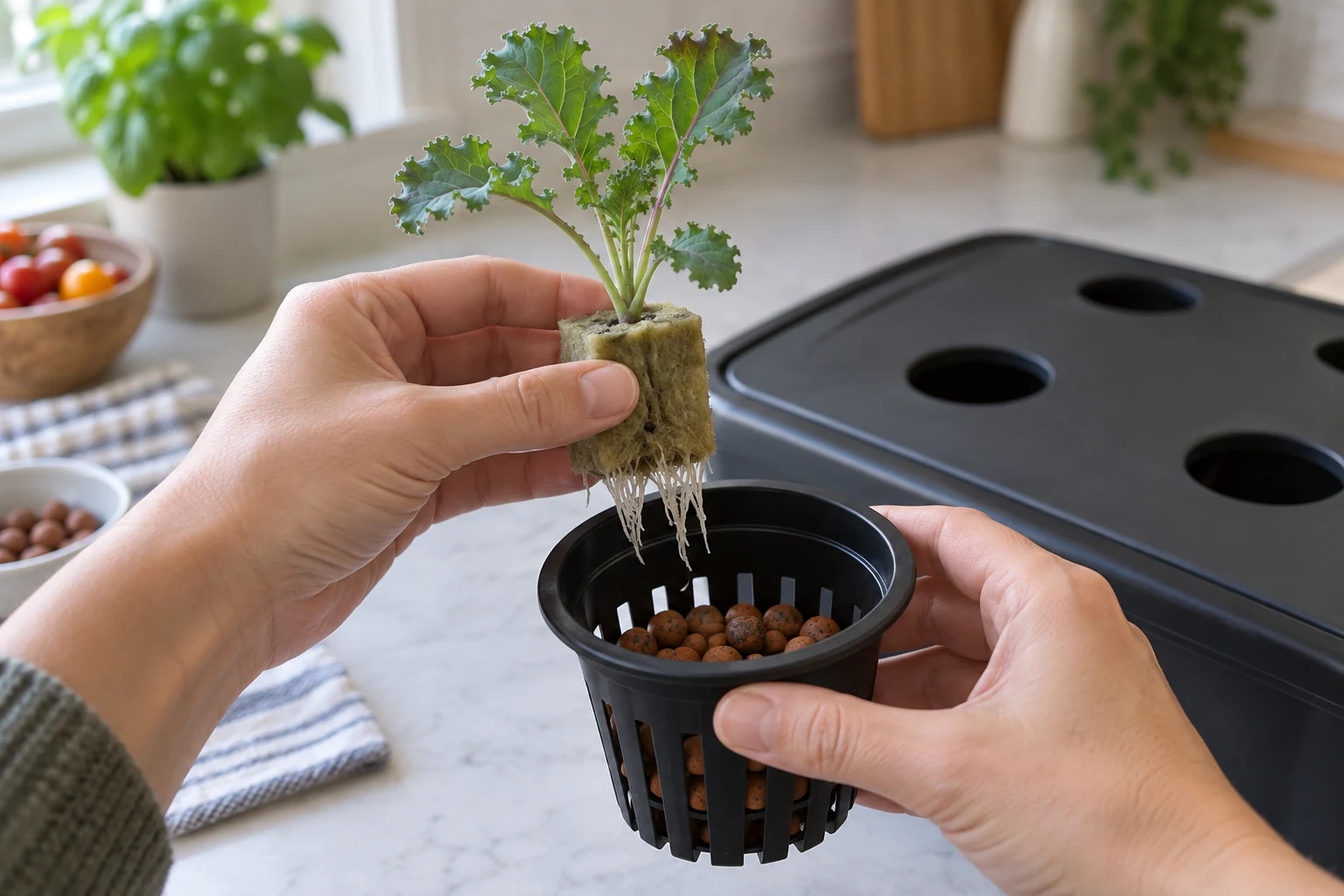
Transfer the plant when several white roots extend from the plug. Usually, that stage is easier to manage than moving a newly emerged sprout. Set the plug in a 2- or 3-inch net pot and support it with rinsed clay pebbles. Keep the stem above the wet surface so it stays dry.
Set the first water line carefully
At transfer, the solution can touch the bottom of the net pot or the lowest edge of the plug. Capillary moisture will support the seedling while its roots enter the reservoir. However, do not drown the whole cube. Once roots reach the solution, allow the level to fall below the net pot and expose an air space.
Plan the timing with the seed-to-harvest calculator. The result is a planning estimate rather than a promise, since temperature, light intensity, variety, and transplant stress can move the date.
🛠️ Build a Reservoir That Matches the Plant
Kratky works best for a limited baby-kale crop
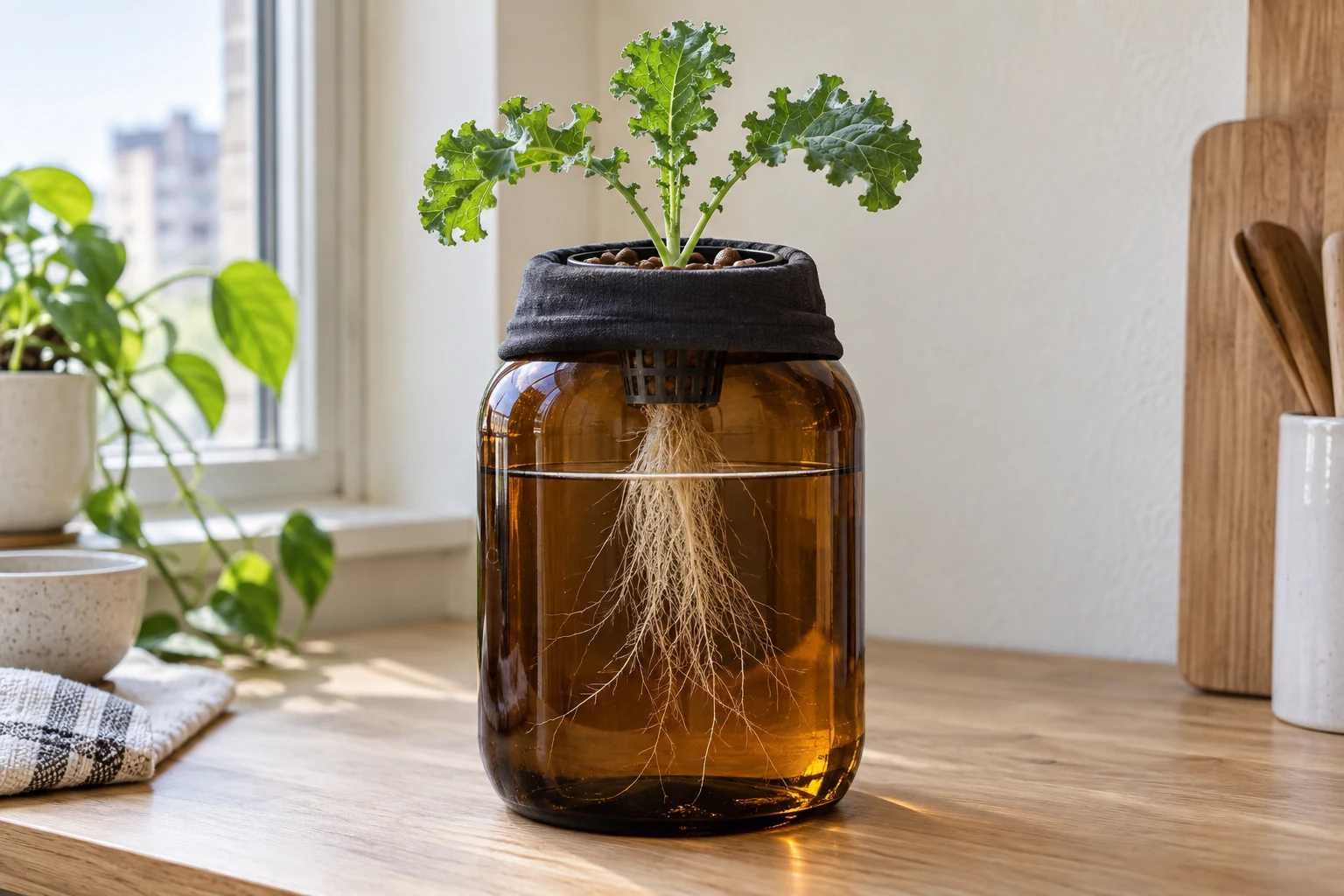
Kratky is passive and silent. As the plant drinks, the falling solution creates a humid air gap for oxygen roots. Therefore, the level is supposed to decline. A 1-gallon light-proof container gives baby kale more margin than a quart jar, although you still need to monitor it.
Do not top off a Kratky vessel every morning. Instead, let the level fall and preserve the established air gap. If a long crop runs low, add a little nutrient solution at the same strength, raising the level by no more than about an inch, and never back around the crown. The small-system top-off guide explains the difference between passive Kratky and active systems.
For a deeper comparison, use the DWC versus Kratky apartment guide. It can help you decide whether silence matters more than the extra root support of continuous aeration.
DWC gives a mature plant more margin
DWC uses an air pump and air stone to oxygenate the nutrient solution. For one mature kale plant, use a 2- to 3-gallon reservoir rather than a crowded jar. The extra volume slows water-level, EC, pH, and temperature swings. It also reduces the chance that a leafy top will tip the system.
In active DWC, check the water level daily. Top off with plain water because the plant generally removes water faster than mineral salts. Then replace the full nutrient solution about every two weeks so you are not trying to correct an unknown mixture indefinitely. Read how often to change hydroponic water for the complete routine.
Keep light out and spills contained
Use an opaque lid and reservoir. If you can see the solution through a wall or net-pot gap, algae can use that light. Cover leaks with a removable sleeve or other light-blocking material, but keep the water-level mark accessible. For an active bloom, follow the hydroponic jar algae guide.
Also, place the reservoir in a shallow waterproof tray. Keep electrical joins higher than the water line and form a drip loop in each cord. Those small choices make routine top-offs safer in a rented kitchen, bedroom, or living room.
🧮 Free tool
Your kale numbers, worked out for your reservoir
The pH and nutrient calculator turns the targets below into one recipe: the pH range, the EC to aim for and how much nutrient to add for your water volume. Here it is for kale in a 10 litre (about 3 gallon) DWC reservoir.
🔆 Set Light, pH, EC, and Temperature
Give the canopy 14 hours of consistent light
Run the grow light for 14 hours on and 10 hours off. A timer keeps that rhythm consistent and gives the plant a dark period. For a typical small LED, 6 to 8 inches above established kale is a starting point, not a guarantee for every fixture.
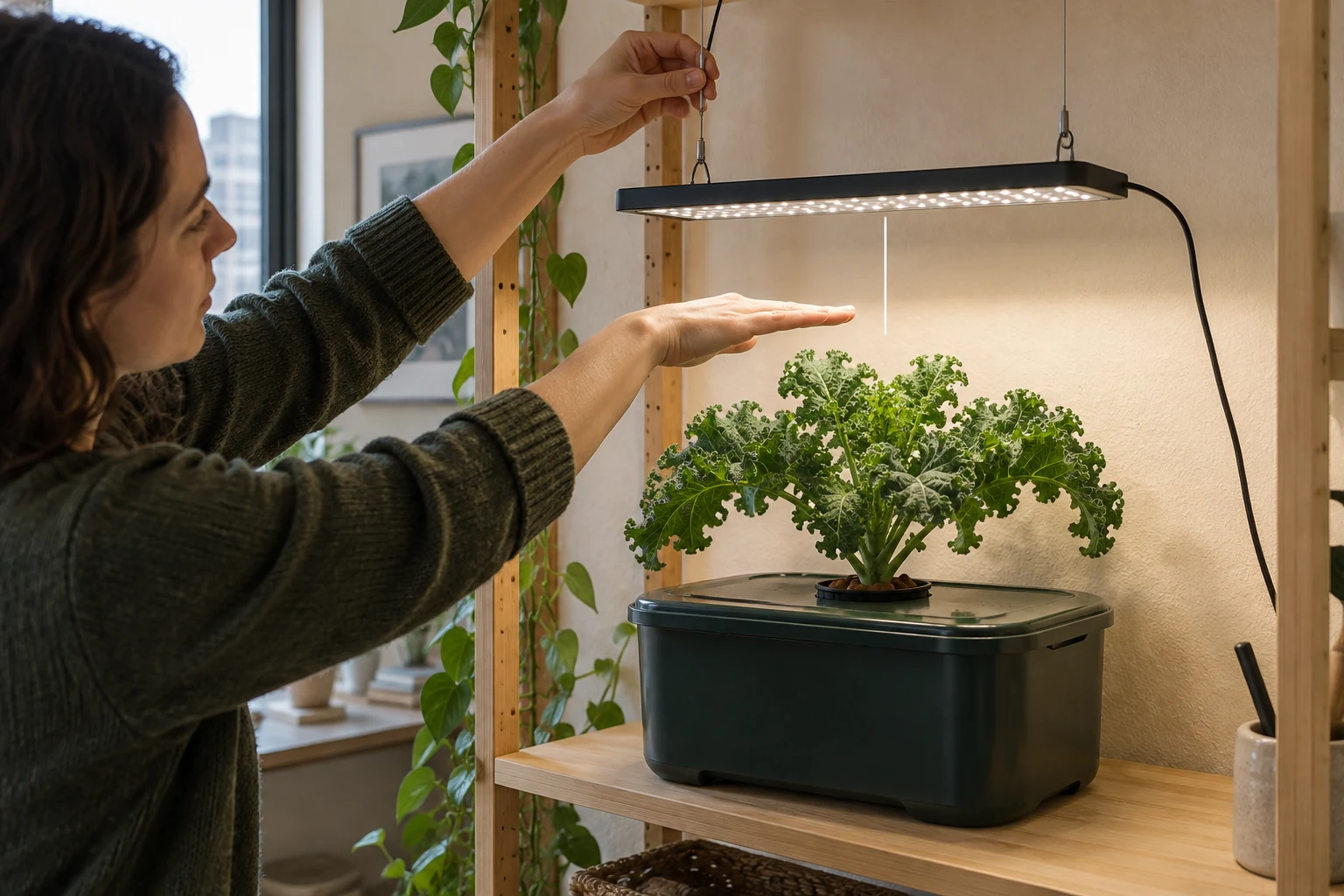
Next, watch the leaves. A stretched stem and wide gaps between leaves suggest insufficient light. Bleached patches, upward-curling edges, or a hot canopy suggest too much intensity or heat. Check the manufacturer’s chart when it is available, and use the hydroponic grow light calculator to estimate coverage. If you need a fixture, compare the compact LED grow light research picks.
If you measure light, aim roughly for 250 to 400 µmol/m²/s PPFD across the canopy. However, a single center reading can hide dim edges. The PPFD, PAR, and lumens guide explains what the meter is actually reporting.
Use the correct EC for each stage
Keep seedlings around EC 1.0 to 1.2. After the plant is established and growing new leaves, raise the solution gradually toward EC 1.6 to 2.0. The EC and nutrient-strength guide explains why water loss can make a small reservoir stronger even when you add no fertilizer.
Always mix nutrients into water according to the label. If the product has Part A and Part B, add each part separately and stir between them. Never combine concentrated parts directly. If you are choosing a formula, the small-system hydroponic nutrient guide compares the practical formats.
After mixing, measure EC before adjusting pH. A meter turns a vague feeding problem into a useful number; see the EC and TDS meter research guide if you need one. When EC rises while the water level falls, dilute with plain water. When both EC and the water level fall, the plant may be consuming nutrients as well as water.
Keep pH between 5.5 and 6.5
Target pH 5.5 to 6.5, and check it after the nutrient is mixed. Make small corrections, stir, and wait before testing again. Repeated large doses of pH adjuster can overshoot the target in a small reservoir. Use the pH and nutrient calculator for measured doses, then follow its small-system calculator guide.
Test with a calibrated meter rather than guessing from leaf color alone. The beginner pH meter guide covers useful features and care. If the number keeps moving, use the pH drift troubleshooting guide before adding another correction.
Keep the roots cool enough to breathe
A practical root-zone range is 65 to 75°F (18 to 24°C), while kale generally grows well with room air around 60 to 75°F (16 to 24°C). Warm water holds less dissolved oxygen. Therefore, a sunny window, hot LED driver, or dark reservoir can create root stress before the leaves look damaged.
Move the reservoir away from direct sun and separate it from heat-producing equipment. For more options, follow the small hydroponic system temperature guide. Also, if you fill from the tap, check whether your utility uses chlorine or chloramine. Chlorine may dissipate after standing, but chloramine generally does not; the tap-water guide explains the difference.
✂️ Use the Cut-and-Come-Again Harvest Method
Wait for leaves large enough to spare
Baby leaves may be ready about 30 to 45 days after sowing. A fuller plant often needs 45 to 60 days or more before the first substantial cut. Instead of using the calendar alone, look for several healthy outer leaves and a developing center.
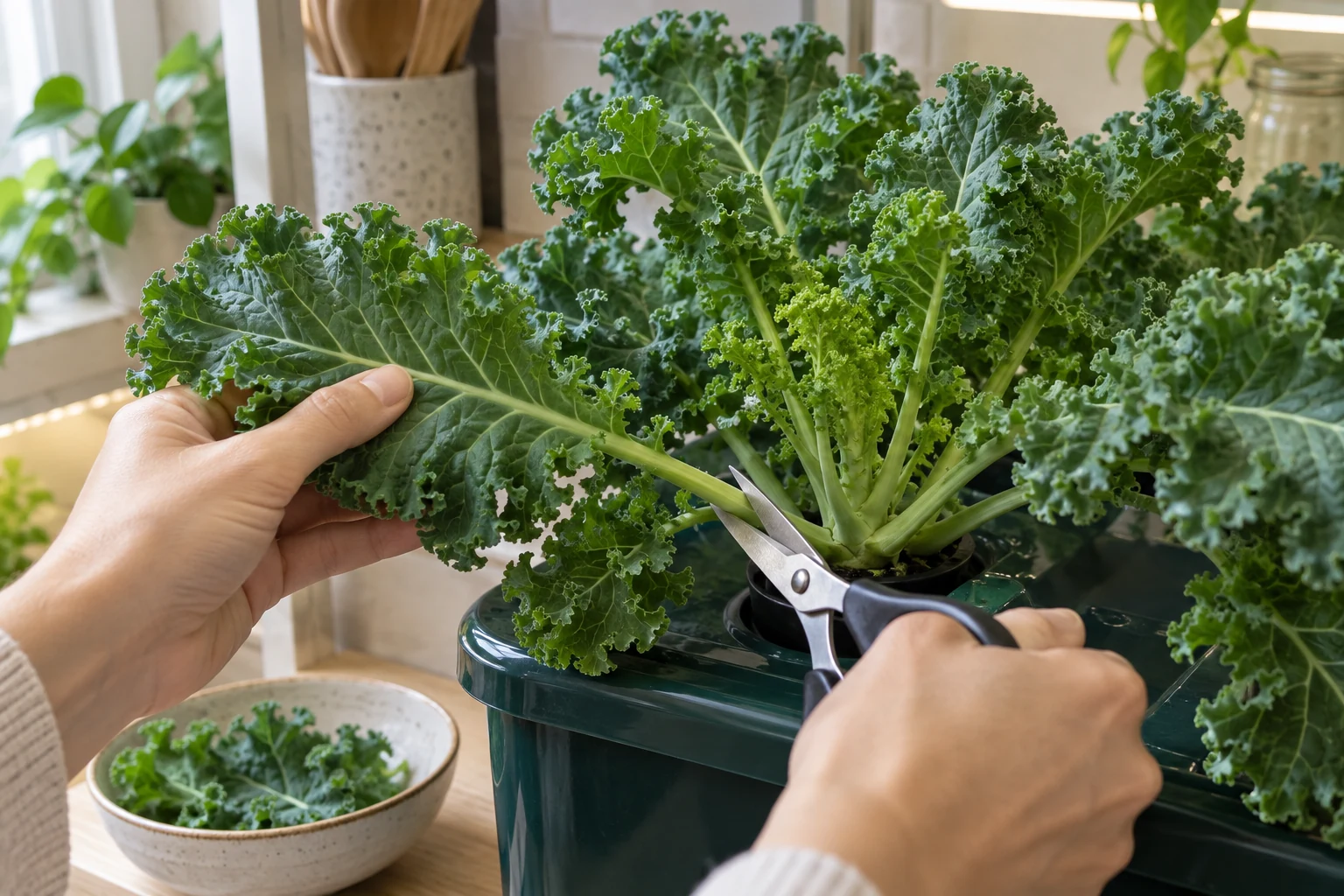
Then remove two or three of the oldest outer leaves at their base. Leave the central crown and small inner leaves untouched, because that growing point produces the next harvest. Use clean scissors or a clean knife, and avoid tearing the main stem.
Harvest every 5 to 7 days
Once the plant is established, inspect it every 5 to 7 days. Take the oldest usable leaves first and stop while the plant still has a strong canopy. Regular, moderate cuts keep the crop lower than waiting for one large harvest.
However, pause harvesting if the plant is recovering from heat, root damage, a major pH correction, or nutrient burn. New growth should resume before you remove more leaf area. A healthy plant can remain productive for roughly 6 to 10 weeks or longer, but its useful life depends on root space and conditions.
Wash, dry, and cool the leaves
Rinse harvested leaves under cool potable water. Then dry them well and refrigerate them in a clean container with a paper towel to manage surface moisture. Excess water on stored leaves speeds deterioration, while crushing them into a tightly packed container bruises the tissue.
🔍 Troubleshoot Hydroponic Kale by Symptom
| What you see | Check first | First response |
|---|---|---|
| Pale older leaves | pH, EC, and roots | Correct the measured cause |
| Brown leaf edges | EC and canopy heat | Dilute only if EC is high |
| Tall, weak stem | Light intensity and distance | Increase usable light gradually |
| Brown, slimy roots | Water temperature and oxygen | Clean, cool, and restore aeration |
| Bitter, tough leaves | Heat, plant age, and bolting | Cool the area or restart the crop |
Pale or yellow lower leaves
First, measure pH and EC. Yellow older leaves can result from weak feeding, but they can also appear when the solution contains nutrients that the roots cannot use because pH is outside range. Therefore, adding more nutrient before measuring can worsen the problem. The yellow-leaf diagnosis guide gives a fuller sequence.
Next, inspect the roots and water. Healthy new roots are generally pale and firm. Brown color alone can come from nutrients, but slime, shedding tissue, or a bad odor points to root-zone trouble.
Brown tips or crispy margins
Check EC before assuming a deficiency. If it is above the target and the water level has fallen, add plain water gradually or replace the solution. Also, check canopy heat and airflow. A leaf can show damaged edges when roots cannot move enough water to the rapidly growing tissue.
Do not add Cal-Mag automatically. Your base water and nutrient may already provide enough calcium and magnesium. Instead, use measured water quality and the plant’s full symptom pattern before adding another product.
Leggy growth or a leaning plant
Confirm that the light runs for 14 hours and covers the entire canopy. Then measure the fixture-to-leaf distance. If the plant leans toward one edge, center it under the useful light footprint or rotate the container between checks. If upper leaves bleach or curl after a change, consult the grow light burn guide.
Brown, slimy roots or bad-smelling water
Act promptly when roots feel slimy or the reservoir smells stale. Remove dead root material with clean tools, wash the empty reservoir, mix fresh solution, and correct high water temperature or failed aeration. In Kratky, also confirm that an air gap remains above the solution.
Do not casually pour hydrogen peroxide into a living root zone as a substitute for correcting the cause. It can damage plant tissue at the wrong concentration. The safer prevention sequence is covered in the small-system root rot guide.
Bitter leaves or a flower stalk
Kale naturally becomes tougher as leaves age, and heat can push the plant toward bolting. Harvest younger outer leaves and keep the room within the practical temperature range. Once a strong flower stalk forms and flavor declines, replacing the plant may be more useful than trying to reverse its life stage.
Oklahoma State University Extension: EC and pH Guide for Hydroponics
Arizona State University: Hydroponic Kale pH Growth Response
Utah State University Extension: Vegetable Harvest and Storage
📚 Want to see where these numbers come from? The kale section of the crop sources page shows the sources behind each growing number, with a label for how well each one is backed.
💬 A Word From Sarah
The useful apartment decision comes before you buy a container: are you growing a quick batch of baby leaves or maintaining one mature plant? Once that is clear, the reservoir size, system, and harvest schedule become much easier to choose. Give a full kale plant enough water volume, and use the scissors to control the canopy instead of asking a quart jar to control the roots.
❓ Frequently Asked Questions
Can kale grow hydroponically in an apartment?
Yes. Kale can grow under an LED in Kratky or DWC. Baby kale fits the smallest practical setup, while one mature cut-and-come-again plant is better in a 2- to 3-gallon DWC reservoir. Keep the container light-proof and leave room above it for a 12- to 18-inch canopy.
Can I grow hydroponic kale in a mason jar?
A jar is best treated as a short baby-kale crop, not a permanent home for a full plant. Kale develops a large root mass and drinks quickly. For baby leaves, use the largest light-proof vessel you can fit, preserve the Kratky air gap, and monitor the level closely.
What EC is best for hydroponic kale?
Use EC 1.0 to 1.2 for young seedlings. After the roots and true leaves are established, increase the solution gradually toward EC 1.6 to 2.0. Measure before changing the feed, because water loss can raise EC even when you have added no extra nutrient.
What pH does hydroponic kale need?
Keep the nutrient solution between pH 5.5 and 6.5. Mix nutrients first, then measure and adjust pH in small steps. If pH moves quickly after every correction, check water alkalinity, reservoir size, root condition, and meter calibration before adding more adjuster.
How much light does indoor kale need?
Run the light for 14 hours and give the plant 10 hours of darkness. A small LED may start 6 to 8 inches above established leaves, but fixture output varies. Use the manufacturer’s guidance, watch for stretching or bleaching, and measure coverage when possible.
Does hydroponic kale need an air pump?
Baby kale can grow without a pump in a correctly managed Kratky container. A mature plant benefits from DWC because continuous aeration and a larger reservoir give its roots more support. In either system, do not submerge the crown or eliminate the root-zone air space.
When can I harvest hydroponic kale?
Baby leaves may be ready about 30 to 45 days after sowing. A fuller plant often takes 45 to 60 days or longer. Harvest according to plant size as well as the calendar: wait until several healthy outer leaves can be removed without disturbing the small central growth.
How do I harvest kale so it grows back?
Cut two or three mature outer leaves at their base with clean scissors. Leave the central crown and its small leaves intact. Check again in 5 to 7 days, but pause if the plant is recovering from heat, root damage, nutrient burn, or a major solution correction.
Why are my hydroponic kale leaves turning yellow?
Measure pH and EC before adding nutrients. Yellow older leaves can come from weak feed, pH-related nutrient lockout, unhealthy roots, or normal aging. Inspect water temperature and root texture as well. Correct the measured cause instead of treating every yellow leaf as a fertilizer shortage.
Can kale share a reservoir with basil or lettuce?
Separate containers are easier to manage because crops can differ in mature EC, temperature preference, root size, and water use. Kale can quickly dominate a small shared reservoir. Separate vessels also let you remove one plant without disturbing the roots or feeding schedule of another.
Happy growing!

Sarah Whitfield is the founder of Urban Hydro Space and an indoor gardening enthusiast dedicated to helping apartment dwellers grow fresh herbs and vegetables in small spaces. She researches hydroponic systems carefully from real specifications and verified buyer feedback, and shares practical tips and honest, clearly labeled product picks to make indoor gardening accessible for beginners.