⏳ 20 min read · Last updated: August 2026
If you want to boost hydroponic herb flavor in a small apartment kitchen, you have probably noticed that indoor greens taste like watery grass. I remember harvesting my first batch of sweet basil in a tiny studio kitchen. I had watched those lush leaves fill the countertop for weeks. Then I added them to dinner and tasted almost nothing, which was the moment I realised the setup itself needed changing.
Flavour comes from mimicking the challenges outdoor plants face. Herbs in soil produce fragrant oils to protect themselves from intense light, wind, and dry spells. Indoor systems remove all of that, so we have to put a little of it back through light, feeding, and temperature. You do not need a greenhouse either, because a countertop garden responds to the same adjustments.
Dropping ice cubes into the solution shocks the root zone, then fades within the hour. If you need to cool water, freeze a sealed bottle and rest it against the outside of the container instead. That pulls heat out gradually without touching the roots.
📐 The Settings At A Glance
Four levers control herb flavour indoors: light height, light hours, nutrient strength, and harvest timing. Each one is crop-specific rather than universal, so the table below gives the numbers before the sections explain the reasoning.
- Hang lights 6 to 8 inches above leafy herbs, though woody thyme and oregano want 4 to 6.
- Feed each crop its own range, since basil wants EC 1.8 to 2.2 while thyme wants 1.2 to 1.6.
- Run 14 hours on and 10 off, because the dark period is when oils accumulate.
- Harvest within minutes of lights-on, so you catch the overnight oil peak.
- Top off daily with plain water, then run a full reservoir change every 2 weeks.
- Fastest harvest with zero pump noise → Kratky basil in a mason jar
- Maximum volume and bushy growth → deep water culture mint
- Strongest aroma per leaf → oregano or thyme, though both are slow
🔆 Light Settings That Build Essential Oils
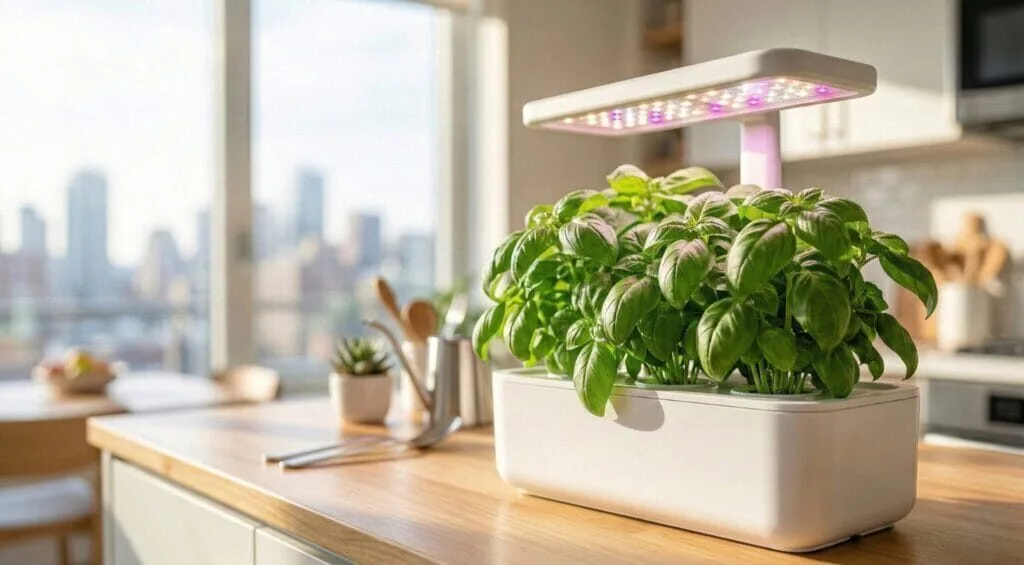
Light is the fuel for an indoor garden, and it doubles as a signal. Adjusting your fixture is the fastest way to boost hydroponic herb flavor, because intensity drives oil production directly.
Inside the leaves of basil, mint, and oregano, tiny glands called trichomes store the aromatic compounds. Weak lighting makes the plant stretch upward instead of packing those glands, so hang height matters more than the wattage printed on the box.
Underpowered lights leave herbs pale and spindly, which is a common problem in north-facing apartments with no direct sun. A strong full-spectrum LED lets the plant photosynthesise enough sugar to build a full oil profile, and the leaves come back thick and dark green with a scent you notice walking past.
💡 Adjusting Hang Height For Essential Oils
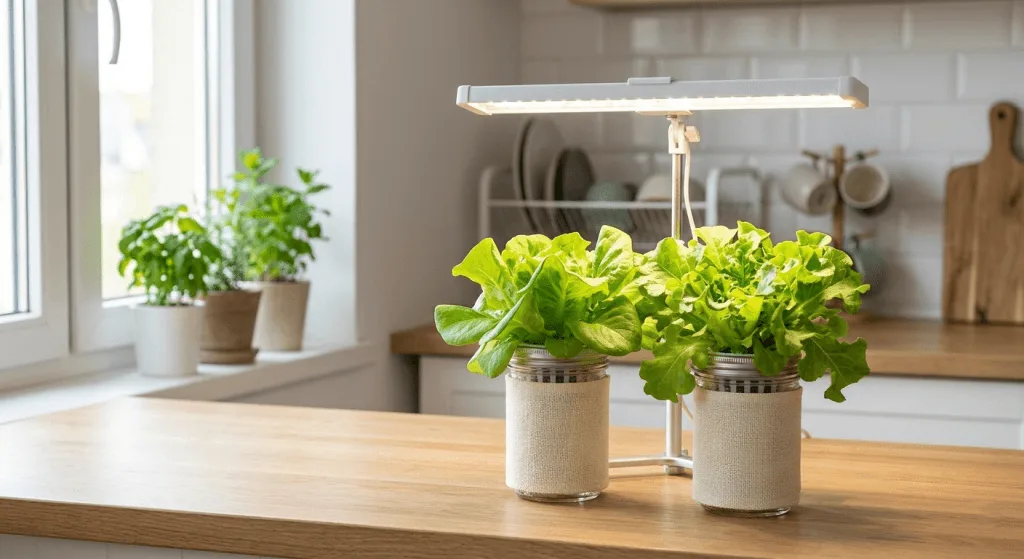
Keep the fixture 6 to 8 inches above leafy herbs like basil, mint, parsley, and chives. Woody herbs are different, so drop the panel to 4 to 6 inches for both oregano and thyme. Seedlings want 10 to 12 inches until true leaves appear.
That leafy-herb distance puts the canopy in the range of 200 to 400 µmol/m²/s, which is where oil production holds steady without scorching. Renters short on windowsill space usually go vertical, and my guide on one light, many herbs: apartment shelf layouts that work covers arranging crops that want different heights under a single panel.
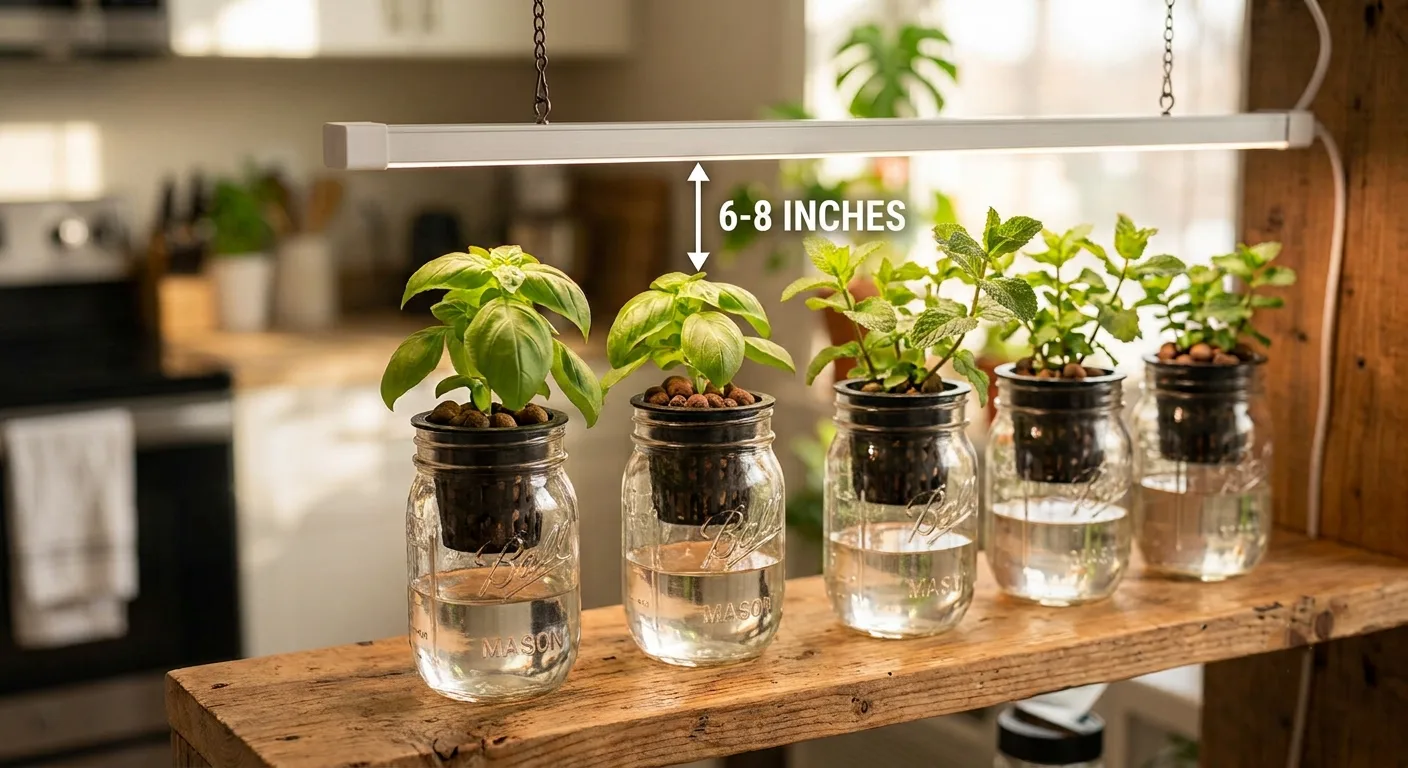
Too far away and the stems stretch, which is where weak flavour begins, since the plant has no spare energy for compounds like linalool or menthol. Keeping the light close stimulates leaf cells into producing protective oils instead.
Watch for bleached or curled leaves though, because that is grow light burn rather than a nutrient issue. Raise the fixture by 2 inches and give it 3 days to recover.
Measure the canopy height weekly, then adjust the chains or pulleys to hold that gap. Leave a light fixed in place and the plants outgrow the sweet spot inside a week, so the reading you took on Monday is wrong by Friday.
⏱️ Managing Light Hours And Photoperiod
Every herb and green here runs on 14 hours of light and 10 hours of darkness. That photoperiod mimics a bright summer day while leaving a proper night, and it is not a figure to push. Longer cycles do not add flavour, though they do trigger bolting in cilantro and spinach.
Never run lights for 24 hours, because the dark period does real work. Herbs convert the day’s sugars into aromatic oils overnight, so removing the night removes the payoff. Leaves turn pale and the scent fades. Whether hydroponic herbs need darkness at night covers what happens during those ten hours.
A reliable timer removes the daily switch-flipping. A compact digital model fits into a tight power strip, and my guide to the 3 best compact timers for apartment grow lights lists the ones that hold their programme.
Automated smart gardens need checking too, since their internal clocks drift after a power cut and can flip the lights on at 2am. Resetting the device restores a natural rhythm.
🔍 Troubleshooting Weak Or Leggy Herbs
Sometimes the lights are on and the plants still struggle. Catching it fast keeps the harvest from tasting like plain water.
- Lower the LED panel to 6 inches above the top leaves, or 4 for woody herbs.
- Confirm the timer is set to a solid 14 hour photoperiod.
- Check that no leaves touch the hot glass or metal casing of the fixture.
- Trim the top node of leggy basil or mint to force bushy side-branching.
Concentrating light energy on a shorter bushier plant puts those oils where you want them. In a space with no natural sun this matters twice over, so the roundup of best grow lights for low-light apartments under $50 covers fixtures that deliver enough intensity cheaply.
If nothing improves, check the age of the panel. Diodes degrade over time and emit fewer usable photons even while they still look bright, so replacing panels every couple of years keeps output at the intensity oils require.
🧪 Nutrient Concentration And EC Settings
Feeding is the second lever, and it is the one most beginners get backwards. More nutrient does not mean more flavour, because over-feeding pushes fast watery growth that spreads the oils thin. Sitting near the bottom of a crop’s own range gives you smaller leaves carrying far more taste.
Getting there means using the right minerals. Hydroponic fertilisers supply nitrogen, phosphorus, and potassium in forms roots absorb directly, and that balance drives the metabolic pathways behind aromatic oils. My beginner nutrients guide lays out a simple feeding schedule, and the nutrient roundup for small systems covers which products suit a jar.
Never pour standard soil fertiliser into a reservoir, since those formulas lack the micronutrients a soilless plant depends on. Mineral salts like calcium nitrate and potassium phosphate are what actually feed the crop.
📋 Finding Each Crop’s EC Sweet Spot
There is no universal flavour number, which is the single most repeated mistake in this topic. Basil needs EC 1.8 to 2.2 for its peppery bite, mint runs heavier at 2.0 to 2.4, while thyme and oregano want just 1.2 to 1.6 because woody stems take up salt fast. A figure that suits one starves or burns another.
Seedlings start at EC 1.0 to 1.2 whatever the crop, with basil the one exception that will take up to 1.6. The full explainer sits in my EC guide for apartment herbs.
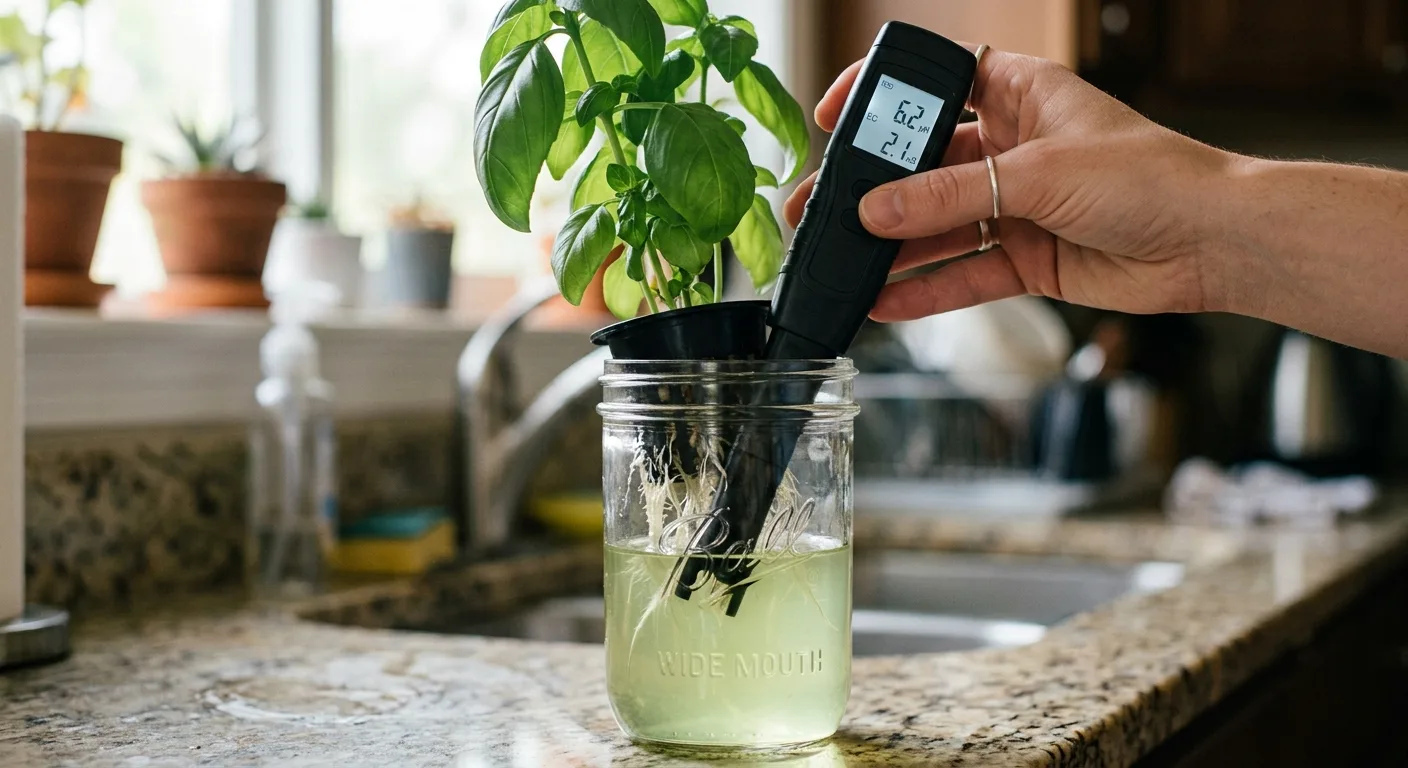
Push EC too high and you burn the leaf tips, which stresses the plant in the wrong direction and drops oil output. I made that mistake once by holding a mint reservoir at EC 2.6 chasing maximum flavour. The leaf margins went black and crispy inside 3 days, and healthy growth only returned after I brought it back to 2.0.
My guide on lowering EC safely in tiny reservoirs covers the correction, while the hydroponic mint apartment guide covers that crop end to end. For basil, the foolproof basil guide does the same.
Accurate readings need a decent meter, because cheap pens drift and quietly lead you into over-feeding. My notes on the best EC and TDS meter for small reservoirs cover which ones hold calibration.
🧴 Sharing One Reservoir Between Crops
Sharing one reservoir between crops forces a compromise, so aim for EC 1.5. That is a deliberate middle ground rather than an ideal. It sits well under basil while sitting near the top of thyme’s range, so both survive it and neither peaks. Growing your heavy and light feeders in separate jars is what actually unlocks the flavour.
| Herb | EC mature | Target pH | Key flavour compound |
|---|---|---|---|
| Basil | 1.8 to 2.2 | 5.5 to 6.5 | Linalool, so aim low in the band |
| Mint | 2.0 to 2.4 | 5.5 to 6.5 | Menthol, though it burns past 2.4 |
| Oregano | 1.2 to 1.6 | 5.5 to 6.5 | Carvacrol, since Greek types carry most |
| Thyme | 1.2 to 1.6 | 5.5 to 6.5 | Thymol, therefore lean feeding wins |
| Parsley | 1.4 to 1.8 | 5.5 to 6.5 | Apiole, because slow growth concentrates it |
| Cilantro | 1.4 to 1.8 | 6.5 to 6.7 | Linalool again, so watch that odd pH |
💧 Managing Nutrient Lockout And pH
Water pH decides whether any of that feeding lands. Hold it between 5.5 and 6.5 for most herbs to prevent nutrient lockout, since minerals bond into unavailable forms outside that window. Cilantro is the one exception, wanting 6.5 to 6.7. When lockout hits, the plant looks starved while sitting in a full reservoir.
Leaves yellow and flavour thins, so test every 3 to 5 days rather than weekly. Phosphoric acid lowers pH reliably, and citric acid works as a milder organic option, though it breaks down faster in small jars.
If the reading keeps sliding back after every correction, why pH keeps drifting in small systems explains the mechanism, while the beginner pH meter guide covers which pens stay calibrated.
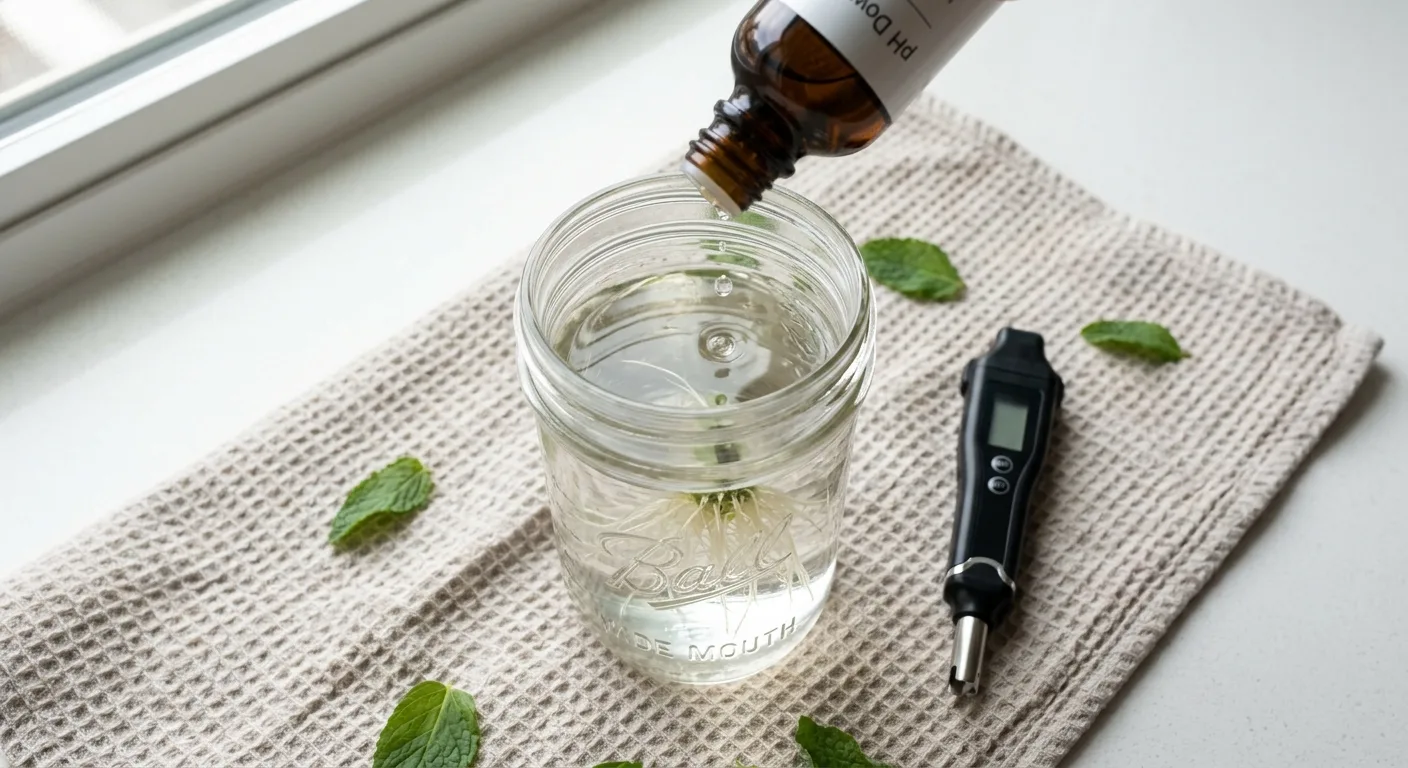
Calcium and magnesium deserve a check too, because tap water in many buildings runs short of both and produces stunted leaves. My breakdown on whether you need Cal-Mag in a small system covers how to tell.
Skip the home remedies here. Wood ash and baking soda both raise pH, yet they introduce sodium or trace heavy metals that accumulate in a small reservoir. Standard hydroponic adjusters cost little and behave predictably.
⚠️ Troubleshooting Leaf Tip Burn And High EC
Over-feeding shows up as dry brown edges, and that tip burn means the vascular system is struggling to move water against high salt pressure. Act quickly, because the damage spreads inward toward the young flavour-packed leaves.
- Measure the current solution to see how far the level has climbed.
- Remove half the nutrient solution with a clean siphon.
- Refill with pure pH-adjusted water to dilute the remaining salts.
- Hold the new reading at EC 1.2 to 1.5 for 4 to 7 days while the plant recovers, then return to the crop’s own range.
Between changes, top off with plain water only, and run a full change every 2 weeks as covered in how often to change hydroponic water.
If tip burn persists after a full change, look at the air rather than the water. Still, humid air stops the plant transpiring, and calcium travels with the transpiration stream, so it never reaches the newest leaves. That is a delivery failure rather than a shortage, and more Cal-Mag will not fix it. Airflow will.
✂️ Harvest Timing And Cutting Techniques
Knowing when to cut is the third lever, and it costs nothing. Harvest at the wrong stage and you miss the peak concentration of essential oils entirely, so timing does as much work here as feeding does. Aim for leaves that are fully mature but taken before the plant turns its attention to flowers.
Chemical profiles shift as herbs age. Cut too early and the oils have not developed, which gives you a grassy taste. Wait too long and the plant redirects sugars into reproduction, leaving older leaves tough and bitter.
Pruning also triggers lateral buds, which keeps the canopy compact. A bushy plant is far easier to manage on a crowded kitchen shelf than a tall spindly one, and it puts more leaf area under the light.
🌿 Identifying The Peak Harvest Window
Cut leafy herbs just before flowering begins. Once buds form, the plant channels its sugars into reproduction and away from the leaves, which turns them bitter and woody. That change ruins the crop for cooking.
Watch for bud formation and prune it out the moment you spot it. Harvesting through the vegetative peak keeps every cut packed with the compounds you grew the plant for.
Leaf size reads maturity fairly well. Broad basil leaves hold the highest volume of aromatic compounds, whereas small thick leaves suggest the plant is past its peak and wants cutting back to force fresh growth.
🍃 Harvest Time Of Day And Cutting Method
Time of day changes the result more than most people expect. Oils sit at their highest concentration right as the grow lights come on, because the plant builds them through the dark period. They dissipate as the room warms.
- Wait until 10 minutes after the lights switch on.
- Use sharp clean shears so the cut is crisp rather than crushed.
- Cut the stem at a 45 degree angle just above a node.
- Never take more than one-third of the foliage in one session.
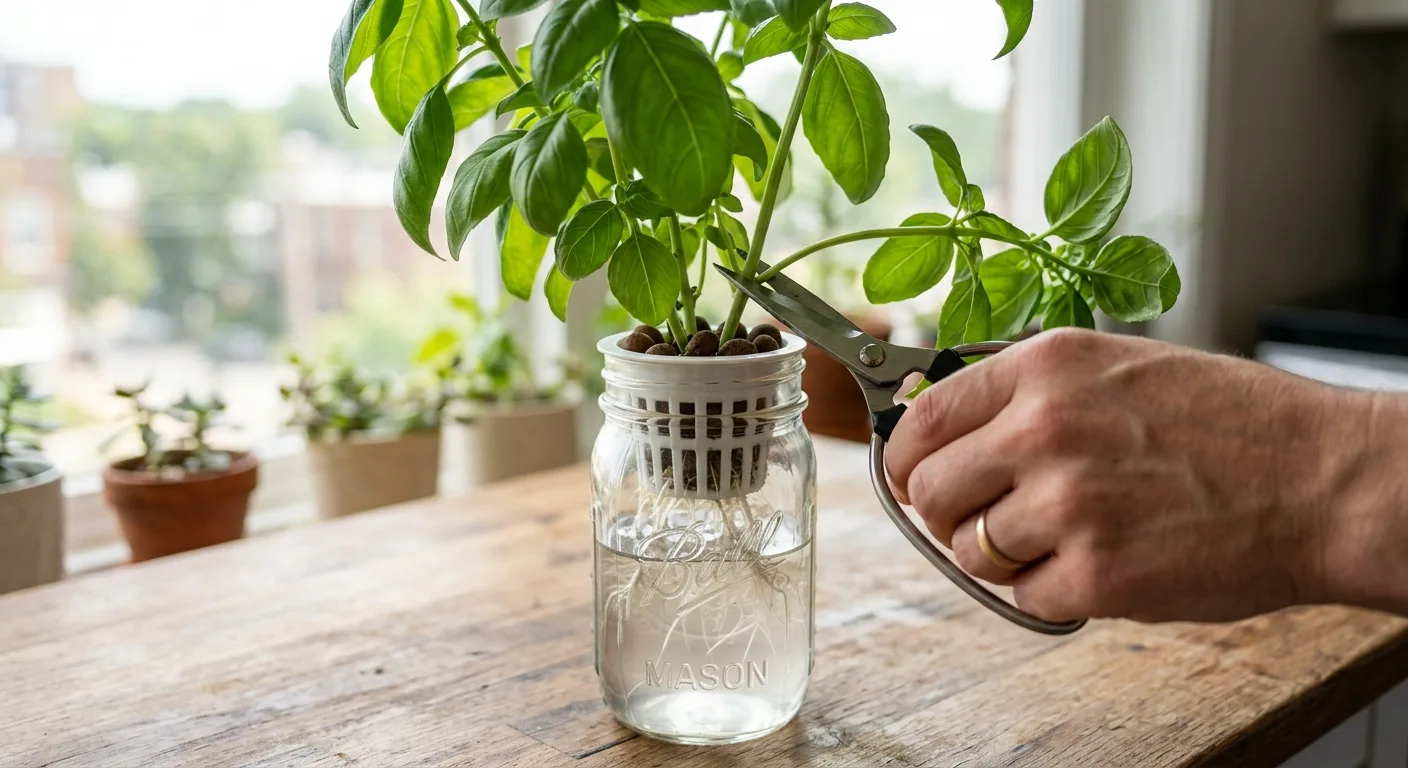
That routine keeps the plant productive rather than shocked. My guide on how to prune hydroponic basil and herbs covers node selection in detail.
Dull shears crush stem fibres instead of slicing them, so the oils oxidise on the wound and the remaining plant loses flavour. Keeping tools sharp and clean prevents that quiet waste.
🚨 Troubleshooting Bitterness After Herbs Bolt
Flowering has already started for some readers, and that is worth addressing directly. Bolting is usually triggered by warm water or a hot room, though you can sometimes still save the plant by acting on the flowering signal quickly.
- Find the central flower spike rising from the main stem.
- Cut the whole spike off, back down to the next set of large leaves.
- Bring the reservoir temperature back into range, since heat caused it.
- Run a full reservoir change every 2 weeks with fresh balanced nutrients.
Removing the flowers pushes the plant back toward leaf production, and sweetness usually returns across the following week.
Bitterness that survives pruning calls for a flush. Running plain pH-adjusted water for 2 days clears accumulated stress compounds, and you can then refill at the crop’s own range rather than a generic figure.
🩹 Mild Stress Tactics That Work In Apartments
Controlled stress is the last lever, and it is the one that separates good herbs from grocery-store herbs. Wild plants build aromatic compounds to survive difficult conditions, so we can trigger that same defence indoors on purpose. Temperature and airflow are the two safe ways to do it.
Restraint is the whole skill here, because heavy stress stunts a plant rather than flavouring it. You want short mild challenges that provoke a reaction without damaging roots.
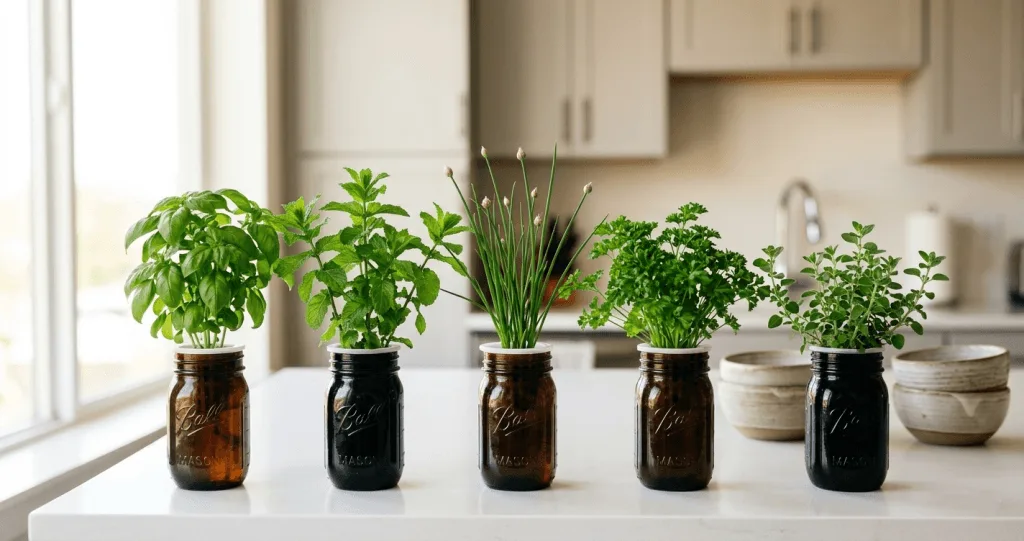
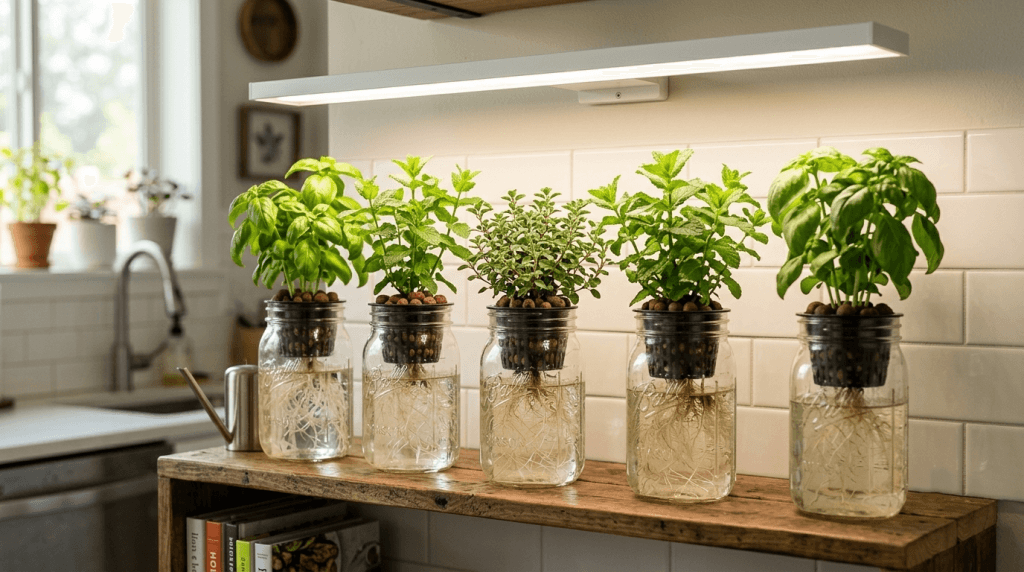
Root space counts as one of those challenges. A mason jar naturally limits root expansion, which nudges the plant toward leaf density and oils instead of endless growth, so small apartment setups have a genuine advantage over big systems.
🌱 Controlled Water Temperature Adjustments
Keep the root zone between 65 and 72°F (18 to 22°C) at all times, for every crop. That is the working range rather than a suggestion, since dissolved oxygen falls off sharply above it. Sitting toward the cooler end of that band in the days before a harvest nudges terpene production upward, so 66 or 67°F is the target rather than anything lower.
Cilantro tolerates a warmer ceiling of 75°F (24°C) before it suffers, though most herbs do not. To cool a reservoir in summer, freeze a sealed water bottle and rest it against the outside of the container, which pulls heat out gradually.
Keep reservoirs away from direct sun as well, and my guide to small hydroponic temperature problems and fixes covers cooling without buying a chiller. To expand the shelf, my guides on hydroponic thyme indoors and hydroponic oregano indoors cover both woody herbs end to end.
🌬️ Air Circulation And Wind Simulation
Wind is the cheapest flavour trigger available. Outdoors it bends stems constantly, which thickens them and stimulates oil glands, and a small fan reproduces that indoors for the price of a takeaway.
Clip a small fan to the shelf and set it to low, aiming across the canopy rather than at it. That steady breeze strengthens stems while clearing the stale air that settles around leaves. My recommendations for the best quiet clip-on fans for apartment shelves cover models that stay silent in a studio.
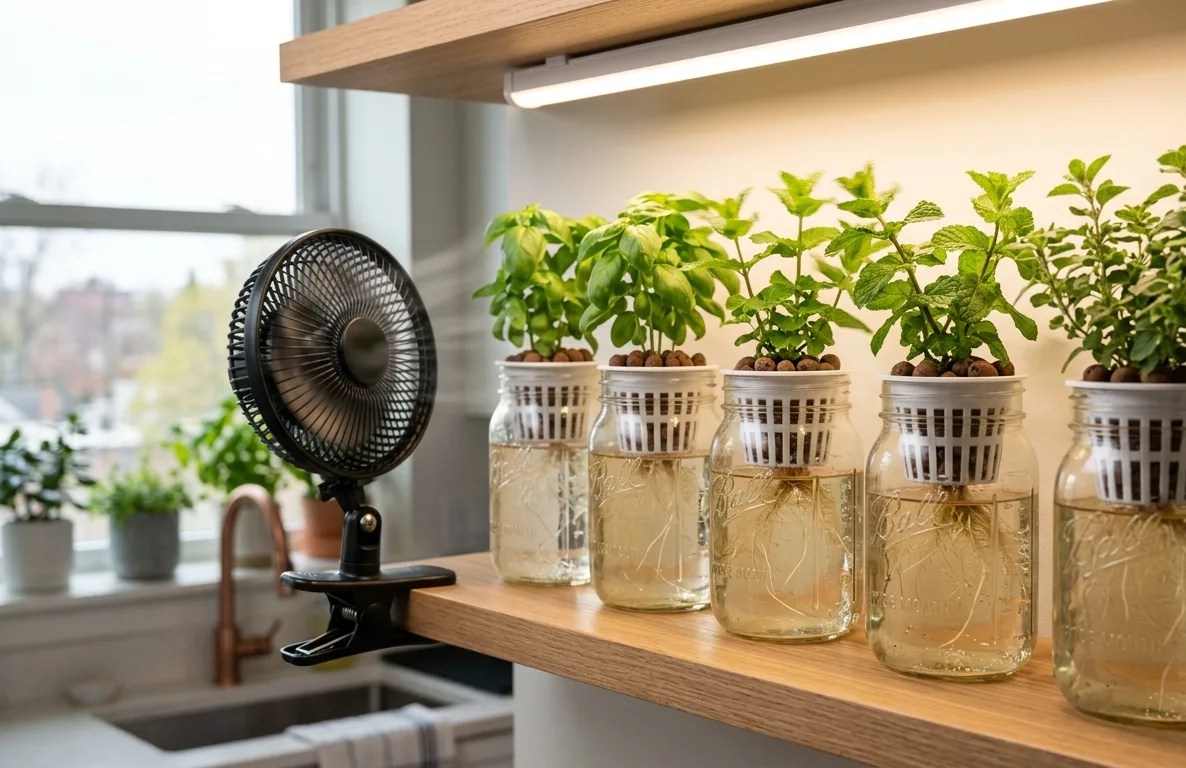
Airflow earns its place twice over, since it also prevents the fungal problems that thrive in stagnant humid pockets. Keeping humidity between 40 and 70 percent handles the rest.
Keep the fan off seedlings though, because young stems windburn without much provocation. A gentle indirect breeze that makes leaves wiggle is the whole target, and anything stronger costs you growth.
⚠️ Troubleshooting Algae And Pathogen Risks
Stress raises pathogen risk alongside flavour, so the two travel together. Warm water and stagnant air invite root rot and powdery mildew, which means a clean dark reservoir is part of the flavour strategy rather than separate from it.
- Rinse the roots gently under lukewarm tap water.
- Clean the jar with diluted hydrogen peroxide, never bleach.
- Cover every light leak using a dark sleeve or black tape.
- Add a small preventative peroxide dose to the fresh water.
My full guide on using hydrogen peroxide safely on root rot gives the exact dilutions, and preventing root rot in small systems explains why oxygen matters more than sterility.
💬 A Word From Sarah
I tried to force a pot of mint into hyper-flavour one summer by cutting its water for four days. The leaves withered into grey crisps and the roots turned slimy brown, and it took three weeks of flushing to rescue a single clone.
What I had confused was stress with damage. Mild stress means holding the reservoir toward the cool end of 65 to 72°F for a few days before harvest, or clipping a fan to the shelf. It does not mean dehydration, and it certainly does not mean chilling the water below that range, which I also tried and which simply stalled the plant.
The version that finally worked was unglamorous. Correct EC for that specific crop, light at the right height for that specific crop, fan on low, morning harvests. No tricks.
❓ Frequently Asked Questions
🧪 What EC should I run to boost hydroponic herb flavor?
Each crop has its own range, so no single number works. Basil wants 1.8 to 2.2, mint runs heavier at 2.0 to 2.4, while thyme and oregano want just 1.2 to 1.6. Aim at the low end of whichever range applies, because that concentrates oils without starving the plant.
🌱 What EC should seedlings start at?
Start at 1.0 to 1.2 whatever the crop, then step up once true leaves appear. Basil is the single exception and will take up to 1.6 while young. Never go below 1.0, which is the lowest safe strength for a seedling, since weak feeding at that stage stunts the plant permanently.
🌿 Can I grow high-flavour herbs in a studio apartment?
Yes, and the small scale actually helps. Compact grow lights and mason jars give you tight control over light height and feeding, which are the two variables that matter most. A limited root zone also nudges the plant toward leaf density rather than sprawl.
🥔 Which herb is easiest to grow for strong flavour?
Basil, comfortably. It grows fast, forgives small EC mistakes, and responds within days to light and pruning changes. Expect a clear difference in aroma two to three weeks after dialling in the settings, which makes it a good crop to learn the levers on.
💧 How often should I change the water?
Top off daily with plain water to replace what the plants drink, then run a full reservoir change every 2 weeks. That rhythm keeps mineral levels stable and prevents the salt build-up that turns flavour harsh. Skipping the full change is the most common cause of drifting EC.
🧬 Can I mix different herbs in one reservoir?
You can, provided you accept a compromise. An EC around 1.5 keeps basil, oregano, and thyme alive without burning the light feeders, though none of them peak there. Mint deserves its own jar entirely, since its 2.0 to 2.4 range would overfeed anything sharing the water.
🍂 Why do thyme and oregano need a different setup?
Both are woody Mediterranean herbs, so they want more light intensity and less food than leafy crops. Hang the panel at 4 to 6 inches rather than 6 to 8, and hold EC at 1.2 to 1.6. Feeding them like basil produces large pale leaves with almost no aroma.
💬 Do hydroponic herbs taste the same as soil herbs?
They can taste stronger, given the right settings. Correct EC and bright light produce high essential oil levels regardless of the growing medium. The bland reputation comes from indoor setups running weak light and generic feeding, not from hydroponics itself.
🍁 Why do my leaf tips burn even at the right EC?
Check the air before the water. Calcium moves through the plant on the transpiration stream, so still humid air stops it reaching the newest leaves even when the reservoir is correctly fed. That is a delivery failure rather than a shortage, and adding Cal-Mag will not help. A small fan on low will.
🆗 Why do my indoor herbs taste watery?
Usually too little light or the wrong feed for that crop. Distant lighting produces thin stretched growth with no oil, while feeding a light crop like thyme at basil strength swells the cells and dilutes what is there. Fix the light height first, since it is quicker to test.
🔆 Does light spectrum affect herb flavour?
Blue wavelengths appear to do most of the work, since blue light is associated with terpene production and keeps plants compact rather than stretched. A full-spectrum LED supplies it alongside everything else the plant needs, which is why I prefer those over red-and-blue panels.
⏱️ How long do herb plants keep producing good leaves?
Basil and mint stay productive for four to six months with regular pruning before vigour fades. Oregano and thyme often run past a year, since they grow slowly and rarely bolt. Once new growth turns thin or pale, start a fresh batch from cuttings or seed.
Happy growing! 🌿
Sarah, Urban Hydro Space

Sarah is the founder of Urban Hydro Space and an indoor gardening enthusiast dedicated to helping apartment dwellers grow fresh herbs and vegetables in small spaces. With hands-on experience testing hydroponic systems, she shares practical tips and honest product reviews to make indoor gardening accessible for beginners.