⏳ 14 min read · Last updated: September 2026
Disclosure: This post contains affiliate links (paid links). As an Amazon Associate I earn from qualifying purchases, at no extra cost to you. I only recommend gear I would run in my own apartment.
🔎 Research pick: I have not grown with the products in this post myself, so every pick rests on published specifications and owner reports. How I test and choose products.
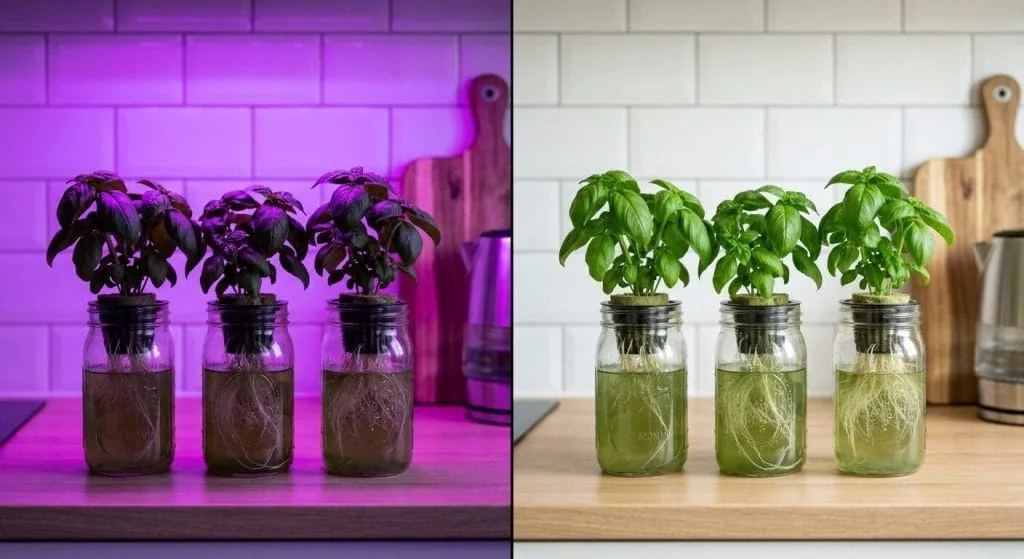
My first grow light turned the kitchen purple. It worked on the basil, yet I could not sit on the sofa without squinting, so it went back after three days.
White LEDs solve that, although picking one is harder than it looks. Two numbers matter: Kelvin, which is how warm or cool the light looks, and CRI, which is how truthfully it shows colour.
Here is the problem nobody mentions. Almost no grow light publishes both. I checked three, and not one gave me a Kelvin rating and a CRI figure together. So this guide covers what to do about that.
New to indoor growing? The apartment hydroponics beginner guide covers the fundamentals first.
- Aim for 4000K to 5000K, since that reads as daylight rather than as a nightclub or a hospital.
- CRI is usually not published. Only one of the three lights below states a figure, so judge by other means.
- Hang it 6 to 8 inches above the canopy. Distance matters far more than colour.
- Run 14 hours on and 10 hours off, on a timer rather than on memory.
- Watch wattage honestly. A bulb rated 153 PPFD at a foot is below what herbs want, so it has to sit closer.
📊 The Three Lights, Compared
These are the three I would actually consider for a kitchen. Ratings are mine, since Amazon’s customer scores are not something I can republish.
⭐ If you only want one recommendation
⭐ Sarah’s Top Pick
Barrina T5 1ft, 4-Pack
Best for: a wire shelf, since four linked strips run off one outlet
★★★★☆
🌡️ What Kelvin Actually Changes
Kelvin describes how the light looks to you, rather than how well it grows a plant. Low numbers read yellow, so 3000K feels like a living room lamp. High numbers read blue, and 6500K feels like a hospital corridor.
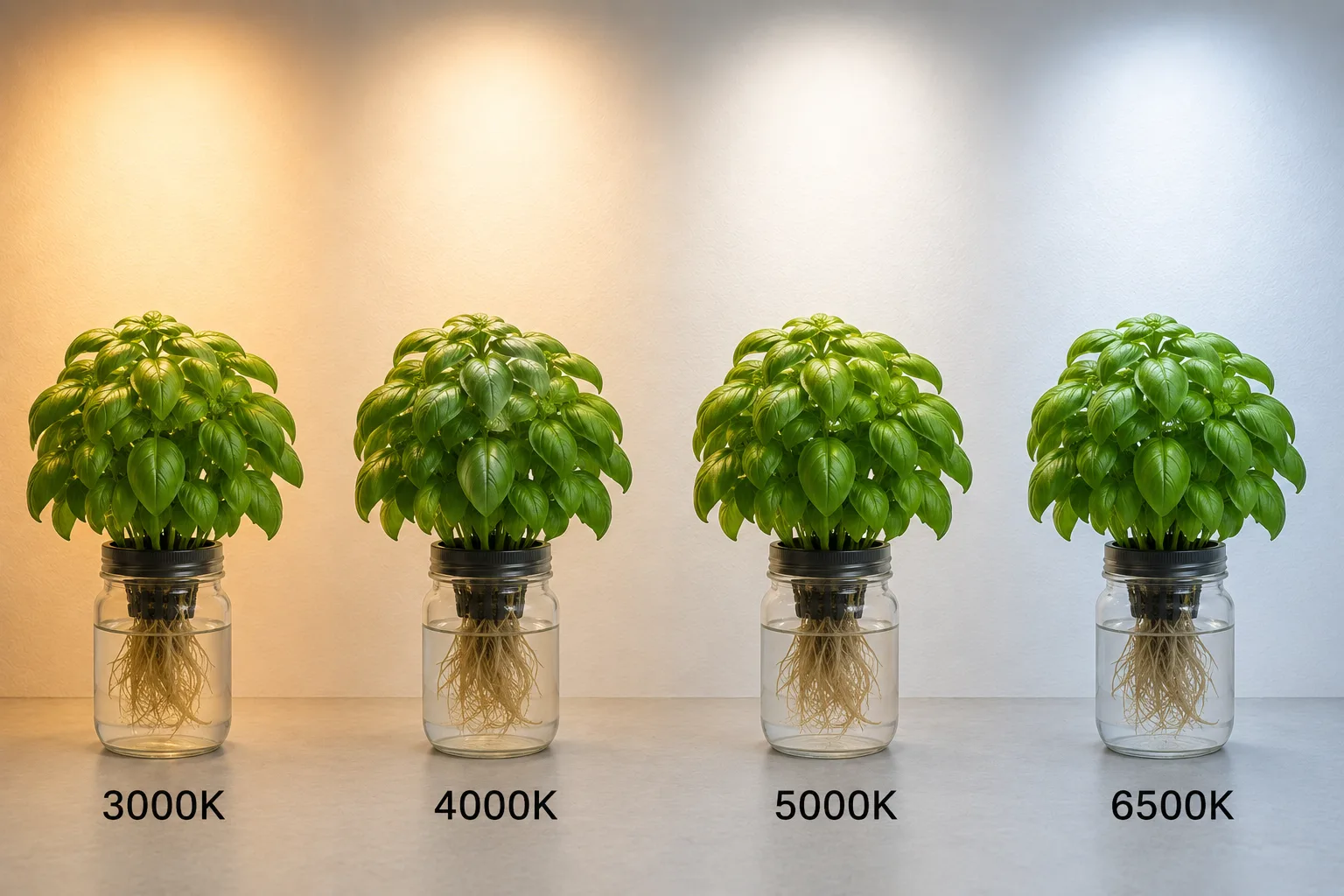
4000K to 5000K sits between the two and reads as morning daylight. That band gives you the blue wavelengths that keep growth compact, while still looking like something you would willingly have in a kitchen.
Match it to the room, though. If your under-cabinet lights are warm and you bolt a 6500K strip beside them, the clash is obvious every evening. When unsure, 4000K is the safe choice, since it reads clean without turning the counter sterile.
🔍 The CRI Problem
CRI measures how truthfully a light shows colour against natural sunlight. A cheap shop light sits near 70, which drains the green out of basil and makes healthy leaves look grey. Anything at 90 or above looks natural.
It matters practically, not just visually. Early nutrient trouble shows as faint yellowing, and spider mites show as fine stippling. Under a low-CRI light you notice both a week later than you would otherwise.
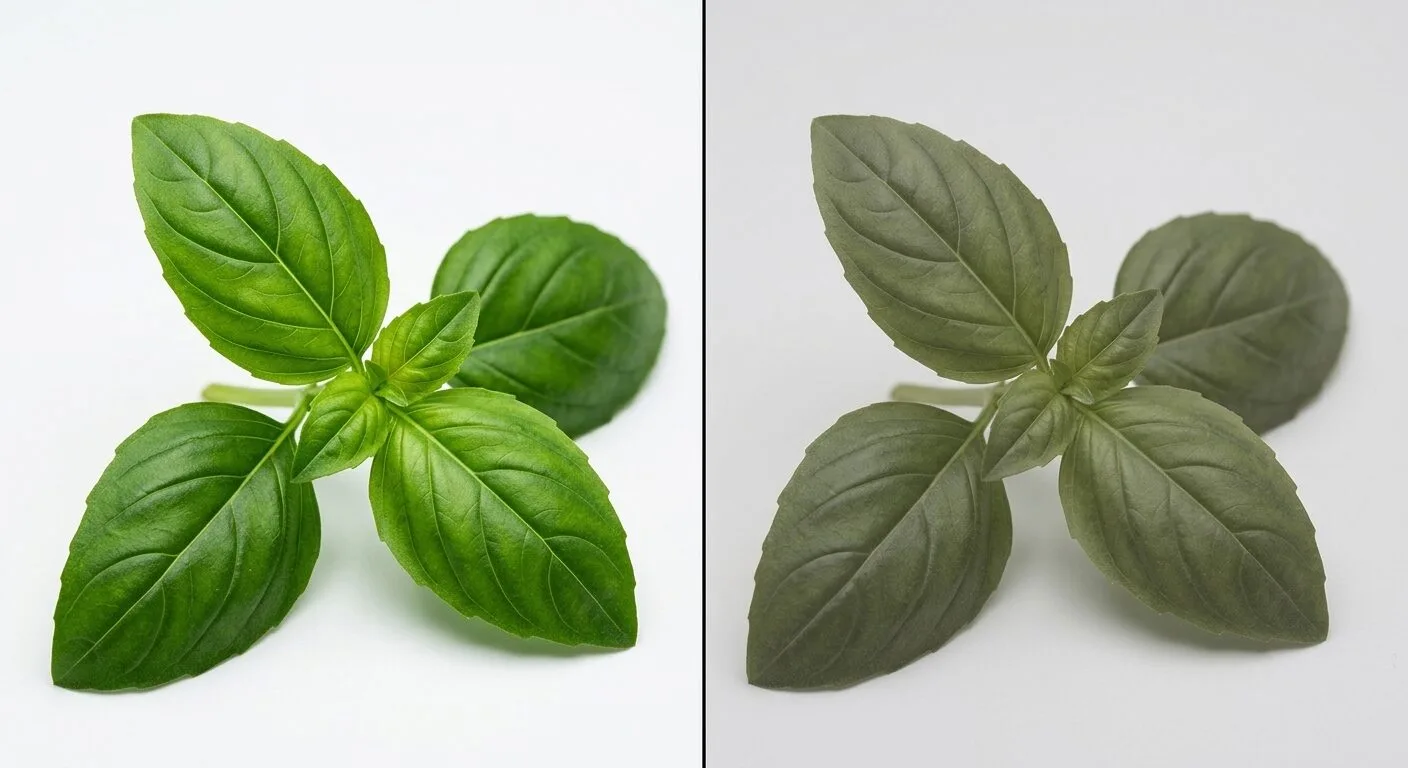
So the standard advice is “buy 90 or above”. Here is what happens when you try.
| Light | Kelvin stated? | CRI stated? |
|---|---|---|
| SANSI 15W A19 | Yes, 4000K | A claim, not a number: “Ra close to 100” |
| Barrina T5 | Yes, 5000K | No, nothing at all |
| PlantSpectrum16 | No, only “white” | Yes, 96 |
Not one gives you both. The two that state Kelvin go quiet on CRI, and the one that states CRI never mentions Kelvin. That is not bad luck, since CRI is a lighting-industry measurement and most plant brands simply never test for it.
So treat any roundup quoting confident CRI figures for five different lights with suspicion. Those numbers usually came from somewhere other than the spec sheet.
🔆 Barrina T5 Strips, My Pick for a Shelf

Amazon price right now: $32.29 Prices refresh automatically. Prices are pulled from Amazon and were last checked on 27 September 2026 at 6:41 am. Amazon prices change often, so check the listing before buying.
These are 1-foot strips at 5000K, sold four to a pack and drawing 20W in total, so 5W each across 96 diodes. That is modest power, though it is spread evenly rather than punched through one spot.
The linking is what earns the top spot. You can chain up to 16 fixtures in series, so a whole wire rack runs from a single outlet. In a flat where outlets are scarce, that matters more than raw output.
Each fixture also has its own switch, which is useful. You can light the seedling shelf and leave the harvest shelf dark without unplugging anything.
Skip the adhesive and zip-tie the strips to the rack instead. Run two per shelf, keep them 6 to 8 inches above leafy greens, and the stretch problem disappears. My herb shelf lighting layout guide covers spacing, while two-tier shelf heights covers stacked racks.
💡 SANSI 15W Bulb, and an Honest Number

Amazon price right now: $19.95
This one screws into any standard E26 lamp, runs at 4000K, and uses a ceramic heat sink rather than aluminium, so it stays cool enough to adjust mid-cooking. SANSI states Ra close to 100, which is a manufacturer claim rather than a tested figure, though it is more than most brands offer.
What I like is that SANSI publishes real photometric data instead of a wattage equivalent. They give PPF 27 µmol/s and PPFD 153 µmol/m²/s at 1 foot.
That is the whole argument for the 6-to-8-inch rule, made with the manufacturer’s own figure. Most listings hide behind “replaces a 150W bulb”, which tells you nothing.
Clamp the lamp to something solid: a counter lip, a shelf edge, or a heavy desk frame. A clip on grow light is the alternative if you have no lamp to spare. Then set the face 6 to 8 inches above the canopy. Going closer risks grow light burn, while going further brings back the stretch.
⚗️ PlantSpectrum16, the Only One That States CRI
Amazon price right now: $149.00
This is a 16W aluminium-bodied fixture with 90 diodes, and it is the only light here that publishes an actual Color Rendering Index: 96. It also quotes 92% PAR, which means most of its output falls in the range plants use.
The aluminium housing works as a heat sink, so the diodes run cooler and hold their spectrum longer than a plastic-bodied light would. The four-year warranty suggests the maker believes that too.
It mounts two ways, either on a rack with the included brackets and zip ties, or free-standing on a disc. There is also an app with a plant library, although the light works fine without ever opening it.
The gap is Kelvin. The listing says “white colored light” and stops there, so you cannot check it against your kitchen fixtures before it arrives. For a light chosen partly on looks, that is a real omission.
🧪 Judging a Light With No CRI Number
Since two of three publish nothing usable, you need a fallback. These four checks cost nothing and work on any listing.
| Check | What it tells you |
|---|---|
| Is it white, or pink? | Blurple diodes always render badly, so white is the shortcut |
| Does it publish PPFD? | A brand measuring one spec usually measures others too |
| Real watts, or “equivalent”? | “Replaces 120W” is marketing, whereas 20W is a fact |
| Photos of real plants? | If their own photos look grey, the light renders grey |
Then test it yourself on day one. Put a ripe tomato and a green leaf under the beam, since those two colours expose a weak spectrum at once. If the red looks brown or the green looks olive, send it back.
Want a stronger fixture than these three? The grow lights under $50 roundup and the countertop LED panel roundup both cover panels. Meanwhile full spectrum versus red and blue explains why white won.
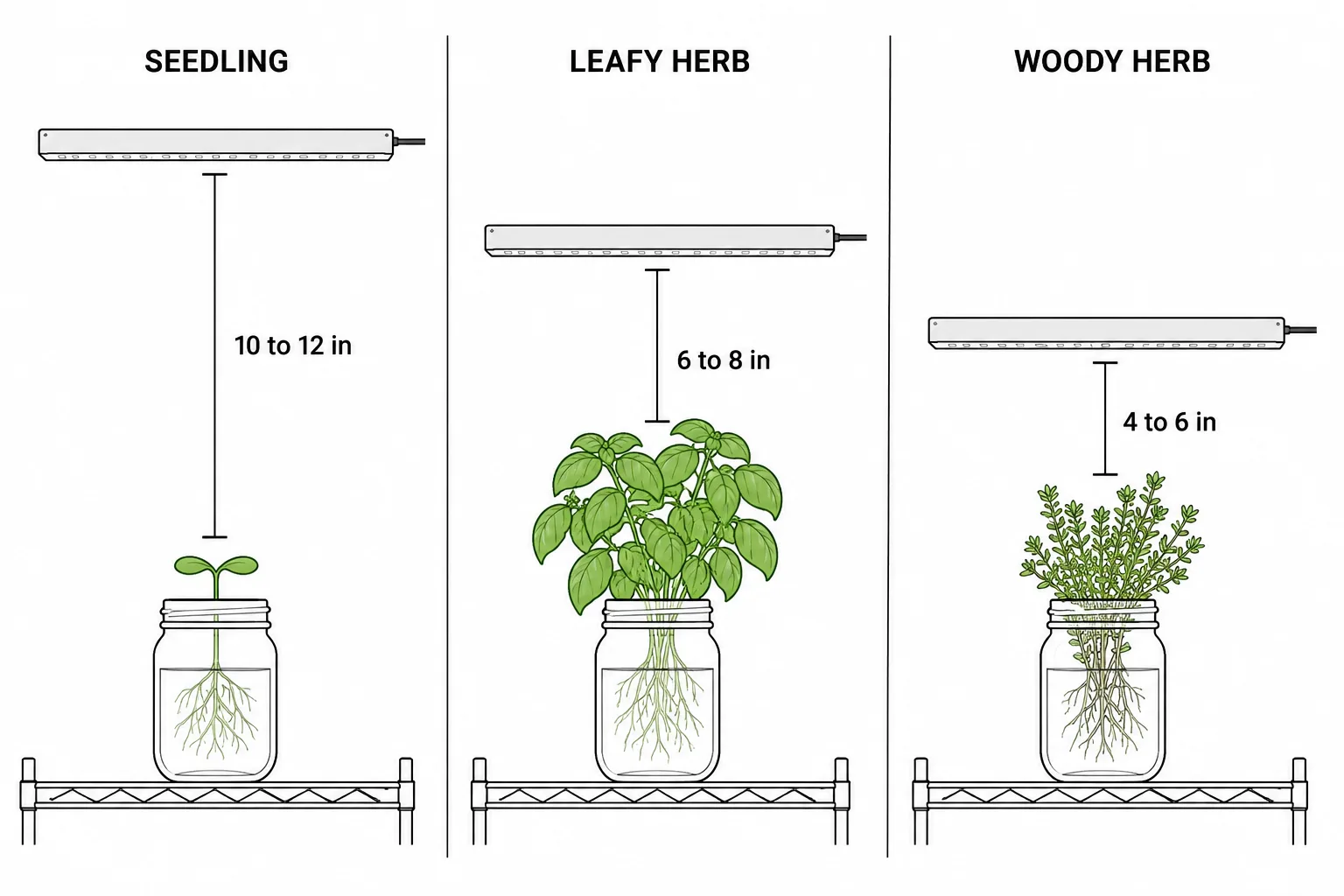
📏 Distance and Schedule Beat Colour
Colour temperature is the last thing that decides whether a plant thrives. Distance and hours come first, and both are simple.
| Setting | Target | Why |
|---|---|---|
| Height, leafy herbs | 6 to 8 inches | Closer burns tips, whereas further brings stretch |
| Height, woody herbs | 4 to 6 inches | Thyme and oregano want more intensity |
| Height, seedlings | 10 to 12 inches | Seed leaves scorch easily, so start further back |
| Schedule | 14 on, 10 off | Plants process sugars in the dark, so it is not wasted |
| PPFD, leafy herbs | 200 to 400 | Below it plants stretch, above it the tips crisp |
Use a timer rather than your memory. The compact timers roundup covers cheap ones, and blocking grow light glow covers the evening side, while the light schedule guide for a 9 to 5 covers fitting the cycle around work. The grow light calculator sizes wattage for your shelf, and the distance guide covers every crop group.
🚨 Troubleshooting
| What you see | Likely cause | Fix |
|---|---|---|
| Long pale stems | Light too far, or too weak | Lower toward 6 inches, then prune |
| Bleached top leaves | Light too close | Raise an inch, and wait three days |
| Older leaves yellow first | pH drift, so nutrients lock out | Test pH before feeding anything |
| Everything looks grey | Low CRI, rather than a sick plant | Check the leaf in daylight first |
| Warm reservoir | Fixture heat, or a sunny sill | Hold 65 to 75°F (18 to 24°C) |
That fourth row catches people out. Under a weak-CRI light a perfectly healthy plant looks ill, so carry the leaf to a window before you change anything. If it is yellow, why apartment hydroponic plants turn yellow covers the real causes, and the pH and nutrient calculator gives your dose.
Keep the routine simple otherwise. Top off daily with plain pH-adjusted water, then do a full reservoir change every 2 weeks. The seed to harvest calculator tells you when the first cut is due, while grow light electricity costs shows how little any of these draw.
💬 A Word From Sarah
I mounted a 6500K garage light over my first Kratky jar to save money. It gave me a headache every morning while the coffee brewed, and the chives underneath looked grey and half dead.
They were not. I carried one stem to the window and it was perfectly green, which is when I understood that I had been diagnosing a plant by the quality of the lamp rather than the plant.
I swapped to a 4000K panel two days later. The chives grew exactly as before, though the kitchen stopped feeling like a car park. That is really the whole point of this article. Colour temperature does not change what the plant does, but it changes whether you can stand being in the room, and whether you can see trouble coming.
❓ Frequently Asked Questions
🌡️ What colour temperature is best for growing herbs indoors?
Aim for 4000K to 5000K, since that band reads as morning daylight rather than as a nightclub or a hospital. It carries enough blue to keep growth compact while still looking acceptable in a kitchen. If you cannot decide, 4000K is the safer default, because it matches most home fixtures.
🔍 Why do most grow lights not list a CRI?
CRI is a lighting-industry measurement, so plant brands rarely test for it. Of the three lights here, only PlantSpectrum16 states a figure at 96. SANSI offers a claim rather than a number, and Barrina says nothing. Treat any roundup quoting confident CRI figures for several lights with suspicion.
☀️ What CRI should I look for?
90 or above, if a number is published at all. Below that, greens go grey and early trouble hides. Since most listings stay silent, judge instead by whether the light is white rather than blurple, whether the brand publishes PPFD, and whether their own product photos look natural.
💡 Can I use a normal 3000K bulb instead?
Yes, although growth stretches more because the blue content is lower. Compensate by moving it closer, toward the 6-inch end. A warm bulb close to the canopy beats a daylight bulb hung too far away, since distance affects a plant far more than colour does.
🌱 Do higher Kelvin lights grow herbs faster?
No. 6500K encourages slightly more compact growth, though it does not increase speed on its own. Intensity and hours do that. Run 14 hours on and 10 off at 6 to 8 inches, and the colour becomes a comfort decision rather than a growth one.
📏 Is 153 PPFD enough for herbs?
Not at that distance. Leafy herbs want 200 to 400, so 153 falls short. SANSI measures theirs at 1 foot, but light falls off with roughly the square of distance, so bringing the bulb to 6 to 8 inches raises the figure sharply. The number is fine, the measuring distance is just further than you should hang it.
📐 How high should I hang a white grow light?
6 to 8 inches above the canopy for basil, mint, chives and lettuce. Woody herbs such as thyme and oregano want 4 to 6 inches, whereas seedlings start further back at 10 to 12 inches. Adjust an inch at a time, then wait three days before judging the result.
🌙 Will a 5000K light stop me sleeping?
It can, since bright blue-heavy light in the evening suppresses melatonin. Sensitivity varies a lot between people, though, so some notice nothing. Put the light on a timer that shuts off a couple of hours before bed, and the problem disappears without costing the plant anything.
🟣 Do I still need purple blurple lights?
No. Full-spectrum white LEDs contain the red and blue wavelengths plants use, and they let you see the plant properly at the same time. Blurple panels render colour so badly that spotting pests or deficiency becomes guesswork, which matters more in a kitchen than a spectrum chart does.
🏠 Can I mix a grow light with my kitchen lighting?
You can, although matching the tone avoids an obvious clash. A 6500K strip beside warm 3000K cabinet lights looks wrong every evening. 4000K sits close enough to most home fixtures to blend, which is why it is the easiest choice for an open-plan room.
🔌 How many strips do I need per shelf?
Two 1-foot strips per shelf covers a standard wire rack well. Barrina links up to 16 fixtures in series, so a two-tier rack still runs from one outlet. Add a third strip only if plants at the edges lag behind the middle ones after a fortnight.
🩹 My herbs look grey under the light. Are they sick?
Probably not. Carry a leaf to a window and look at it in daylight first. Low-CRI lights drain green out of healthy foliage, so plenty of people treat a lighting problem as a nutrient one. If the leaf really is yellow in daylight, check pH before you add anything.
Happy growing! 🌿
Sarah, Urban Hydro Space

Sarah Whitfield is the founder of Urban Hydro Space and an indoor gardening enthusiast dedicated to helping apartment dwellers grow fresh herbs and vegetables in small spaces. She researches hydroponic systems carefully from real specifications and verified buyer feedback, and shares practical tips and honest, clearly labeled product picks to make indoor gardening accessible for beginners.