⏳ 18 min read · Last updated: September 2026
Disclosure: As an Amazon Associate, Urban Hydro Space earns from qualifying purchases at no extra cost to you. This post contains affiliate links. Thank you for supporting Urban Hydro Space!
🔎 Research pick: I have not grown with the products in this post myself, so every pick rests on published specifications and owner reports. How I test and choose products.
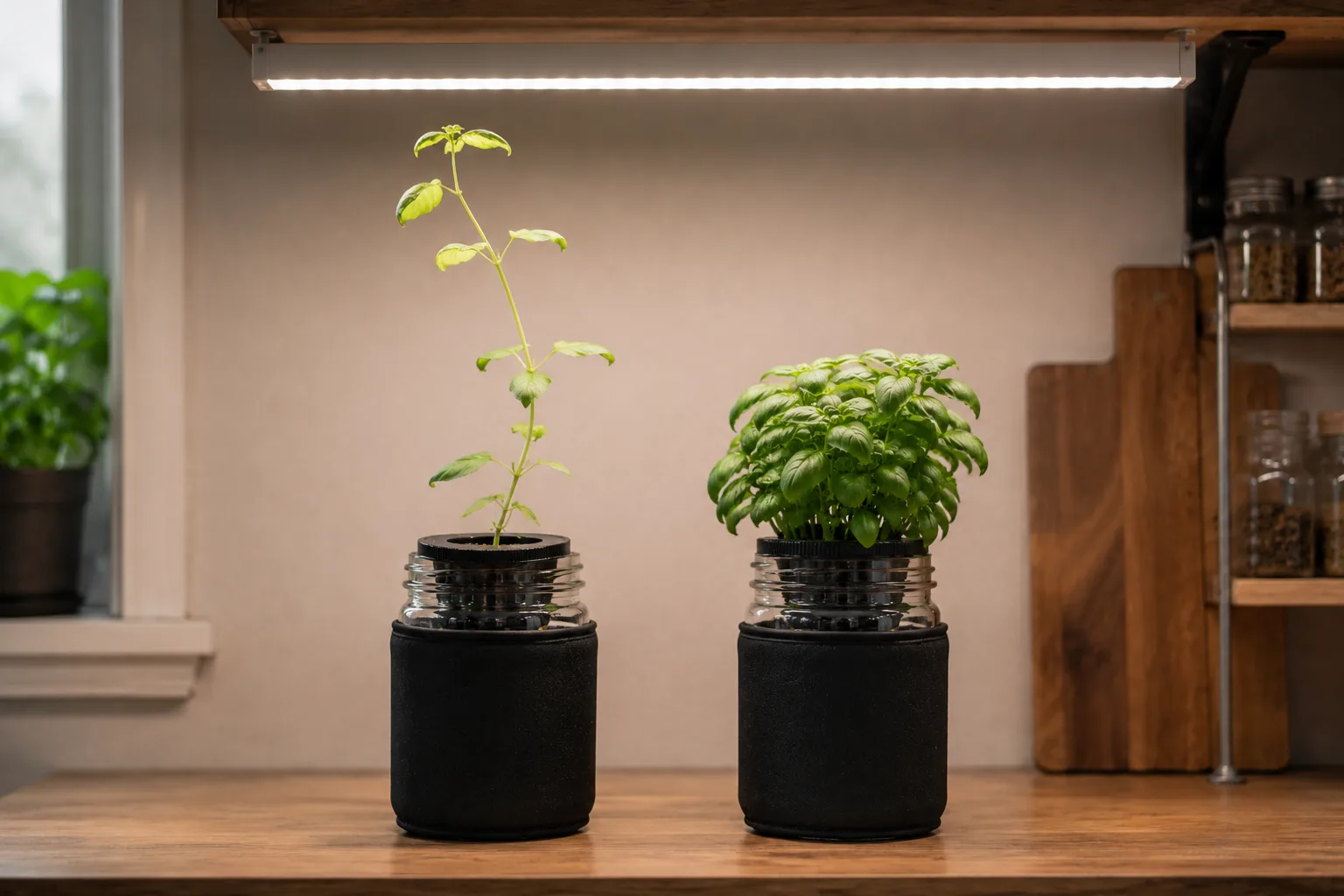
A grow light meter answers one question your eyes cannot: how much usable light is actually landing on your leaves. Last February I learned that the expensive way. I had a 100 watt panel over a two-tier wire rack, four Kratky jars underneath, and basil at the left end that kept stretching while the middle stayed compact. Same light. One shelf. Both jars had gone in on the same afternoon.
So I assumed the panel was faulty and nearly returned it. Then I borrowed a meter. The middle of the shelf read 310, the far left read 96, and those two jars sat eleven inches apart. The panel was fine. My assumption about how light spreads was the broken part, and no amount of staring at the shelf was ever going to tell me that.
☀️ Why a Grow Light Meter Beats Guessing by Wattage
Wattage tells you what the light costs to run, not what the plant receives. Two panels drawing the same power can deliver wildly different intensity at the canopy because the lens, the spacing of the diodes and the mounting height all change where that energy goes. Since almost every apartment setup is short on distance, small changes in height swing the reading hard.
- Most apartment growers never need to buy a grow light meter. A free phone app gets you close enough to fix leggy herbs.
- Leafy herbs want 200 to 400 PPFD at the canopy. Greens sit lower, at 150 to 300.
- Phone cameras read brightness, not plant-usable light, so the app needs a diffuser and a spectrum setting before its number means anything.
- Buy hardware when you are running a shelf with more than one light zone, or troubleshooting a problem you cannot see.
- Where you hold the sensor changes the reading more than which meter you own.
🔍 The Four Ways to Measure, Compared
Four kinds of grow light meter cover every situation an apartment grower runs into. Prices climb steeply, though usefulness does not climb with them.
- Why a grow light meter beats guessing by wattage
- What a grow light meter actually measures
- Where to start: the free phone app
- Stepping up to a budget lux meter
- A dedicated PPFD meter, the real upgrade
- When a remote sensor earns its price
- How to take a reading that means something
- Target PPFD and DLI for apartment herbs
- When you do not need a meter at all
- A word from Sarah
- Frequently asked questions
🧪 What a Grow Light Meter Actually Measures
Every grow light meter reports at least one of three units, though only one of them matters to a plant. Lux measures brightness the way a human eye perceives it, which is weighted toward green and yellow. PAR describes the slice of the spectrum plants can use for photosynthesis, roughly 400 to 700 nanometres. PPFD counts how many of those usable photons land on a square metre every second, so it is the number your basil responds to.
If that distinction still feels slippery, the full breakdown lives in the PPFD vs PAR vs lumens guide. This post assumes you already know PPFD is the target and just want to know how to read it in your own kitchen.
⏲️ The DLI Number That Ties It Together
PPFD is a snapshot. Daily light integral, or DLI, is the total your plant collects over a day, so it is the figure that actually predicts growth. The maths is simple:
DLI = PPFD × hours × 0.0036
Because this site runs a 14 hours on, 10 hours off schedule everywhere, you can shorten that to PPFD × 0.0504. A shelf reading 250 PPFD therefore delivers a DLI of about 12.6, which sits right in the band leafy greens want. Two readings, one multiplication, and you know whether the shelf is feeding your plants or starving them.
📱 Where to Start: The Free Phone App
The cheapest grow light meter is the one already in your pocket. Photone turns your phone camera into a light sensor, and for a single shelf it is close enough to be useful. I still reach for it first. It is free to download and use, with optional paid unlocks you can ignore at first, so it costs nothing to find out whether measuring solves your problem at all.
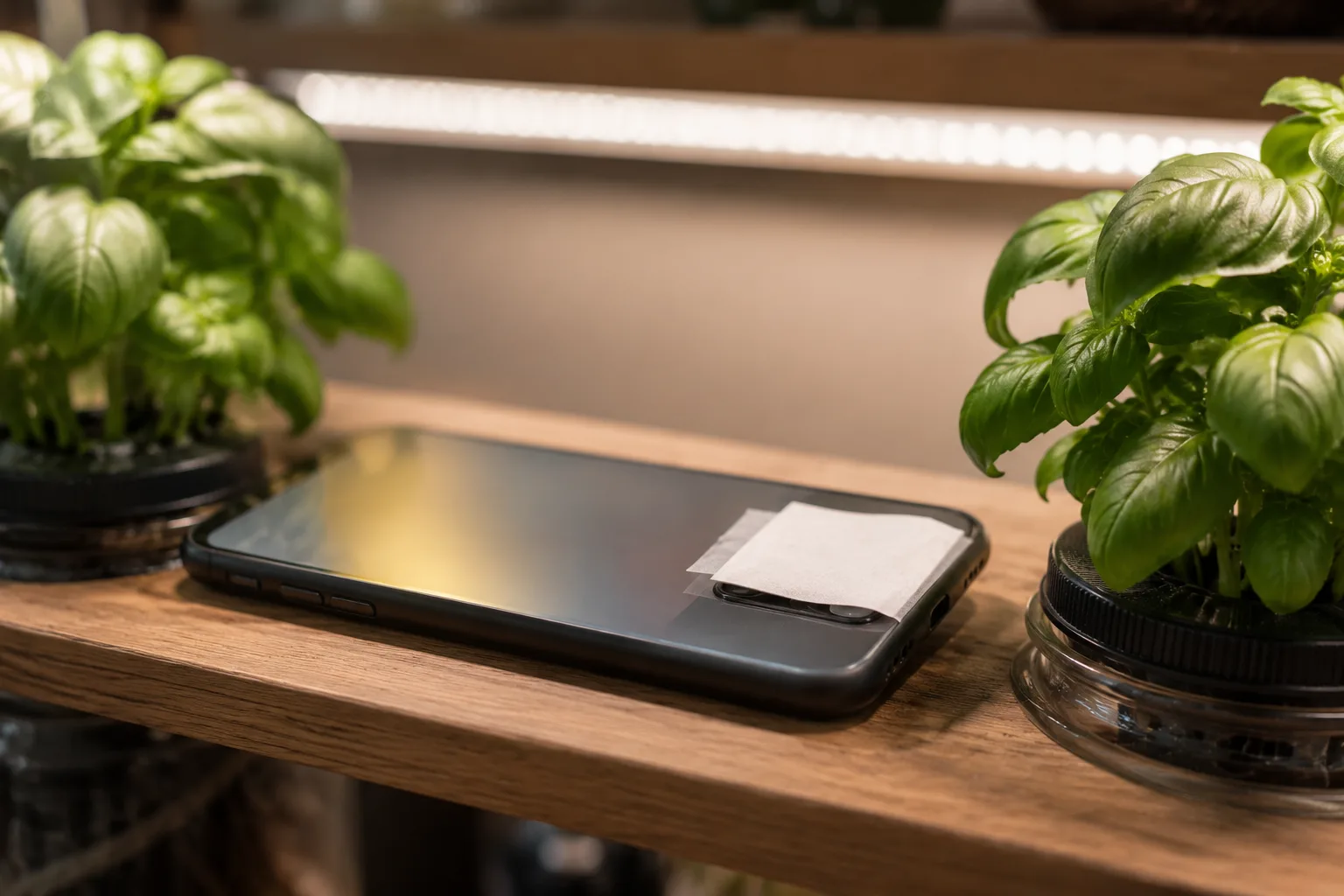
However, the camera was built to photograph faces, not to count photons, so the raw sensor response is nothing like a plant’s. The app corrects for that in software, which works only when you tell it the truth about your setup.
🔎 Why the Diffuser Actually Matters
Your camera lens gathers light from a narrow cone directly in front of it. A real sensor gathers from a full hemisphere, since leaves catch light arriving from every angle. Without something to scatter the incoming light across the lens, the app reads the bright spot it happens to be pointed at and misses everything else.
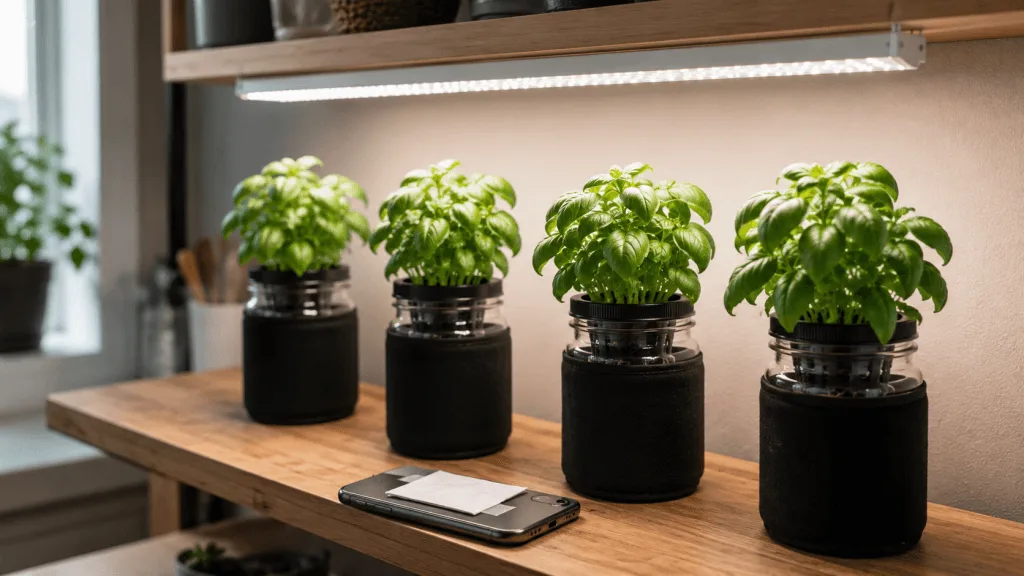
Photone ships instructions for a paper diffuser you fold yourself, and a single sheet of standard printer paper taped over the camera does the job. When I compared a folded-paper reading against a borrowed hardware meter on the same spot, the gap sat inside 15 percent. Without the paper it was out by more than half. So the diffuser is not an optional refinement. It is the difference between a number and a guess.
🌱 Who Should Stop at the App
So stop here if you run one light over one shelf and you are growing herbs or salad. The app will tell you whether the far corner is starving, which is the question most people actually have. It will also tell you when to move the panel, and that decision is worth more than another decimal place of accuracy.
Keep in mind the app is measuring your phone, not your garden. Two phones held side by side rarely agree, so treat the number as a relative reading you compare against itself rather than an absolute truth. As long as you use the same phone in the same way each time, the comparison holds.
💡 Stepping Up to a Budget Lux Meter
A budget lux meter is a real sensor with a real diffuser and it costs about as much as a takeaway. If you distrust software, this is the cheapest way to hold a physical instrument. The catch is that as a grow light meter it reports the wrong unit and expects you to convert.
🪷 The Conversion Factor Problem
Lux weights the spectrum toward what human eyes see best, while plants care most about red and blue. To turn lux into PPFD you divide by a conversion factor that depends entirely on your light’s spectrum. Sunlight runs near 54. A warm white LED lands somewhere around 70. A red and blue panel can sit past 100, and if you use the wrong divisor you can be off by 40 percent while feeling reassured by the hardware in your hand.
Therefore a lux meter is best used for comparison rather than for absolute targets. Take five readings across the shelf, note which spot is brightest, and move plants accordingly. That job it does perfectly well, and the conversion factor cancels out because every reading shares the same error.
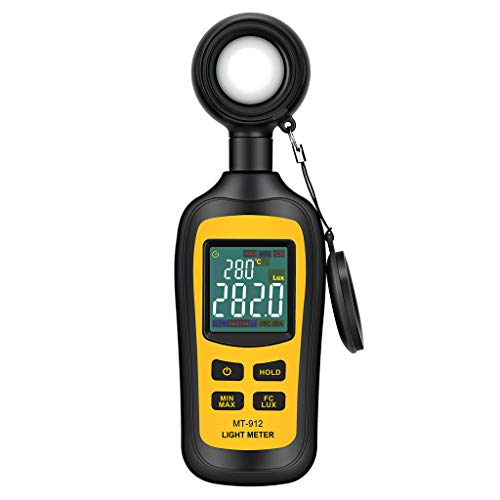
Amazon price right now: $29.98
⚖️ A Dedicated PPFD Meter Is the Real Upgrade
This is where a grow light meter stops being a workaround and starts being an instrument. A quantum sensor is filtered to respond across 400 to 700 nanometres in roughly the way a leaf does, so it hands you PPFD with no conversion and no spectrum setting to get wrong.
A full-spectrum quantum PAR meter replaces a lot of second-guessing. Point it, read it, move on. Since it needs no phone and no paper, mapping a whole two-tier rack takes about four minutes, which matters more than it sounds when you are checking a shelf every few weeks.

Amazon price right now: $79.99 Prices refresh automatically. Prices are pulled from Amazon and were last checked on 27 September 2026 at 6:41 am. Amazon prices change often, so check the listing before buying.
🌿 What Changes When You Can Read PPFD Directly
Two things, and neither is accuracy for its own sake. First, you start measuring more often, because the friction is gone. Second, you can compare across different lights honestly, which the app cannot do reliably once the spectrums differ.
That second point is what convinced me. I was running a white panel over greens and a warmer bulb over a clip-on light for a single jar, and the app told a different story about each depending on which profile I picked. The quantum sensor did not care. Same units, same scale, immediately comparable.
Buy at this tier when you run more than one light, when you are mapping a two-tier grow shelf, or when you have already used the app enough to want something faster.
🔬 When a Remote Sensor Earns Its Price
One step above the handheld sits a grow light meter whose sensor detaches onto a cable, and on a crowded shelf that changes the job. You lay the sensor flat at canopy height, run the cable out, and read the display from somewhere your body is not blocking the light. On a meter with a remote sensor on a long cable the reading stops depending on how far your arm reaches.
Whether that is worth roughly twice the handheld comes down to your shelf. One open counter, no. A two-tier rack with 10 inches of clearance where you cannot get your head in to look, yes, and I would buy it without much hesitation.
True research-grade sensors are a different thing again, and those you should skip. They cost several times what any meter here does, they are calibrated against traceable standards you will never need, and the extra precision buys nothing in a room where moving the light two inches changes the reading by a third. Put that money toward a better light instead, because a reader who spends it on the right budget grow light will grow more food than one who measures a bad light with a perfect sensor.
📏 How to Take a Reading That Means Something
Your grow light meter matters far less than how you hold it. I have watched the same shelf produce readings 200 apart because of how the sensor was held, so this section is worth more than the four above it.
🌿 Measure at the Canopy, Not at the Counter
Light falls off fast with distance, so a reading taken on the counter beside your jars describes a place no leaf occupies. Hold the sensor flat, facing straight up, level with the highest leaves. Then keep your body out of the cone. Leaning over the shelf to read the screen throws a shadow across the sensor, which is the single most common way people record a number far below reality.
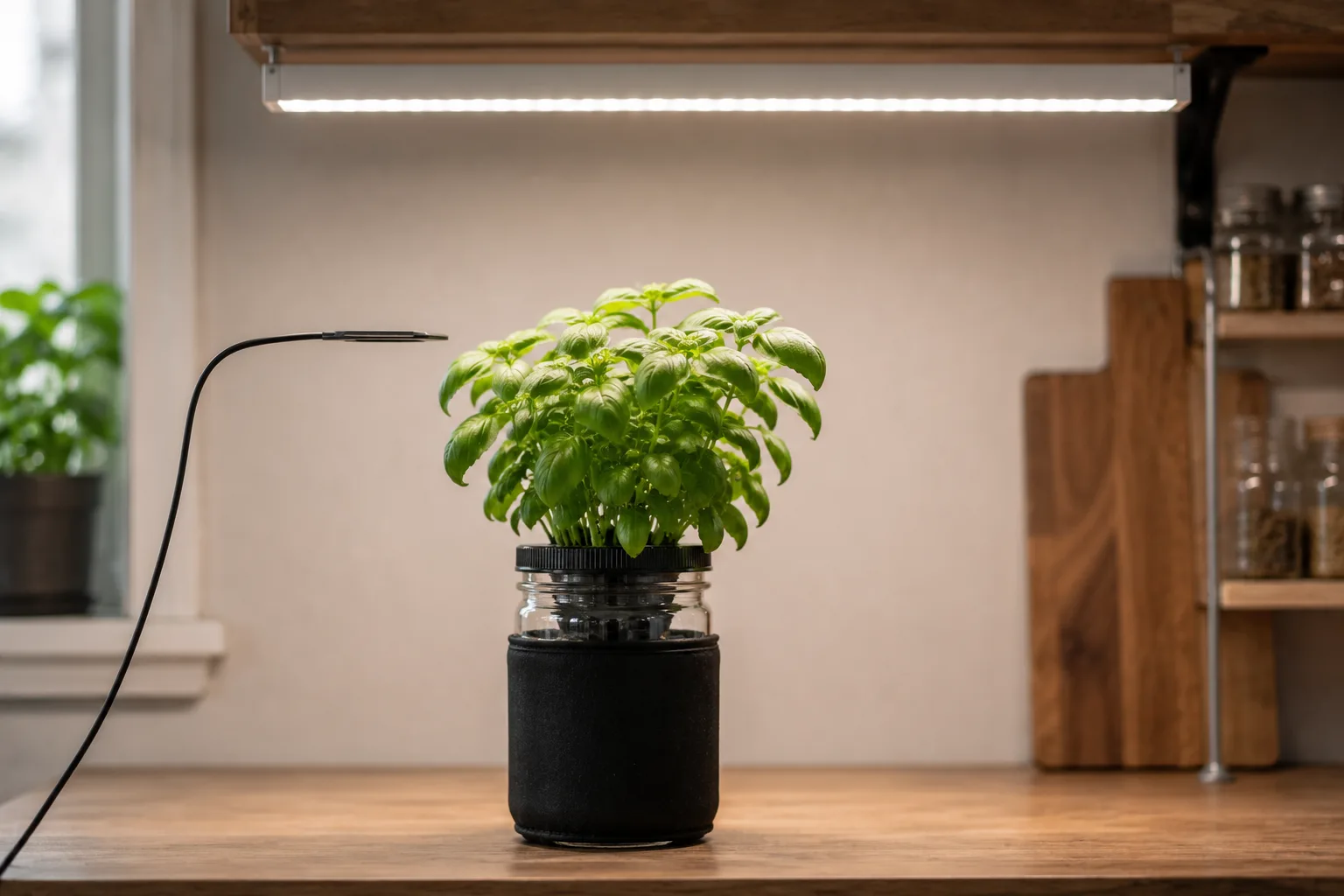
Height is doing most of the work here. Since leafy herbs want the panel 6 to 8 inches above the canopy, and seedlings want 10 to 12, a reading taken at the wrong level tells you about a plant you are not growing.
🧮 Map the Shelf in a Grid, Not a Single Spot
One reading in the middle is how I got fooled in the first place. Take five instead: centre, then each corner of the lit area. Write them down. The pattern is the point, because a panel that reads 320 in the middle and 90 at the edges is telling you the shelf is too wide for the light, not that the light is weak.
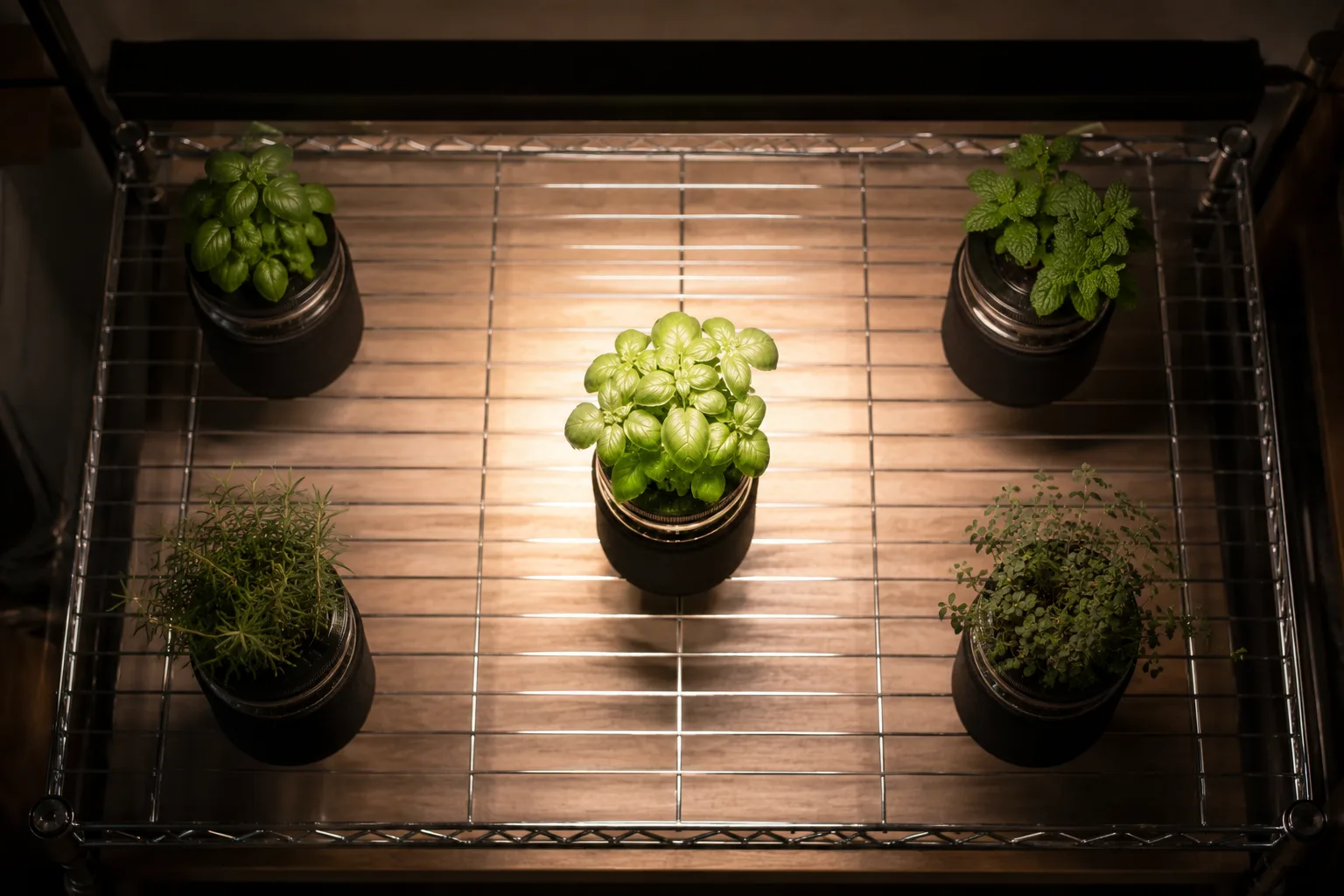
- Turn everything else off, because room lights and window light both contaminate the reading.
- Then set the sensor at canopy height in the centre and record it.
- Repeat at each corner of the area the light covers, so you can see the falloff.
- Step back, since any shadow across the shelf ruins the number.
- Compare the corners against the centre. Anything under half the centre reading is a spot where herbs will stretch.
Once you have that map, the fix is usually rearrangement rather than a new purchase. Hungriest plants go in the middle, tolerant ones to the edges, which is exactly how the shelf layout guide arranges a mixed rack. If you are running basil, mint and lettuce together, the one light, multiple plants breakdown covers who tolerates the edges best.
🔁 Re-Measure After Every Prune
A canopy moves. Basil that was 4 inches tall in week two is 9 inches tall in week five, which means it has climbed most of the way to your panel while you were not looking. Then you harvest half of it and the canopy drops back down. Both events change the number, though neither one prompts most people to check.
So I measure whenever I prune. It takes ninety seconds and it has caught two cases of creeping grow light burn before the leaves bleached.
📊 Target PPFD and DLI for Apartment Herbs
Here are the numbers to compare your grow light meter readings against. These assume the standard 14 hour photoperiod this site uses everywhere.
| Crop group | PPFD target | DLI at 14 hours | What a low reading looks like |
|---|---|---|---|
| Microgreens and tray crops | 120 to 250 | 6 to 12 | Pale, stretched stems that fall over before harvest, because reach beats bulk |
| Leafy greens, lettuce and spinach | 150 to 300 | 12 to 17 | Thin leaves, with long gaps between them |
| Medium-light herbs such as basil | 200 to 400 | 14 to 18 | Leggy stems and weak aroma, since oils build slowly under low light |
| Woody herbs, oregano and thyme | 200 to 400 (thyme 350 to 400) | 12 to 20 (thyme 18 or more) | Soft floppy growth, when it should be dense and woody |
| Fruiting crops | 300 to 600 | 20 to 25 | Flowers that drop before setting fruit, though heat can do this too |
One exception worth knowing before you chase a higher number. Spinach wants 12 hours, and its bolting range starts around 13, so extending the timer is the wrong lever there. The hydroponic spinach guide covers that trap in detail.
If your readings come in low, raising intensity is only one of two options. Running longer hours raises DLI too, though only up to the point where plants need their dark period. The explanation of why the 10 dark hours matter is worth reading before you touch the timer, and a reliable compact timer removes the temptation to do it by hand.
Want the arithmetic done for you? The grow light calculator converts between PPFD, hours and DLI, and the seed to harvest calculator tells you whether your timeline is realistic once the light is right.
Start here: University of New Hampshire Extension: Hydroponics at Home
For the growing side: University of Minnesota Extension on small-scale hydroponics
🚫 When You Do Not Need a Grow Light Meter at All
Plenty of setups run fine without a grow light meter of any kind. A single countertop unit with a fixed light at a fixed height has already been designed around the right intensity, so there is no decision left for a meter to inform. The same goes for one jar under a clip light at a set distance.
Skip measuring when all of these are true:
- You run one light over one small area, so nothing sits at the edges
- Your plants look compact, with short gaps between leaf pairs
- Nothing has changed since the last time things grew well, which is the real test
Buy a meter when you are troubleshooting something specific, when you have added a second light or a second tier, or when you are moving from a windowsill to fully artificial light in a north-facing room. Readings on a healthy garden are interesting. Readings on a sick one are useful.
One more honest note on cost. A meter tells you nothing about your electricity bill, and readers worry about that more than they worry about photons. The running cost breakdown answers that question properly, and a brighter panel does not always cost more to run.
💬 A Word From Sarah
For a long time I measured once, in the middle, and filed the number away as a fact about my shelf. It was not a fact. It was a fact about one square inch on one afternoon at one canopy height, and every one of those three things changes.
What shifted my thinking was noticing that my worst readings always came in August. Not because the light dimmed, but because I had moved the rack away from the window in July to keep the reservoir cool, and the window had been quietly contributing more than I realised. The panel was doing the same work it always did. The room had changed around it.
So now I treat a reading as perishable. I take one after every prune, one whenever I move anything, and one at the start of each season. Three habits, ninety seconds each, and a grow light meter that finally earns its place on the shelf. If you are still building the shelf itself, the complete apartment hydroponics guide covers the setup this all sits on top of, and I would get that right before spending anything on measurement.
❓ Frequently Asked Questions
📱 Are phone light meter apps accurate enough for hydroponic herbs?
Phone apps land within roughly 15 percent of hardware once you fit a paper diffuser and select the correct light source in the settings. For herbs and salad greens that margin is small enough to act on. Without the diffuser the reading can be out by more than half.
🔍 Do I really need a grow light meter for one shelf?
Most single-shelf growers do not. Start with the free app, take five readings, and see whether the pattern explains what your plants are doing. Buy hardware only when you run more than one light zone or when you are troubleshooting a problem the app cannot settle.
🌿 How much PPFD do indoor herbs need?
Medium-light herbs such as basil want 200 to 400 PPFD at the canopy. Leafy greens sit lower at 150 to 300, while microgreens are happy at 120 to 250. Fruiting crops need far more, in the range of 300 to 600, which is beyond most small apartment panels.
💡 Can a cheap lux meter work for hydroponics?
A lux meter compares one spot on your shelf against another perfectly well, since the error is the same everywhere. It struggles with absolute targets because converting lux to PPFD needs a factor that changes with your light spectrum. Use it for mapping, not for hitting a number.
🧪 What is the difference between PAR and PPFD?
PAR names the band of light plants use for photosynthesis, roughly 400 to 700 nanometres. PPFD measures how many of those photons actually reach a square metre each second. So PAR describes a type of light while PPFD describes an amount arriving at your leaves.
⚠️ Why does my reading jump around so much?
Three causes account for almost all of it. Your body shadows the sensor while you read the screen, the sensor tilts away from level, or room and window light contaminate the measurement. Turn other lights off, hold the sensor flat, and step out of the beam.
📏 Where exactly should I hold the sensor?
Level with the highest leaves, facing straight up, with nothing between the sensor and the light. A reading taken on the counter beside your jars describes a place no leaf occupies, and it will usually come in far lower than what the canopy actually receives.
☀️ Should I measure window light too?
Measure it separately, at the same time of day you normally check. Window contribution swings with season and weather, so it is worth knowing how much of your total comes from a source you do not control. A bright windowsill can add meaningfully in summer and almost nothing in winter.
🛠️ My reading is low. Should I raise intensity or run longer hours?
Lower the light closer first, because that costs nothing and it fixes the cause rather than compensating for it. Extending the timer raises daily totals too, though plants still need their dark period, and spinach wants 12 hours and reads much more than that as a signal to bolt.
🧪 My herbs look weak. Is it light or nutrients?
Stretching with long gaps between leaf pairs points to light. Yellowing that starts on older leaves points to feeding or to pH lockout. Check pH before adjusting anything else, since out-of-range pH blocks nutrients the plant already has access to.
🔁 Do grow light meters need calibrating?
Consumer quantum meters ship calibrated and hold that for years of light use. Phone apps are the ones worth sanity-checking, ideally against a borrowed hardware meter once. After that, trust your readings as a comparison against each other rather than as laboratory values.
Still deciding what to buy first? Light is rarely the first purchase that matters. Testing your water sits ahead of it, which is why the pH and nutrient calculator and a decent pH meter for beginners come before any light sensor in my order of priorities. Build the list in the shopping list builder if you want to see the whole spend at once.
Happy growing! 🌿
Sarah, Urban Hydro Space

Sarah Whitfield is the founder of Urban Hydro Space and an indoor gardening enthusiast dedicated to helping apartment dwellers grow fresh herbs and vegetables in small spaces. She researches hydroponic systems carefully from real specifications and verified buyer feedback, and shares practical tips and honest, clearly labeled product picks to make indoor gardening accessible for beginners.