⏳ 25 min read · Last updated: September 2026
Disclosure: As an Amazon Associate I earn from qualifying purchases. Links marked for Amazon are affiliate links, at no extra cost to you.
🌱 Hands-on tested: the KETOTEK pH, EC and temperature meter, the Apera PH20 pH tester and the Apera EC20 EC tester. I have used these in my own grows. How I test and choose products.
Fixing weak tasting hydroponic herbs starts with understanding how indoor plants build essential oils. When I first grew basil in a cramped apartment kitchen, I expected bold peppery leaves for pesto. Instead the harvest tasted like slightly green tap water. It took weeks to work out that flavour needs specific triggers rather than basic survival, so you can grow a huge beautiful plant that carries no culinary punch at all.
In a small setup we pamper plants too much. Warm temperatures, endless water, steady food. Herbs develop their signature flavours as a defence against harsh outdoor conditions, though, so fixing a bland crop means recreating a little of that struggle indoors. If you are new to the hobby, the complete apartment hydroponics guide for beginners covers the setup before you start tuning for taste.
You will see one universal number quoted everywhere, and it is wrong. Mint wants 2.0 to 2.4 while thyme wants 1.2 to 1.6. A figure that suits one starves or burns the other.
The real rule is simpler: run each crop at the low end of its own range. That is what concentrates flavour, and the table below gives every number.
- Not sure what is wrong yet → start with why weak tasting herbs happen
- Leaves are huge and dark but bland → jump to nutrient imbalances
- Stems are long and pale → jump to adjusting light
🔎 The Fast Version: What To Check First
Before changing anything, work out which of the five common causes you are actually looking at. Each one produces a different set of symptoms, so matching the symptom to the cause saves you from adjusting the wrong variable and making things worse. The same checks are also how you boost hydroponic herb flavor on a plant that is already healthy.
- Run each crop at the low end of its own EC range, since no single number suits every herb.
- Drop leafy herbs to 6 to 8 inches below the light, though woody thyme and oregano want 4 to 6.
- Hold a steady 14 hours on, 10 hours off. Longer does not add flavour, and it bolts some crops.
- Always harvest in the morning, right as the lights come on, to catch peak oils.
- Add gentle airflow, because mechanical stress is the cheapest flavour trigger you have.
- Top off daily with plain water, then run a full reservoir change every 2 weeks.
- The Fast Version: What To Check First
- Why Weak Tasting Hydroponic Herbs Happen
- Why One EC Number Cannot Work
- Fixing The Nutrient Imbalances Behind Bland Herbs
- Adjusting Light To Stop Weak Tasting Herbs
- Harvesting Mistakes That Cost You Flavour
- Environmental Factors Destroying Herb Flavour
- A Word From Sarah
- Frequently Asked Questions
| What you see | Most likely cause | Check this first |
|---|---|---|
| 🟢 Huge dark leaves, no smell | Overfed, so growth outran oil production | Compare your EC against the crop’s own range |
| 🌿 Leggy stems, weak taste | Light too far away or too weak | Measure the distance to the canopy |
| 🍂 Pale leaves, bland flavour | Nutrient lockout, therefore pH drift | Test pH before touching the nutrients |
| 🟤 Slimy roots, bitter leaves | Early root rot from warm water | Measure water temperature, not room air |
| 🌸 Sudden bitterness, tall centre stalk | The plant bolted | Check for a flower stalk, since this is final |
🌿 Why Weak Tasting Hydroponic Herbs Happen
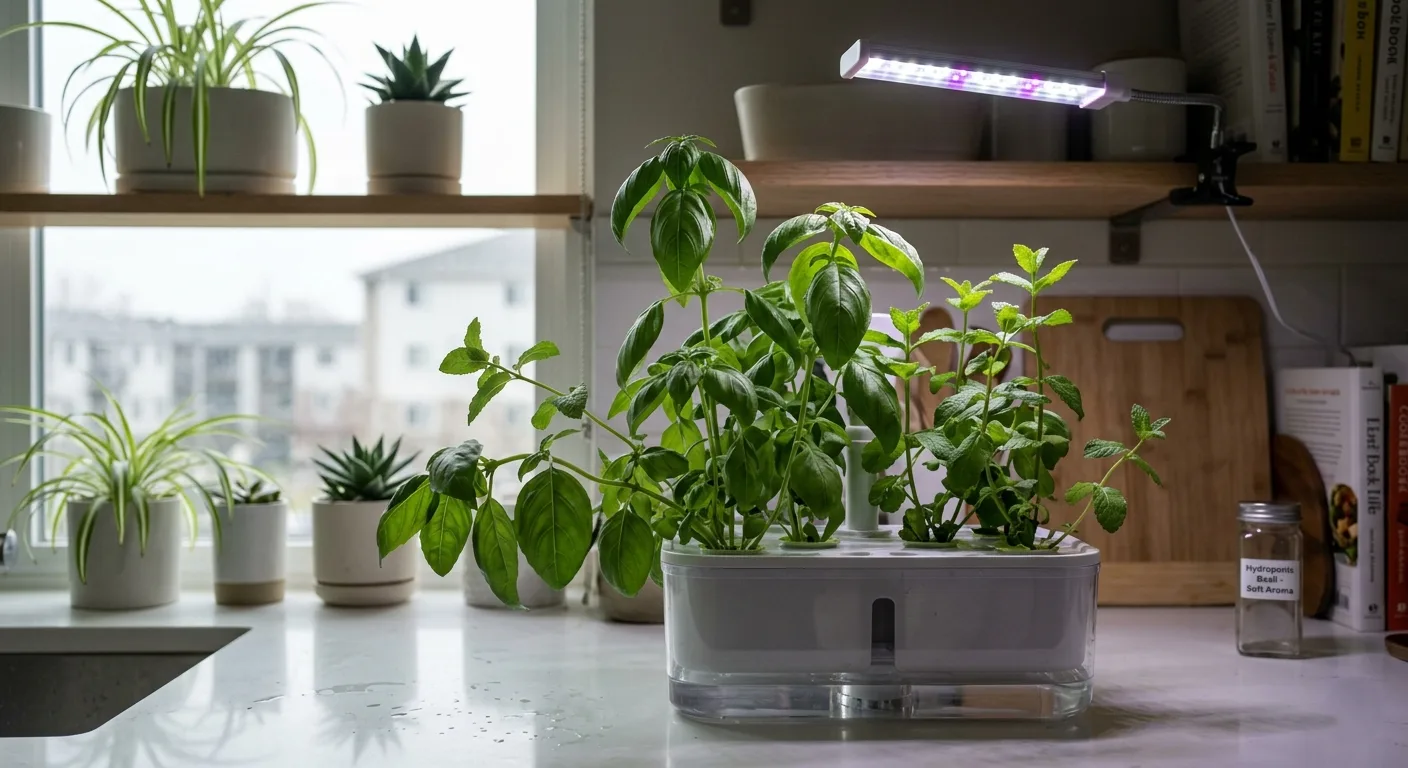
Outdoor plants fight for their lives routinely. They face blistering sun, drying wind, and hungry insects, so they produce strong essential oils to deter pests and shield their leaves. Indoor hydroponic herbs live in luxury, which often results in a bland harvest.
Growing indoors removes all natural stress. Without those triggers the plant simply makes larger leaves and longer stems, so the flavour compounds spread thin across all that new growth. I once stared at a gorgeous bushy mint expecting a bold cup of tea, then got something closer to warm water with a green tint.
The fix is controlled stress rather than neglect. You tweak the environment just enough to trigger the plant’s own defences, and the three levers are light, feeding, and harvest timing.
🔬 How Nutrients Drive Essential Oils
Flavour is a byproduct of secondary metabolites, organic compounds that do nothing for structural growth yet define taste and smell. Potassium and phosphorus play the major roles in building them inside leaf tissue.
Feed a generic vegetative formula forever and the plant lacks the building blocks. Vegetative fertilisers lean on nitrogen to push leafy expansion, so over time that excess suppresses the very oils you want. The result is a watery harvest from a plant that looks magnificent.
Balance is the answer rather than starvation. Every crop has a published range, and sitting near the bottom of it gives you smaller leaves carrying more concentrated flavour. Sitting near the top gives you bulk.
🔍 The Role Of Light Stress In Taste
Light intensity correlates directly with essential oil production. Herbs like thyme and oregano evolved in intense Mediterranean sun, so under a weak LED strip they stretch toward the light and produce thin foliage instead.
Strong light acts as a mild stressor that forces leaves to thicken and produce protective oils. Leggy spindly growth therefore points at light before it points at feeding. Raising the intensity signals the plant to deploy its chemical defences.
🎴 Plant Genetics Versus Environment
Sometimes the problem is the seed rather than the setup. Some varieties are bred for size rather than taste, because commercial growers prioritise weight for grocery packaging. Those strains look impressive and carry little nuance.
Choosing heirloom varieties, or seed labelled for intense flavour, helps a great deal. Genovese basil produces more aromatic oil than a large-leaf Italian type, and Greek oregano carries far more carvacrol than common oregano. Good genetics raise your ceiling.
Even the best genetics fail in a poor environment, though. You still have to supply the conditions that coax those traits out.
📊 Why One EC Number Cannot Work
This is the correction that matters most. There is no universal flavour EC, because a figure that underfeeds mint will simultaneously overfeed thyme. Three crops show the problem clearly.
One number, two opposite failures. That single figure would starve basil and mint while drowning thyme, which is why matching the crop matters more than finding a magic setting. Every crop also starts seedlings at EC 1.0 to 1.2 regardless of where it finishes.
📐 Flavour Settings For Six Common Herbs
Four levers control flavour indoors: light height, light hours, nutrient strength and harvest timing. Each one is crop-specific, so the table puts every number for the six most common kitchen herbs in one place. Run all of them on 14 hours on, 10 hours off, and aim for the low end of each EC band when taste matters more than size.
Seedlings of every crop start at EC 1.0 to 1.2, although basil takes up to 1.6. Lean woody growth concentrates thymol and carvacrol, whereas basil needs a richer feed before it makes much linalool.
- Want the fastest result → move the light closer, since distance is the usual culprit
- Leaves pale and bland → test pH, because lockout mimics hunger exactly
- Leaves dark green and watery → you are overfeeding for that crop, so drop toward its floor
⚗️ Fixing The Nutrient Imbalances Behind Bland Herbs
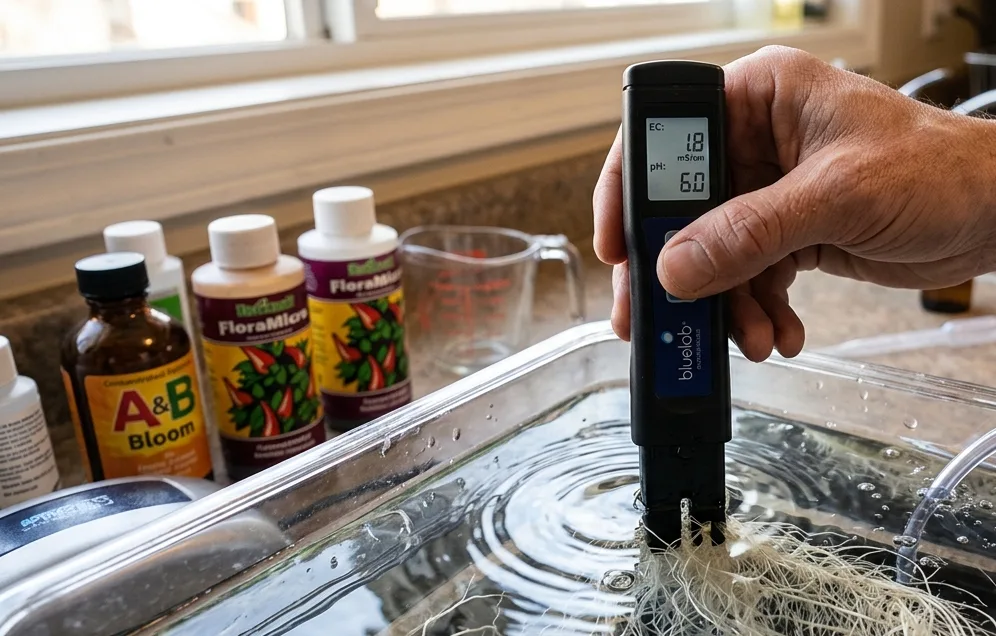
Your mix dictates everything from growth speed to final taste. Many beginners buy a generic fertiliser, pour it in, then hope. That keeps plants alive, although it rarely produces anything worth cooking with.
Bland herbs often suffer a chemical imbalance rather than a shortage. If pH drifts, the roots cannot absorb the trace minerals that build aromatic oils, so the jar looks full of food while the plant starves. Choosing the right product in the first place is covered in the nutrient roundup for small systems, and the beginner nutrients guide lays out the schedule.
📊 Checking EC Against Your Crop
Electrical conductivity measures total dissolved salts. Run it above your crop’s range and the plant takes up water fast, which swells the cells and spreads the oils thin. That is why an overfed plant looks superb and tastes of nothing.
So compare your reading against the table above rather than a universal figure. If mint reads 1.5 it is hungry, whereas thyme at 1.5 is already near the top of its band. A reliable EC meter for small reservoirs is the only way to know week to week, and how to lower EC safely covers the correction when you overshoot.
Hold pH between 5.5 and 6.5 so the plant can reach those flavour-building minerals at all. Cilantro does best in the upper half, 6.0 to 6.5. Test every few days, since a stable environment lets the plant spend energy on oils rather than stress recovery. The pH and nutrient calculator gives you the target pH, EC, and dose for each crop in one place.
📉 Why Too Much Nitrogen Dilutes Taste
Nitrogen fuels leafy growth. Feed heavy doses and leaves become huge, soft, and dark green, yet essential oil production cannot keep pace with that expansion.
Most apartment growers cannot dial nitrogen independently, though, because a one-part powder mixes everything together. The practical move is either dropping overall EC toward your crop’s floor, or switching to a formula with a higher potassium and phosphorus ratio. Both push the plant to mature rather than expand. Mixing two-part nutrients in small jars covers how to shift the ratio properly if your product allows it.
🧴 Sharing One Reservoir Between Crops
A shared reservoir forces a compromise, so aim for EC 1.5. That is a deliberate middle ground rather than an ideal. It sits well under basil while touching the top of thyme’s range, so both survive it and neither peaks.
Mint is the exception worth planning around, because its 2.0 to 2.4 range would overfeed anything sharing the water. Give it its own jar. In fact, splitting heavy and light feeders into separate containers is the change that most often turns a bland mixed shelf into a flavourful one, and shelf layouts for one light and many herbs shows how to arrange them.
🚰 Troubleshooting Nutrient Lockout
Sometimes the food is in the water and the plant refuses it. That is lockout, and it happens when pH swings out of range so minerals bond into forms roots cannot take up. Leaves pale, taste turns flat, and adding more nutrient makes it worse.
- Unplug the lights and any circulating pump first.
- Drain the old solution away.
- Rinse the reservoir walls gently to clear salt buildup.
- Refill with fresh water, then balance pH before adding nutrients.
A full reservoir change every 2 weeks prevents those clusters forming at all, and how often to change hydroponic water explains why the rule holds even when EC reads fine. Between changes, top off with plain water only, which topping off without messing up your nutrients covers. If drift keeps returning after every correction, read why hydroponic pH keeps drifting in small systems, and the beginner pH meter guide covers which pens hold calibration.
Test pH every 3 to 5 days rather than weekly, since small jars drift fast. Phosphoric acid lowers pH reliably, while citric acid is a milder option that breaks down faster in a small reservoir. Skip home remedies such as wood ash or baking soda, because they add sodium or trace metals that build up in a jar. Tap water in many buildings also runs short of calcium and magnesium, so check whether you need Cal-Mag in a small system if new leaves stay stunted.
⚠️ Fixing Leaf Tip Burn From High EC
Over-feeding shows up as dry brown leaf edges. That burn means the plant is struggling to move water against high salt pressure, and it spreads inward toward the young, flavour-packed leaves, so act quickly.
- Measure the solution to see how far EC has climbed.
- Remove half the nutrient solution with a clean cup or siphon.
- Refill with plain pH-adjusted water to dilute the remaining salts.
- Hold EC 1.2 to 1.5 for 4 to 7 days while the plant recovers, then return to the crop’s own range.
If tip burn continues after a full change, look at the air rather than the water. Calcium travels with the transpiration stream, so still, humid air stops it reaching the newest leaves even when the reservoir is fed correctly. That is a delivery failure rather than a shortage, which is why more Cal-Mag will not fix it while a small fan often will. For bigger corrections, lowering EC safely in tiny reservoirs walks through the dilution maths.
🧂 What To Do If Nutrient Tweaks Fail
You might balance pH, hit the right EC, and still get dull herbs. If the chemistry is sound, the roots are the next suspect, since a damaged root system cannot process a perfect solution.
- Lift the net cups, then inspect the roots for brown slime.
- Smell the water, because sulfur or rot means anaerobic bacteria.
- Check that your nutrient bottles have not expired or crystallised.
- Confirm the root zone gets oxygen, whether from an air stone or a Kratky air gap.
Healthy roots are white and fibrous. Treat decay before worrying about flavour, since preventing root rot in small hydroponic systems explains why oxygen rather than hygiene is the real variable.
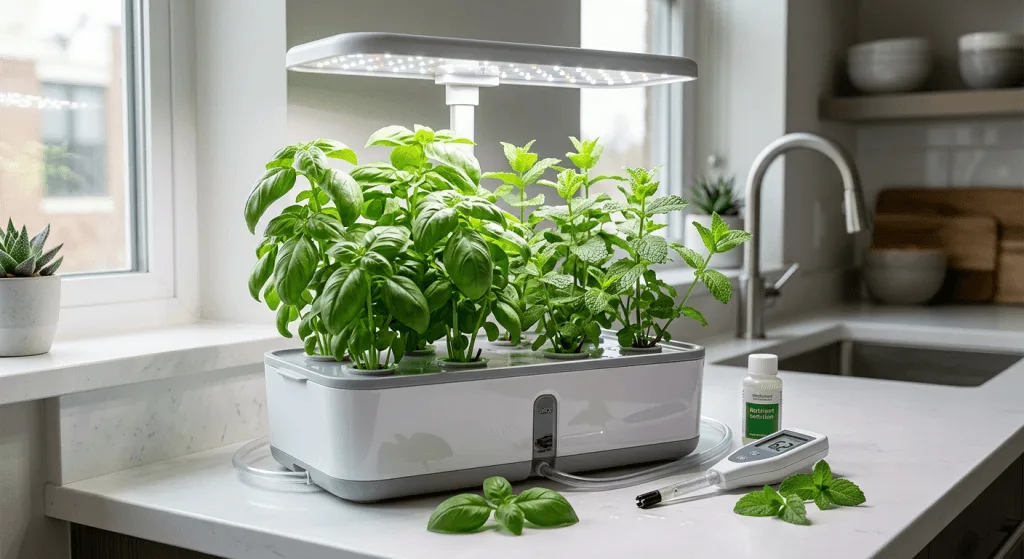
Before you blame the light, check the feed. These are the meters I test with:
- KETOTEK pH, EC and temperature meter: one pen for all three readings, so it is the one I would buy first on a tight budget
- Apera PH20 pH tester: a dedicated pH pen, worth having because a second reading catches a probe that has drifted
- For feeding several containers I pair it with the Apera EC20 EC tester: EC only, but it is the pen I reach for when several containers need checking
I have used the KETOTEK, the PH20 and the EC20 in my own grows. For side-by-side comparisons, see my pH meter roundup and then the EC meter roundup.
☀️ Adjusting Light To Stop Weak Tasting Herbs
Lighting is the engine of an indoor garden. Without enough photon energy the plant cannot run the photosynthesis that builds complex flavour, and many apartment growers rely on window light or a desk lamp. That leads straight to a bland harvest.
Raising intensity forces the plant to adapt by thickening cell walls and ramping up oil production. The grow light calculator works out your PPFD target from shelf size, and PPFD versus PAR versus lumens explains why the lumens figure on the box tells you nothing.
⏱️ Hitting The Right Daily Light Integral
Daily Light Integral is the total light a plant receives across a day. Run only eight hours and the plant barely covers survival, let alone flavour.
Set timers to 14 hours on and 10 hours off, which is the standard for every herb and green here. Resist the temptation to push further, since longer days do not add flavour and they trigger bolting in spinach and cilantro. If work makes the timing awkward, the light schedule guide for 9-to-5 growers shows practical windows, and one of the best compact timers for apartment grow lights removes the guesswork.
Consistency matters as much as duration, because plants expect a reliable sunrise. The dark period is doing real work too, and whether hydroponic herbs need darkness at night explains what happens during those ten hours.
Smart gardens need a check as well, because their internal clocks can reset after a power cut and switch the lights on at 2am. When the schedule looks wrong, reset the device so the plant gets its rhythm back.
📏 Distance Between Grow Lights And Canopies
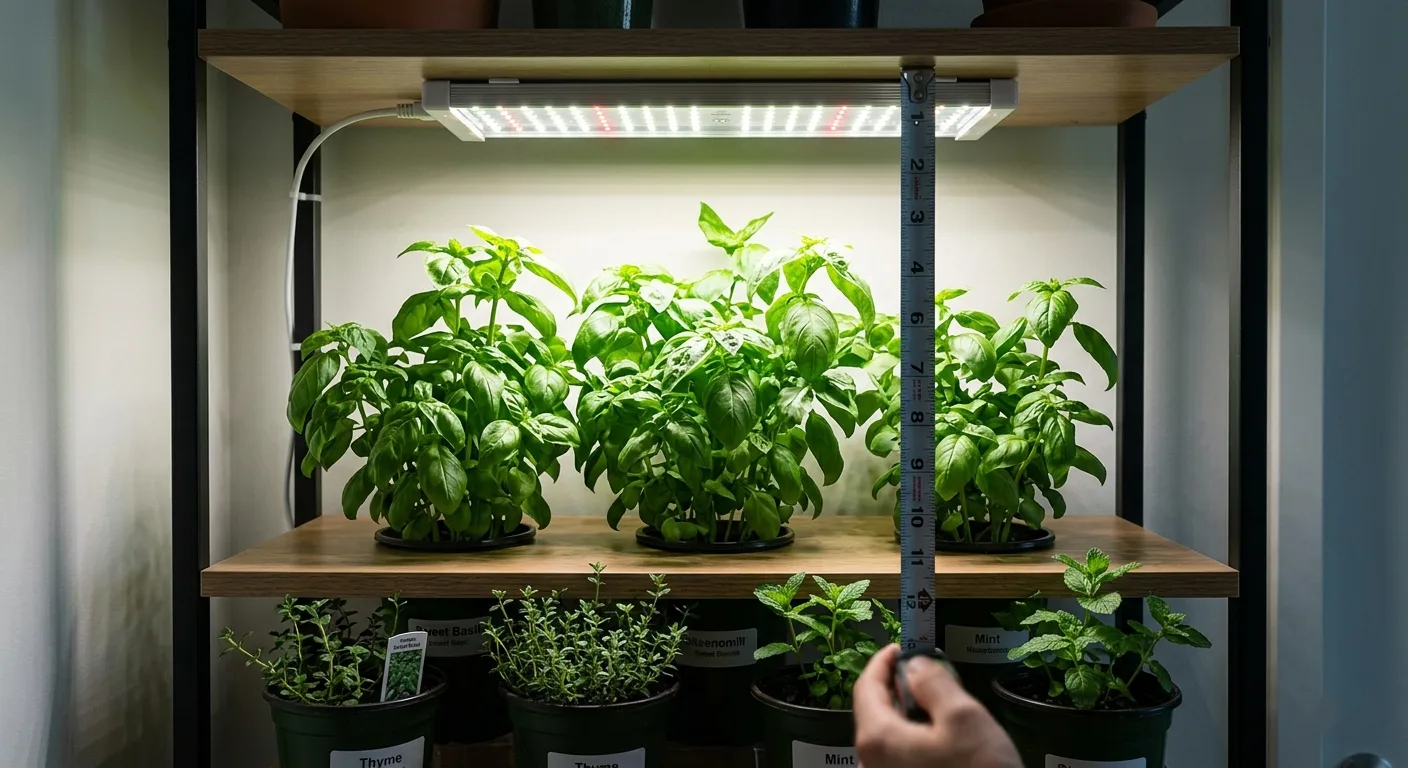
A powerful light becomes useless at the wrong distance, since intensity drops off sharply as it increases. A panel two feet above your basil leaves the plant starving in the shadows.
Lower it to 6 to 8 inches above the highest leaves for most herbs. Thyme and oregano are the exception at 4 to 6 inches, because woody herbs need more intensity to build oils, and seedlings want 10 to 12 until true leaves appear. For leafy herbs, that distance should put roughly 200 to 400 µmol/m²/s on the canopy, which is where oil production holds steady without scorching. Curling or crispy brown edges mean you went too close, which is grow light burn rather than a nutrient problem. Exact heights by crop are in the grow light distance guide.
Adjust as the plant grows, since the canopy rises every week. Running crops at two different heights on one shelf is covered in running one grow light over multiple plants.
🔆 Using Blue Light For Oil Production
Spectrum alters how a plant develops. Red light promotes flowering and stretch, whereas blue keeps plants compact and bushy. More usefully, the blue end triggers defensive oil production.
If your fixture has adjustable channels, favour blue and white during vegetative growth to mimic bright midday sun. The full comparison sits in full spectrum versus red and blue LED grow lights, which also explains why the blurple panels look the way they do.
Avoid warm yellow bulbs meant for living rooms, because they lack the spectrum to drive proper photosynthesis. A proper horticultural light pays for itself in taste alone.
🚨 What To Do If Light Upgrades Fail
Sometimes you fix the light and the flavour stays flat. When that happens the issue is usually root health or oxygen, since a bright light demands a root system that can keep up metabolically.
- Check the roots for brown slime, which signals early rot.
- Confirm your air pump is bubbling, or that a Kratky jar still has its air gap.
- Verify the water stays below 75°F (24°C).
- Ease the nutrient concentration down toward the crop’s floor.
If nothing improves, check the age of the panel. LEDs lose output over the years while still looking bright to the eye, so an old fixture can deliver far fewer usable photons than its label promises.
If the fixture itself is the weak link, the roundup of best grow lights for low-light apartments under $50 covers solid options, and whether a clip-on grow light can really grow herbs answers the obvious follow-up.
✂️ Harvesting Mistakes That Cost You Flavour
When and how you cut matters as much as how you feed. Many beginners wait too long, letting the plant shift energy toward flowering, and once an herb bolts the leaves turn bitter or lose aroma entirely.
Pruning is continuous in hydroponics. Regular harvesting keeps a plant bushy and in active oil production, so treating your garden as a display piece rather than a food source produces bland results. To plan sessions in advance, the seed to harvest calculator maps your timeline from either seed or transplant.
🕰️ Timing Your Harvest For Maximum Oils
Plants synthesise and store essential oils overnight, so concentration peaks by the end of the dark period. As the day warms, some of those volatile compounds evaporate away.
Prioritise a morning harvest and snip right as the lights come on. Waiting until evening to cut cilantro or mint costs you a real percentage of the aroma you spent weeks building.
🌿 Catching The Peak Before Flowering
Cut leafy herbs through their vegetative peak, before flowering begins. When buds form, the plant sends its sugars into reproduction instead of leaves, so flavour turns bitter and the stems go woody. Broad, fresh basil leaves carry the most aroma, whereas small, thick leaves suggest the plant is past its best and wants cutting back.
Basil and mint give you a short window to rescue them when you catch buds early:
- Find the flower spike forming at the top of the main stem.
- Pinch or cut it back to the next pair of large leaves.
- Bring the reservoir back to 65 to 75°F (18 to 24°C) if heat triggered it.
- Keep harvesting every week or two so new buds never get a start.
Leaf quality usually improves again within a week or so. Cilantro and spinach are different, however, because once they send up a tall centre stalk the bitterness does not reverse. The seed to harvest calculator helps you plan cuts before that point.
🔪 Pruning Techniques To Boost Flavour
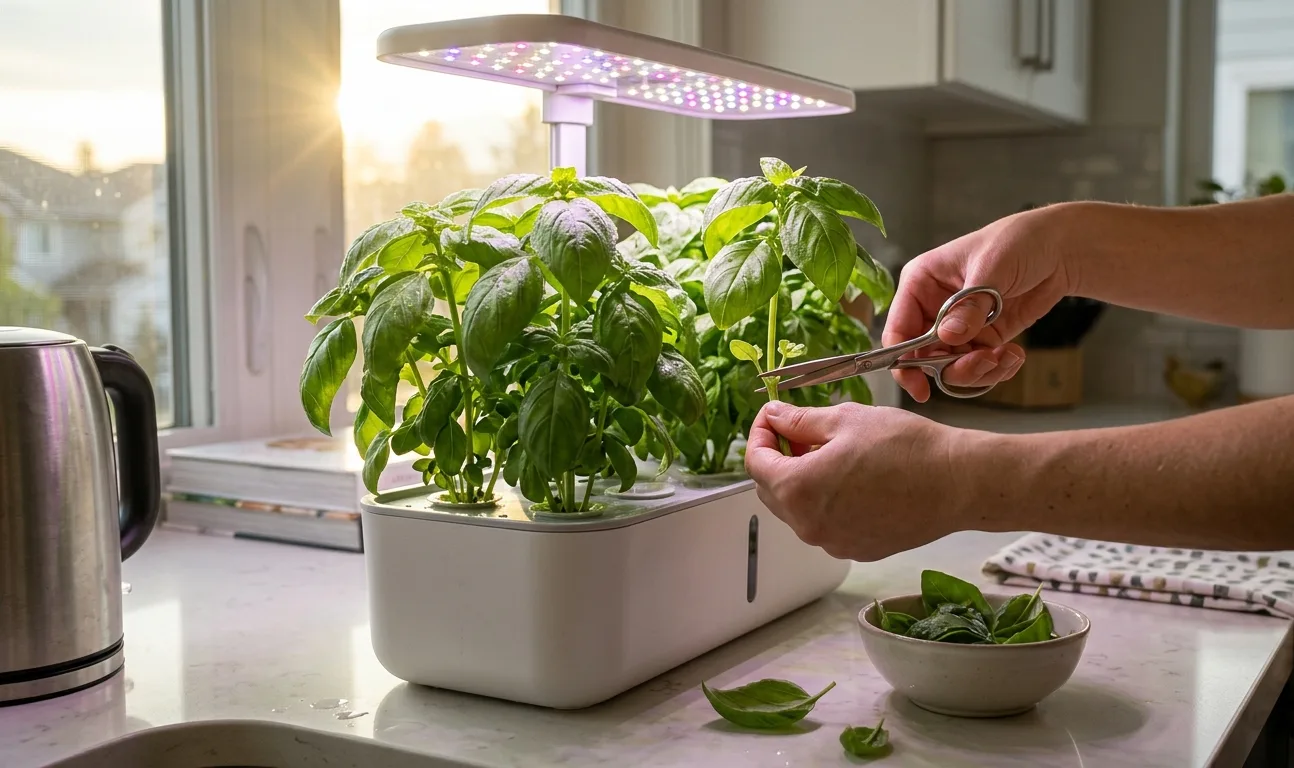
Where you cut dictates how the plant regrows. Snipping at random leaves bare stems that waste energy, whereas cutting to a node directs growth outward into a dense aromatic canopy.
Use clean sharp scissors and cut just above a leaf node, the small bump where new leaves are forming. That forces the stem to split into two new branches. The technique is covered properly in how to prune hydroponic basil and herbs, and the foolproof basil guide covers timing for that crop specifically.
Pruning also opens airflow through the middle of the plant, which reduces fungal risk and acts as another mild stressor.
🍂 The Pinch Test For Potency
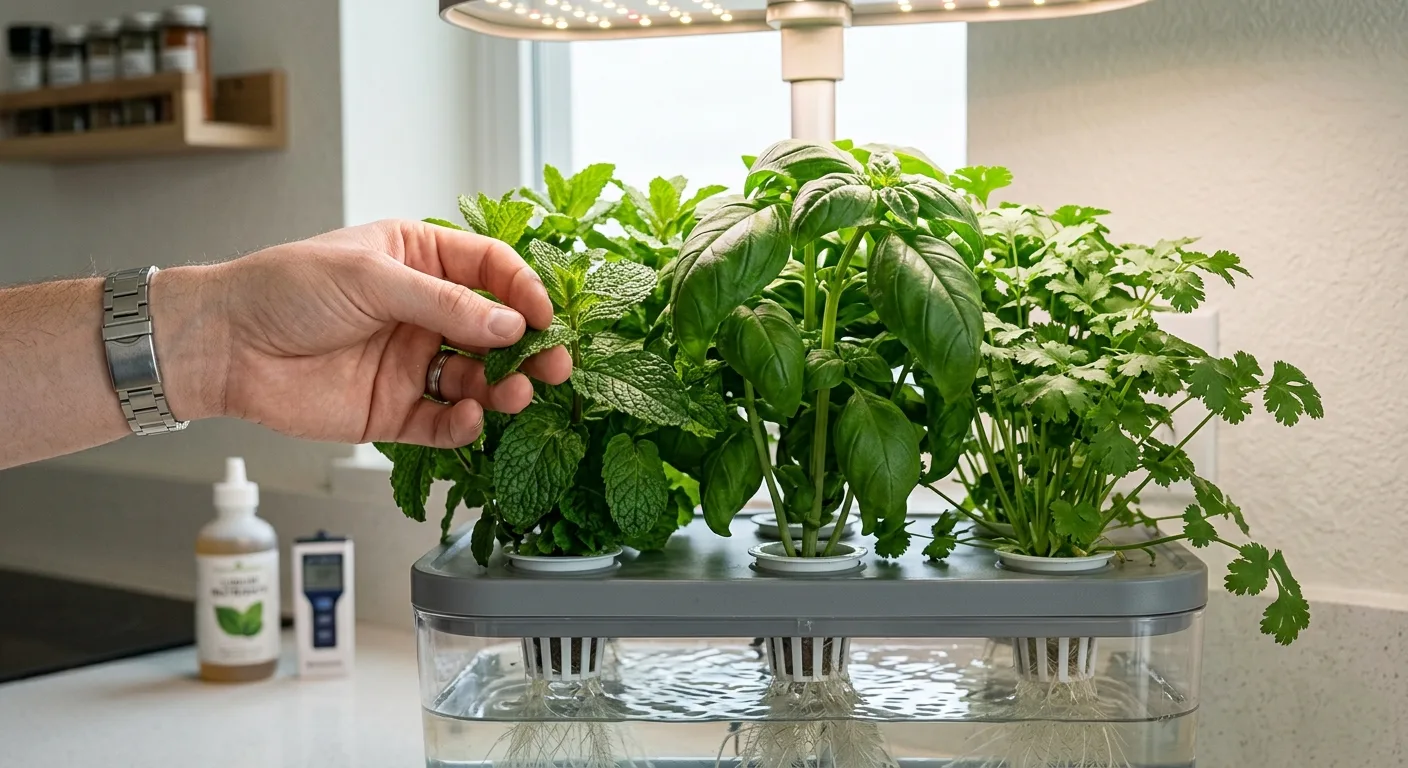
Test before you commit to a full harvest. A giant basil leaf can look ready and carry no bite at all, so rub one lightly between thumb and finger. That friction releases the volatile oils.
Faint smell means another week of high-intensity light. Sharp and pungent means you are clear to cut. Comparing old lower leaves against young top growth also reads plant health, since the leaves nearest the light should always smell strongest.
🩹 What To Do If Your Plant Wilts After Cutting
Harvesting sometimes shocks a plant into drooping, because removing foliage cuts its ability to transpire and pull water. It looks alarming, though it is fixable.
- Check the reservoir, then confirm the roots still reach the solution.
- Dim the light if your fixture allows it, or raise it an inch or two for 24 hours.
- Add a gentle fan breeze to stimulate the remaining leaves.
- Wait three days before adding any new fertiliser.
The plant should recover as it adjusts to its new size. Next time take smaller, more frequent clippings.
🌡️ Environmental Factors Destroying Herb Flavour
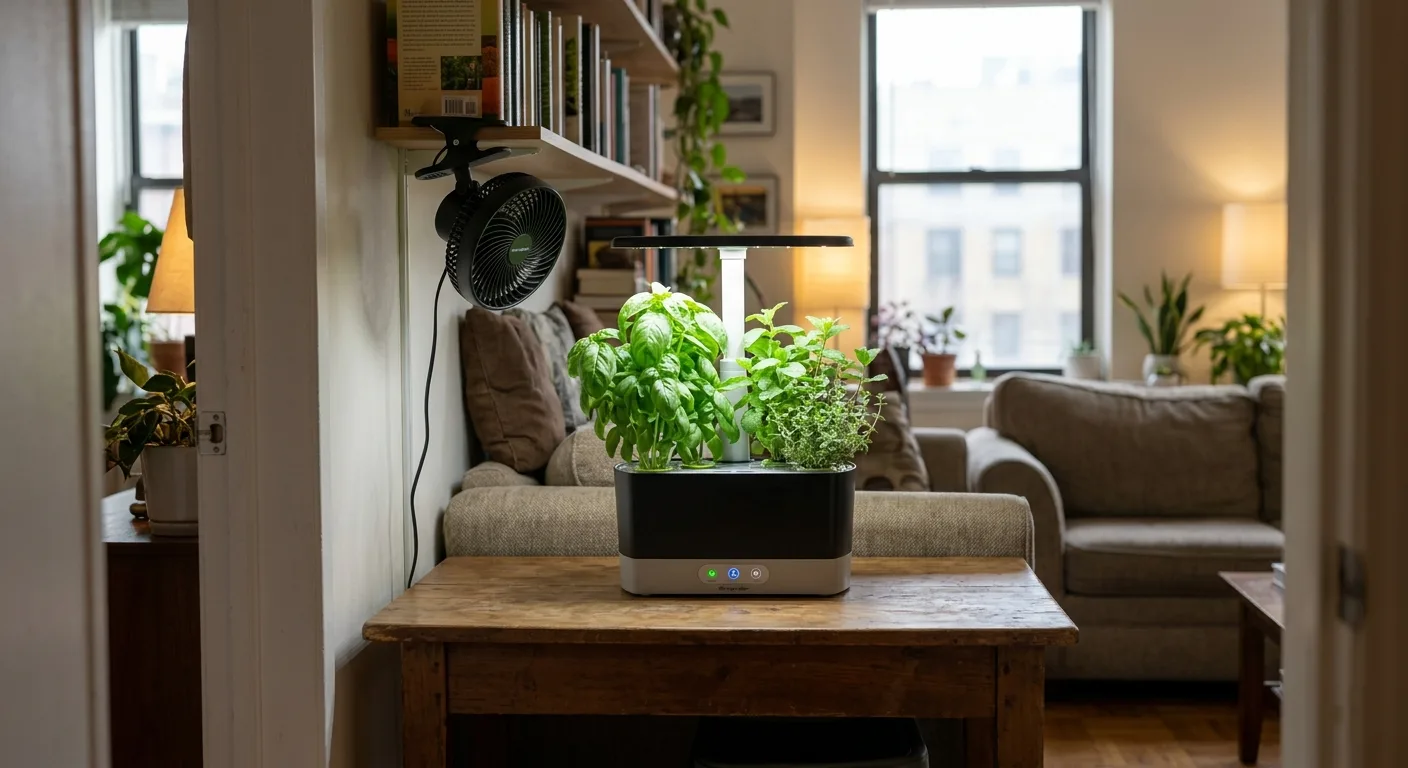
Your apartment climate affects plant chemistry more than most people expect. These systems sit in living spaces, exposed to air conditioning, heater vents, and shifting humidity, so fluctuating conditions stress the plant in the wrong ways.
Water quality matters just as much. Stagnant water breeds bacteria that compete with roots for oxygen, and once oxygen drops the plant slows oil production to conserve energy. The routine in cleaning a small hydroponic system covers sanitation without flooding your kitchen.
❄️ Why Temperature Swings Cause Weak Tasting Herbs
Swinging between day and night pushes a plant into survival mode. Cold shocks the root zone, whereas heat drives rapid water uptake that dilutes the flavour inside the leaf.
Keep the reservoir at 65 to 75°F (18 to 24°C) for every crop. Air temperature is crop-dependent, though: warm-season herbs like basil, mint, oregano, and thyme want 65 to 75°F, while cool-season crops like lettuce and cilantro prefer 60 to 70°F. Keep systems away from AC vents and poorly insulated windows.
A reservoir that feels warm to the touch means the roots are suffocating, since warm water holds less dissolved oxygen. Shade the basin from the light, and small hydroponic temperature problems and fixes covers cooling without a chiller. Never drop ice into the solution, because the swing shocks roots and fades within the hour. Instead, freeze a sealed bottle of water and rest it against the outside of the container, which pulls heat out gradually. Do not chase flavour by going below 65°F either, since cold water slows uptake and thins the taste.
🌬️ Airflow And Plant Stress
Airflow supplies the mechanical stress indoor plants never get. Outdoors, wind pushes against stems and forces them to thicken, and that same movement triggers defensive compounds.
Set a small clip fan to blow gently across the canopy, so the leaves move slightly rather than whipping about. Good airflow also prevents fungal problems and speeds transpiration, which keeps roots pulling nutrients up. This is the cheapest flavour upgrade available, and the roundup of quiet clip-on fans for hydroponics covers which stay silent in a studio.
Aim the fan across the canopy rather than straight at it, and keep it off young seedlings, since tender stems windburn easily. Humidity plays into this too. Above roughly 70 percent, transpiration slows and the plant moves fewer nutrients up from the roots, which thins the flavour, so keep the room between 40 and 70 percent.
🔇 Managing Water And Air Pump Noise
Oxygenating an active system needs pumps, yet the hum disrupts a small flat. Unplugging them at night starves the roots of oxygen, which ruins flavour, so that is not the answer.
A thick silicone mat under the pump absorbs most of the vibration, since structure-borne noise rather than the motor is usually what you hear. Fully submerging a water pump stops the trickling sound. If it persists, quieting a hydroponic pump in an apartment covers the fixes, while the roundup of best quiet air pumps for apartment DWC lists the lowest-noise models.
🩺 What To Do If Environmental Tweaks Fail
If temperature is stable, a fan runs, the water is balanced, and the herbs still lack flavour, a hidden pathogen may be sabotaging everything upstream.
- Remove the plant, then check the net cup for a foul odour.
- Inspect the stem near the medium for white mould or soft spots.
- Drain the system and sterilise every plastic component.
- Start fresh seed in new sterile rockwool rather than nursing a sick plant.
Starting over with a sanitised system is often the fastest route to a good harvest. Germination is covered in starting hydroponic seeds in rockwool.
| Environmental factor | Impact on herb flavour |
|---|---|
| Humidity above 70 percent | Slows transpiration, therefore dilutes the oils |
| Water below 65°F (18°C) | Slows uptake, so growth stalls and flavour thins |
| Water above 75°F (24°C) | Oxygen falls, therefore roots rot and taste turns bitter |
| Stagnant air | Weak stems, since no mechanical stress triggers oils |
| Old nutrient water | Salts accumulate, so the taste turns harsh |
💬 A Word From Sarah
When I first grew mint in a tiny bathroom setup, I ran it at whatever number I had read online rather than mint’s own range. I got a sprawling bush that took over the shelf, and I was proud of it right up until I made tea. The leaves tasted like lettuce with a faint hint of grass.
What I eventually worked out is that mint is the heaviest feeder on my shelf at 2.0 to 2.4, and I had been running it well under that while simultaneously overfeeding the thyme sitting next to it on the same reservoir. One number cannot serve both. Splitting them into separate jars fixed both plants inside a fortnight.
That is the lesson I would pass on. Bigger plants do not mean better flavour, and a universal EC does not exist. Look up the crop, aim at the low end of its own band, then put the light where that crop wants it.
❓ Frequently Asked Questions
🧯 Why do my hydroponic herbs taste like water?
Usually because they never faced any stress. Without wind, intense sun, or pest pressure, plants skip the protective oils that create flavour. Overfeeding compounds it, since fast watery leaf growth spreads the aromatic compounds thin across more tissue than the plant can fill.
💧 My basil is huge and dark green but smells of nothing. Why?
Size and aroma are separate outcomes, and chasing one costs the other. Soft dark leaves mean the plant is running fast on nitrogen while oil production lags behind that growth. Ease the feed toward the bottom of basil’s range, move the light closer, and the next flush comes back smaller and far stronger.
🌱 Can I make hydroponic basil taste stronger?
Yes, though check the feed first. Basil wants EC 1.0 to 1.6, nudged toward 1.8 in winter, so a reading well under 1.0 means it is hungry and one well over 1.6 dulls it. Then lower the light to 6 to 8 inches and cut stems as the lights come on each morning.
🌿 Why do my thyme and oregano taste of nothing?
Almost always because the light sits too far away and the feed runs too rich. Both are woody herbs wanting the panel at 4 to 6 inches, closer than anything leafy, and a lean EC, 1.2 to 1.6 for thyme and 1.4 to 1.8 for oregano. Rich feeding under weak light produces exactly the large pale scentless leaves people complain about.
📦 Does the Kratky method produce weaker tasting herbs?
No, not on its own. Flavour problems in Kratky jars trace to poor windowsill lighting or the wrong nutrient strength for that crop. Give it proper full-spectrum light at the right height and the correct EC, and a jar produces herbs every bit as aromatic as a pumped system.
💡 How many hours of light do herbs need for good flavour?
Fourteen hours on and ten off, every day. Longer cycles do not add flavour and they cause real problems, since spinach bolts past about 13 hours and cilantro follows soon after. Short cycles are the real risk, because the plant cannot synthesise enough energy for complex oils.
🍂 Should I stress my plants to improve taste?
Mild stress helps, provided it is the right kind. A gentle breeze from a clip fan is the safest and cheapest, since mechanical movement triggers oil production without risking the plant. Do not withhold water or let temperature swing, because those cause damage rather than flavour.
🧤 When is the best time to harvest hydroponic herbs?
In the morning, right after the lights come on. Essential oils peak at the end of the dark period, then evaporate steadily as heat builds through the light cycle. Cutting at the start of the day captures the highest concentration you will get.
🧴 Can I mix different herbs in one reservoir?
You can, as long as you accept a compromise. An EC around 1.5 keeps basil, oregano and thyme alive without burning the light feeders, although none of them peak there. Mint deserves its own jar, since its 2.0 to 2.4 range would overfeed anything sharing the water.
🌸 My herb turned bitter overnight. Can I fix it?
If a tall centre stalk has appeared on cilantro or spinach, the plant bolted and that bitterness will not reverse. Basil and mint caught at the first buds can be pinched back and usually recover. Pull it and start again with the temperature under control. Cilantro and spinach bolt fastest, so succession planting every three weeks keeps a young replacement always coming up behind.
💬 Do hydroponic herbs taste the same as soil herbs?
They can taste just as strong, given the right settings. Correct EC for the crop and bright light at the right height produce high essential oil levels whatever the growing medium. The bland reputation comes from indoor setups running weak light and one generic feed, rather than from hydroponics itself.
⏱️ How long do herb plants keep producing good leaves?
Basil and mint usually stay productive for four to six months with regular pruning before vigour fades. Oregano and thyme often run past a year, because they grow slowly and rarely bolt. When new growth turns thin or pale, start a fresh batch from cuttings or seed.
Happy growing! 🌿
Sarah, Urban Hydro Space

Sarah Whitfield is the founder of Urban Hydro Space and an indoor gardening enthusiast dedicated to helping apartment dwellers grow fresh herbs and vegetables in small spaces. She researches hydroponic systems carefully from real specifications and verified buyer feedback, and shares practical tips and honest, clearly labeled product picks to make indoor gardening accessible for beginners.