

⏳ 20 min read · Last updated: October 2026
Disclosure: As an Amazon Associate, Urban Hydro Space earns from qualifying purchases at no extra cost to you. This post contains affiliate links. Thank you for supporting Urban Hydro Space!
🌱 Hands-on tested: the KETOTEK pH, EC and temperature meter and the Apera AI209 PH20. I have used these in my own grows. 🔎 Research pick: everything else in this post, chosen from published specifications and listings. How I test and choose products.
The best pH meter for hydroponics only helps when you apply its reading to the crop in front of you. Here is a mistake that catches a lot of beginners. The basil looks fine, but the chives beside it stay thin and pale, in the same kind of jar, with the same nutrients, on the same shelf. Meanwhile, the grower holds everything at pH 5.6 and feels rather pleased that it is inside the textbook range.
Chives, like cilantro, do best in the upper half of that range, pH 6.0 to 6.5, and a reservoir parked near 5.5 shows on them first.
In that situation the meter is right the entire time. The number is read correctly and simply applied to the wrong plant.
That is the honest case for owning a pH meter. Not that it prevents mistakes, but that it turns a mystery into a fact you can look up.
Finding a tester you can trust is the cheapest insurance in indoor growing, because it costs less than the plants you will otherwise lose. If you are still choosing a system, the apartment hydroponics beginner guide covers the full picture before you spend on sensors.
Why the Best pH Meter for Hydroponics Beginners Is Your Most Important Tool
The wrong pH starves a plant sitting in a full reservoir. Nutrients are present, dissolved and correctly dosed, yet the roots cannot take them up because the chemistry outside the root will not release them.
This is nutrient lockout. It looks exactly like underfeeding, so many beginners respond by adding more fertilizer and then make it worse.
Most leafy greens and herbs sit at pH 5.5 to 6.5. Below 5.0 or above 7.0, though, roots stress within days. A meter turns that from a guess into a number, and because every other reservoir decision depends on it, that is the number to get right first.
- Target pH 5.5 to 6.5 for herbs and greens. Chives and cilantro sit in the upper half, 6.0 to 6.5. → crop targets
- Store the glass probe wet in potassium chloride solution. Never dry, and never in distilled water, because distilled strips the glass. → storage routine
- Test every 3 to 5 days on a small reservoir, since small volumes drift fastest. → testing guide
- Dilute acid adjusters in a separate cup before they touch your reservoir. → adjusting numbers
- Measure your tap water before adding anything. Its starting pH and hardness decide how much your reservoir will fight you. → tap baseline
Quick Picks: Four pH Testing Methods Compared
- One or two jars, and you also need an EC reading → KETOTEK pH + EC + Temp Meter the budget combo
- If you want manufacturer-listed ±0.1 accuracy and IP67 waterproofing → Apera PH20 the mid-priced pen
- When you want nothing to charge, calibrate or drop in the water → General Hydroponics drop kit the cheapest option
- If you already own a yellow pen → keep using it this week, then replace it this month
- If you are not sure which device to buy → start with choosing a pH meter for a small reservoir
- If you already own a meter and need setup help → jump to the three pH meter reviews
- When the meter is giving strange readings → jump to pH meter reading problems
- If you want the maintenance routine → jump to pH probe storage and maintenance
Sarah’s Two Picks for 2026
Best for most apartment beginners
KETOTEK pH + EC + Temperature Meter
★★★★☆ Sarah’s rating: 4 out of 5
Reads pH, EC and temperature from one budget kit. Not waterproof and it wants recalibrating monthly, though a beginner needs both numbers more than either one precisely.
Amazon price right now: $14.99
Best long-term accuracy
Apera Instruments AI209 PH20
★★★★☆ Sarah’s rating: 4.5 out of 5
Accurate to ±0.1, waterproof, automatic temperature compensation, calibration solution and KCl storage cap included. It also holds calibration for weeks.
Amazon price right now: $55.90
Ratings above are my editorial assessment. The KETOTEK and the Apera AI209 PH20 are hands-on tested, and every other meter here is a research pick based on published specifications. Links are affiliate links. Prices are pulled from Amazon and were last checked on 9 October 2026 at 7:30 pm. Amazon prices change often, so check the listing before buying.
Choosing the Best pH Meter for Hydroponics Beginners
Three things decide whether a tester is still in your drawer next year. The rest is marketing.
Does It Come With a Storage Cap?
This is the spec nobody checks, yet it kills more meters than dropping them does. A pH probe is a thin glass bulb that only works while its surface stays hydrated. Let it dry out and the response goes sluggish, then wrong, then permanently so.
A proper meter ships with a cap containing a sponge you keep wet with potassium chloride solution. Cheap pens ship with a plastic sleeve and nothing else, so the probe dries between uses and the pen dies in a season. That is the real reason budget pens have short lives, rather than build quality.
Automatic Temperature Compensation
Water temperature shifts the chemistry the probe is measuring. Test the same jar at 62°F in the morning and then at 78°F in the afternoon, and you get two different numbers from water that never changed.
Look for ATC on the box. It corrects internally, so you read the real value instead of the drift.
Keeping the reservoir at 65 to 75°F (18 to 24°C) means the correction barely has to work, and temperature problems in small systems covers why that range matters for the roots as well as the readings.
Know What Your Tap Water Starts At
Before you dose anything, test the tap on its own. Mine reads 7.8 straight from the kitchen, before anything else goes in.
Starting pH is only half of it, though. The number that actually matters is alkalinity, the water’s resistance to being changed. Hard tap water will drag your reservoir back up toward 7.5 within a day, no matter how carefully you set it.
If you find yourself adding pH Down every single morning, the water is the problem rather than your technique. Spring water vs distilled vs RO and whether tap water works in small systems both go into the fix.
Why Cheap Yellow Pens Fail
Generic yellow pens vary more than their identical cases suggest. Many omit automatic temperature compensation or a proper storage cap, and sellers do not always publish a useful accuracy specification. Those omissions make it harder to know whether a reading is dependable after the first calibration.
That is what makes drift dangerous. The display still looks precise even when the probe has moved away from its calibration. Check any inexpensive pen against fresh pH 4.0 and 7.0 buffer before trusting it with a reservoir.
A wrong number you trust is worse than no number at all, because it stops you looking for the real cause. If a pen cannot return close to both buffer values after calibration, replace it or confirm the reservoir with a liquid drop test.
Best pH Meters for Hydroponics: Three Beginner Picks
KETOTEK pH + EC + Temp (Best for Most Beginners)
The KETOTEK combo set is the meter I point most new growers toward, because it covers both numbers a beginner needs for the price of one decent pen.
The reasoning is arithmetic rather than engineering. A good pH pen and a good EC pen bought separately cost several times as much, whereas this one kit reads pH, EC, TDS and temperature together.
Owning both numbers matters more at the start than owning one of them precisely, though. pH and EC fail independently, yet their symptoms look identical from above the waterline: pale, stalled, unhappy.
With only a pH reading you may chase acidity while the real problem is a reservoir that has concentrated to EC 2.8. The EC guide for herbs and lettuce explains the target numbers, while the best EC and TDS meters for hydroponics keeps that separate buying decision on the EC page.
What you give up at this price:
- Keep it away from the rim, since there is no waterproof rating
- The pH probe drifts. Monthly recalibration is not optional here
- Plastic build that feels like what it costs
- Accuracy around ±0.2 rather than ±0.1, which is fine for a jar and not fine for a lab
Amazon price right now: $14.99
Apera AI209 PH20 (Best Long-Term Accuracy)

The Apera Instruments AI209 PH20 is the stronger pH-only instrument here, and it is one I have used in my own grows. Apera lists ±0.1 pH accuracy, automatic temperature compensation, and an IP67 waterproof, floatable body. In my use, it has held calibration for weeks rather than days.
It also arrives as a complete kit with the meter, pH 4.0 and 7.0 buffer solutions, batteries, lanyard, and carrying case. The stable-reading icon tells you when to record the number. Because the body is waterproof and floatable, an accidental drop is easier to recover from than it would be with the KETOTEK.
The catch is that it only reads pH. Pair it with an EC pen and the pair costs meaningfully more than the combo above, which is why it is not my pick for a first purchase.
One thing to check before you order: Apera’s own Amazon listing sometimes shows a later ship date instead of “In Stock”. You can still order it, but if the date is weeks away, compare it with the Bluelab pH PenPlus in the brand reviews below, which Bluelab sells directly on Amazon.
Amazon price right now: $55.90
General Hydroponics Drop Kit (Best on a Tight Budget)

The General Hydroponics pH Test Kit is worth taking seriously rather than treating as a fallback. It is the cheapest option here, and it has no battery, no probe to dry out and no calibration to forget.
Fill a clean tube with about 5 ml of nutrient solution, add three drops, then match the color to the chart. The result is a color band rather than a decimal, so it will not separate pH 5.9 from 6.0. However, it clearly shows whether the reservoir is inside the usual 5.5 to 6.5 band or far outside it.
The limits are real though. Matching colors under a purple grow light is close to impossible, so do it in daylight or under a white bulb. The tube also gets fiddly if you are testing four jars twice a week.
Amazon price right now: $14.19
Setting Up a New Meter
Open the Apera case and you get the meter, two small bottles of calibration fluid, and a lanyard too. Inside the protective cap sits a sponge that holds the potassium chloride liquid keeping the sensor alive between uses. Never let the sensor dry out.
If you are mixing the best hydroponic nutrients for small systems the same afternoon, set the meter up first so you can check the batch before it goes anywhere near a plant.
Calibration Made Simple
Calibration means showing the pen two liquids whose values are already known, so that it can correct its own maths. It takes three minutes.
- First pour a little pH 7.0 buffer into a clean glass. Never dip into the master bottle.
- Then rinse the probe in distilled water and shake off the drops.
- Next submerge the tip and press the calibration button.
- Wait 30 to 60 seconds for the confirmation icon.
- Repeat with the pH 4.0 buffer for a two-point calibration, which is more accurate than one.
Other pH Meter Brands Reviewed
Search Amazon for a pH meter and neither of my picks is near the top. Seven other names keep coming up, from budget two-pen sets to a Bluelab with a replaceable probe. None of them has been in my jars, so treat this section as a close reading of each spec sheet with my opinions on top. It is not a test.
Two details decide whether a pen still tells the truth after a season, so I looked for them first: whether the probe stays wet between uses, and whether the pen calibrates at two points or only one.
Bluelab pH PenPlus (Replaceable Probe)

Every pH probe wears out. Usually it takes the pen with it. On the PenPlus you swap in a new probe and keep the body, and if I were buying a pen to keep for years, that is the feature I would pay for.
On paper it is built for wet benches: IP68, a backlit screen, two-point calibration with a 30-day reminder. The box carries pH 4.0 and 7.0 sachets plus KCl storage solution, and Bluelab, a New Zealand company, backs it with a two-year limited warranty.
Before you buy:
- Reads pH and temperature only, so nutrient strength still needs the KETOTEK or an EC pen
- Sachets run out fast. Keep a bottle of buffer for the monthly check
- Several times the KETOTEK’s price
Check the PenPlus listing on Amazon · Amazon price right now: $115.00
Bluelab pH Pen (The Classic Bluelab)

This is the Bluelab most pH meter roundups name, and the spec explains why: ±0.1 pH, a double-junction probe, automatic temperature compensation, two-point calibration and a 30-day calibration indicator.
What it lacks is the PenPlus’s replaceable probe. When this probe ages, the whole pen goes in the drawer. If the two are within a few dollars of each other when you shop, buy the PenPlus.
Bluelab pH Pen on Amazon · Amazon price right now: $89.95
Apera PH60 (Premium Series)

The PH60 is the bigger brother of the PH20 I actually use. Apera rates it to ±0.01 pH, with automatic calibration at one to three points that recognizes five buffers, ATC and a replaceable glass probe.
That extra decimal is wasted on a jar of basil. Plants do not notice a tenth of a point, never mind a hundredth. The replaceable probe is the honest reason to pay more than the PH20. This one is sold by Apera as well, and those listings have been quoting late ship dates.
Check the PH60 listing and its ship date · Amazon price right now: $79.99
Apera PC60 5-in-1 (One Pen for Both Numbers)
Here is the grown-up version of the KETOTEK idea. One waterproof body reads pH, EC, TDS, salinity and temperature, the multi-parameter probe is replaceable, and the case holds calibration and storage solutions.
Weigh it against a PH20 and an EC20 bought together, because that is the money it replaces. Amazon sells it directly, and in early October it was in stock while Apera’s own listings were not.
Apera PC60 on Amazon · Amazon price right now: $131.17
VIVOSUN pH and TDS Meter Set (Budget Combo)

Probably the first meter Amazon shows you. It is the same idea as my KETOTEK set: a pH pen and a TDS and EC pen sharing a box, a case and three calibration buffers, with the TDS and EC pen rated ±2%.
I would be careful with the pH side. The title promises “0.01 accuracy” yet the specifications give no pH accuracy at all, so read 0.01 as the screen’s resolution until a buffer check says otherwise. Neither pen has a waterproof rating. I have not tested it and cannot tell you whether its probe holds calibration better or worse than the KETOTEK’s, so check it in fresh pH 4.0 and 7.0 buffer the day it arrives.
VIVOSUN set on Amazon · Amazon price right now: $15.19
YINMIK 4-in-1 pH and EC Meter (Stays in the Water)
Most pens want to be dipped, read, rinsed and capped. YINMIK says this one can sit in a reservoir or a hydroponic tube and keep reading pH, EC, TDS and temperature, and it arrives with pH 4.00 and 7.00 solution, an EC standard and the EC side calibrated at the factory.
Living in the water spares you the capping ritual. It does not spare you calibration, so the monthly two-point check stays on the calendar.
YINMIK 4-in-1 on Amazon · Amazon price right now: $25.99
Milwaukee pH600 (Basic Backup Pen)
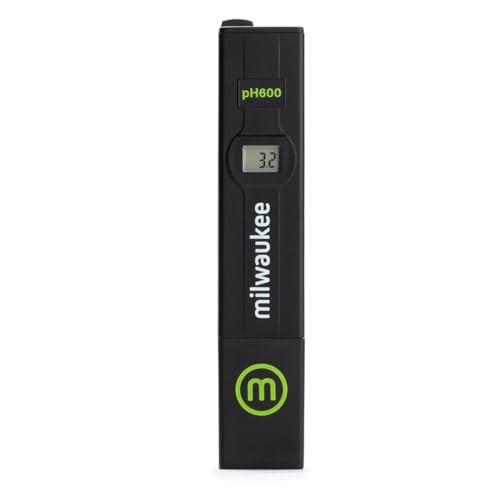
Milwaukee Instruments makes lab and field meters, and the pH600 is its simplest pocket pen. Its spec sheet gives ±0.1 pH at 0.1 resolution. Calibration is manual and one-point: dip it in pH 7.0 buffer and turn a small screw until the screen agrees. No automatic temperature compensation is listed, and the Amazon listing says the cap keeps the sensor moist when the pen is stored upright.
One point corrects the pen at 7.0 and nowhere else, while a reservoir lives between 5.5 and 6.5. A second opinion, then. Not the pen I would dose by.
Milwaukee pH600 on Amazon · Amazon price right now: $32.25
What about Hanna? Hanna Instruments has a long reputation in pH testing and makes a GroLine range for growers. Every US Amazon listing I could find was a third-party reseller down to its last few units, so there is no Hanna link here. Buy one from a seller you trust and give it the same buffer check.
pH Targets by Crop
Most of the shelf runs on one range. Two crops do not, and those two are where beginners lose plants without ever suspecting the number they were so careful about.
| Crop | Target pH | Notes |
|---|---|---|
| Basil, mint, lettuce, spinach, arugula, dill, parsley, chives, thyme, oregano | 5.5 to 6.5 | Aim for 6.0 and stop fussing, since the range is wide for a reason |
| Cilantro | 6.0 to 6.5 | The upper half of the usual band. The old 6.5 to 6.7 target traced to one grower guide, so we dropped it |
| Watercress | 6.5 to 7.0 | Also higher than the rest, and rare on an apartment shelf, though worth knowing |
| Rockwool pre-soak | 5.5 | Deliberately low, because the alkaline cube pulls it up as it absorbs |
Cilantro’s target and basil’s do not overlap, so a shared reservoir is a compromise for one of them. Sources disagree on how much that matters, which makes a separate jar for cilantro cheap insurance rather than a strict rule. Growing cilantro without constant bolting covers the rest of what makes it the hardest herb on the list.
How to Check pH in a Hydroponic Reservoir
Check every 3 to 5 days on a countertop system, because small volumes drift fastest. Wait longer and acidity swings as plants drink water and leave salts behind.
Reservoir rhythm as a whole is covered in how often to change hydroponic water and the seed to harvest calculator tells you when demand is about to climb.
Gathering Your Water Sample
Do not dip the pen into the main jar. Roots snap, and a probe pushed through a root mass reads the film around the roots rather than the bulk solution.
Instead pull 2 to 3 ounces with a clean syringe, stir it gently, then test that. If you run a passive jar from the Kratky method vs DWC comparison, drawing from the side of the jar keeps the root mass undisturbed.

Reading and Adjusting the Numbers
Dip the pen into the sample cup without touching the bottom of the glass. Wait 30 to 45 seconds. The number climbs, wobbles, then settles. Read the settled one.
If it sits outside pH 5.5 to 6.5 adjust in the cup first. One drop of pH Down or pH Up into your 3-ounce sample shows you how reactive your water is before you commit the whole reservoir. Hard water, in particular, will surprise you by barely moving.
Always dilute adjusters in fresh water before they enter the system. Otherwise, neat pH Down poured onto roots burns them. Food-grade phosphoric acid is the standard, whereas citric acid is gentler but drifts back within a couple of days, so it suits a one-off correction rather than a routine.
If your number will not stay put at all, why hydroponic pH keeps drifting in small systems diagnoses the cause.
🧮 Free tool
Got a reading? Now get your target and dose.
Pick your crop, your system and your water volume, and the pH and nutrient calculator gives you the pH range to aim for and the nutrient dose to mix. Here is the answer for basil in a 1 liter mason jar.
Using a pH Meter on Drinking Water, Tap Water or RO Water
Plenty of people looking for a pH meter want it for water in general, not for a reservoir. The same pens work. A meter that reads a nutrient solution reads tap, filtered or well water just as well. The habits above carry over unchanged: fresh buffer, a clean cup and a settled reading.
For plain water I would reach for the Apera PH20 or the Bluelab pH Pen rather than the KETOTEK. Both list ±0.1 accuracy, about twice as tight as the KETOTEK’s, and that gap matters more when you are comparing one water source with another. The drop kit is the wrong tool here, since its color bands are too coarse to tell two taps apart.
Why RO and Distilled Water Read Strangely
Pure water is the one sample that fools a good meter. RO, distilled and deionized water carry so few ions that a standard probe has almost nothing to respond to, so the number creeps and never quite settles. Pure water also starts absorbing carbon dioxide from the air the moment you pour it, which turns it slightly acidic. Camlab, a laboratory supplier, explains both effects and notes that a trustworthy reading of pure water needs an electrode made for low ionic strength.
For growing, that rarely matters. Once nutrients go in, the water is full of ions and reads normally, so test the mixed reservoir rather than the bare RO water. Spring water vs distilled vs RO covers when pure water is worth the trouble.
pH Does Not Tell You Water Is Safe to Drink
A pH reading tells you how acidic the water is and nothing more. It cannot detect lead, bacteria, nitrates or anything else that makes water unsafe. In the US, your water utility publishes a yearly water quality report called a Consumer Confidence Report. For a private well, a certified lab test is the way to check. Use the meter for what it is good at, which is keeping a reservoir where the roots can feed.
Fixing Common pH Meter Reading Problems
Glass bulbs and tiny currents make a fragile combination. Dirt, dry air or a weak battery throws readings off without warning. Cleaning the probe fixes most of it, though, in under five minutes.
Dealing With Jumping Numbers
When digits bounce between 4.0 and 8.0, the probe cannot find a stable signal. Usually that means static, a dirty bulb, or else a dying battery. Step away from motors and grow light ballasts first, then:
- First take the meter out of the water and switch it off.
- Then rinse the probe under lukewarm tap water for ten seconds.
- Next check the battery compartment for moisture or corrosion.
- Replace the batteries if the meter is older than six months.
Reviving a Dried-Out Sensor
A dry bulb gives sluggish readings that take minutes to settle, if they settle. Fill a cup with 3M KCl storage solution, submerge the glass bulb, and leave it 12 to 24 hours. The soak then rebuilds the hydrated layer on the glass surface.
Recalibrate afterwards before you test your hydroponic lettuce reservoir or anything else.
| Symptom | Likely Cause | Quick Fix |
|---|---|---|
| Numbers jump rapidly | Either a dirty probe or a low battery | First rinse the probe, then swap batteries |
| Reading stuck at 7.0 | The glass bulb has cracked | Replace the meter, since a cracked bulb cannot be repaired |
| Sluggish response | The sensor dried out | Soak in KCl for 24 hours, then recalibrate |
| Drifts up every morning | Hard tap water, because alkalinity is high | Switch to RO, or else cut tap 50/50 |
| Crashes below 5.0 in days | Root rot, or else organic breakdown | First smell the water, then inspect the roots |
That last row catches people out. A reservoir sliding acidic over a few days, especially with a smell to it, is usually biology rather than chemistry.
What to do when your water smells bad and using hydrogen peroxide on root rot deal with the cause.

pH Meter Storage and Maintenance Routine
The whole routine is two drops of liquid and about four seconds. Beginners throw the pen in a drawer after use, then buy another one every season. That is an expensive way to avoid a small habit.
Protecting the meter is the same discipline as preventing root rot before it starts: cheap upkeep beats expensive rescue.
Keeping the Bulb Hydrated
The cap holds a sponge. After every test, check it is damp, and add 3 to 5 drops of KCl storage solution if it has dried.
Never store the probe in distilled water, though. This is the mistake that feels most like good practice and does the most harm. Distilled water is ion-hungry, so it pulls ions straight out of the glass membrane, ruining the bulb faster than leaving it dry.
Tap water, similarly, is nearly as bad. KCl or nothing.
Monthly Recalibration Steps
Every digital sensor drifts. Recalibrate monthly, tied to a fixed date so it does not slip. I do mine on the first Saturday alongside a reservoir change, which means one thing to remember instead of two.
The accessories roundup covers the buffer and storage fluids worth keeping on the shelf.
→ University of Minnesota Extension: Small-Scale Hydroponics
→ University of New Hampshire Extension: Hydroponics at Home
A Word From Sarah
pH can slide a full point in a few days with nobody touching the jar: a basil jar at 6.2 on a Monday can read 5.1 by Friday as the plant drinks and concentrates what is left. The leaves do not show it yet, so on a weekly schedule you would find it a week later with the damage already done. That is why the meter is not the thing that matters. The routine is. A good pen in a drawer protects nothing, so I check every three or four days and tie the check to a habit I already have, such as a set evening, which keeps a silent crash from going unnoticed.
- Most beginners, one or two jars → KETOTEK pH + EC + Temp Meter. The budget option, and it also covers both numbers that matter.
- You grow regularly and want ±0.1 → Apera PH20. Mid-priced and waterproof, and it holds calibration for weeks.
- Tight budget, or you hate maintenance → General Hydroponics drop kit. Cheapest of the three, because there is no battery and no probe to kill.
- You own a generic yellow pen → use it this week, then replace it this month.
Frequently Asked Questions
What pH should hydroponic herbs be kept at?
Aim for pH 5.5 to 6.5 for almost everything on an apartment shelf, with 6.0 as the practical target. Cilantro and chives do best in the upper half, 6.0 to 6.5. Watercress runs higher at 6.5 to 7.0. Outside those ranges the roots stop absorbing iron and calcium even when the reservoir is correctly fed.
How do you check pH in hydroponics?
Stir or circulate the mixed reservoir, then pour a small sample into a clean cup. Rinse the probe, place only its sensing end in the sample, and wait for a stable reading. Rinse again before storage. Check every 3 to 5 days, and daily during the first week after a new nutrient mix.
Are cheap pH meters accurate?
Some cheap pH meters can read accurately immediately after calibration, but price does not tell you how long they will hold that calibration. Check the pen against fresh pH 4.0 and 7.0 buffer. If it cannot return close to both known values, confirm the reservoir with a liquid test and replace the pen.
Why does my pH climb back up every day?
Hard tap water is the usual cause. Alkalinity buffers the water and drags it back toward 7.5 no matter how carefully you set it. Cutting your tap 50/50 with RO or distilled water reduces the buffering and the number holds. Fresh nutrient solution also shifts pH upward for the first day as salts dissolve fully.
Why does my pH crash below 5.0?
A steady slide downward over a few days usually means biology rather than chemistry. Root rot and organic breakdown release acids as they progress. Smell the water and look at the roots: healthy roots are white and smell of almost nothing, whereas failing roots turn brown and smell like pond water. Fix the rot, not the number.
Does water temperature affect my pH reading?
Yes. Temperature alters the chemistry the probe measures, so the same jar reads differently morning and afternoon. Automatic Temperature Compensation corrects for this internally. Keeping the reservoir between 65 and 75°F means the correction barely has to work, which also happens to be the range roots prefer.
Can I use vinegar to lower my water acidity?
In an emergency only. Vinegar breaks down in the reservoir and the pH drifts back up within 24 to 48 hours, so you end up correcting the same jar repeatedly. Use a dedicated hydroponic pH Down for anything ongoing. Citric acid is gentler than phosphoric but still more stable than vinegar.
Can I store my pH probe in distilled water?
No, and this is the most common way beginners destroy a good meter. Distilled water is ion-hungry and strips ions out of the glass membrane, which ruins the bulb faster than storing it dry. Use 3M KCl storage solution. If you run out, pH 4.0 buffer works as a temporary stand-in.
How do I test a sealed Kratky jar?
Lift the net cup out by about an inch and slide a clean syringe into the gap to draw a small sample. Test it in a separate cup, adjust there if needed, and pour it back without disturbing the roots. The Kratky lettuce jar guide covers the full setup.
Which pH meter is considered the best quality?
For the three beginner options compared here, the Apera PH20 has the strongest published specification: ±0.1 pH accuracy, automatic temperature compensation, and an IP67 waterproof body. The KETOTEK is the better value when you also need EC. Laboratory meters can be more precise, but they are unnecessary for a small hydroponic reservoir.
What are the downsides of using a pH meter?
Digital pH meters need calibration, correct storage solution, batteries, and a careful rinse after each test. The glass sensor can dry out or break, and a precise display can still be wrong when calibration drifts. A liquid drop kit avoids those maintenance problems, although its color bands provide a less precise reading.
Which brand is considered the best for pH meters?
Bluelab and Apera are the two brands you will see recommended most often for hydroponics, with Hanna and Milwaukee also common. Bluelab designs its pens around growing, while Apera offers lab-style specifications for less money. In this guide the Apera PH20 is my hands-on pick for accuracy and the Bluelab pH PenPlus is the research pick if you want a replaceable probe. The brand matters less than keeping the probe wet and calibrating monthly.
What is the most accurate pH meter for water?
Of the pens in this guide, the Apera PH60 has the tightest published accuracy at ±0.01 pH, against ±0.1 for the Apera PH20 and the Bluelab pH Pen. For tap or drinking water, ±0.1 is plenty. Very pure water such as RO or distilled is the exception: it drifts on any standard pen, so a true reading there needs an electrode made for low ionic strength. A pH reading also cannot tell you whether water is safe to drink.
Can I grow without a digital pH meter at all?
Yes. The General Hydroponics drop kit is a practical alternative. Put about 5 ml of nutrient solution in the clean vial, add 3 drops, and match the color under daylight or a white bulb. It needs no calibration or storage solution, although it gives a color band instead of a decimal reading.
If you are running one or two jars, buy the KETOTEK pH + EC + Temp meter. It gives you both numbers that decide whether a plant eats, in one budget kit. If you already know you are staying with this hobby, the Apera PH20 is the stronger long-term pick on paper, and a waterproof body is the kind of feature that earns its keep the first time a meter goes into the jar instead of staying on the shelf.
Happy growing! 🌿
Sarah, Urban Hydro Space

Sarah Whitfield is the founder of Urban Hydro Space and an indoor gardening enthusiast dedicated to helping apartment dwellers grow fresh herbs and vegetables in small spaces. She researches hydroponic systems carefully from real specifications and verified buyer feedback, and shares practical tips and honest, clearly labeled product picks to make indoor gardening accessible for beginners.


