

⏳ 23 min read · Last updated: October 2026
Disclosure: As an Amazon Associate, Urban Hydro Space earns from qualifying purchases at no extra cost to you. This post contains affiliate links. I have not grown with the fans in this post myself. Every pick is researched from published specifications and listings, and I say so plainly. Thank you for supporting Urban Hydro Space!
🔎 Research pick: I have not grown with the fans in this post myself, so every fan pick rests on the makers’ published specifications and listings. The one exception is the KETOTEK meter suggested for checking water temperature, which I use. How I test and choose products.
A fan is the last thing on most minds when a closet shelf goes up. The nutrients get calibrated and the light timer gets programmed, and everything feels organized. Yet a few days of still air is all it takes for a fuzzy white bloom of powdery mildew to settle across the mint, which is why the best clip-on fan for hydroponics belongs in the setup from day one.
Nothing is wrong with the solution or the pH in that case. The air in the closet simply never moves, so humidity sits on every leaf and never dries. A desk fan borrowed from the bedroom helps, but it eats half the shelf, which is why a fan built for the job is worth finding.
Airflow does two jobs, though only one of them is obvious. First it dries leaf surfaces before spores can take hold. Second, the constant flexing makes stems lay down thicker cell walls. Plants grown with a breeze stand up on their own. Plants grown in still air flop. If you are relying on whatever air happens to move through your apartment, your herbs are paying for it. Before you spend anything, the apartment hydroponics beginners guide covers where a fan sits in the wider setup.
Best Clip-On Fan for Hydroponics: Quick Picks
Five fans, compared on what actually matters on a small shelf, namely how loud it is at 2am, whether the clamp holds, and whether it reaches the back row.
- For a bedroom, insist on a published figure under 40 decibels on the lowest speed. Vague claims like “whisper quiet” mean nothing.
- One 6-inch fan covers a standard 3-foot shelf so long as you aim it above the canopy rather than into it.
- Aim for a gentle rustle. If stems are bending, the fan is too close or too fast.
- Measure before buying, because most clamps open to about 2 inches and thicker shelf edges will not hold.
- A fan prevents mildew. It will not cure mildew you already have, so treat first and then keep the air moving.
Clip-On Fan Comparison Table
- Sleeping near your grow setup → Vornado Pivot Clip since 31 dB on low is a published figure rather than a claim
- Two shelves to cover → Hurricane Classic 2-Pack because two fans cost less than most single units
- After humidity-triggered automation (with an AC Infinity UIS controller) → AC Infinity CLOUDRAY S6
- Budget decides it → Genesis 6-Inch Convertible
- No free wall outlet → SLENPET USB Fan
The most versatile clip fan for an apartment shelf. A published 31 dB on low, a 360-degree axis so you can aim it exactly, and a clamp that grips desks, uprights and bed frames. It gives you more control than anything else here at the price.
- ✅ Published 31 dB on low, not a marketing adjective
- 🔁 Full 360-degree axis with three speed settings
- 📎 Multi-surface clip that grips desks and shelf uprights
- ⚠️ Does not oscillate side to side
- Least polished build here
What Makes a Good Clip-On Fan for Hydroponics?
Three things separate a fan you forget about from one that rattles off the shelf inside a month. First, noise decides whether you can run it around the clock. Then clamp strength decides whether it stays put. Finally power source decides whether it fits your outlet layout at all.
Noise Level and Motor Type
Brushless DC and EC motors run quieter than plain AC motors, because there are no brushes rubbing against the armature. For a fan near a bed, look for a published figure under 40 dB on the lowest speed. The Vornado lists 31 dB, which is quieter than a library.
So be skeptical of unquantified claims. “Whisper quiet” appears on almost every listing and means nothing, so a brand that publishes a number is telling you something a brand that does not is avoiding. Cheap fans also tend to develop a rattle within a few months as the plastic housing loosens against the casing, and at that point your only options are re-clamping onto something harder or buying another fan.
Clamp Strength and Jaw Width
Weak springs lose their grip on wire shelving over weeks, because vibration slowly works them loose. Rubberised jaws hold better on smooth metal and kill the buzz at the same time. Measure before you order:
- First measure the thickness of your horizontal shelf edge.
- Then measure the diameter of any vertical pole you might clip to instead.
- Finally compare both against the listed clamp capacity before adding to cart.
Size Versus Shelf Depth
Generally a 6-inch fan is the sweet spot for apartment shelves. Smaller units look tidy and then fail to reach the back row, which is exactly where stagnant air pools and mildew starts.
Depth, though, matters more than width here. A fan will push air across three feet of shelf without much trouble, but a shelf that is deep front to back needs the fan angled from one end rather than mounted at the front. If you run a two-tier shelf expect to need one fan per level, since air does not travel between tiers on its own.
Clip Fan, Inline Fan or Tent Fan?
“Hydroponics fan” covers more than one machine, and only one of them is what a shelf needs. A clip fan stirs the air around the leaves. An inline duct fan pulls air out of a tent through a duct, which matters for heat and smell in an enclosed space and does nothing on an open shelf. Oscillating tent fans sit in between: clip fans built for tent poles, usually with EC motors and a published noise figure.
For jars on a shelf or a counter, buy a clip fan from the five below. The tent fans further down earn their place once you grow inside an enclosure, and the last FAQ covers inline fans.
Vornado Pivot Clip
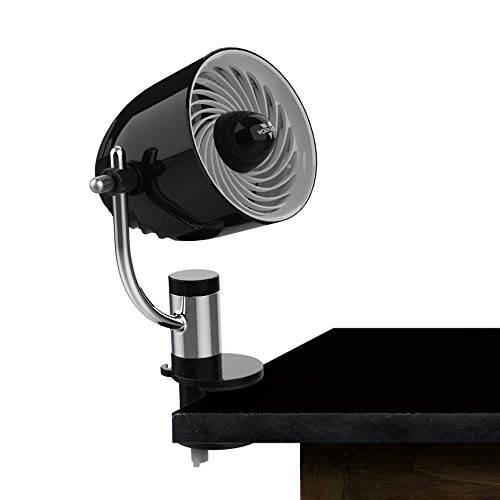
The Vornado is easily the quietest fan here, with a published 31 decibels on low and 41 on high. That low figure is the reason it takes the top spot: if your shelf shares a room with your bed, this is the one that will not wake you. The 360-degree axis then lets you aim the airflow rather than accept wherever a fixed head happens to point.
One honest caveat, though. It is the least polished build on this list. Most complaints concern two things: the clip sliding on smooth round poles, and the missing side-to-side oscillation. Both are covered below. Neither changes what it does better than anything else here, which is verified quiet airflow you can point exactly where the shelf needs it.
Amazon price right now: $24.99
- Best for: Bedroom or studio grows, where noise is a hard limit
- Noise: Published 31 dB low, 41 dB high
- Clamp: Multi-surface clip, 360-degree axis, 3 speeds
Focused, Quiet Airflow
The Vornado throws a tight column of air that carries across a room instead of dispersing a foot from the grille. Aim it above the canopy and the air falls back down through the leaves, closer to how wind behaves outdoors. The clip grips desk edges, bed frames, shelf uprights and counters, and three speeds plus the full rotation give you more adjustment than most fans at this price.
That focus suits a few jobs particularly well:
- Breaking up a pocket of humid air trapped over a dense herb cluster
- Cooling a warm nutrient reservoir on a hot afternoon
- Single-shelf setups where one zone needs the air and the rest does not
Two Limitations to Know
First, it does not oscillate, so a single unit may leave the far end of a wide shelf underserved. The clip holds flat edges well but can slide on smooth round poles if knocked. Zip-tie the cord to the shelf rail, because then a tug on the cable cannot drag the fan off its mount.
Using It to Cool a Warm Reservoir
Once water climbs past 75°F (24°C) dissolved oxygen falls and roots start to struggle. Aiming the Vornado at the outside of your jars during the hottest part of the day pulls a couple of degrees out through evaporation.
- Aim at the base of the jars rather than the canopy.
- Then set the lowest speed.
- Check the water after 30 minutes. The KETOTEK meter I use for pH reads water temperature too.
- Finally raise the angle back toward the canopy once it drops below 70°F (21°C).
Hurricane 6-Inch Classic 2-Pack
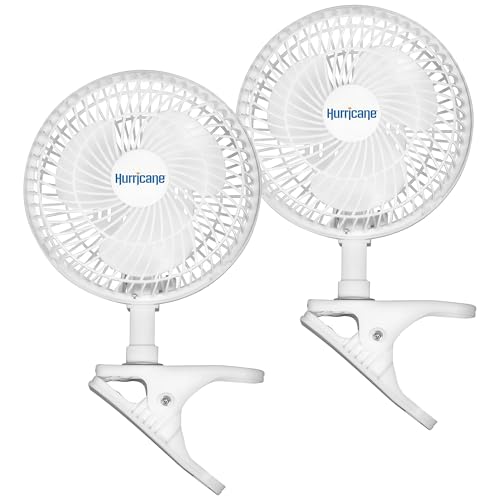
Meanwhile the Hurricane Classic is the best value here, provided you have more than one shelf. A two-pack works out far cheaper per fan. Each one runs a quiet 2-speed motor, moves 306 CFM on just 14 watts, and comes with a 2-inch clamp jaw that fits standard wire racks, desks and tent poles without slipping. The single-unit listing is ETL certified.
Amazon price right now: $30.89
Best value here
Only need one shelf covered? The single Hurricane Classic is also available.
- Best for: Two-shelf setups, or anyone wanting two fans at a single-fan price
- Noise: Quiet on low, with a noticeable hum on high
- Clamp: 2-inch jaw, fits standard wire racks and tent poles
Solid Coverage
That 306 CFM reaches the back of a deep shelf where the air otherwise sits still. Run one over mature basil and point a second at the lower tier, where mint traps humidity between its stems. The metal grille shrugs off knocks, and the manual speed switch is the kind of simple mechanism that rarely fails on a fan running 24 hours a day.
It earns its place in these situations:
- Large reservoirs sitting under warm lights
- Dense canopies of mature mint or basil
- Two-tier setups where one fan cannot reach both levels
The Downsides
Still, the motor hums audibly on the top speed. It will not drown out a television in the next room, though a bedroom is the wrong place for this fan on high. The clamp handles most racks and uprights, but if your shelf edge is thicker than 2 inches the jaw cannot close properly and the grip goes soft. So measure first.
Mounting for Rattle-Free Operation
Thin plastic trays flex as the motor runs and then broadcast the vibration through the whole shelf. A metal pole or a thick wooden upright is a far better anchor:
- Find a sturdy pole or upright near the canopy.
- Squeeze the handles to open the jaws fully.
- Then slide the rubberised jaws over the pole.
- Finally release slowly and push on the fan head to confirm the grip before walking away.
AC Infinity CLOUDRAY S6
This is comfortably the most capable fan here, provided you take the shelf seriously. The CLOUDRAY S6 runs an IP54-rated EC motor on carbon steel gears and dual ball bearings, so it is built for the humidity a hydroponic setup produces. Standard clip fans use basic AC motors, whereas this EC motor runs quieter, lasts longer and draws less power for the same airflow. Buy it if you want a fan still running in two years without bearing noise.

Amazon price right now: $49.99 Prices refresh automatically. Prices are pulled from Amazon and were last checked on 8 October 2026 at 9:25 pm. Amazon prices change often, so check the listing before buying.
- Best for: Humidity automation, or growers already running AC Infinity gear
- Noise: EC motor, near-silent on low, though no dB figure is published
- Clamp: Clip-on with an IP54 moisture rating
What Works Well
Ten speed levels and ten oscillation ranges together mean you can sweep a full 3-foot shelf or lock onto one trouble spot without moving the fan. It also links to AC Infinity UIS controllers for app control, scheduling and climate triggers. If you already run their lights or inline fans, it joins the same system. Set a humidity threshold and it reacts on its own.
The IP54 rating, meanwhile, matters more than it sounds. Splash from a reservoir top-off will not short it, which is worth having when the fan lives a few inches from open water. Power draw stays low at slow speeds, so a long grow cycle barely registers on the bill. For the wider heat picture, summer grow light heat management covers what else to change.
It handles delicate jobs other fans bully:
- Newly sprouted lettuce that needs the lightest possible movement
- Tall cilantro stems that snap under heavier airflow
- Dense oregano canopies needing penetration without drying the tips
Things to Keep in Mind
It is the most expensive fan here, and that price buys motor quality and smart integration rather than more air. It also needs a wall outlet, so a shelf far from a socket means an extension cord, and it will not run from a USB power bank during an outage.
Keeping the Motor Clean
Dust builds on the leading edge of each blade, and then the motor works harder and runs warmer. Clean it every four to six weeks:
- Unplug the fan at the socket.
- Then unclip the front grille carefully.
- Wipe each blade with a damp microfibre cloth.
- Finally refit the grille before restoring power.
Genesis 6-Inch Convertible
The Genesis, however, earns its place on price-to-usefulness. It is the cheapest fan here, and it punches well above that price. It converts between clip-on and tabletop by swapping the base with a butterfly screw. Two quiet speeds, a head that tilts forward and back, and a spring-loaded clamp make it a sensible choice when you want basic coverage cheaply.

Amazon price right now: $14.94
- Best for: Budget growers wanting a clip fan and a tabletop fan in one
- Noise: Soft white noise on low, louder on high
- Clamp: Spring-loaded; no jaw size published, so measure your edge
Versatile Mounting
The spring grip suits a desk edge or a slim shelf (Genesis does not publish its jaw size), and the tilting head reaches the lower canopy where still air collects. Swapping modes takes ten seconds, which leaves you several usable positions:
- Clipped vertically to a tent pole or shelf upright
- Standing flat on a bookshelf beside the grow area
- Clipped to a seed tray edge for low-angle airflow
Noise Profile
Low speed gives a soft white noise that most people tune out within a day. High is louder and belongs in a living room or utility closet rather than a bedroom. If a published decibel figure is what you need for a bedroom decision, the Vornado at 31 dB is the safer buy. Anywhere else, the Genesis on low is a non-issue.
Using Airflow to Deter Fungus Gnats
Fungus gnats are weak fliers, so moving air makes it hard for them to land, and harder still to lay eggs. Positioning the Genesis to blow across the tops of your net cups builds a barrier they struggle to cross, which cuts your reliance on sticky traps when the medium surface is also kept dry. Traps, dry tops and the rest of the plan are in my fungus gnat guide for indoor hydroponics.
- Position the fan to blow sideways across the top of the net cups.
- Then confirm the airflow reaches the full length of the shelf.
- Run it through the 14 hours your lights are on.
- Finally check the medium surface weekly for larvae or eggs.
Start here: How to Set Up a Closet Hydroponic Garden as a Renter
Also useful: Best Quiet Air Pump for Apartment DWC Setups
And finally: Spider Mites on Countertop Hydroponic Gardens
SLENPET 6-Inch USB Fan
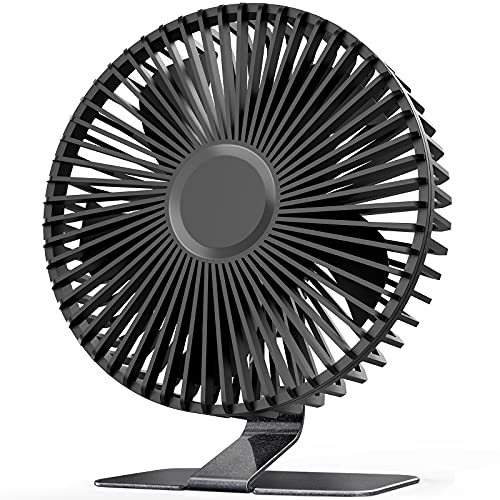
The SLENPET is not really a clip fan at all. It sits on a metal base rather than clamping to an edge, so it takes shelf surface instead of shelf edge. It belongs here for one reason, which is the USB plug. When your shelf has no free wall socket, this runs off a power bank, a laptop port or any phone charger. Four speeds and a head tilting from 0 to 90 degrees give more control than most USB desk fans.
Amazon price right now: $19.99
- Best for: Shelves with no outlet, power bank setups, or a single Kratky jar
- Noise: Under 50 dB across all four speeds
- Mount: Metal base stand with no clip, tilts 0 to 90 degrees
USB Convenience
The 4.9-foot cable threads through wire rack openings, so you are not left with a bundle on the shelf. Noise stays under 50 dB at every speed including the top one. The metal base outweighs a plastic stand, so it does not walk across the shelf when the motor runs, and it makes a sensible second fan alongside an AC unit on a bigger rack.
It fits a few specific situations:
- Running from a battery pack through a power cut
- Adding airflow to a cramped section where a cord would be awkward
- Cooling a single-jar windowsill Kratky setup
Power Constraints
USB fans move less air than AC models of the same blade size, because the available power is simply lower. This works as the primary fan for a single tray, though it will not ventilate a full three-foot herb shelf alone. The base can slide on a smooth surface, so a square of rubber shelf liner underneath fixes that in seconds. The listing adds a catch for power banks: speed 4 only works on a 2-amp USB source, so a weaker bank tops out at speed 3.
Wind Training for Seedlings
Seedlings need a lighter touch than mature plants, since a full-power AC fan will snap a stem at the base in the first week after germination. The SLENPET on its lowest speed makes the gentlest current of anything here, which is what you want for building stem strength without breaking anything.
- Place the fan on the shelf 18 to 24 inches from the seedling tray.
- Then connect the cable to a power bank or charger.
- Set the lowest speed.
- Finally watch for a gentle rhythmic flutter. If leaves are bending sideways, move it further back.
Grow-Tent and Battery Clip Fans Reviewed
The five fans above all grip a flat edge. Grow-tent fans grip a pole, which is a different job, and a battery fan keeps air moving when there is no outlet nearby. None of these has been on my shelves. Everything below comes from the makers’ listings; the opinions about where each one fits are mine.
VIVOSUN AeroWave E6 Gen2 (Oscillating, for Tents)

This is the fan most grow-tent shoppers end up looking at. VIVOSUN quotes 320 CFM at 33 dB(A) from a dual ball bearing EC motor, five oscillation levels, and a head that pulls back if it hits something instead of jamming. There are 10 speeds, though only 5 without VIVOSUN’s GrowHub controller, which is sold separately, plus a natural wind mode and an IP54 rating.
The clamp is made for round or square poles with a rubber pad. In a tent that makes it the obvious pick. On a flat wooden shelf it is the wrong tool.
VIVOSUN E6 on Amazon · Amazon price right now: $45.99
Spider Farmer 6-Inch Clip Fan (Quietest on Paper)

Spider Farmer lists 33 dB at its loudest, from an EC motor that runs up to 2,300 RPM across 10 speeds, with 90 degrees of automatic side-to-side oscillation and 100 degrees of manual tilt. It also springs back when it touches something.
Check the clip before anything else. Spider Farmer specifies poles from 16 to 25 mm, which describes a tent frame and not much else in an apartment, so measure first. The front frame comes off for cleaning, a small thing that matters on a fan running all day beside damp leaves.
Spider Farmer clip fan on Amazon · Amazon price right now: $39.98
VIVOSUN AeroWave D4 (4-Inch, Hangs From a Hook)
A 4-inch fan for tight spots, like the gap between two shelf tiers or the underside of a wire shelf, where it hangs from its detachable, angle-adjustable hook. It mounts four ways: flat, clamped to a pole, hung from above, or stuck to a tent wall with an iron plate you buy separately. VIVOSUN puts the maximum noise at 35 dBA.
The detail I like best is in the listing’s small print. It keeps its speed setting after a power cut, so on an outlet timer it comes back on at the speed you chose instead of sitting off.
VIVOSUN D4 on Amazon · Amazon price right now: $19.99
Koonie 8-Inch Rechargeable (No Outlet Needed)
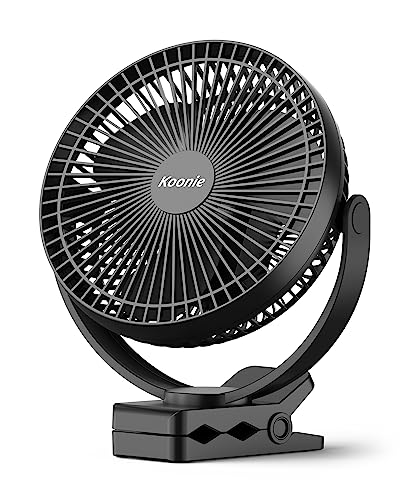
This is the answer to a shelf with no outlet within reach. Koonie fits a 10,000 mAh battery it says lasts up to 24 hours on a charge, without saying at which speed, and a 3-inch clamp that closes on a thick shelf edge. Three speeds plus an energy-saving setting, a head that turns 360 degrees, and USB-C charging at 5 V 2 A that takes about six hours.
Unlike the SLENPET above, it actually clips on.
Koonie fan on Amazon · Amazon price right now: $39.99
Two more worth knowing about. Mars Hydro’s M6 lists 350 CFM, under 32 dB and a choice of 45 or 90 degree oscillation, but it was down to its last units in early October. And AC Infinity makes the CLOUDRAY in two other shapes: the 4-inch S4 for shallow shelves, and the A6, which is the S6’s EC motor without the oscillation.
Fan Placement and Airflow Strategy
Choosing the fan solves half the problem, while placement solves the rest. Pointing it straight at stems causes wind stress and dries leaf tips, in much the same way a grow light held too close burns them. Bounce the air off a nearby wall instead, or aim above the canopy so it falls back through the foliage. Leaves should flutter, though stems should stay put. If you are already seeing powdery mildew on basil still air is almost certainly part of it.

Finding the Right Distance and Angle
The common mistake is treating mildew as a chemistry problem: a week of checking pH, adjusting the reservoir and reading about fungicides, when the real issue is that nothing inside the closet has moved air since the day the shelf went up. There is no reservoir fix, because the reservoir was never the problem.
So aim at a wall or above the plant tops rather than into the leaves. Hold pH between 5.5 and 6.5 as well, since roots need both airflow and correct chemistry to work, and fixing one while ignoring the other gets you halfway. If you are unsure what your reservoir is actually running at, the EC meter roundup covers the tools.
Three markers confirm you have it right:
- Leaves move gently while stems stay upright
- Humidity holds between 40 and 70 percent on a digital hygrometer
- Condensation clears from jar lids within an hour of lights-on
Preventing Mildew and Heat Buildup
Meanwhile still air traps light heat and gives spores a surface to settle on. Once the grow space passes 75°F (24°C) at the reservoir, you need active circulation to protect the roots.
Air temperature depends on the crop. Basil, mint, oregano and thyme like 65 to 75°F (18 to 24°C); lettuce, spinach and cilantro do better at 60 to 70°F (15 to 21°C). Keep leafy herbs 6 to 8 inches under the light and keep air moving so the canopy dries between cycles.
To recover from a heat spike:
- Turn the fan to its highest speed.
- Then open a nearby window to vent the room.
- For a quick drop, press a capped bottle of ice against the outside of the reservoir for 30 to 60 minutes. Never put loose ice in; the meltwater thins the nutrients and shifts the pH.
- Finally cut light intensity by 20 percent until the room drops below 70°F (21°C).
🔎 Quick diagnosis: what you see and what it means
| What you see | Most likely cause | Check this first |
|---|---|---|
| White powder on leaves | Powdery mildew, because the air is stagnant | Raise the fan speed, or else add a second unit |
| Bending or snapping stems | Wind stress from direct airflow | Move the fan back, or aim at a wall instead |
| Rattling fan noise | A loose clamp vibrating against the shelf | Re-clamp onto a solid pole or wooden upright |
| Dry, crispy leaf tips | The fan is aimed straight at the canopy | Redirect the airflow above the plant tops |
| Mildew returns after treating | Airflow fixed, though spores survived | Prune infected leaves, then deep-clean the shelf |
What a Fan Will Not Fix
Now, this is the part most roundups leave out, and it is the reason some people buy a fan and stay disappointed.
A fan is preventive rather than curative. It stops mildew taking hold, but it does not kill what is already growing, so if leaves are already dusted white you need to prune the worst of them and treat before airflow does any good. The powdery mildew guide covers treatment order.
Nor will a fan rescue a reservoir that has gone wrong. Brown slimy roots come from warm water and low oxygen, which is a job for root rot prevention and an air pump rather than moving air above the waterline. A fan blowing over a rotting jar just spreads the smell around your apartment.
Nor will it lower room temperature. It moves warm air around and creates evaporative cooling at wet surfaces, though the room stays exactly as warm as it was. And it will not substitute for cleaning: spores overwinter on shelf surfaces and net cup rims, so a full system clean between crops matters as much as the breeze.
Start here: University of Minnesota: Small-Scale Hydroponics guide
For the chemistry: Penn State Extension: Hydroponics systems and plant nutrition
Which Clip-On Fan Should You Buy?
If you buy one fan, the Vornado Pivot Clip suits most apartment growers. and with a published 31 dB low speed, it handles a bedroom without disturbing sleep, and the 360-degree axis gives targeting control fixed-head fans cannot match at the price.
For two shelves or a larger closet, the Hurricane Classic 2-Pack gives you two fans for what most single units cost. The AC Infinity CLOUDRAY S6 justifies its premium if you want humidity automation or already run their gear. The Genesis is the answer when budget decides everything. Finally the SLENPET covers the case where USB is your only power source. Building a tent instead of a shelf? The compact closet grow tent roundup covers the enclosures these clip into.
A Word From Sarah
A clamp on a cheap plastic shelf edge can feel solid at bedtime and still work loose overnight from motor vibration, and a fan that drops into a mint jar in the dark makes a mess you hear before you see. So test every clamp before you leave a fan alone: press the head from a few angles, then shove the whole thing sideways. If it shifts at all, find a better anchor. It sounds too obvious to bother with, right up until it happens to you in the dark.
Frequently Asked Questions
What is the best clip-on fan for hydroponics in a bedroom?
The Vornado Pivot Clip, because it publishes 31 decibels on low rather than claiming to be quiet. That is below a library reading room. The 360-degree axis lets you aim airflow precisely without oscillation, which removes the varying noise that wakes people. Keep it on the lowest speed overnight for continuous circulation.
How much airflow does a hydroponic setup need?
Enough to cause a gentle flutter in the upper leaves while stems stay upright. One 6-inch clip fan on low covers a standard 3-foot shelf. Aim above the canopy rather than into the stems, and hold humidity between 40 and 70 percent so mildew has nowhere comfortable to settle.
Will a fan get rid of powdery mildew I already have?
No. A fan prevents mildew rather than curing it, so airflow alone will not clear leaves that are already coated. Prune the worst leaves, treat the rest, then deep-clean the shelf surfaces where spores survive. Only after that does constant airflow keep it from returning.
Can a regular desk fan work for indoor hydroponic plants?
Yes, if you can spare the surface. Clip fans save shelf room by mounting to the rack or a tent pole instead, and they let you aim at one zone. Whichever you use, check it has a low speed setting gentle enough for seedlings, since full power snaps young stems at the base.
Should I leave my hydroponic fan running all day?
Running it 24 hours gives the best protection against mildew and fungus gnats. If you would rather limit runtime, put the fan on the same timer as your lights so it runs through the full 14-hour photoperiod. Continuous airflow matters most in summer, when apartment humidity climbs.
Is an oscillating fan better than a stationary one?
An oscillating fan spreads air more evenly across a wide shelf, so no single plant takes constant direct wind that dries its tips. A stationary fan aimed at a wall achieves something similar through reflection. Choose oscillation for a dense wide shelf, and a fixed head when one zone needs the air.
Can I put my fan on the same timer as my grow light?
You can, and it is the tidiest option if you want to limit runtime. Bear in mind that humidity peaks in the dark hours when the lights are off and the canopy stops transpiring, so a fan that sleeps with the lights leaves the riskiest window uncovered. Continuous running is safer.
Will a fan running all night keep me awake?
At 31 dB, roughly the level of a quiet room, most people stop noticing within a couple of nights and some find it helps. The problem is never the steady hum but the rattle, which comes from a loose clamp rather than the motor. Mount to something solid and the noise disappears.
What is the most powerful clip on fan?
There is no useful single winner without a comparable airflow measurement and the distance from fan to canopy. For a small herb shelf, maximum power is rarely the goal. Choose adjustable airflow that gently moves leaves across the whole tier without drying or bending them.
Do clip fans overheat?
A working fan should be used only within its manufacturer’s instructions. Any electrical fan can become unsafe if the motor stalls, the vents are blocked or the cord is damaged. Unplug a fan that smells hot, stops turning or has a damaged cable, and check its exact model for recalls. Keep plugs and cords clear of reservoir spills.
What is the best mini fan for plants?
Pick a fan whose lowest setting gives gentle leaf movement at your shelf distance. A secure clip, adjustable angle and tolerable noise matter more than the strongest setting. The comparison above separates a bedroom shelf from a larger rack; measure the mounting edge before choosing.
What is the best clip-on fan for a grow tent?
One that clamps a tent pole and publishes its noise figure. The VIVOSUN AeroWave E6 (33 dB(A), five oscillation levels), the Spider Farmer 6-inch (33 dB at its loudest, for poles of 16 to 25 mm) and the AC Infinity CLOUDRAY S6 (10 oscillation ranges, IP54) all fit. Pick by the controller you already own, since app control on each needs the maker’s own hub.
How long should you leave a fan on your seedlings?
For the same hours as the light, on the lowest speed and 18 to 24 inches back, as in the SLENPET section above. A gentle flutter is the target. Leaves bending sideways mean the fan is too close or too fast.
Will a clip fan clamp onto a wooden or thick shelf?
Measure the edge first. The Hurricane’s jaw opens to 2 inches and the Koonie’s to 3 inches, and the Vornado’s multi-surface clip grips edges, uprights and frames. Grow-tent fans such as the Spider Farmer are made for 16 to 25 mm poles and will not close properly on a thick board.
Will my fan turn back on by itself after a power cut or on an outlet timer?
That depends on its switch. A fan with a rocker switch or a knob stays switched on, so it restarts with the power; a push-button fan may come back off. Among the fans here, VIVOSUN’s D4 listing says it keeps its speed setting through a power loss. For anything else, test it once: set it running, cut the timer, restore it and watch.
Which inline fan is best for a grow tent?
An inline fan is for extracting air through a tent duct, while a clip-on fan circulates air around the leaves. They solve different problems. Size a tent extractor for the tent and ducting rather than using this clip-fan ranking; use a small circulation fan only as a separate addition inside the tent.
Use these free calculators to dial in the rest of your setup alongside the new fan:
- pH and Nutrient Calculator for the right mix and pH target for your herbs
- Grow Light Calculator for correct light height and intensity
- Seed to Harvest Calculator to estimate your first cut by crop and system
- Shopping List Builder to build a beginner kit matched to your budget
Happy growing! 🌿
Sarah, Urban Hydro Space

Sarah Whitfield is the founder of Urban Hydro Space and an indoor gardening enthusiast dedicated to helping apartment dwellers grow fresh herbs and vegetables in small spaces. She researches hydroponic systems carefully from real specifications and verified buyer feedback, and shares practical tips and honest, clearly labeled product picks to make indoor gardening accessible for beginners.


