⏳ 19 min read · Last updated: September 2026
Making one grow light for multiple plants work is a common puzzle when you live in a small apartment. On a tiny kitchen counter, the question is whether basil, mint and lettuce can all share the same LED panel without one of them suffering. You don’t have the space or the budget for three different lighting rigs. It feels like you need to choose between growing a single crop or watching half your herbs stretch into weak vines. That is a different puzzle from moving one light between separate systems on a rotation, though, and sharing one grow light across multiple systems covers that logistics question instead.
It’s possible to mix these crops on a shared shelf if you understand how light drops off around the edges. However, your LED panel creates a bright zone in the direct center and softer zones on the perimeter. By matching each plant to its preferred zone, you can therefore maximize your harvest in a tiny footprint.
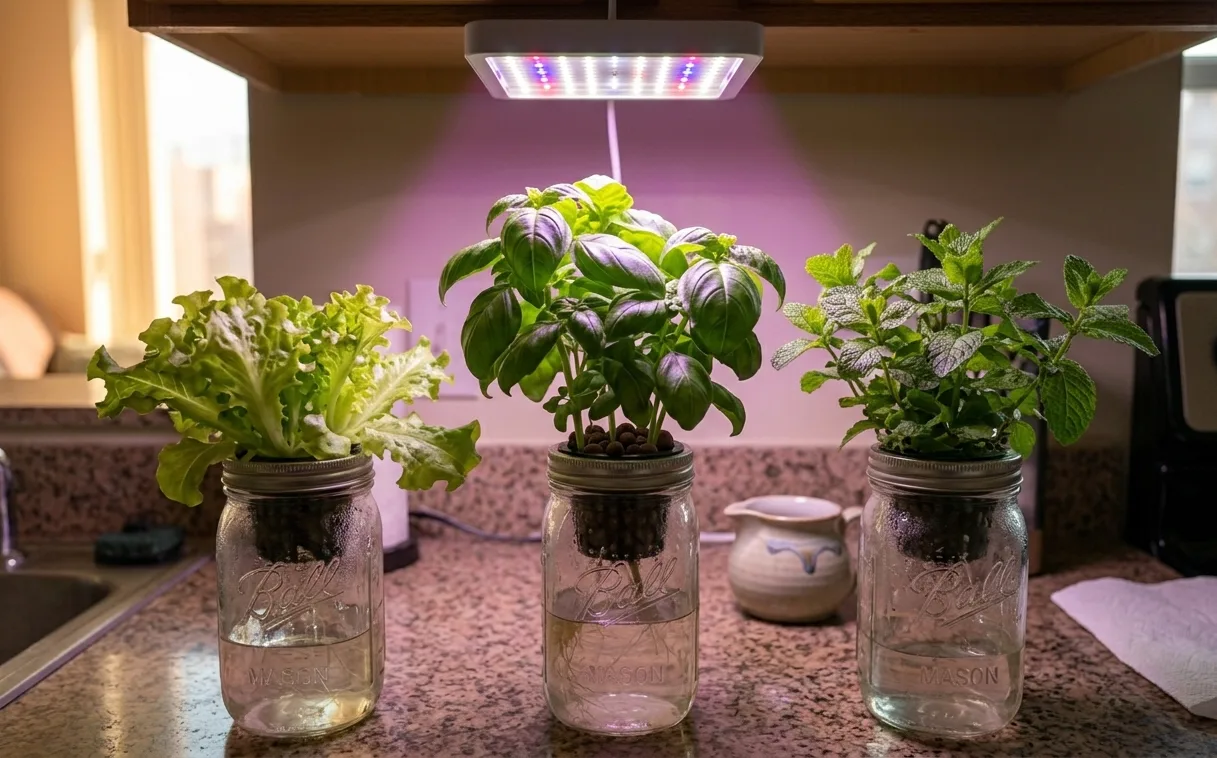
✅ Key Takeaways
- Set your timer for 14 hours on to support both herbs and greens.
- Keep the light 6 to 8 inches above the tallest canopy.
- Place high-light basil in the center, while low-light lettuce goes on the edges.
- Raise shorter jars rather than lowering the light and burning taller plants.
When you set up one grow light for multiple plants it’s worth mapping out the specific needs of each crop. Still, not all herbs respond the same way to shared resources. With that in mind, you must plan your shelf layout before germinating seeds.
- You want fast harvests for salads → start with lettuce on the edge
- You want a forgiving plant that bounces back → start with mint in the center
- Mapping The Light Footprint: Center Versus Edges
- How To Manage Different Plant Heights On One Shelf
- Balancing Nutrients When Sharing A Grow Space
- Managing Temperature Gradients Under Your Panel
- Creating The Ideal Daily Light Schedule
- Troubleshooting Mixed Crop Lighting Issues
- Choosing The Right Grow Light Shape For Your Apartment
- A Word From Sarah
- Frequently Asked Questions
💡 What One Grow Light Actually Covers, Centre Versus Edges
When trying to figure out how to use one grow light for multiple plants, you need to look at how light naturally disperses. An LED panel doesn’t push out an even wall of photons. The area directly under the middle of the board receives the highest intensity. As you move outward, the light levels drop off.
Because of this, you can’t treat every square inch of your shelf as equal real estate. High-light herbs need those intense center rays because they drive flavorful oil production. In contrast, delicate greens will scorch if they sit too close to the hottest part of the panel.
☀️ Reserving the intense center for woody herbs
Basil and mint thrive when they receive direct energy from the strongest diodes. That is why you want to reserve the exact center of your light footprint for these vigorous growers. They demand a PPFD of 200 to 400 to stay bushy and prevent weak stems.
To arrange your center zone for success:
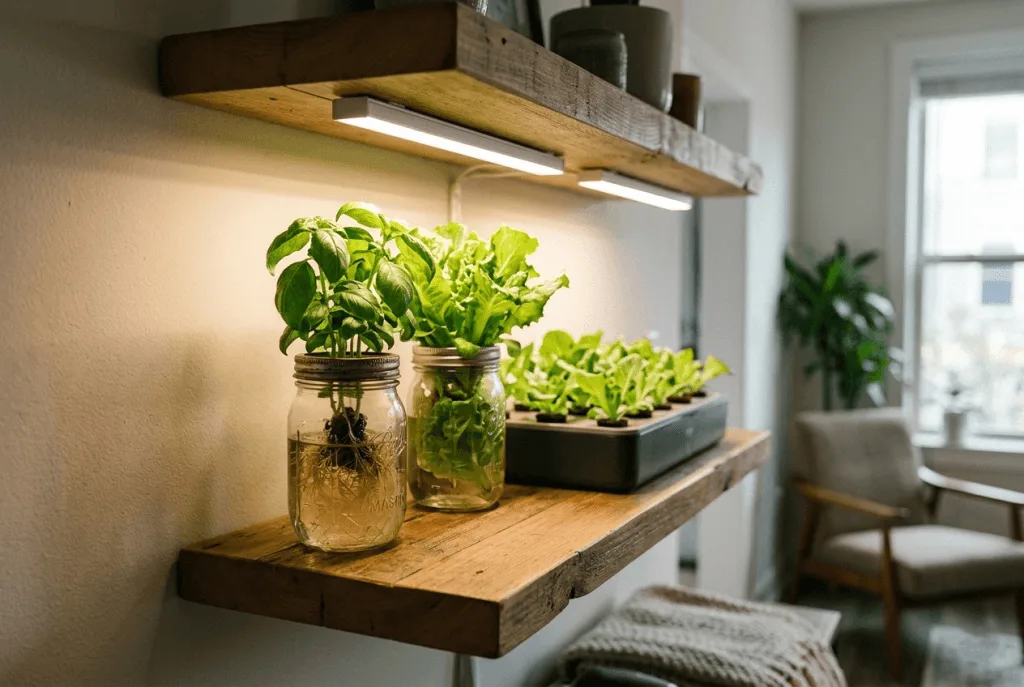
- Place your basil directly under the middle of the LED board.
- Keep the light panel 6 to 8 inches above the top leaves.
- Ensure the jars aren’t blocking each other from the overhead beam.
- Rotate the jars a quarter turn each week so the canopy grows evenly.
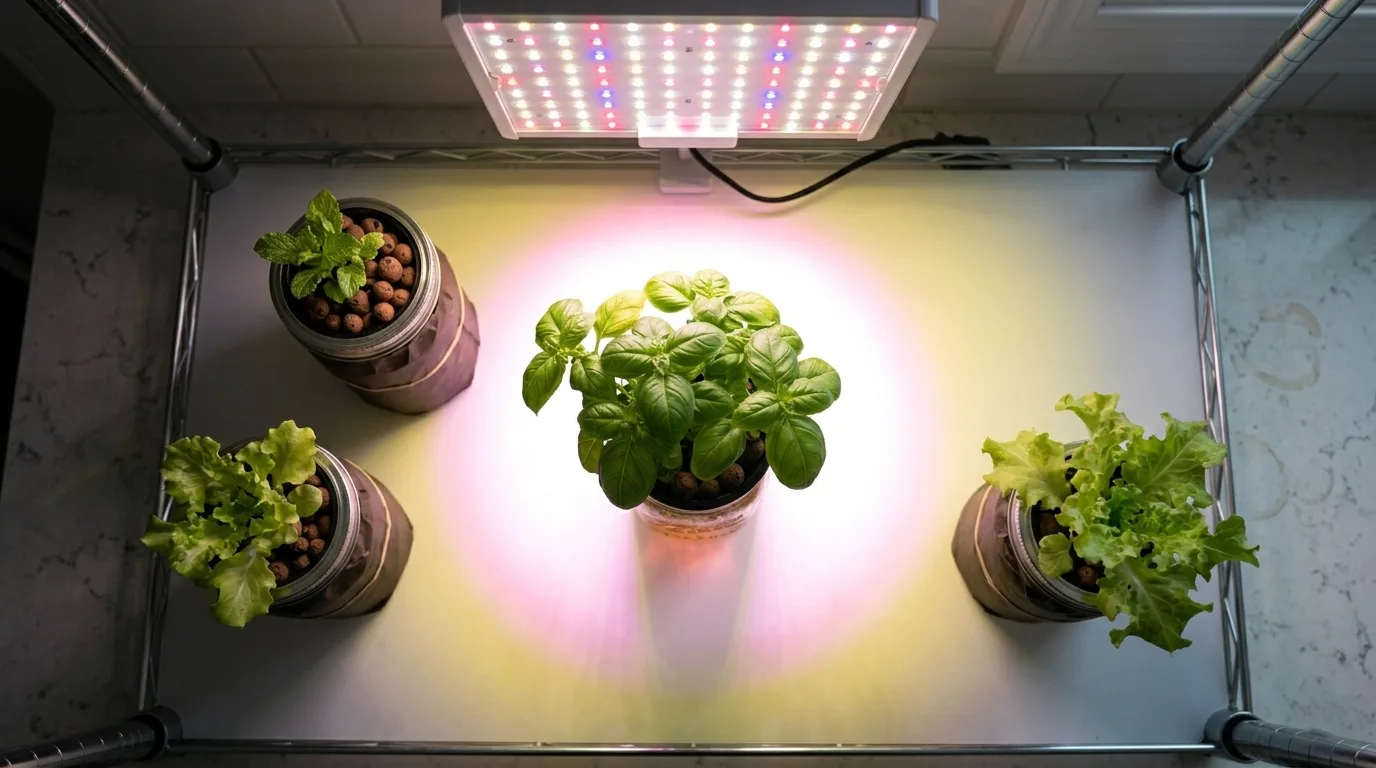
When this happens, your basil will develop thick stems and broad leaves. When you push it to the edges, the plant will stretch sideways trying to reach the center. That also ruins the neat shape needed for a small apartment counter.
🍃 Utilizing the softer perimeter for leafy greens
Lettuce is much more forgiving for photon density. Instead, it prefers the cooler ambient light found on the perimeter of your shelf. The edges of a standard LED panel usually provide a PPFD of 75 to 200, which is plenty for leafy greens.
If you leave lettuce in the blazing center, the ambient heat might push the root zone temperature above 75°F (24°C). Placing them on the perimeter keeps their reservoirs cooler and also delays bolting. Use the seed to harvest countdown to track when each crop on your mixed shelf is approaching peak production so you can plan rotations without gaps. You’ll enjoy crisp salads for much longer.
→ The Best Grow Lights for Low-Light Apartment Hydroponics (Beginner Setups Under $50)
→ How Far Should Grow Lights Be From Hydroponic Herbs On A Small Shelf
🔍 How to find your brightest spots without fancy tools
You don’t need an expensive PAR meter to map out your apartment light footprint. You can also use simple observation to figure out where the intense zones end and the soft zones begin. As a result, you can confidently place your plants without second-guessing.
To map your light footprint manually:
- Turn on your grow light at night while the room is dark.
- Place a sheet of blank white printer paper flat on your grow shelf.
- Look for the bright white circle directly under the diodes.
- Also note where the light fades into a softer grey tint near the edges.
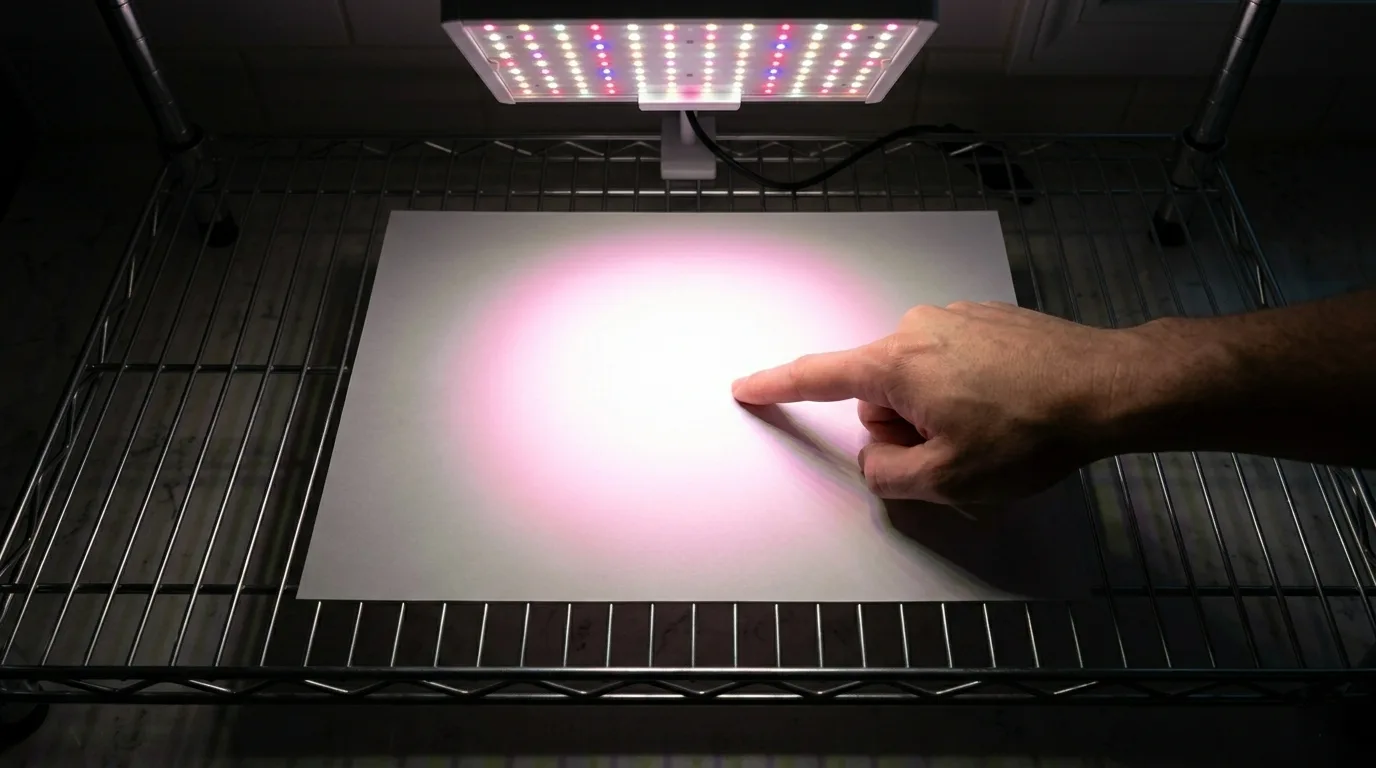
The bright white zone is where your basil and mint belong. The softer grey-tinted zone, however, is perfect for your lettuce and chives. With that in mind, you can also optimize any odd-shaped shelf.
↕️ How To Manage Different Plant Heights On One Shelf
The trickiest part of using one grow light for multiple plants is keeping the canopy level. Basil wants to shoot up into a tall bush, while lettuce prefers to stay low and wide in its net cup. When you adjust the light height to accommodate the tall basil, your lettuce gets left in the dark.
That is why you need to equalize the distance between the light source and the top leaves of every plant. If you don’t, the shorter crops will stretch, weaken, and collapse under their own weight. This exasperates many beginners who expect an even garden.
🩴 Elevating shorter jars to meet the light
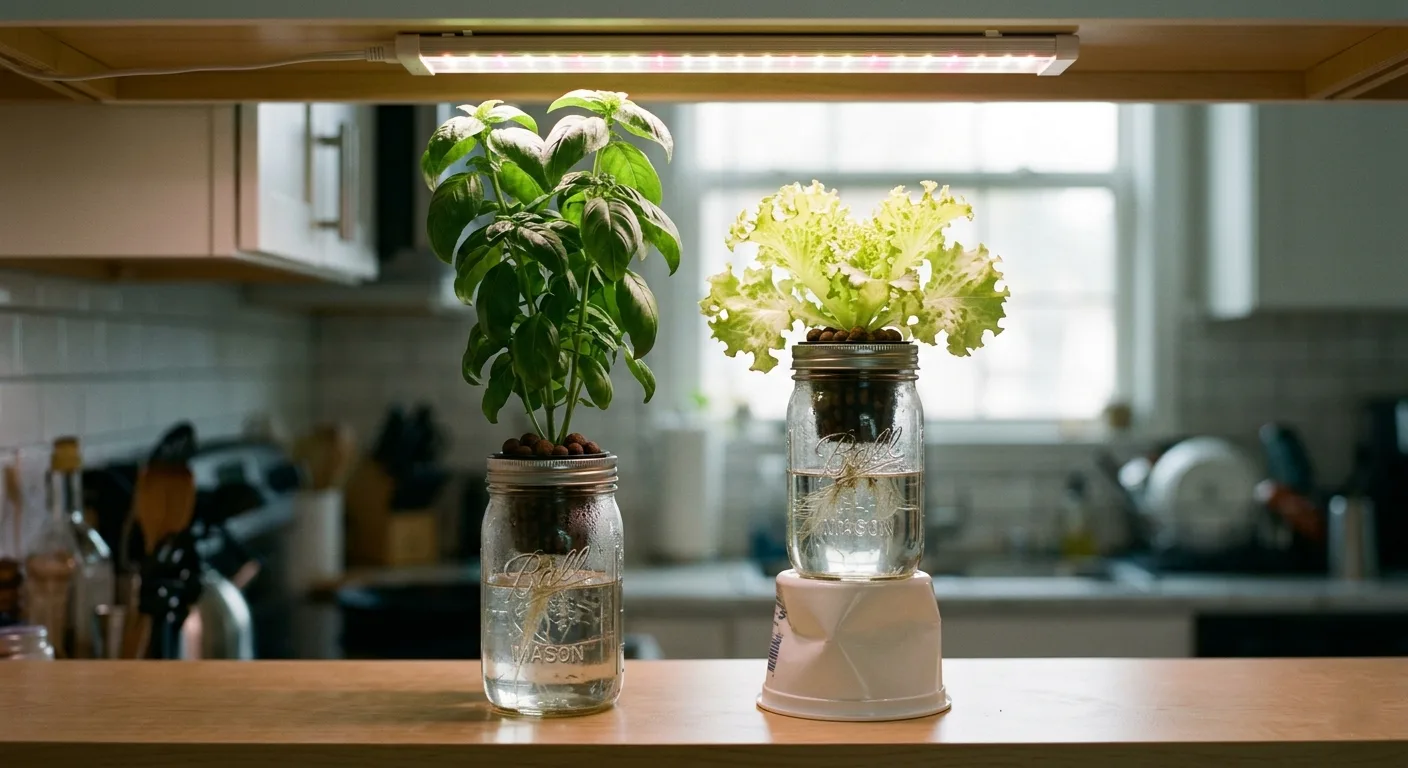
Instead of lowering the light and causing tip burn on your tall herbs, you should raise the short plants. This keeps the panel at a safe height for the basil while giving the lettuce the proximity it needs. It’s a simple physics trick for small spaces.
Good household items for boosting your jars include:
- Empty yogurt containers flipped upside down
- Thick hardcover books wrapped in a plastic bag
- Spare plastic net cups stacked together
- Small wooden blocks or sturdy cardboard shipping boxes
By boosting the lettuce up by a few inches, you ensure every plant stays within the ideal 6 to 8 inches distance from the diodes. This keeps the whole shelf productive.
✂️ Pruning vigorous growers like basil and mint
Even with elevation tricks, however, mint and basil will still try to take over the shelf. When you let them grow unchecked, their broad leaves will cast shadows over the rest of the crops. You’ll need to trim them regularly to maintain harmony.
To keep vigorous herbs under control on a shared shelf:
- Locate a stem that’s growing taller than the rest of the canopy.
- Find a node where two tiny side shoots are emerging from the main stem.
- Use sterilized scissors to snip the main stem a quarter-inch above those side shoots.
- Finally, remove any large fan leaves that are shading neighboring lettuce jars.
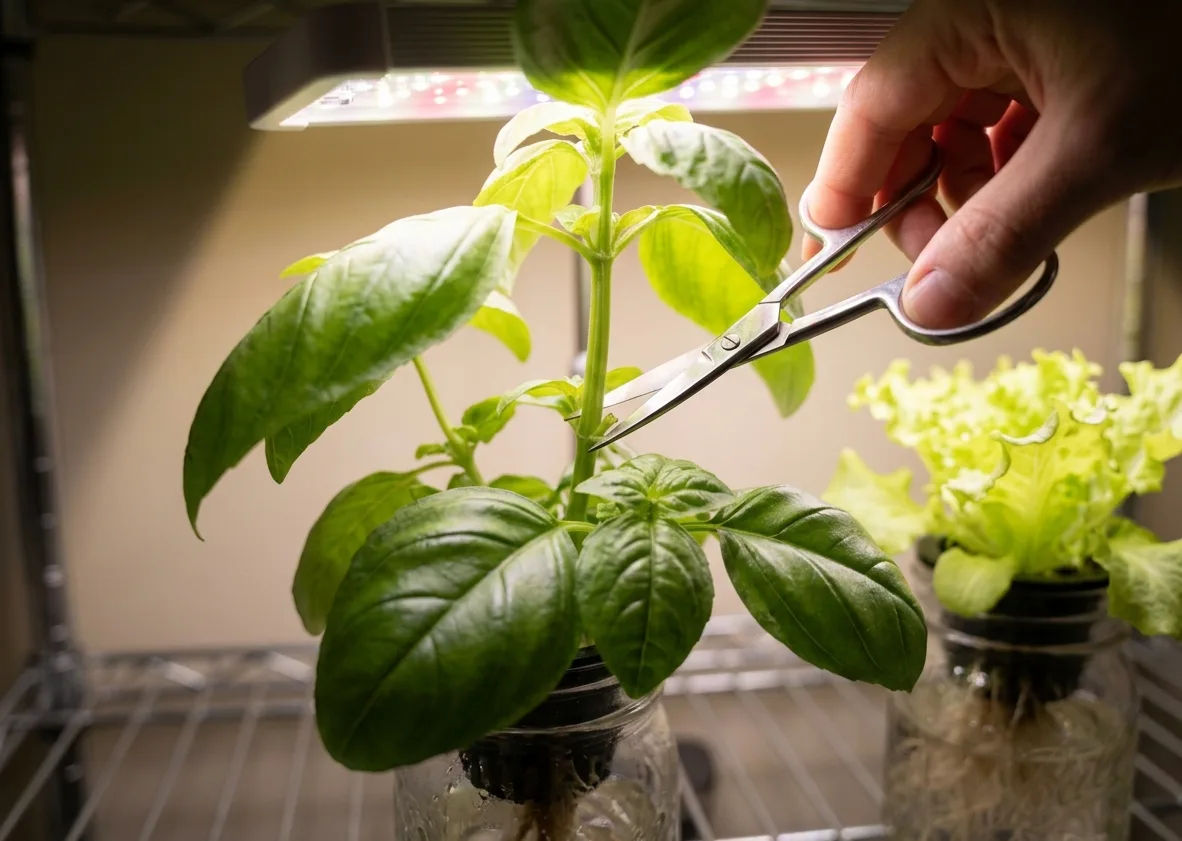
This forces the herb to grow wider rather than taller. It keeps the canopy level manageable under a shared panel, so you rarely need to adjust the light hanger.
📏 When it makes sense to raise the main light panel
Sometimes pruning isn’t enough to contain a mature basil plant. When your tallest herb comes within three inches of the diodes, you must raise the entire light fixture. Otherwise, the upper leaves will suffer irreversible thermal damage.
When you raise the main light, the intensity reaching the shorter plants drops. Instead, you must compensate by adding extra elevation blocks under your lettuce jars. It’s a constant balancing act, but it becomes second nature after a few weeks.
🧪 Balancing Nutrients When Sharing A Grow Space
When configuring one grow light for multiple plants, you must think about what happens below the surface. Sharing a light often tempts beginners into sharing a single large water reservoir. This sounds easier, but it rarely works well for mixed crops in small spaces.
Basil and lettuce have different nutritional needs. However, if you try to feed them from the same tub, one of them will suffer from toxic buildup or starvation. They just don’t play well together in the same nutrient bath.
⚗️ The risks of using a shared water reservoir
When you use a shared reservoir such as a smart garden, you need to find a compromise. A safe middle ground for a mixed herb and lettuce tub is EC 1.5. This is slightly low for mint, but it won’t burn the lettuce roots.
| Crop | Ideal EC Range | Ideal pH Range |
|---|---|---|
| Lettuce | 1.0 to 1.4 | 5.5 to 6.5 |
| Basil | 1.0 to 1.6 | 5.5 to 6.5 |
| Mint | 2.0 to 2.4 | 5.5 to 6.5 |
You’ll notice the pH range of 5.5 to 6.5 overlaps nicely for all three crops. Out-of-range pH causes nutrient lockout even when nutrients are present. Keep a close eye on your meter whenever you force them to share a tub.
💧 Why individual jars work better for mixed crops
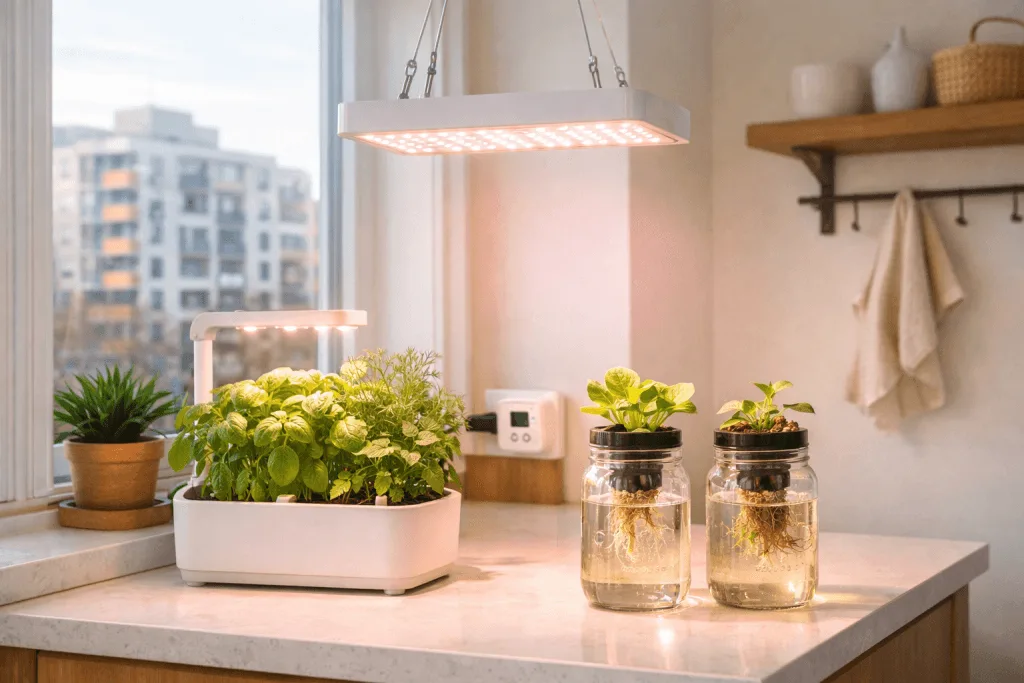
That is why I recommend the Kratky method for beginners with mixed shelves. After all, separate mason jars let you customize the water for each plant without needing a pump. It also makes managing one grow light for multiple plants much smoother.
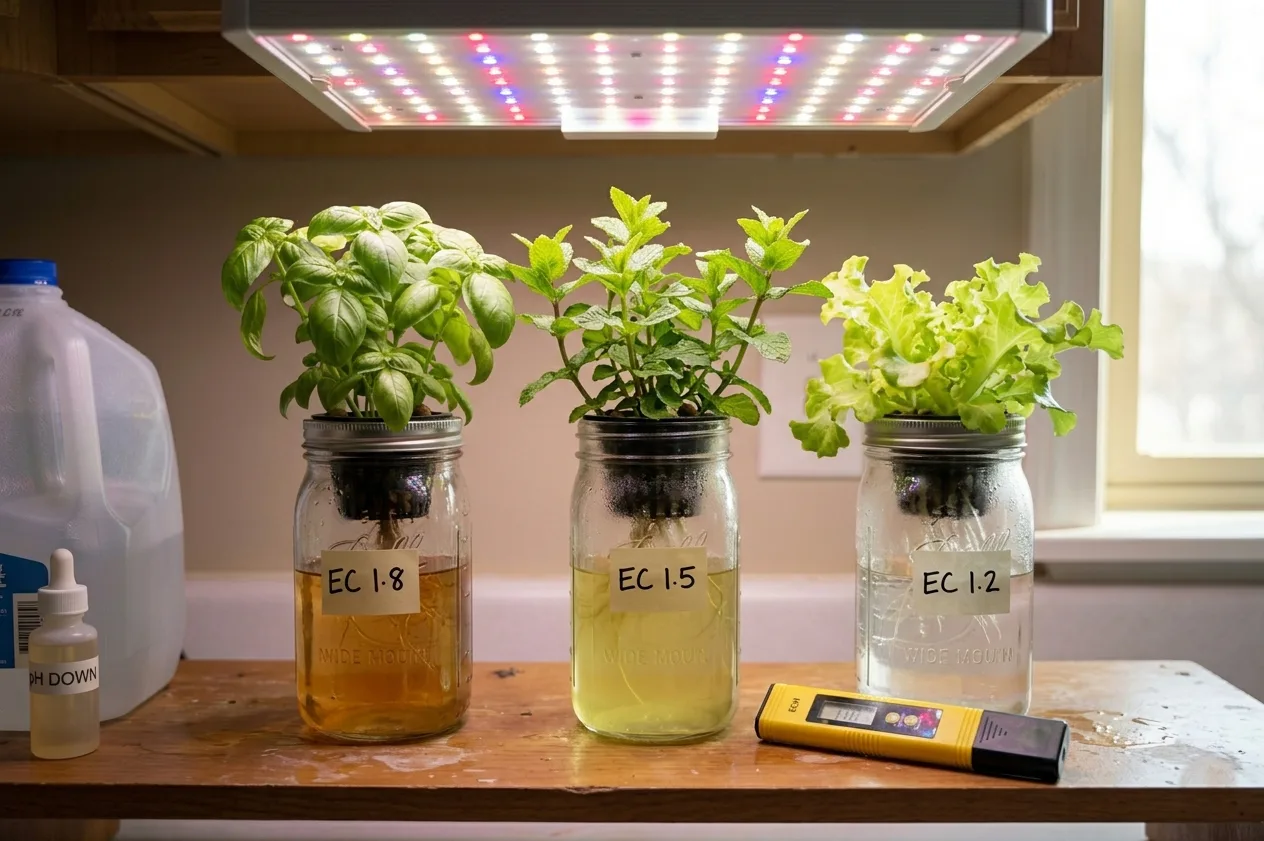
When you use individual jars, you can keep the basil at a strong EC 1.8 while keeping the lettuce at a gentle EC 1.2. You just top off daily with plain pH-adjusted water, and perform a full reservoir change every 2 weeks. It takes the guesswork out of feeding.
🌱 Finding the sweet spot for pH and EC overlap
If you prefer adjusting water in one large batch before filling your Kratky jars, you can mix a universal beginner solution. This won’t maximize the mint’s potential, but it keeps the lettuce safe from nutrient burn.
To mix a universal batch for a mixed shelf:
- Fill a gallon jug with plain tap water and let it sit for a day so the chlorine off-gasses.
- Add liquid hydroponic nutrients until the meter reads EC 1.5.
- Use a dropper of pH Down to bring the acidity to pH 6.0.
- Pour this balanced solution into your individual plant jars.
By aiming right in the middle, you provide enough food for the herbs without frying the delicate greens. Before mixing your first batch, the hydroponic shopping list builder helps you pick the right liquid nutrient for a mixed shelf setup. It’s a great timesaver for busy apartment dwellers.
🌡️ Managing Temperature Gradients Under Your Panel
Lighting isn’t just about photons; it’s also about heat. LED panels run cooler than old-school bulbs, but they still emit radiant heat from the center diodes. When you pack plants onto a small shelf, this heat builds up and affects the water temperature in your jars.
Herbs and greens have different thermal tolerances. Basil loves warmth, while lettuce prefers a chill. You must monitor your shelf’s microclimate to prevent root rot from setting in.
🔥 Heat buildup directly under the diodes
The center zone of your light footprint is also the hottest spot on the shelf. The ambient air temperature here can reach 75°F (24°C) during the middle of the light cycle. This warms the water inside your Kratky jars.
Warm water holds less dissolved oxygen than cool water. When this happens, roots become stressed and the plant will decline if left uncorrected. Basil can handle water up to 75°F (24°C) making it the best candidate for this warm central zone.
🧊 Keeping your edge reservoirs cool enough
Lettuce roots are sensitive to warm water. If their reservoir climbs above 75°F (24°C), the plant thinks summer has arrived and will bolt. It sends up a bitter flower stalk, so your salad harvest is ruined.
To keep edge jars cool on a shared shelf:
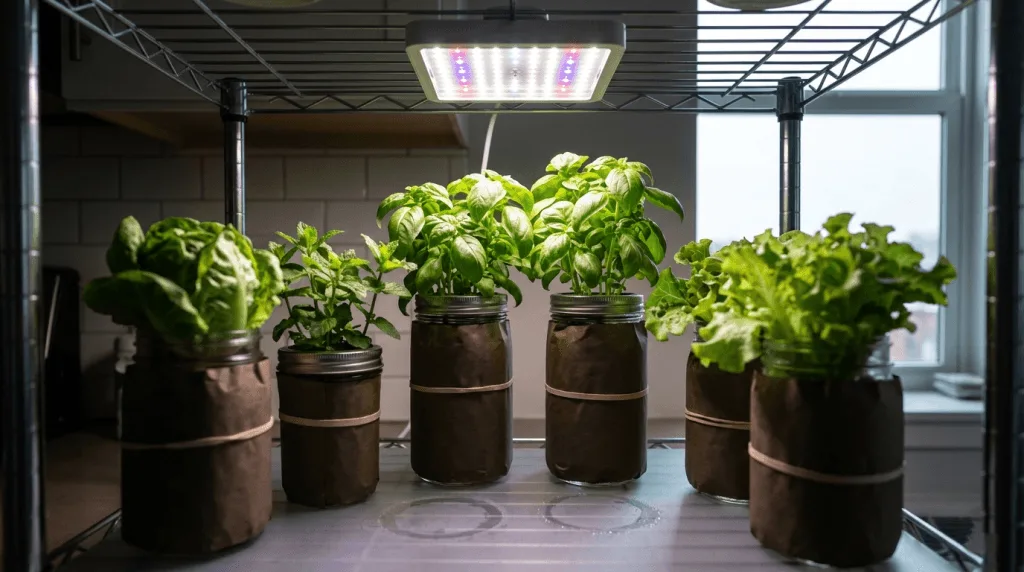
- Wrap the glass jars in white paper so ambient heat reflects away from the water.
- Keep the lettuce jars at least four inches away from the hottest central jars.
- Top off daily with plain pH-adjusted water at cool room temperature, rather than ice-cold water from the fridge.
- Ensure the room’s air temp stays around 65 to 75°F (18 to 24°C) by day, with cooler nights.
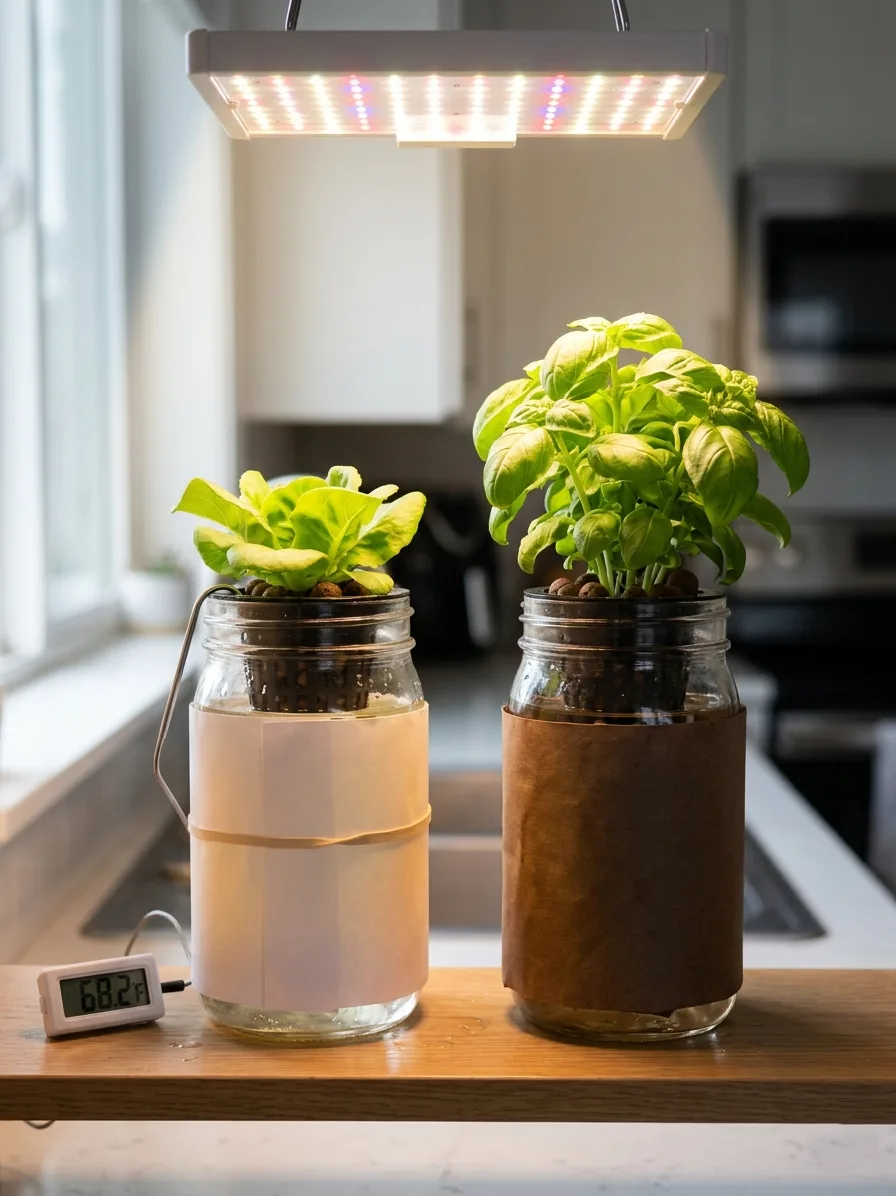
By protecting the edge reservoirs from the central heat, you extend the lifespan of your greens by several weeks.
🌊 Adding airflow to equalize the shelf climate
When your apartment lacks good ventilation, heat will pool under the grow light canopy. This stagnant air causes the center plants to overheat while trapping humidity around the leaves. That’s a recipe for powdery mildew and weak stems.
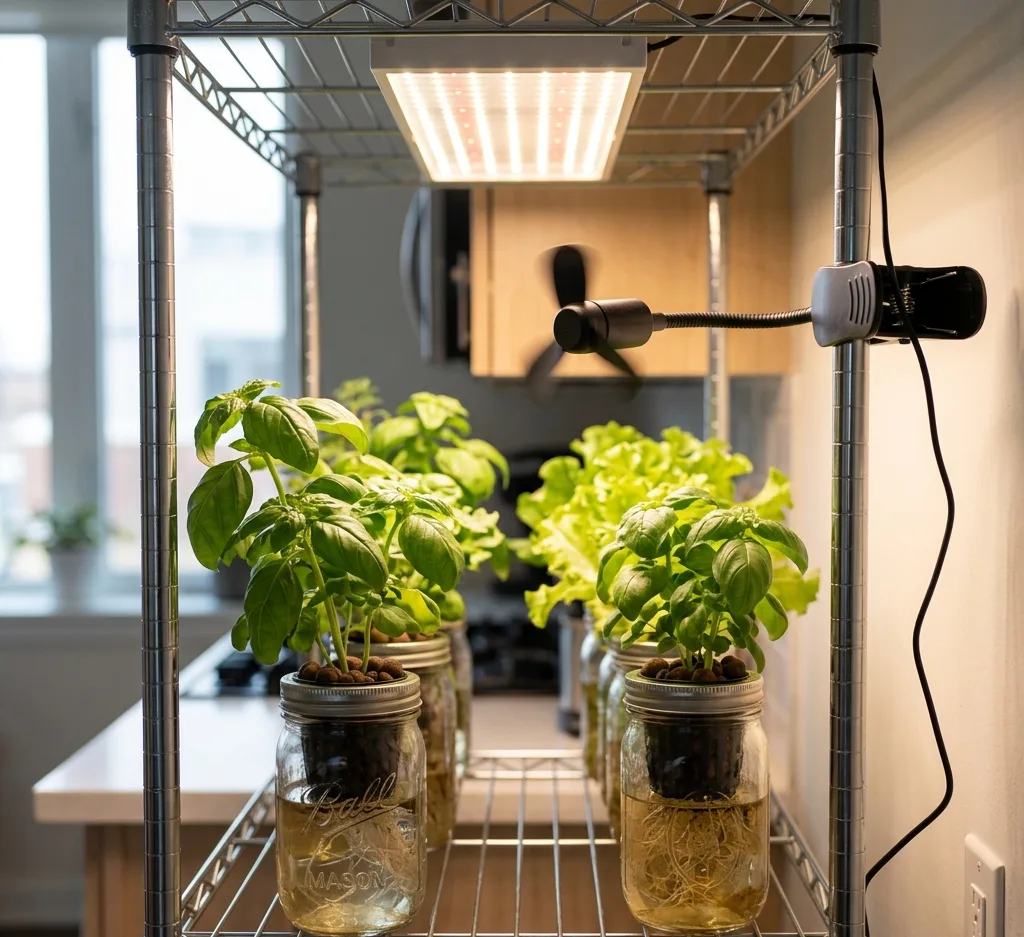
You can, however, equalize the shelf temperature by clipping a small USB computer fan to the side of the rack. Aim the breeze just above the tops of the jars. As a result, the hot air gets pushed out of the center, leaving a gentle, uniform climate across the entire mixed crop.
→ How To Prevent Root Rot In Small Hydroponic Systems Before It Starts
→ Deep Water Culture vs Kratky for Tiny Apartments: Which Is Easier for Beginners?
⏱️ Creating The Ideal Daily Light Schedule
You can’t leave your grow light on forever. Plants process the photons they absorb during the day into usable sugars during the night. Finding a schedule that satisfies both high-light herbs and low-light greens requires a balanced timer setting.
If you run the light for too long, your lettuce will scorch. If you run it too short, your mint will grow leggy. You need a reliable middle ground.
☀️ Setting your timer for optimal growth
The standard schedule for mixed herbs and greens is 14 hours on and 10 hours off. This provides a sufficient Daily Light Integral for the basil, yet it does not overwhelm the lettuce on the perimeter.
To set up a reliable apartment light schedule:
- Plug your LED panel into an automatic smart plug or mechanical timer.
- Set the activation time for 6:00 AM, before you wake up.
- Set the deactivation time for 8:00 PM to give yourself some evening ambiance.
- Leave the timer alone so the plants experience a consistent daily rhythm.
This automated approach also prevents you from forgetting to flip the switch. It’s the easiest way to ensure your mixed shelf thrives while you’re busy at work.
🌙 Why the dark period matters for shared setups
Beginners often think leaving the light on for 24 hours will yield massive, fast harvests. This is a mistake. However, plants need a dark period to respire and move nutrients from their roots up into their leaves.
Without 10 hours of uninterrupted darkness, the plants eventually suffer from stress. The leaves will turn yellow, and growth will stall. In short, you must respect the night cycle just as much as the daylight hours. The guide on why hydroponic herbs need darkness at night explains the biology behind this and covers what happens when a timer fails mid-cycle.
🔆 Dealing with ambient room sunshine
When your apartment has large windows, ambient sunlight will hit your grow shelf. This extra free energy also changes the math for your mixed crops. So you might not need to run your LED panel for the full duration.
For instance, if your shelf sits near a bright south-facing window, you can reduce the artificial timer to 12 hours. The natural sunshine provides a boost that keeps the basil happy, while saving you a few dollars on your monthly power bill.
🛠️ Troubleshooting Mixed Crop Lighting Issues
Even with careful planning, putting one grow light for multiple plants into practice can lead to some hiccups. Sometimes the edges are too dark, or the center is too hot. When you pack different species onto one small shelf, they’ll tell you what they dislike.
- Not sure what is wrong yet → check the diagnosis table below
- You know the cause → jump straight to the specific fixes
🔎 Quick diagnosis table
| What you see | Most likely cause | Check this first |
|---|---|---|
| 🟡 Long, stretching lettuce stems | Light too far away | Raise the jar closer to the light |
| 🟡 Crispy brown tips on basil | Light burn or high EC | Check EC, ensure 6-8 inch gap |
| 🟡 Yellowing leaves across all plants | pH drift causing lockout | Test pH, adjust to 5.5 to 6.5 |
🔍 Fixing leggy lettuce on the perimeter
If your edge-placed lettuce starts looking like a miniature palm tree, it’s starving for photons. This happens when the light panel isn’t wide enough to cast a decent footprint over the sides. The plant stretches upward in a desperate attempt to gather more energy.
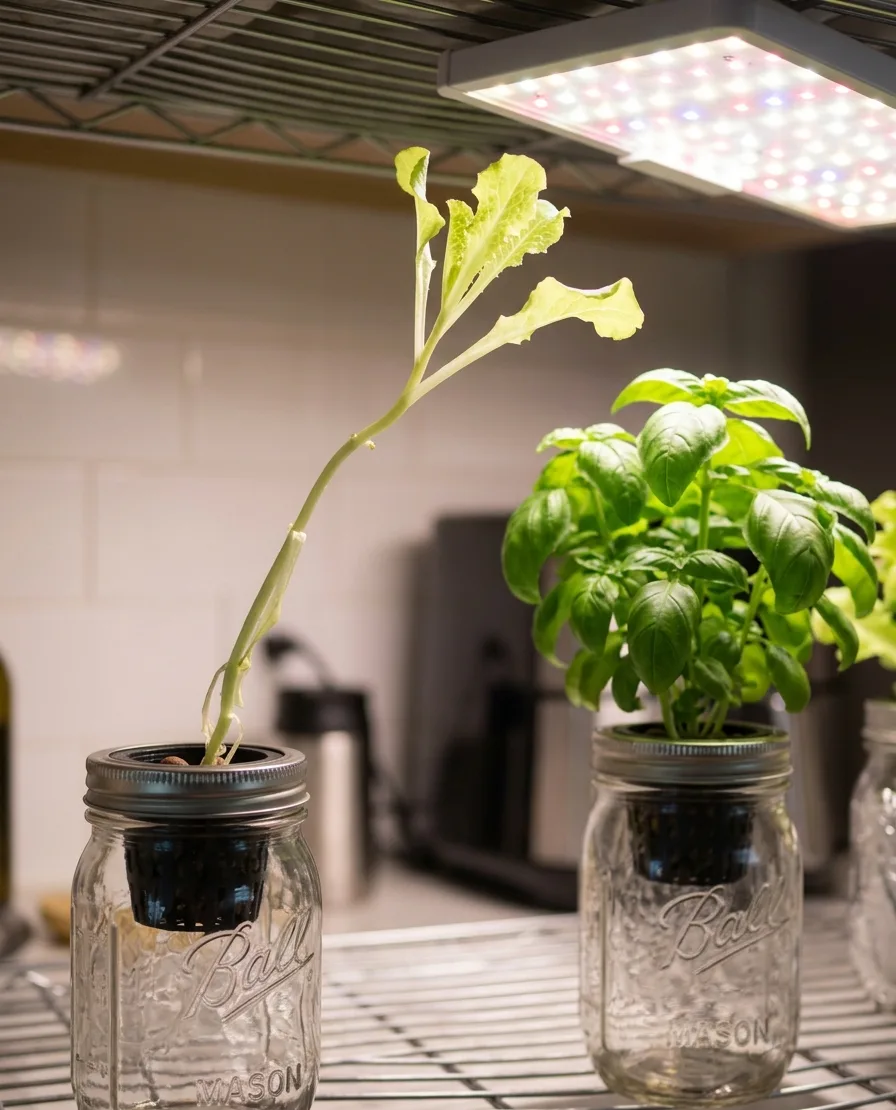
To fix leggy lettuce on a shared shelf:
- Place an overturned bowl under the jar so it sits higher.
- Line the wall behind the shelf with aluminum foil or white poster board so stray light bounces back.
- Check your timer to ensure you run the system for a full 14 hours daily.
- Prune neighboring plants whenever they cast heavy shadows over the smaller jars.
By bringing the lettuce closer to the light source, you stop the vertical stretching. The new center leaves will grow compact and dense.
→ Apartment Hydroponics: The Complete Beginner’s Guide
→ Why Your Apartment Hydroponic Plants Turn Yellow (And Simple Fixes That Work)
🩹 Healing burned basil tips in the center
Sometimes the center of the footprint is too intense. If your basil leaves look papery, bleached, or have crispy brown edges, it’s getting roasted. This can exasperate a beginner, but it’s an easy fix.
If you confirm the light is at least 6 to 8 inches away, the burn might be a nutrient issue. High transpiration from intense light causes the plant to drink water faster than nutrients. This spikes the EC in the jar.
To correct tip burn in a mixed setup:
- Remove the plant from the hot center zone temporarily.
- Dump the current reservoir and rinse the roots gently.
- Refill the jar with fresh water mixed to a lower strength, around EC 1.2.
- Move the jar back until the light sits at the proper height.
Because of this reset, the plant stops hoarding excess salts. The new growth should soon emerge green and healthy, usually within a week.
🚨 Correcting yellow leaves across the entire shelf
When every plant under your light starts turning yellow, the light isn’t the problem. This uniform yellowing points to a pH crash. When the water becomes too acidic, the roots can’t absorb nitrogen or iron.
You must test the water in every jar. If the reading falls outside the pH 5.5 to 6.5 range, you have nutrient lockout. However, you can fix this by doing a full water change and refilling the jars with properly balanced nutrient solution.
📐 Choosing The Right Grow Light Shape For Your Apartment
Not all grow lights fit the same physical spaces. When you design a mixed-crop shelf, the shape of your LED fixture matters just as much as the wattage. You want a shape that matches your counter layout.
A mismatched light leaves dark corners where nothing grows. In contrast, a well-chosen fixture illuminates every jar efficiently. This keeps your apartment looking tidy and intentional.
🔲 Square panels versus long rectangular bars
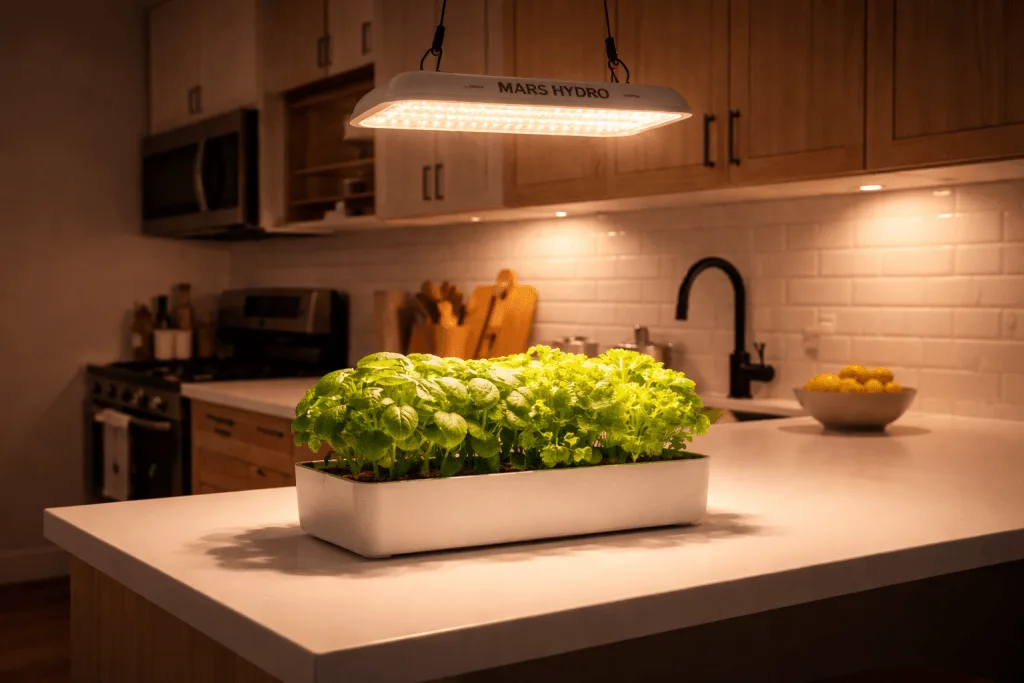
Square LED panels work best for deep kitchen counters or square side tables. They create a distinct circular footprint. This lets you place one basil plant dead center and surround it with a ring of four lettuce jars.
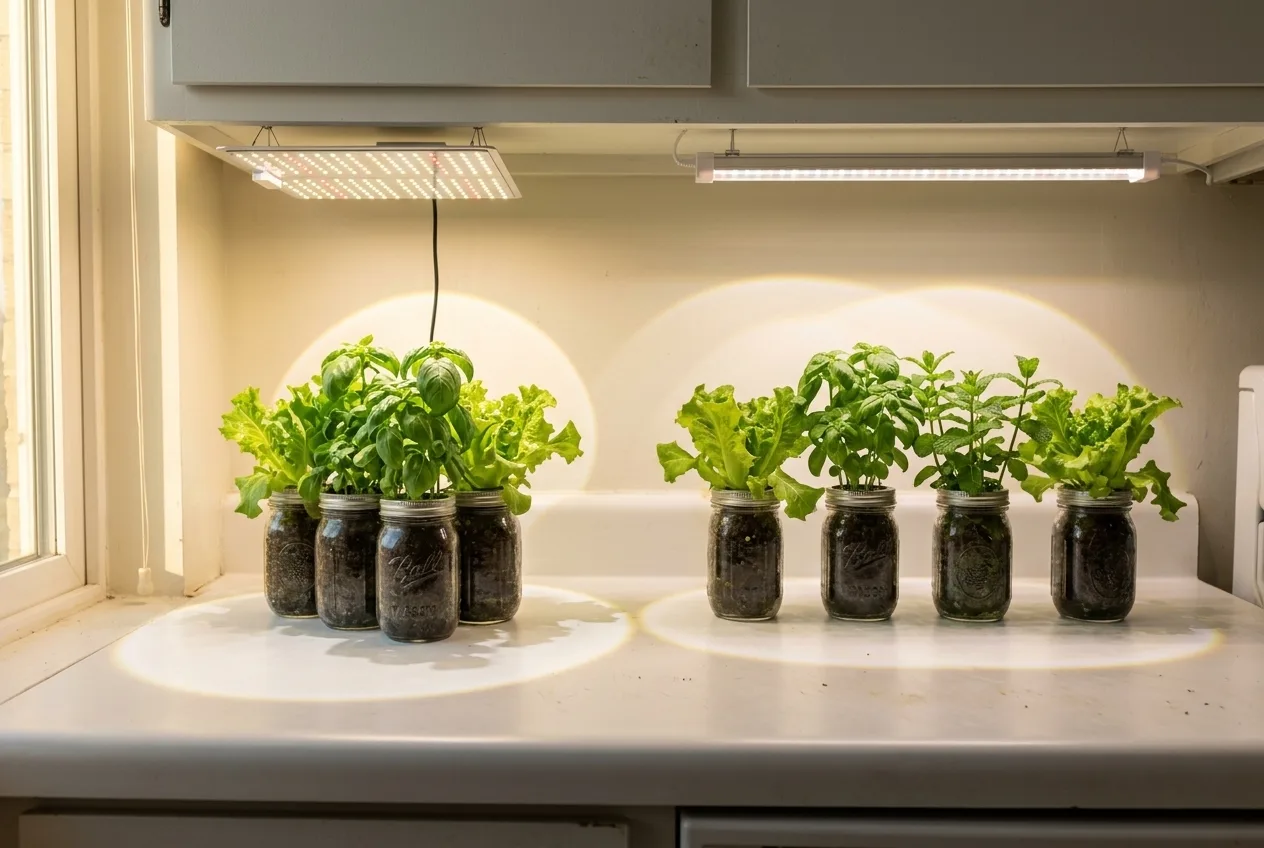
Long rectangular LED bars, on the other hand, are better suited for wire shelving units. They also provide even distribution along a straight row of jars. With that in mind, you can place mint and basil in the middle of the row, and flank them with lettuce on the far left and right ends.
💡 Using clip-on lights to fill dark corners
Sometimes your main panel just isn’t wide enough to support the edge plants. If your apartment has an awkward corner, you can supplement the main light with a cheap LED wand. It adds the missing photons without taking up counter space.
Good places to mount a clip-on light include:
- The vertical pole of a wire shelving rack
- A nearby kitchen cabinet lip
- The edge of a sturdy bookshelf
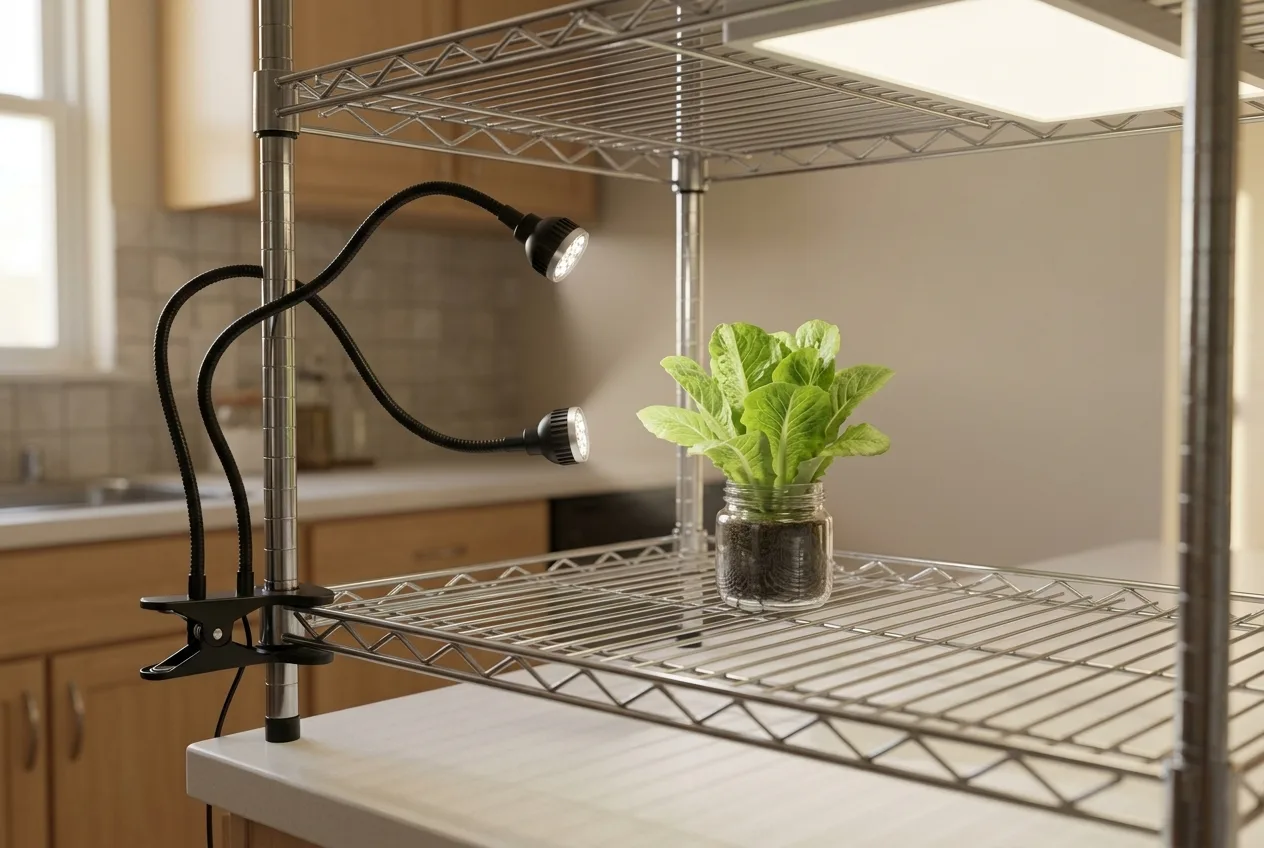
By adding a secondary clip-on, you turn a struggling edge lettuce into a thriving producer. It’s a low-cost fix for uneven apartment lighting.
→ Can a Clip-On Grow Light Really Grow Hydroponic Herbs in an Apartment?
→ Why Algae Keeps Growing In Hydroponic Jars And How To Stop It In An Apartment
🛠️ Upgrading your setup as your garden expands
Once you master one grow light for multiple plants, you’ll probably want to grow more crops. You don’t have to throw away your first light. You can link multiple low-wattage bars together in a daisy chain.
This allows you to add a second shelf to your apartment rack. You can dedicate the top shelf to high-light herbs and the bottom shelf to low-light greens. It’s a natural progression that keeps your indoor garden fun and productive.
💬 A Word From Sarah
Basil and lettuce under a single 15-watt panel is a classic pairing, and the tempting move is to put the lettuce directly under the center beam for a fast salad harvest. The heat under that beam can push the jar to 76°F (24°C) by the third afternoon, and then the roots brown and the plant bolts within a week. Push the greens to the far edge instead, where the jar stays nearer 68°F (20°C), and the leaves stay crisp for weeks. So I map the light’s heat footprint before placing sensitive plants on a mixed shelf.
❓ Frequently Asked Questions
💡 Can I use one grow light for multiple plants in a small apartment?
Yes, you can share a single light across different crops. You just need to place high-light herbs like basil in the bright center and move low-light greens like lettuce to the edges. This simple zoning strategy ensures every plant gets exactly what it needs without requiring a second panel.
📏 How far should the light be from a mixed canopy?
Keep the panel 6 to 8 inches above the tallest plant. If shorter plants are struggling, raise their jars on blocks rather than lowering the light and burning the taller herbs. Using upside-down yogurt containers or spare net cups is a free way to boost those smaller greens into the optimal light zone.
⏱️ What is the best light schedule for mixed herbs?
Run your system for 14 hours on and 10 hours off. This standard schedule provides enough energy for basil and mint without causing your lettuce to bolt prematurely. Plug your panel into an automatic smart timer so you never accidentally leave the lights on overnight and stress your plants.
💧 Do I need a shared reservoir for multiple plants?
No. Individual Kratky jars are better for beginners. They allow you to customize the nutrient strength for heavy feeders like mint while keeping a lower EC for your sensitive lettuce. This separation prevents toxic salt buildup and stops vigorous herb roots from choking out the smaller crops in a shared tub.
✂️ How do I stop basil from shading my lettuce?
Prune your basil just above a growth node to keep it bushy rather than tall. This stops it from blocking the light footprint from reaching shorter plants nearby. Trimming the top leaves every two weeks forces the plant to grow wider, maintaining an even canopy across your entire shelf.
🌱 Why are the plants on the edges getting leggy?
Plants stretch when they don’t receive enough photons. You can fix this by elevating the edge plants, rotating your jars weekly, or adding reflective material to the shelf walls. Bouncing stray light back toward the jars with white poster board often stops this vertical stretching within just a few days.
🍅 Can I grow tomatoes under the same light as lettuce?
It’s difficult. Tomatoes require intense light and a much higher EC. Sharing a small panel usually results in poor fruit yield or scorched lettuce leaves. If you want to grow fruiting crops, give them their own dedicated light fixture and a separate reservoir tailored for blooming nutrients.
Happy growing! 🌿
Sarah, Urban Hydro Space
Sarah Whitfield is the founder of Urban Hydro Space and an indoor gardening enthusiast dedicated to helping apartment dwellers grow fresh herbs and vegetables in small spaces. She researches hydroponic systems carefully from real specifications and verified buyer feedback, and shares practical tips and honest, clearly labeled product picks to make indoor gardening accessible for beginners.