⏳ 16 min read · Last updated: September 2026
Figuring out the right EC for hydroponic herbs feels like learning a foreign language at first. A cheap digital meter shows “1800” on the screen, and there is no way to tell whether the basil is starving or about to suffer severe chemical burns. Guess wrong, add more fertilizer, and the leaf tips can crisp up like burnt toast by the weekend.
When you grow plants in small spaces, nutrient concentration matters. A large commercial reservoir can buffer mistakes, but a quart-sized glass jar on your kitchen counter reacts fast. If you add too much food, the water turns toxic to the roots. If you add too little, growth stalls out. You’ll avoid a lot of frustration once you learn how to read your water. If you haven’t set up your first system yet, the complete beginner’s guide to apartment hydroponics covers everything from choosing a container to your first harvest.
- The safe middle ground is EC 1.5 for mixed herb systems.
- Always top off your jars daily with plain pH-adjusted water so salts do not spike.
- Perform a full reservoir change every 2 weeks to reset nutrient balance.
- Keep your water temperature between 65 to 75°F (18 to 24°C) so roots can absorb the food you provide.
- What Is EC For Hydroponic Herbs?
- The Best EC Range For Hydroponic Herbs In Small Systems
- Recognizing When EC For Hydroponic Herbs Is Too High
- Spotting Low EC In Your Apartment Hydroponics
- Managing EC Drift In Tiny Countertop Jars
- Troubleshooting EC For Hydroponic Herbs
- A Word From Sarah
- Frequently Asked Questions
🧪 What Is EC For Hydroponic Herbs?
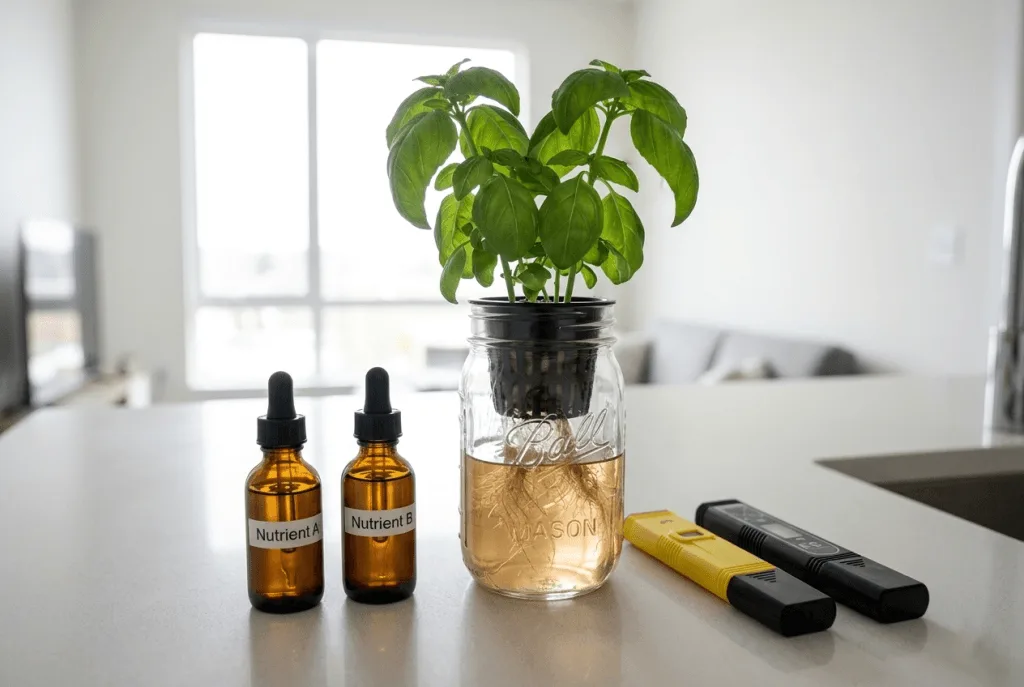
Electrical conductivity measures how well a liquid conducts electricity. Pure water doesn’t conduct electricity at all. However, when you dissolve hydroponic nutrients into water, you introduce mineral salts. These salts carry an electrical charge. By measuring that charge, therefore, you find out exactly how much food is suspended in your reservoir.
Understanding ec for hydroponic herbs keeps you from guessing. Instead of relying on vague package instructions that say “use one scoop per gallon,” a meter gives you a hard number. This proves especially helpful in apartment setups where you might only be mixing a single liter of water at a time.
⚗️ Why PPM and EC Confuse Beginners
You’ll often see growers talking about Parts Per Million (PPM) alongside electrical conductivity. They measure the same thing, but they use different scales. Think of it like measuring temperature. For example, you can use Fahrenheit or Celsius to describe how hot your kitchen is. Similarly, meters read the electrical charge and then calculate a PPM number based on a conversion factor.
The problem, however, is that different meter brands use different conversion factors. So if I tell you to aim for 1000 PPM, your meter might read that as a much stronger or weaker nutrient solution than mine does. Electrical conductivity is a universal standard, though. An EC 1.8 reading is identical on every meter across the globe.
To avoid mistakes when setting up your first jars:
- Always buy a meter that displays electrical conductivity.
- Ignore the PPM setting if your meter offers both.
- Record your daily readings in the same unit so you can track trends.
🔍 Keeping Your Meter Accurate
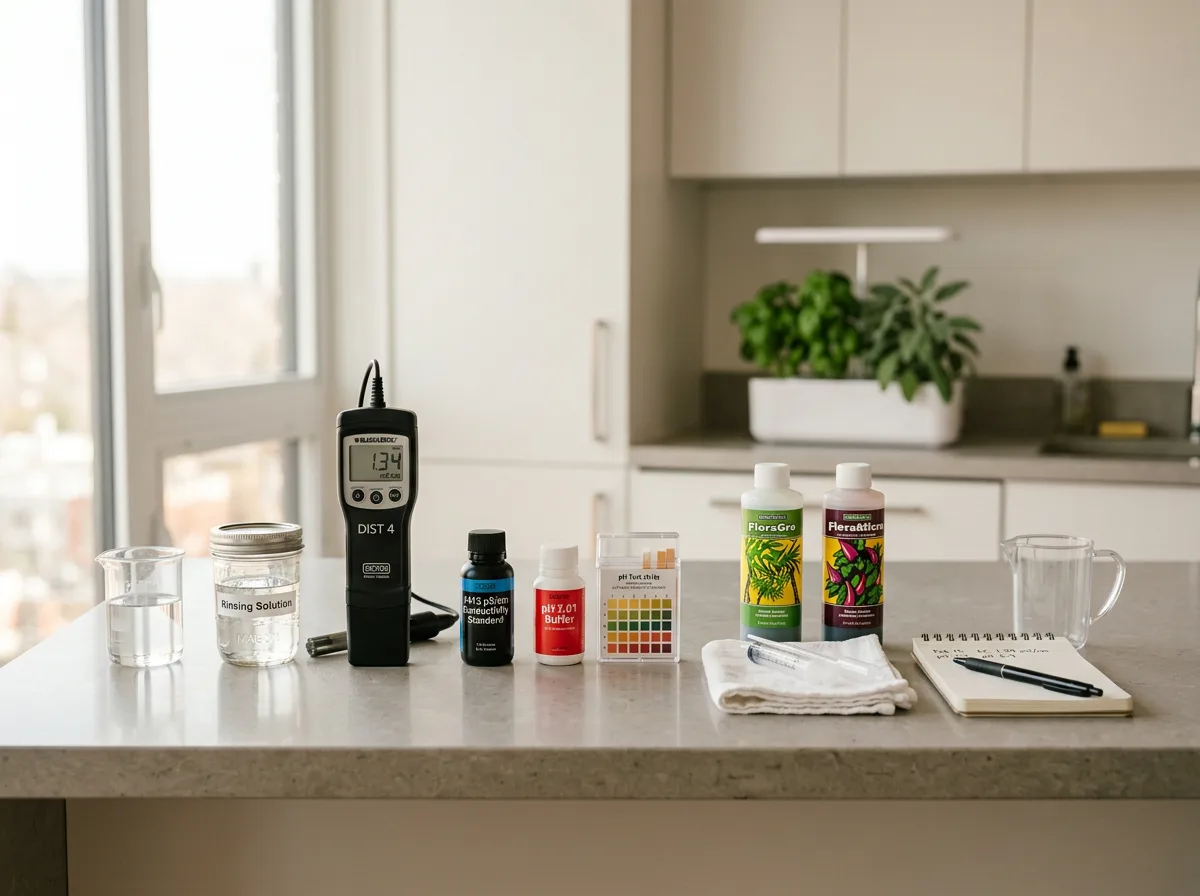
Your meter will drift out of calibration over time. When you drop it, leave it near a hot sunny window, or let the probes dry out, the readings become unreliable. An inaccurate meter leads to terrible decisions. You might think your ec for hydroponic herbs is perfect, only to find out you’ve been starving your plants for weeks.
To keep your equipment running properly:
- Rinse the probe in plain tap water after every use so salts do not dry on it.
- Never touch the delicate glass or metal sensors, because skin oils coat them.
- Calibrate the device once a month, or whenever readings look odd, using a standard calibration fluid.
- Store the meter upright in a cool drawer away from your grow lights.
→ Best pH Meter for Hydroponics Beginners (Honest Apartment Review)
→ Apartment Hydroponics: The Complete Beginner’s Guide
📊 The Best EC Range For Hydroponic Herbs In Small Systems
Different plants want different amounts of food, and the gap is wider than most beginners expect. A massive tomato plant needs a heavy diet to produce fruit, whereas delicate cilantro prefers a lighter touch. Finding the right ec for hydroponic herbs depends on what you’re growing. For a full breakdown of feeding schedules that sit alongside these EC targets, the beginner hydroponic nutrients guide with feeding schedule covers small apartment systems step by step. For most indoor setups under artificial light, however, less is often more.
📊 Crop EC Targets at a Glance
The chart below puts every beginner crop on one scale, so you can see at a glance why a single number cannot serve them all.
When you grow indoors, your plants don’t experience the intense heat and wind of an outdoor garden. They transpire less water, meaning they don’t need excessive mineral salts pulled up into their leaves. Pushing your numbers too high in an apartment system usually backfires.
📋 Specific Crop Targets
Here are the canonical targets for common apartment crops. Stick to these numbers so your root zones stay healthy and your leaves stay green.
- Fast results with limited light → start with lettuce
- A forgiving plant that bounces back → start with mint
- Bright LEDs and a bushy harvest as the goal → start with basil
🌊 The Safe Middle Ground For Mixed Systems
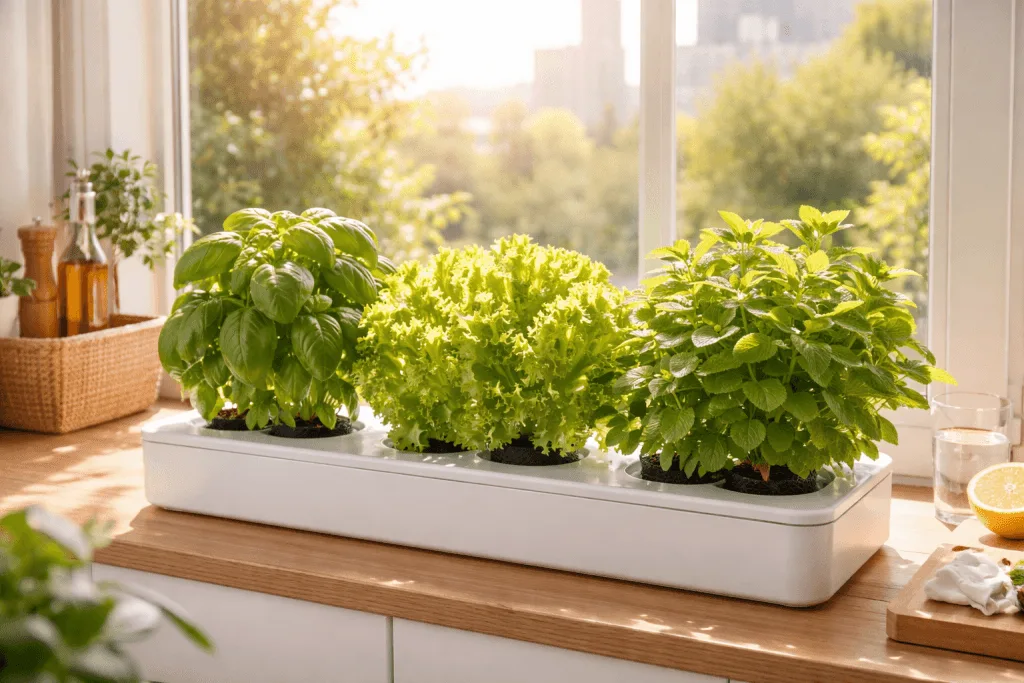
When you use a countertop system such as an AeroGarden, your plants all share the same water basin. You can’t give your basil an EC 2.0 while keeping your thyme at an EC 1.2 in the same tank. Finding the right ec for hydroponic herbs in a shared system therefore means compromising.
For mixed reservoirs, aim for a shared safe middle ground: EC 1.5. This concentration provides enough nutrition for heavier feeders to grow steadily without burning the delicate tips of lighter feeders. Keep your pH between 5.5 to 6.5 to ensure all those nutrients remain available to the roots.
🚨 Recognizing When EC For Hydroponic Herbs Is Too High
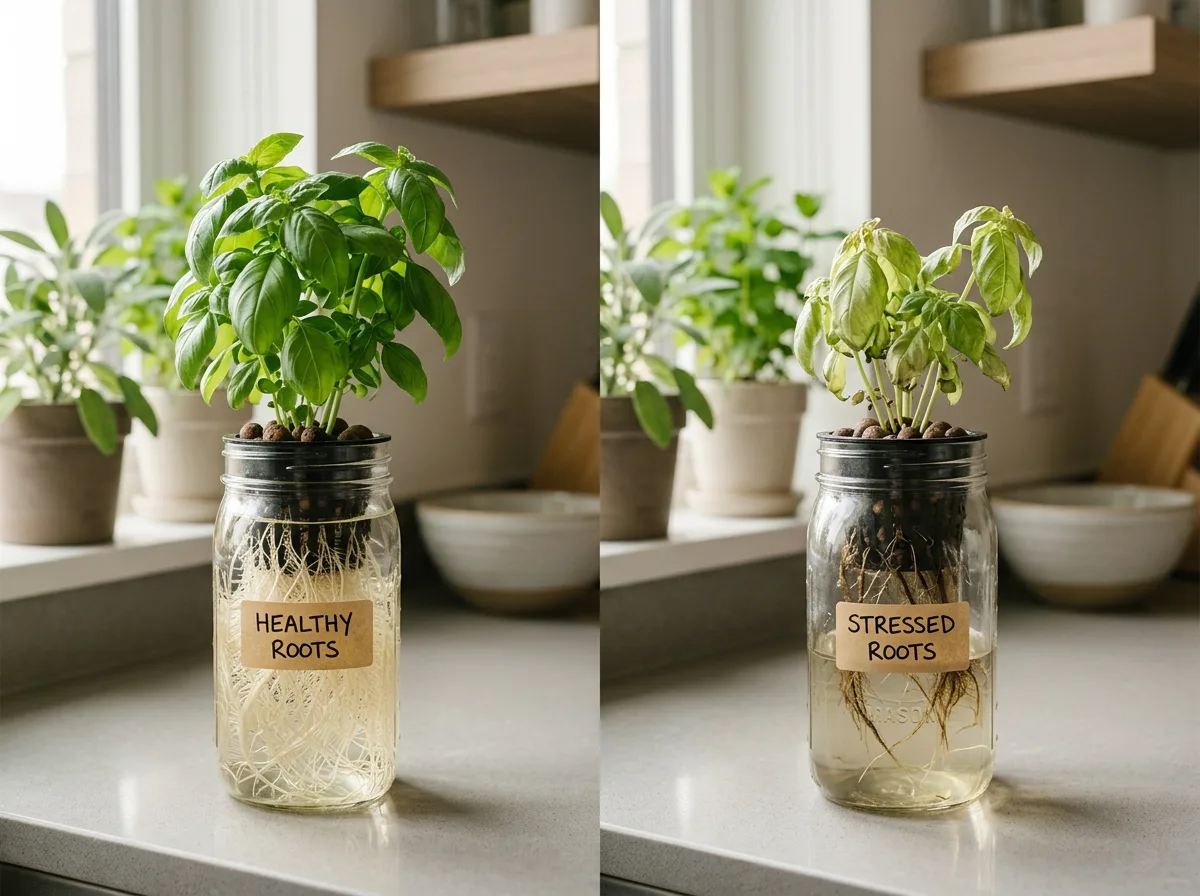
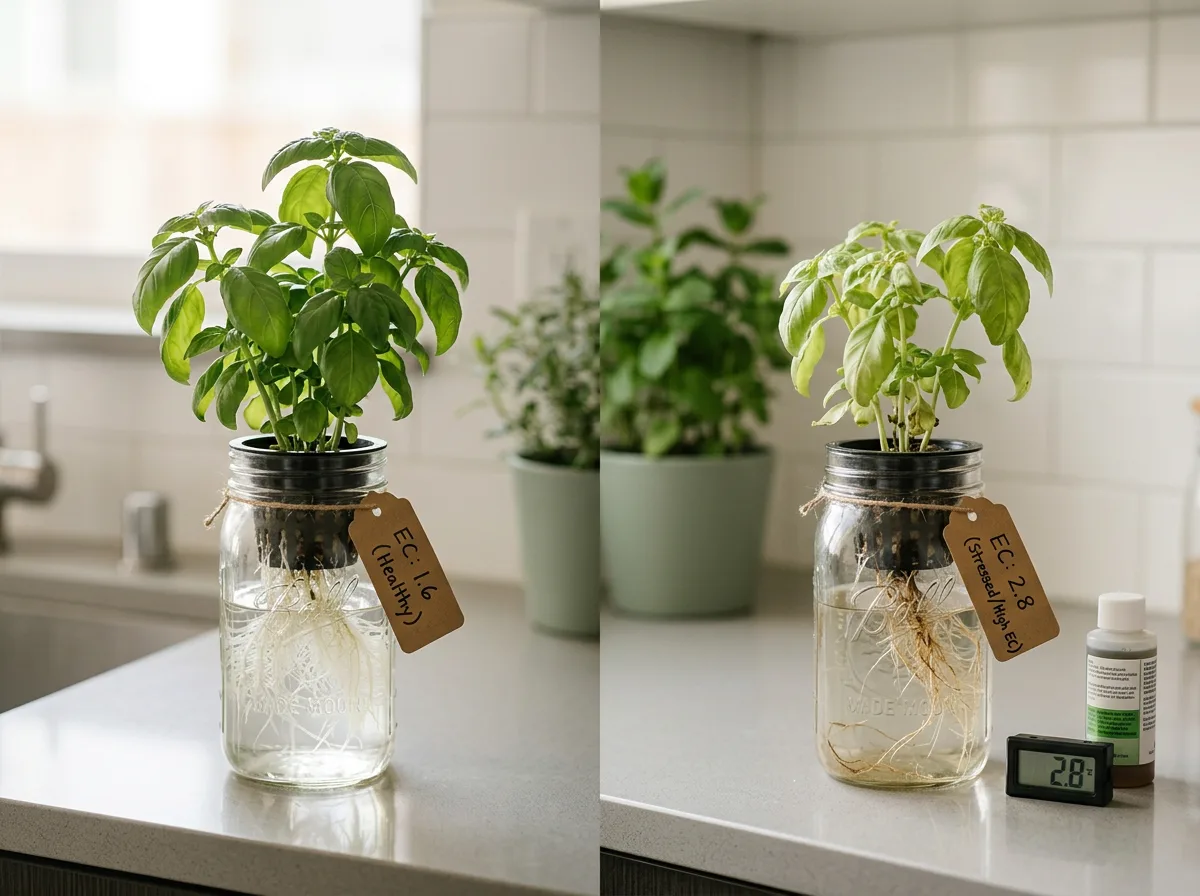
I see this mistake more than any other. You look at your plants, decide they need to grow faster, and add an extra splash of nutrients to the jar. Within a few days, the plant looks miserable. High ec for hydroponic herbs creates a toxic environment where water gets pulled out of the plant cells rather than pushed into them.
When the salt concentration in the water becomes higher than the concentration inside the roots, reverse osmosis occurs. The plant effectively dehydrates while sitting in a pool of liquid. This stresses the plant and also opens the door to pathogens.
🍃 Signs of Nutrient Burn
Your plants will try to tell you when they’ve had too much food. You just have to know what to look for. The damage usually shows up on the foliage first, since the plant attempts to push excess salts to the farthest points of its vascular system.
Watch out for these common symptoms of a hot reservoir:
- The very tips of the leaves turn brown and crispy.
- Older leaves curl downward at the edges like claws.
- Foliage takes on an unnatural, dark artificial green color.
- White crusty salt builds up around the base of the stem or net cup.
💧 How To Dilute A Tiny Reservoir
If you test your water and find the number is way over your target, don’t panic. You don’t always need to throw the batch away. Fixing the ec for hydroponic herbs in a small jar, however, just requires a bit of math and some plain water.
To safely lower the strength in your container:
- Remove a specific measured amount of water (such as one cup) from the jar.
- Replace that exact volume with plain, unfertilized tap water.
- Stir the reservoir gently with a clean spoon so the layers mix.
- Wait five minutes for the solution to stabilize.
- Test with your meter again. If it’s still too high, repeat the process.
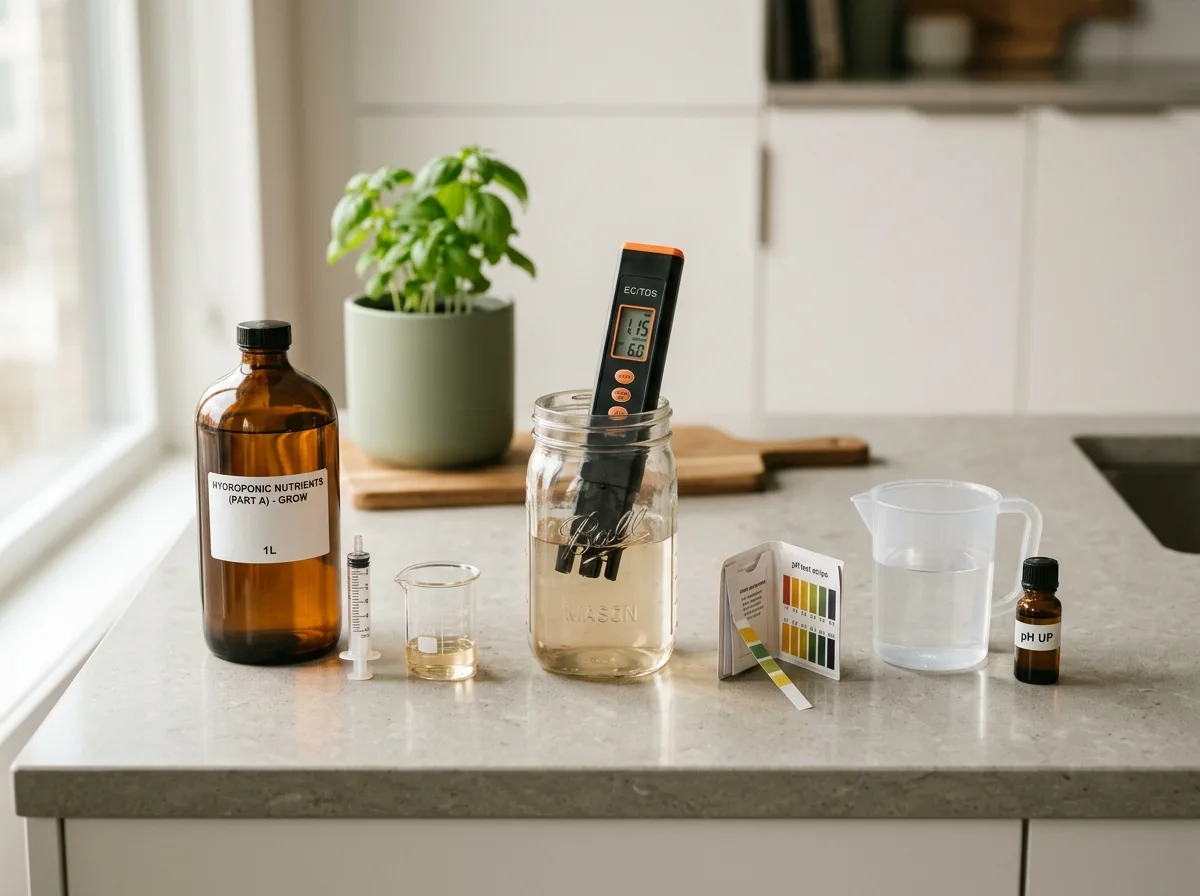
Never add strong pH adjustment chemicals directly to a tiny jar until you have diluted them. Instead of raw chemicals, you can use food-grade citric acid as an alternative to lower pH, though it won’t hold the pH steady for as long as commercial phosphoric acid does.
⏳ Spotting Low EC In Your Apartment Hydroponics
Sometimes we swing too far the other way. If you’re terrified of burning your plants, you might mix your water too weakly. When the ec for hydroponic herbs drops below 1.0 for mature plants, they run out of building blocks. A plant can’t create new cellular tissue without nitrogen, phosphorus, and potassium.
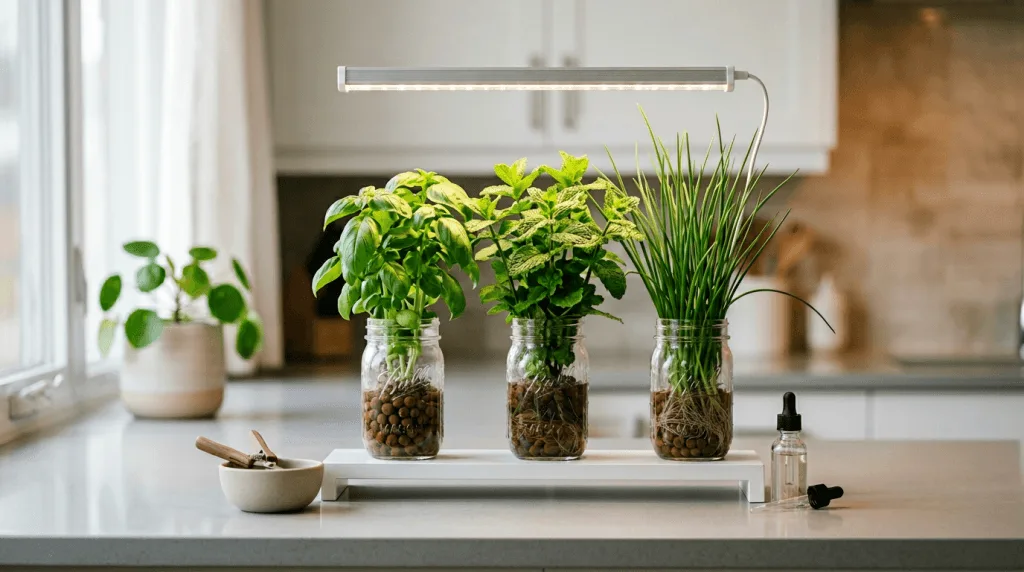
This happens frequently in Kratky jar setups. As the plant consumes water, it also eats the nutrients. Over time, the jar might still be half full of liquid, but the actual food content has dropped to near zero. The plant sits in stagnant, empty water.
🔎 Yellowing and Stunted Growth
A starving plant looks different from a burned plant. Instead of crispy brown edges, the whole plant begins to lose its vitality. Eventually the plant will cannibalize its older leaves to find the mobile nutrients needed to grow new tips.
If your levels are too low, you’ll see these warning signs:
- Older leaves near the base turn uniformly pale yellow.
- The stem becomes thin, weak, and bends under its own weight.
- Growth stalls, producing no new leaves for over a week.
- New leaves emerge much smaller than previous growth.
↑ Safely Bumping Up The Strength
When you discover your water is too weak, resist the urge to pour raw concentrated fertilizer directly into the jar. Concentrated nutrients are heavy and will sink, creating a toxic puddle around the bottom roots before they dissolve. This shocks the root system.
To fix low nutrient levels correctly:
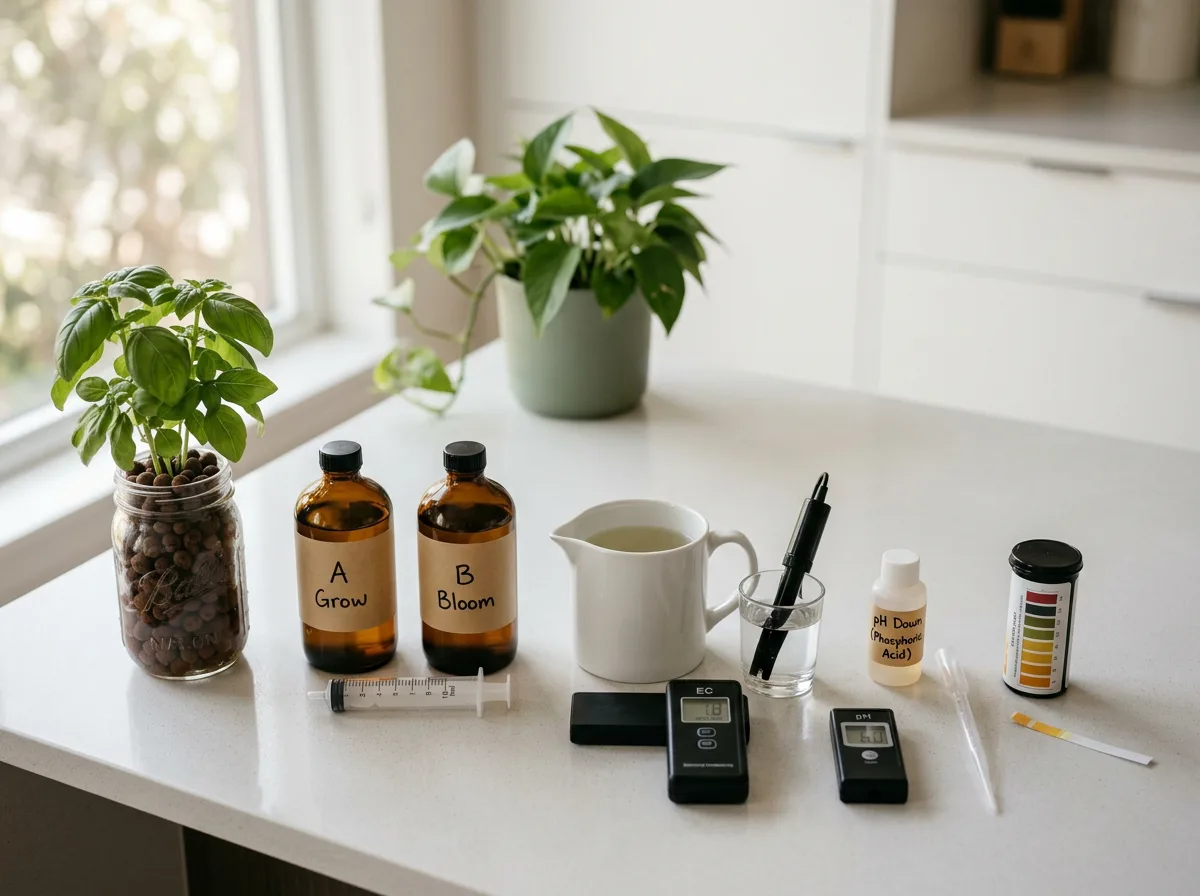
- Mix a small batch of concentrated nutrient solution in a separate measuring cup.
- Pour the new mixture into your reservoir in small increments rather than all at once.
- Stir the water to disperse the salts.
- Wait a few minutes, then check the reading with your meter.
- Stop adding when you reach your target, such as EC 1.6.
→ Why Your Apartment Hydroponic Plants Turn Yellow (And Simple Fixes That Work)
→ Simple Apartment Friendly Kratky Setups You Can Build With Jars And Kitchen Supplies
🌡️ Managing EC Drift In Tiny Countertop Jars
If you measure your water on Monday and it reads perfect, it won’t read the same on Thursday. The ec for hydroponic herbs shifts as the plant interacts with its environment. Understanding this drift is the key to mastering apartment hydroponics.
Plants drink water and eat nutrients at different rates depending on the temperature and humidity of your room. In most indoor spaces, the air is dry. Air temp usually sits between 60 to 70°F (15 to 21°C) while humidity ranges from 50 to 70 percent. Under these conditions, plants often drink water faster than they consume mineral salts.
🩴 Why Volume Matters
In a large five-gallon bucket, for instance, losing a cup of water to evaporation barely changes the chemistry. However, in a quart-sized mason jar, losing a cup of water represents a massive volume reduction. When the water leaves, the salts stay behind. This causes the nutrient strength to spike.
Consequently, you’ll need to stay vigilant with small containers. Therefore, daily checks become a necessity when plants get large. As a result, many beginners switch to slightly larger containers once their herbs mature. If you don’t have space for larger containers, you must manage the drift manually.
💧 The Water Change Rule
To combat this drift, you therefore need a strict maintenance schedule. Never try to endlessly balance an old jar of water by adding drops of this or that. Eventually, the ratio of individual minerals gets skewed, even if the total electrical conductivity looks fine on your meter.
Follow the golden rule of small-system maintenance:
- Top off daily with plain water to keep the volume steady and prevent spikes.
- Perform a full reservoir change every 2 weeks to reset the baseline.
- Clean the jar during water changes to prevent algae from consuming your nutrients.
Getting the mechanics of this right makes a real difference. The guide on how to top off hydroponic water correctly walks through the exact process for every system type, including how to avoid root shock when you refill.
🛠️ Troubleshooting EC For Hydroponic Herbs
Even with a perfect setup, things will go wrong. When a plant looks sad, beginners usually reach for the fertilizer bottle. This is almost always a mistake. You’ll need to diagnose the problem systematically before you start altering the water chemistry.
- Not sure what is wrong yet → start with the Quick diagnosis table below
- You know the cause → jump to the relevant section below
🔎 Quick diagnosis table
| What you see | Most likely cause | Check this first |
|---|---|---|
| 🍃 Crispy brown leaf tips | Nutrient strength too high | Measure EC and dilute if above 2.0 |
| 🟡 Pale yellow lower leaves | Nutrient lockout or starvation | Verify pH is between 5.5 and 6.5 |
| 💧 EC keeps rising daily | Plant drinking water faster than food | Top off daily with plain water |
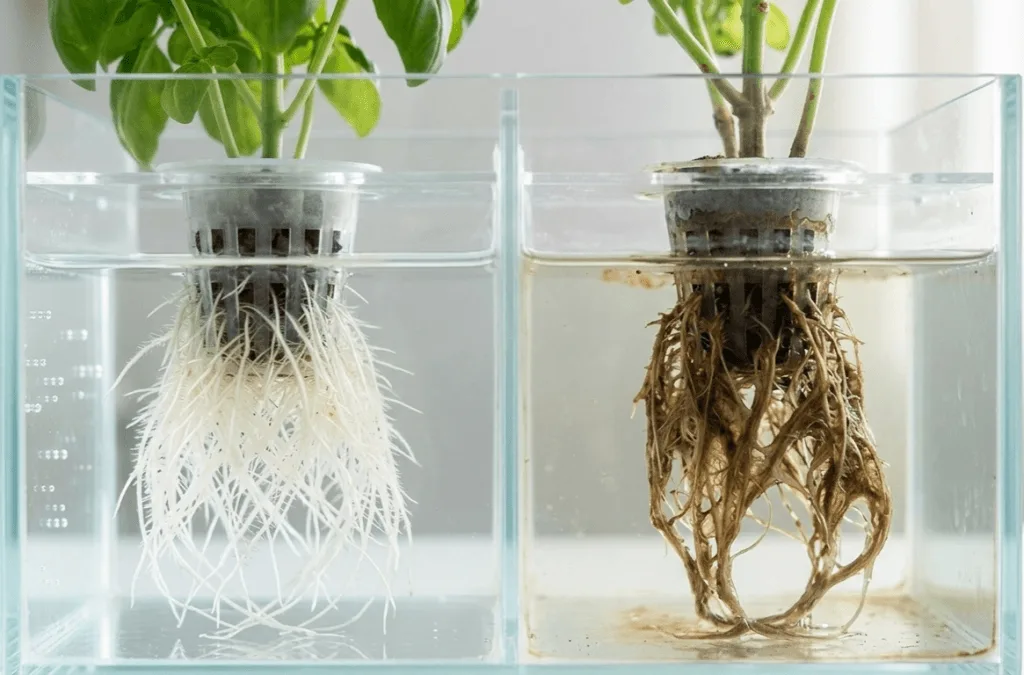
| 🩹 Brown, slimy roots | High water temp causing rot | Check temp is below 75°F (24°C) |
⚖️ When pH Masks An EC Problem
If your ec for hydroponic herbs looks perfect but your plants are starving, your pH is likely out of range. Nutrients only remain dissolved and available to the plant when the water sits in a specific acidity window. For general herbs and greens, this window is 5.5 to 6.5.
If the pH drifts up to 7.0, iron and manganese precipitate out of the solution. They form tiny solids that the roots can’t absorb. Your meter will still read EC 1.6 but the plant acts like it’s starving because it’s locked out of eating. Always fix your pH before you adjust your nutrient strength.
| Problem | Meter Reading | Correct Action |
|---|---|---|
| Yellowing leaves | pH 7.2, EC 1.8 | Lower pH to 6.0, don’t add food |
| Tip burn | pH 6.0, EC 2.8 | Dilute reservoir with plain water |
| Slow growth | pH 6.2, EC 0.6 | Add nutrients to hit target range |
🌡️ Temperature’s Role In Nutrient Uptake
Roots become stressed when water runs too warm. The optimal root zone temperature sits safely between 65 to 75°F (18 to 24°C). Above 75°F (24°C), the dissolved oxygen in the water drops. When roots lack oxygen, they lose their ability to process high nutrient loads.
If your apartment runs hot in the summer, you’ll need to lower your nutrient strength. A plant can handle an EC 2.0 in cool, oxygen-rich water. Put that same plant in 75°F (24°C) water at the same concentration, and it’ll likely develop nutrient burn or root rot. Drop your targets by 20 percent during heat waves.
To cool down a hot reservoir without making a mess:
- Move the jar away from sunny windowsills that act like magnifying glasses.
- Ensure your grow light sits 6 to 8 inches above the canopy to reduce radiant heat.
- Wrap the glass jar in reflective material to block light and ambient warmth.
→ How To Prevent Root Rot In Small Hydroponic Systems Before It Starts
→ Grow Light Burn In Small Indoor Hydroponic Setups (And How To Fix It)
→ How To Grow Hydroponic Cilantro Indoors Without Constant Bolting
→ Penn State Extension: Hydroponic Plant Nutrition and Deficiencies
💬 A Word From Sarah
Misreading a nutrient label is the classic way to kill a batch of countertop mint, because more food sounds like faster harvests. Run a jar at EC 2.6 for four days and the leaf edges turn brown, curl inward and feel as dry as paper. The fix is to pour half the water out, refill with plain water to bring the reading back into mint’s 2.0 to 2.4 range, and wait: the crispy leaves never heal, but new growth comes in bright green and soft within about a week. So I use the free shopping list builder to pick a mild liquid nutrient, and I start everything at half strength to be safe.
❓ Frequently Asked Questions
📊 What is a good EC for hydroponic herbs?
A safe starting point for most leafy greens and herbs is an EC of 1.2 to 1.6. Basil sits in that band at 1.0 to 1.6, mint runs far higher at 2.0 to 2.4, and lettuce prefers the low end at 1.0 to 1.4. Always measure after adjusting your pH. If you’re unsure where to begin, starting lower prevents accidental root damage.
🩴 Can I use the same EC for all my indoor herbs?
You can keep a shared reservoir at EC 1.5 for a mixed herb garden. While mint could take more nutrients and oregano might prefer less, this middle ground keeps most common apartment crops healthy without risking severe nutrient burn. Just monitor the tips of the most sensitive plants for any signs of crisping.
💨 Why does my hydroponic EC keep rising?
In small apartment setups, plants often drink water faster than they consume nutrients. As the water level drops through evaporation and plant uptake, the remaining salts become more concentrated, causing your EC reading to climb over a few days. To counter this natural spike, top off your jar with plain water daily.
⏱️ How often should I check the EC in my jars?
For small jars or countertop systems, it helps to check your nutrient strength twice a week. If you notice rapid changes, topping off the container daily with plain water prevents the nutrient concentration from spiking too high. Once your plants mature and drink faster, you’ll likely need to check it daily.
⚖️ Do I measure EC before or after adjusting pH?
Always mix your nutrients and measure your EC first. Once your nutrient strength is correct, then you adjust the pH. Adding pH buffers can slightly alter the electrical conductivity, but the nutrient baseline needs to be established beforehand. If you adjust pH first, adding your liquid food later will just ruin the balance again.
⏳ What happens if my hydroponic EC is too low?
When nutrient levels drop too far, older leaves often turn pale or yellow as the plant pulls mobile nutrients to support new growth. Overall development slows down, and the stems may look thin or weak compared to healthy plants. If you see these starvation signs, gradually bump up your feed strength to restore their color.
🚨 Can high EC cause root rot in hydroponics?
While high nutrient strength doesn’t directly cause root rot, it stresses the root system. Damaged, burned roots are much more susceptible to pathogens, especially if your water temperature climbs above the safe threshold of 75°F (24°C).
Happy growing! 🌿
Sarah, Urban Hydro Space

Sarah Whitfield is the founder of Urban Hydro Space and an indoor gardening enthusiast dedicated to helping apartment dwellers grow fresh herbs and vegetables in small spaces. She researches hydroponic systems carefully from real specifications and verified buyer feedback, and shares practical tips and honest, clearly labeled product picks to make indoor gardening accessible for beginners.