🔎 Research pick: I have not grown with the products in this post myself, so every pick rests on published specifications and owner reports. How I test and choose products.
⏳ 21 min read · Last updated: September 2026
Finding the best quiet air pump for hydroponics nearly broke my relationship with DWC growing before it started. So I plugged in my first unit, a commercial model from a local fish store, while expecting gentle bubbling. Instead, a loud mechanical rattle filled my studio apartment within seconds. Then the vibration traveled through the wooden shelf and into the wall. By day two, therefore, a neighbor knocked on my door asking if my refrigerator was dying. I yanked the cord out and sat there staring at my healthy basil roots, wondering if silence and deep water culture could ever coexist in a small shared building.
They can. You just need the right equipment, plus a few cheap physical tricks. Roots suspended in water need constant dissolved oxygen, since that is how they absorb nutrients and stay white. Meanwhile a stalled pump starts the clock on root rot within hours. Without steady aeration, root rot moves in fast, so it kills a plant in under a week. These four units were compared side by side on published noise specs and verified buyer reviews across different reservoir sizes, to find what actually stays quiet in a real apartment, not just in a manufacturer’s sound booth. If you’re still deciding which system to build first, the complete beginner’s guide to apartment hydroponics covers which setups need aeration before you spend anything on equipment.
🔈 Why the Best Quiet Air Pump for Hydroponics Matters in an Apartment
An air pump sits outside the water and vibrates, so it pushes ambient air through a plastic hose into your reservoir. That external vibration is, in fact, the entire noise problem. Because the pump casing bounces against whatever surface it rests on, your shelf or countertop effectively becomes an acoustic amplifier. For example, a unit that reads 40 dB in isolation can read closer to 55 dB sitting on hollow wood. That difference is the gap between a library whisper and a normal conversation, so it matters in a studio. So, for anyone working from home or sleeping in the same room as their garden, that gap matters every hour of every day.
📊 At a Glance: Which Pump Fits Your Setup
- Match pump output to your reservoir, so start at 1.5 liters per minute for jars under 2 gallons.
- Isolate the casing from hard surfaces because surface resonance rather than the motor is most of the noise.
- Switch to a micro-pore ceramic airstone to replace loud bursting bubbles with a quiet fizz.
- Run your pump 24 hours a day every day, because roots never stop respiring. There is no safe off period for an active DWC system, although Kratky is the exception.
- Add a check valve just above the waterline to protect the motor from back-siphoning during power cuts. It costs a couple of dollars, yet it is the difference between a pump that survives its first outage and one that does not.
🏆 Sarah’s Top Pick
Tetra Whisper IQ 20
A dedicated sound shield plus a self-priming motor, together with operation Tetra advertises as under 40 dB, make this the most reliable quiet pump for 3 to 5-gallon DWC totes.
★★★★☆ Quietest pump by the numbers · Under 40 dB
These ratings are my editorial assessment from published specifications and verified buyer reviews, not hands-on testing unless a review says otherwise. Links are affiliate links.
🔎 The Four Pumps Compared
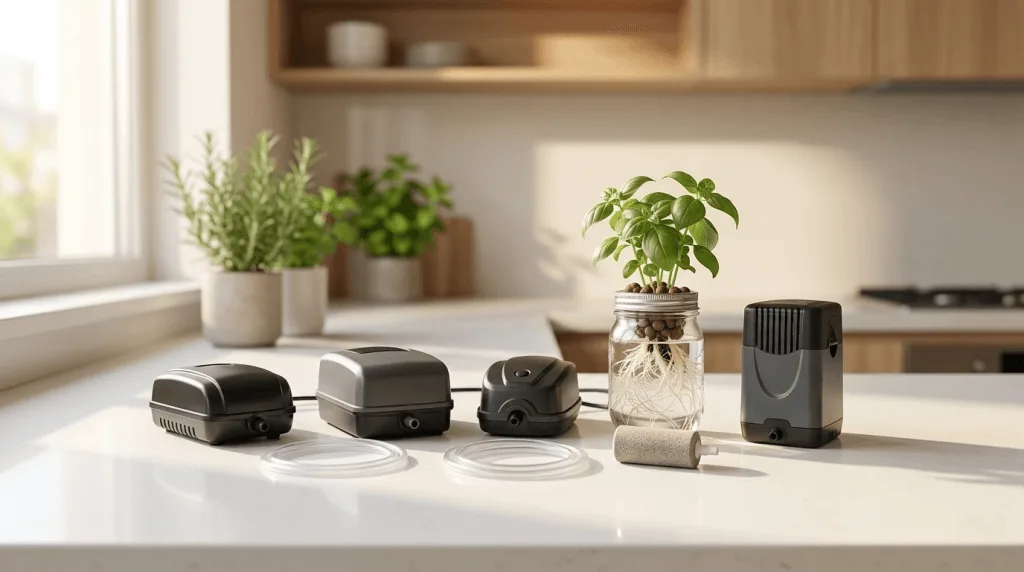
- Since you are growing in a single mason jar or 1-gallon container → Tetra Whisper 10
- Instead running a 3 to 5-gallon multi-plant tote → Tetra Whisper IQ 20
- Or you need a fully submersible all-in-one for 5 to 15 gallons → Hygger 5-in-1
- Finally, if you want adjustable flow across multiple reservoir sizes → EHEIM Air Pump 100
🏆 Top Picks: The Best Quiet Air Pump for Hydroponics
Each of these units earns its place, though only for a specific reservoir size and noise tolerance. However, over-sizing is the most common mistake beginners make. For example, a pump rated for 20 gallons running on a 1-gallon mason jar will push violent bubbles that splash nutrient solution everywhere and stress the roots with excessive agitation. Always match the output to your actual container. Because DWC versus Kratky setups in apartments have quite different pressure requirements, read each pick carefully before ordering.
💧 Tetra Whisper 10: Best for Single Jars and 1-Gallon Containers

Amazon price right now: $19.97
★★★☆☆ Best for Beginners / Single Jars
⚠️ Watch out for: Fixed flow rate with no adjustment dial, and cartridges need monthly replacement
The Tetra Whisper 10 is the unit I point a beginner toward first. Its dome-shaped casing suspends the internal motor away from hard surfaces, which is the design feature that cuts the vibration behind most apartment noise complaints. Three-stage filtration pulls debris from the water while the bio-foam cultivates the beneficial bacteria your roots need. For a full basil DWC build, the foolproof guide to growing hydroponic basil pairs well with this pump. If the setup is going in a bedroom or another noise-sensitive room, the quiet 5 gallon DWC bucket build for an apartment bedroom covers this same pump inside a foam enclosure with the cord and tubing routed for a shared wall. Push it at about 1.5 liters per minute into a one-gallon container and you’ll get clean white roots without violent splashing.
⚠️ Setup Safety: Avoiding Back-Siphon
One rule: always position the unit above the waterline. Otherwise, if the power cuts while it’s sitting below the reservoir surface, water will back-siphon into the motor through the airline tubing. However, a cheap plastic check valve placed just above the waterline prevents this entirely. Then use the seed to harvest countdown to track when your basil hits its peak oxygen demand phase, usually around week 4, so you can monitor bubble output more closely as the root mass grows.
| What I Like | What to Watch |
|---|---|
| Dome shape isolates the motor naturally | Cartridges need monthly replacement |
| proven long-term reliability | Not adjustable; single fixed flow rate |
| 3-stage filtration keeps water clean | Must sit above waterline to avoid siphon |
🌊 Tetra Whisper IQ 20: Best for Multi-Plant Totes

Amazon price right now: $23.17 Prices refresh automatically. Prices are pulled from Amazon and were last checked on 27 September 2026 at 4:15 am. Amazon prices change often, so check the listing before buying.
★★★★☆ Best for Multi-Plant Totes • Under 40 dB
⚠️ Watch out for: Larger footprint than the Whisper 10, and surface agitation can cause gradual pH rise between checks
When you scale up to a multi-plant tote holding 3 to 5 gallons, the Whisper 10 no longer has enough pressure to push bubbles all the way to the bottom. That is where the Tetra Whisper IQ 20 fills the gap. It includes a dedicated sound shield, a soft barrier between the motor and the outer casing that absorbs vibration before it reaches the plastic shell. Tetra rates it at under 40 dB in controlled conditions, and buyers running it on a 5-gallon opaque bin report it stays impressively quiet on a silicone mat. Better still, the self-priming submerged motor means no annoying manual priming ritual every time you refill your reservoir after a full water change.
🧪 Watch Your pH With Strong Aeration
Meanwhile the smart-path spillway oxygenates the water surface as liquid returns to the tank, which reduces the load on any separate airstone you’re running. This matters because more surface agitation means faster CO2 outgassing, which can gradually push your pH upward between checks. Therefore, plan to test your pH every two to three days when running strong surface agitation. Keep it in the 5.5 to 6.5 range for most herbs and you’ll have no lockout issues.
| What I Like | What to Watch |
|---|---|
| Sound shield is genuine hardware, rather than marketing | Larger footprint. Check your shelf space first |
| #1 ranking in its category with proven reliability | Surface agitation can cause gradual pH rise |
| Self-priming motor. No setup fuss after water changes | Large Bio-Bag cartridges cost more per refill |
🔇 Hygger 5-in-1 Internal Filter: Best Submersible All-in-One

Amazon price right now: $16.99
★★★☆☆ Best Submersible All-in-One5W
⚠️ Watch out for: Fewer long-term reviews than the Tetra range, and the ceramic shaft needs cleaning every 1 to 2 weeks
The Hygger 5-in-1 takes a quite different approach. Instead of sitting outside your reservoir, it submerges fully into the water, so the motor noise goes underwater with it, muffled by the surrounding liquid. This is, in fact, the single most effective noise reduction strategy available, and the Hygger packages it with wave making, aeration, filtration, and circulation in one compact 5W unit. It also weighs only 11.2 ounces, which makes repositioning inside a tote painless. What is more, the 50PPI filter cotton combined with hollow quartz balls handles both mechanical debris and biological culture, so your water stays clean without a separate filter running alongside it.
📊 Flow Direction and Track Record
The adjustable outlet nozzle lets you direct flow horizontally across the root mass, or instead at an angle upward toward the surface. In shallow, wide bins common to multi-plant setups, therefore, horizontal flow distributes nutrients far more evenly than straight-up bubbling alone. One honest note: with only 54 reviews at time of writing, this is a newer product, so it lacks the long track record of the Tetra options. If you prefer proven longevity over cutting-edge design, then the Tetra IQ 20 is the safer bet. However, if you want a single, silent, all-in-one device for a larger basin, the Hygger is the most space-efficient option on this list.
| What I Like | What to Watch |
|---|---|
| Fully submerged, so it is the quietest option on the list | Fewer reviews than the Tetra range |
| 5-in-1 replaces multiple separate devices | Ceramic shaft needs cleaning fortnightly, otherwise flow drops |
| Only 5W, negligible electricity cost | Requires screwdriver to open cartridge for cleaning |
🚰 EHEIM Air Pump 100: Best Adjustable Dedicated Air Pump

Amazon price right now: $39.94 Prices refresh automatically. Prices are pulled from Amazon and were last checked on 27 September 2026 at 4:15 am. Amazon prices change often, so check the listing before buying.
★★★☆☆ Best Adjustable Flow Control
⚠️ Watch out for: Heavier and larger than the other options at 1 lb, and requires a silicone mat since it sits outside the reservoir
The EHEIM Air Pump 100 is, notably, the only dedicated true air pump on this list. For the wider gear list, see the hydroponic accessories guide. Whereas the Tetra units are hang-on-back power filters and the Hygger is a submersible all-in-one, the EHEIM is built purely to push air. That focus, therefore, pays off in control. The built-in mechanical dial lets you adjust exactly how much air flows into your system, which matters when you want to dial back bubble agitation at night or scale up when plants hit their peak oxygen demand phase. Also, the rubberized corners dampen internal vibrations before they reach the outer casing, so it starts quiet straight out of the box without any DIY modifications.
💧 The Diffuser Upgrade
The included adjustable diffuser also produces smaller, more consistent bubbles than standard blue mineral stones. As a result, smaller bubbles mean a larger total surface area for gas exchange per unit of air pushed, which keeps your dissolved oxygen levels high while keeping the surface noise low. This diffuser also resists mineral clogging better than compressed ceramic stones because you can clean it by rinsing under a tap rather than soaking it for 30 minutes. Finally, I recommend running this unit on a folded silicone mat and positioning it at the same height as the waterline in your reservoir to keep airflow pressure consistent.
| What I Like | What to Watch |
|---|---|
| Built-in dial gives precise output control | Larger and heavier than the other options (1 lb) |
| Adjustable diffuser included, no extra purchase | Fewer reviews than Tetra options |
| Rubberized corners cut vibration at the source | Sits outside the reservoir. Needs a silicone mat |
🔧 How to Silence Any Air Pump Setup
Even the quietest unit on this list can get noisy, though, if you place it poorly. If yours has already started rattling, my guide to quieting a noisy hydroponic pump covers the same fixes step by step. So, before ordering a replacement, try these physical adjustments first. Most acoustic problems come from surface contact and airflow restrictions, rather than from the motor itself. Because of this, fixing how the device interacts with its environment costs nothing and often solves the problem.
🪴 Isolating the Pump from Hard Surfaces
Hard plastic vibrating against wood or laminate turns your entire shelf into a speaker, so placement matters. Therefore, a thick silicone kitchen mat folded once or twice under the unit breaks that vibration chain. A purpose-made rubber and cork anti-vibration pad does the same job better and costs a few dollars a pad, since the alternating rib pattern absorbs across both light and heavy loads rather than just compressing flat. For total isolation, you can physically hang the device from a small ceiling hook using a short length of paracord looped through the casing handle. Once the pump dangles freely in the air, then it transfers zero vibration to any surface below it.
🌬️ Upgrading to a Micro-Pore Airstone
Standard blue mineral stones produce large, uneven bubbles, so they burst loudly at the surface. However, replacing them with a micro-pore ceramic stone transforms the sound profile. The finer the pore, the smaller the bubble, and therefore the quieter the fizz at the waterline. As a result, your roots stay oxygenated with a gentle mist rather than a rolling boil, and your nutrient solution splashes far less onto the surrounding surfaces.
Buy them in bulk, because stones are consumables rather than hardware. A ten-pack of 1-inch cylinder stones costs very little, which works out cheaper per stone than cleaning the old one every time it clogs. Each one runs at 0.8 L/min and any nano pump from 2 to 4 W will drive it, so they suit jars and small buckets rather than large totes.
| Stone Type | Bubble Size | Noise Profile | Clog Frequency |
|---|---|---|---|
| Standard Blue Mineral, so the cheapest | Large and uneven | Loud popping | Every 3 to 4 weeks |
| Micro-Pore Ceramic, so the quietest | Fine mist | Gentle fizz | Every 6 to 8 weeks |
| Adjustable Diffuser (EHEIM) | Variable | Customizable hum | Rinse under tap |
✂️ Trimming the Airline Tubing
Long, coiled, or kinked hoses force the internal motor to push against back-pressure, since air cannot turn corners freely, which raises both the operating volume and the temperature of the unit. So, trim your airline tubing to cover only the direct distance from the pump to your reservoir, and remove any sharp bends or kinks along the path. A smooth, short, straight line keeps airflow resistance minimal, so your motor runs at the quiet end of its range.
If your hose has gone cloudy or stiff, a 13 ft tubing kit replaces it and throws in two spare stones, four connectors and two check valves. Position the light overhead at the correct height too. Use the free grow light calculator to confirm the right height for your LED over your DWC basin. Then, the daily light cycle guide shows how I schedule all my equipment to run quietly alongside a normal work-from-home routine.
🧰 Building a Simple Soundproof Box for Larger Units
For unavoidably loud models running larger systems, therefore, a small enclosure cuts the noise without restricting operation. First, take a plastic food container or a shoebox lined with acoustic foam panels, then cut two clean holes, one for the power cord and one for the air tubing. Rest the unit inside on a thick kitchen sponge. Finally, leave the box partially open at one end to allow fresh intake air, because a sealed box will cause the motor to overheat within hours.
🚨 Troubleshooting Sudden Pump Noise
A previously silent setup that suddenly gets loud usually has one of three problems. However, a maintained unit can return to quiet operation without buying a replacement. So, work through these checks before you throw anything away.
🩺 Clearing Clogged Airstones
Mineral buildup from your nutrient solution slowly clogs the tiny pores of your airstone, since salts precipitate as water evaporates. As a result, the motor strains against this restriction and hums loudly. When your unit gets clearly louder than usual, follow these steps:
- First remove the airstone from the reservoir, though leave the airline tubing connected.
- Next soak the stone in a mild hydrogen peroxide solution for 20 to 30 minutes.
- Then scrub the surface gently with a soft toothbrush to dislodge mineral scale.
- Then rinse with plain tap water until no bubbles appear on the dry surface.
- Finally reinstall it and listen for the return of a quiet, even bubble pattern.
Diluted white vinegar works as an alternative, but it requires a thorough rinse because residual acid will alter your reservoir pH. Afterward, give roots two to three days to recover from any brief oxygen reduction during maintenance.
Honestly though, past the second or third soak the pores never fully reopen and the pump keeps straining. So once cleaning stops restoring the original bubble pattern, swap the stone rather than scrubbing it again. Bought as a multipack, replacing is cheaper than the electricity a labouring motor wastes.
🔍 Replacing a Worn Diaphragm
Inside traditional air pumps, a small rubber diaphragm flexes thousands of times per hour to push air. After one to two years of continuous use, this rubber can crack or stretch, so the unit then rattles loudly without moving any air to your roots. Fortunately, replacement diaphragm kits cost under five dollars for most popular models and swap in under ten minutes. First you unscrew the bottom casing, then pop out the old rubber piece, and press the new one into place. No tools beyond a small Phillips screwdriver.
🔬 Fixing Kinked Airline Hoses
Sometimes the loudest noise comes from a simple external problem. If your tubing gets pinched under a reservoir lid or compressed behind a shelf, the back-pressure forces the motor to grind. Therefore, inspect the full length of your hose regularly for sharp bends. Also, install a plastic check valve slightly above the main waterline so that power outages cannot allow water to back-siphon into the motor housing. This single addition extends the life of any air pump considerably and protects your electrical equipment from water damage.
- pH + EC monitor: KETOTEK pH/EC/Temp Combo Meter. One probe reads pH, EC, and water temperature so you can catch the gradual pH rise that surface aeration causes before it locks out your nutrients.
- pH adjustment: pH Up and Down Kit. Keeps your reservoir in the 5.5 to 6.5 window even when strong aeration pushes CO2 out of solution and nudges pH upward.
- Check valve: A plastic non-return check valve placed just above the waterline stops nutrient solution from back-siphoning into your pump motor during power cuts. Find one at any aquarium shop for under two dollars.
Build your complete DWC setup with the hydroponic shopping list builder.
→ University of Minnesota Extension: Small-Scale Hydroponics
→ University of New Hampshire Extension: Hydroponics at Home
🛒 Free tool
Building a DWC setup around your pump?
The shopping list builder shows the whole kit for your crop, experience and budget, split into what to buy first and what can wait, so the pump is not the only thing you get right.
💬 A Word From Sarah
I made the mistake of running a commercial aquarium pump on my 5-gallon mint tote at full output, because I thought more bubbles guaranteed faster growth. Instead, the bubble agitation was so violent it splashed nutrient solution onto my kitchen wall every hour, and the constant surface turbulence caused my water to evaporate at nearly double the usual rate. By day four, my EC had climbed from 2.0 to 2.6 without me adding a single drop of fertilizer, and the mint tips burned.
So I dropped the pump output to the lowest dial setting, switched to a micro-pore airstone, and let the reservoir settle for 48 hours. The EC stabilized back at 2.0 on its own as evaporation slowed down. Now I check EC every two days without fail, top off with plain pH-adjusted water daily, and do a full reservoir change every 2 weeks. Less mechanical power, then, means more consistent results.
❓ Frequently Asked Questions
⏱️ Do I need to leave the air pump on all the time?
Yes. Roots fully submerged in a DWC reservoir need uninterrupted dissolved oxygen. If the pump stops for several hours, oxygen levels drop rapidly, roots become stressed, and the plant declines faster than most beginners expect. There is no safe off period for an active deep water culture setup. Run your pump continuously, day and night.
🧬 Which herb is easiest to start with in a DWC air pump setup?
Basil and lettuce are the best starting points. Both respond well to dissolved oxygen and grow fast in small countertop setups. Basil handles slight over-sizing of the pump better than delicate greens because its root structure tolerates more agitation. Start with a one-gallon jar, a Tetra Whisper 10, and a single basil seedling before scaling up.
🧪 Can one air pump run multiple hydroponic containers?
Yes, if you split the output with a gang valve and add a check valve on each line. A single pump loses pressure as you add outlets, so match total flow to your combined reservoir volume. For more than two containers, a dedicated air pump like the EHEIM Air Pump 100 handles the split load better than a compact filter.
⚗️ Do bubbles change the pH of my nutrient solution?
Yes. Continuous aeration gradually raises pH as carbon dioxide outgasses from the solution. Check your levels every two to three days and keep the reading between pH 5.5 and 6.5 for most herbs. If it drifts upward between water changes, add a small drop of pH Down after your daily top-off. The free pH and nutrient calculator gives starting numbers.
🔌 Can I put my hydroponic air pump on a timer?
No. Never run your aeration system on an intermittent timer. The roots require continuous steady dissolved oxygen to absorb nutrients from the water. Turning the pump off for even a few hours overnight can cause partial root suffocation that shows up as wilting or yellowing the following day. Timers are appropriate for grow lights, not air pumps.
🌡️ Does pushing air into the reservoir change the water temperature?
Slightly. Ambient room air pushed into the reservoir can warm or cool the water depending on your apartment climate. Keep your reservoir between 65 to 75°F (18 to 24°C) for healthy root function. Above 75°F, dissolved oxygen drops and root rot risk rises sharply. Position jars away from radiators, sunny windowsills, and warm appliances during summer.
🍂 Why are my leaves turning yellow even though the air pump is running?
Yellow leaves almost always point to nutrient lockout or deficiency, not an oxygen problem. Check your pH first. If it has drifted above 6.5, iron and manganese lock out even when your EC looks normal. Good aeration speeds up nutrient uptake but cannot fix a reservoir sitting outside the correct pH window. The yellow leaves fix guide covers every cause.
🏠 Can I realistically run an air pump in a studio apartment?
Yes, and the units on this list make it practical. The Tetra Whisper 10 and EHEIM Air Pump 100 both operate below 40 dB when placed on a silicone mat, quieter than a laptop fan at normal volume. Position the pump at least 3 to 4 feet from your sleeping area and the sound becomes a non-issue for most people.
💧 How often should I change the water in my DWC system?
Top off daily with plain pH-adjusted water, since that replaces what evaporates and keeps your EC from spiking. Perform a full reservoir change every 2 weeks to flush out mineral salt buildup and reset the nutrient balance. Good aeration slows root rot between changes, although it does not replace the need for complete flushes. Mark your calendar so you don’t skip it. The full schedule per system is in how often to change hydroponic water.
🌬️ How often should I replace an airstone?
Every two to three months in a nutrient reservoir, because mineral salts fill the pores far faster than they would in a fish tank. Soaking in peroxide buys you a cycle or two, though the pores never fully reopen, so the pump keeps straining. Since airstones come cheaply in a multipack, swapping is cheaper than the electricity a labouring motor wastes.
🛑 Do I really need a check valve?
Yes, if the pump sits below the waterline, and honestly yes anyway. When power drops, water siphons backward up the tubing and into the motor, which kills the pump and floods your shelf. A small check valve stops it. Alternatively, mount the pump above the waterline, although a valve costs less than remembering to. For the wider outage plan, see my power outage backup guide.
💧 What is the best type of pump for hydroponic systems?
For deep water culture and most small apartment reservoirs, a dedicated air pump moving air through an airstone is the right tool. It feeds oxygen to the roots around the clock without heating the water the way some submersible pumps can. Water pumps only become necessary once you build recirculating systems with multiple sites, which most apartment setups never need. Match the pump size to your reservoir volume and run it 24 hours a day.
Happy growing! 🌿
Sarah, Urban Hydro Space

Sarah Whitfield is the founder of Urban Hydro Space and an indoor gardening enthusiast dedicated to helping apartment dwellers grow fresh herbs and vegetables in small spaces. She researches hydroponic systems carefully from real specifications and verified buyer feedback, and shares practical tips and honest, clearly labeled product picks to make indoor gardening accessible for beginners.