⏳ 13 min read · Last updated: March 2026
Growing hydroponic basil in my apartment changed how I cook. I used to buy those sad basil clamshells from the grocery store for pasta night, only to watch them turn black in the fridge after just a few leaves. Frustrating. A waste of money. So I switched to a simple indoor setup, and now I can walk over, snip fresh basil, and toss it straight into pasta, pizza, salads, or eggs whenever I want.
If you cook often, you know the pattern. You either overpay for limp basil that barely lasts, or you buy a living pot that drops leaves and gives up a week later. Hydroponic basil solves both problems. One small setup can keep producing for weeks if you prune it the right way. When you are ready to move beyond basil, the Growing Guides hub brings together all my tutorials on systems, grow lights, nutrients, and other crops.
- Keep hydroponic basil at a pH of 5.8 to 6.2 for steady nutrient uptake.
- Target an EC of 1.0 to 1.4 mS/cm for seedlings, building to 1.6 to 2.2 mS/cm for mature plants.
- Give basil 14 to 16 hours of light each day under a full-spectrum LED.
- Prune by cutting just above a pair of leaf nodes so the plant grows bushier instead of taller.
- Replace the nutrient solution every 1 to 2 weeks rather than endlessly topping it off.
🔎 Quick-start table
| What basil needs | Good beginner target | Why it matters |
|---|---|---|
| 💧 pH | 5.8 to 6.2 | Keeps nutrients available to the roots |
| 🧪 EC | 1.0–1.4 seedlings / 1.6–2.2 mature | Prevents weak growth or overfeeding |
| 💡 Light | 14 to 16 hours daily | Supports leaf production and stronger flavor |
| 🌡️ Water temperature | 65 to 72°F (18 to 22°C) | Keeps roots oxygenated and healthy |
| ✂️ Pruning | Above leaf nodes | Encourages bushier regrowth |
- No prior hydroponics experience → start at Step 1 and follow in order
- Tried basil in soil and kept killing it → jump to the common mistakes section
- Setup running but basil is leggy or pale → go straight to daily care and harvest technique
- Why Hydroponic Basil Is the Best Herb for Apartment Growing
- What You Need to Grow Hydroponic Basil
- How to Start Hydroponic Basil Step by Step
- How to Care for Hydroponic Basil Every Week
- How to Harvest Hydroponic Basil So It Keeps Growing
- Common Hydroponic Basil Mistakes
- A Word From Sarah
- Frequently Asked Questions
🌿 Why Hydroponic Basil Is the Best Herb for Apartment Growing
Basil is one of the easiest herbs to grow in water because it likes warmth, steady moisture, and long bright days. Those are exactly the conditions a small indoor hydroponic system provides. Unlike soil, a hydroponic setup gives basil regular access to water and nutrients without the constant dry-wet cycle that stresses small potted herbs. As a result, growth is faster and more predictable.
Another big win is cleanliness. You skip the bag of potting mix, reduce mess on the counter, and avoid fungus gnat drama that starts in damp soil. For apartment living, that matters more than most people expect. Growing basil hydroponically also gives you more control over light, water, and feeding — which means fewer surprises and faster problem-solving when something looks off.
📋 What You Need to Grow Hydroponic Basil
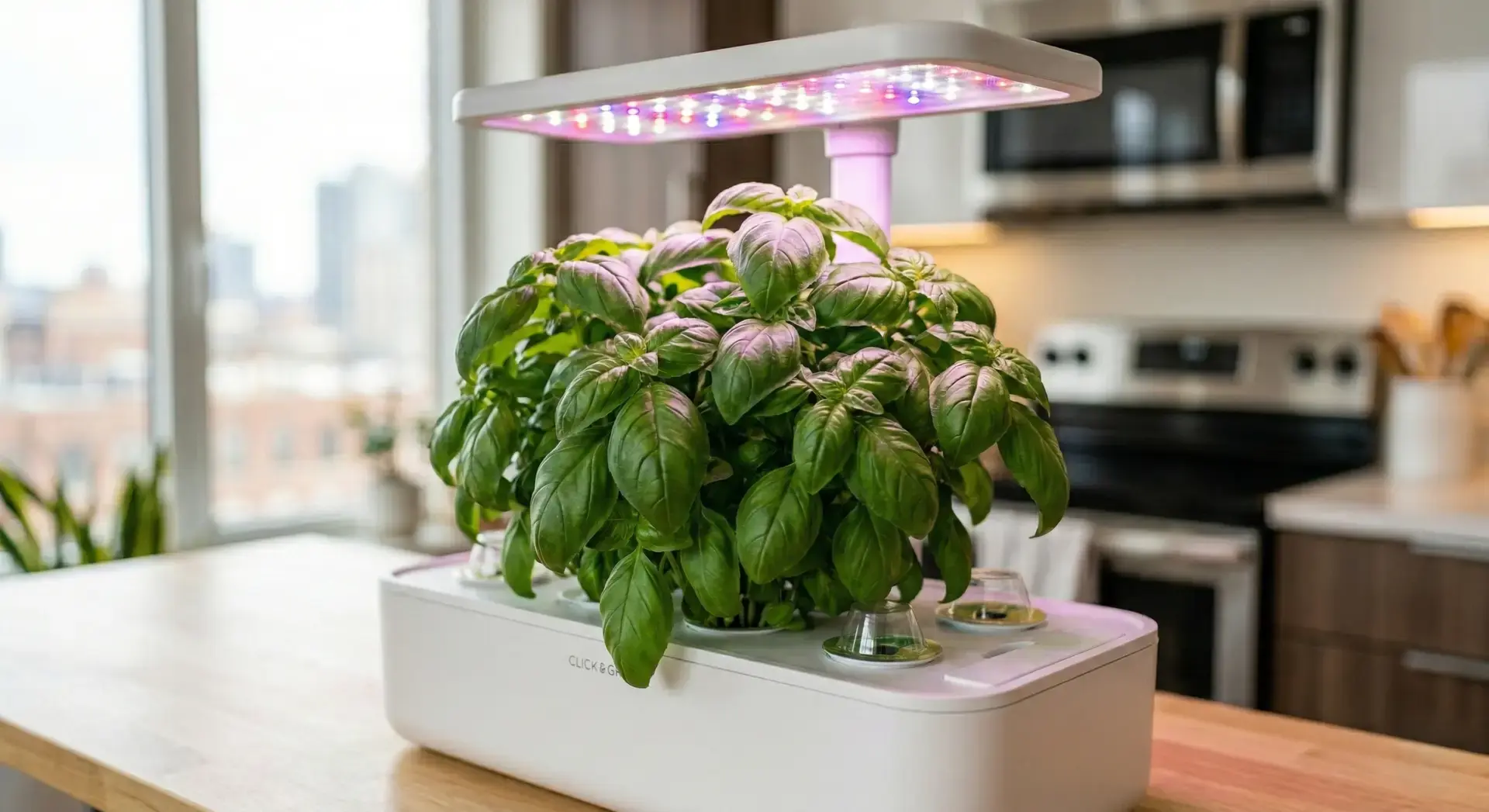
You do not need a spare room or a fancy setup. In most apartments, indoor hydroponic basil can thrive on a counter, shelf, or sunny corner with just a few basic pieces. Use the free shopping list builder to put together a complete kit based on your budget — it takes under a minute.
🌱 The system
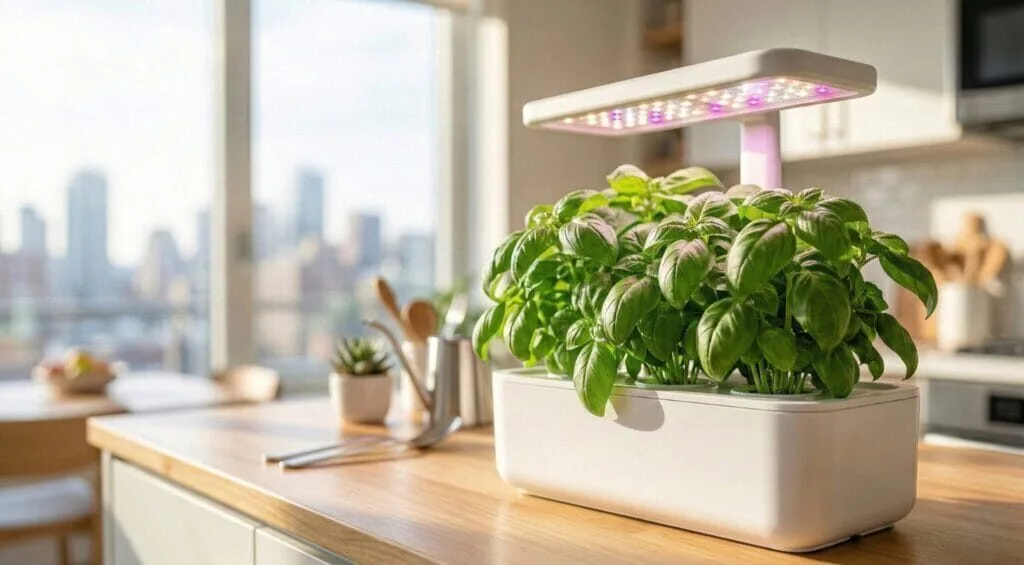
- A compact countertop hydroponic unit like an AeroGarden-style system if you want the easiest plug-and-play route.
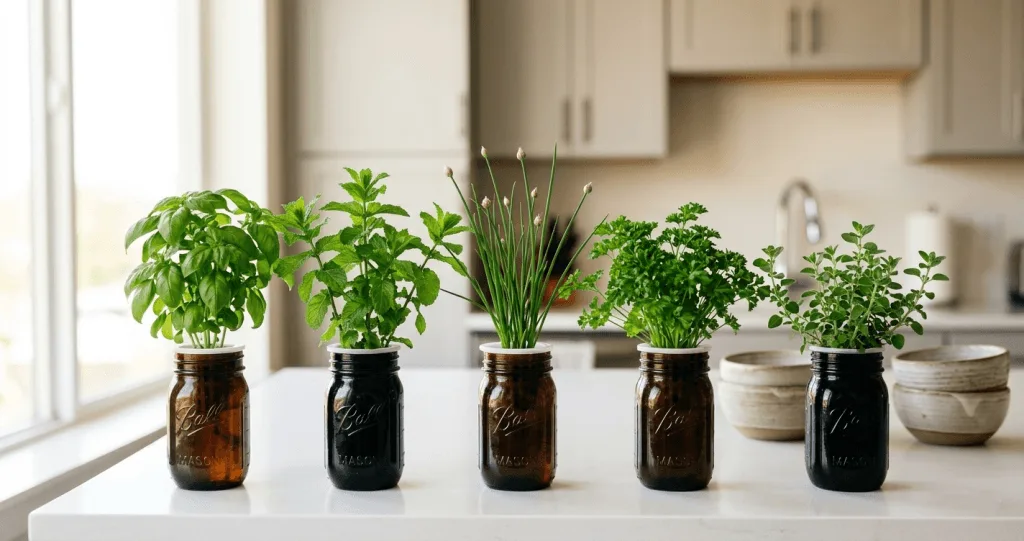
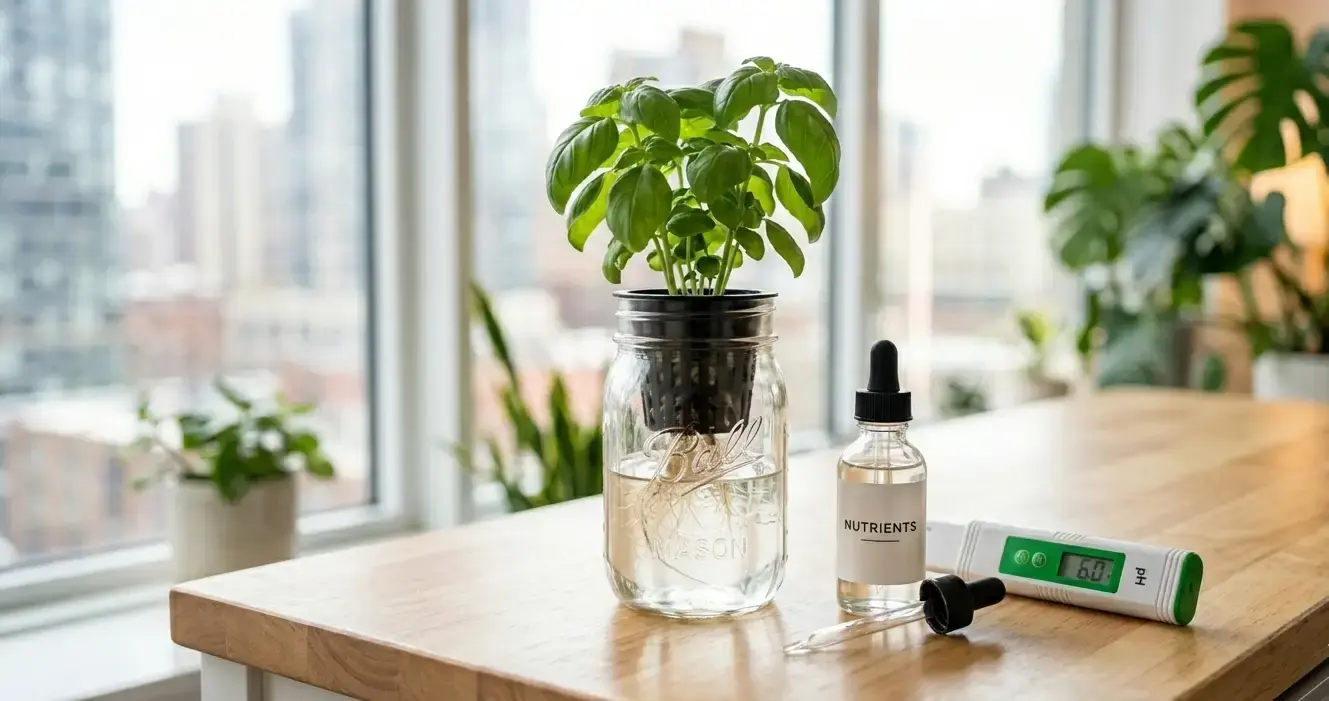
- Or a simple Kratky jar setup with a mason jar, net cup, grow sponge, and light-blocking sleeve if you want the cheapest route.
Countertop systems cut down on guesswork because the light, pod spacing, and water reservoir are already built in. A Kratky setup is silent and budget-friendly. For a small apartment, both work well.
💡 The light
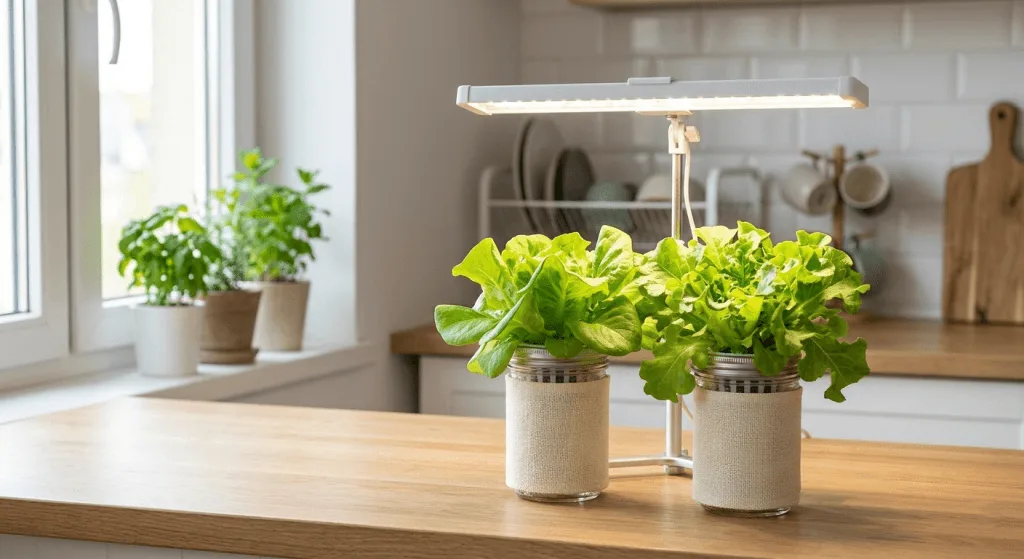
Basil needs strong, regular light indoors. If your window is weak or inconsistent, a small full-spectrum LED is the easiest fix. Aim for 14 to 16 hours each day and keep the lamp roughly 12 to 18 inches above the plant depending on the fixture. Use the free grow light calculator to find the exact wattage and hang height for your space.
- Point the light from above, not from the side
- Put it on a timer so the schedule stays consistent
- Raise it gradually as the basil gets taller
If the stems get thin and stretched, the light is probably too weak or too far away. If the top leaves bleach or look stressed, the fixture may be too close.
🧪 The nutrients and meter
Water alone will not grow strong basil for long. You need a basic hydroponic nutrient plus a pH meter, because feeding without checking pH is where most beginner frustration starts. My guide to the best hydroponic nutrients for small apartment systems breaks down exactly which formulas work best for herbs like basil.
- Use a general hydroponic nutrient suitable for herbs or leafy greens
- Keep pH around 5.8 to 6.2 at all times
- Start at EC 1.0 to 1.4 mS/cm for seedlings, then increase to 1.6 to 2.2 mS/cm once the plant is established and actively producing leaves
- Keep water between 65 and 72°F (18 to 22°C)
✅ How to Start Hydroponic Basil Step by Step
Starting hydroponic basil is a clear process once you see the order. First, plant the seeds. Next, give them steady light. Then maintain the water, pH, and nutrients without overcomplicating things.
💧 Step 1: Start the seeds
- Moisten the grow sponge or starter plug with plain water
- Drop in 2 to 3 basil seeds
- Place the sponge in the pod or net cup
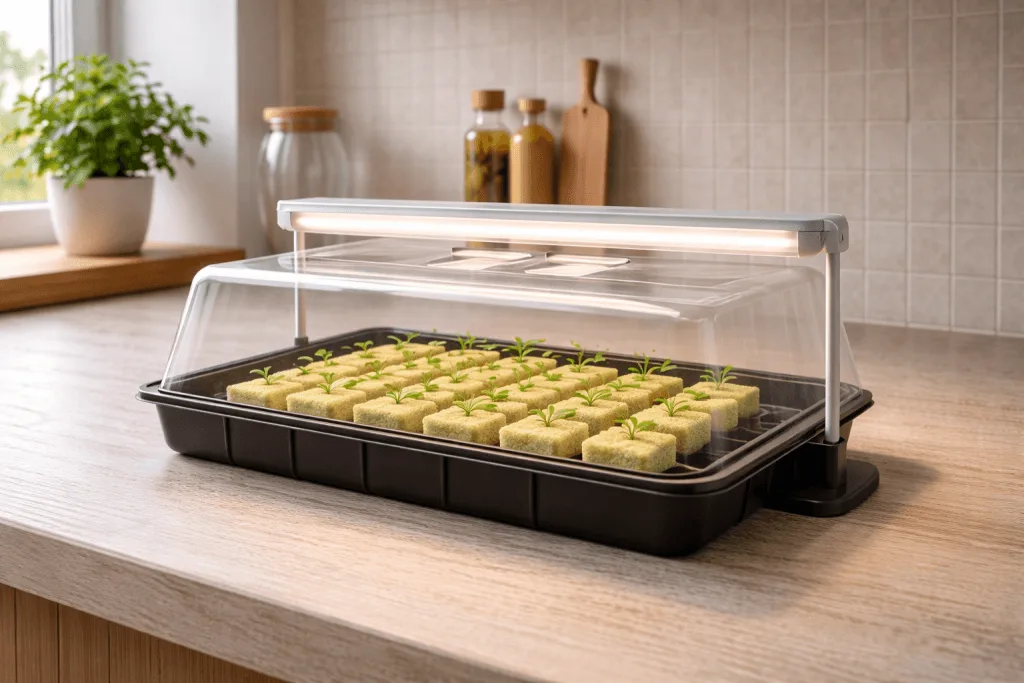
Basil usually sprouts in 3 to 7 days if the environment is warm and moist. If you want a small speed boost, pre-soak the seeds for about 24 hours before planting. For a full guide on starting any crop from scratch in a sterile growing medium, see my walkthrough on how to start hydroponic seeds in rockwool without damping off.
🌞 Step 2: Give seedlings enough light early
Once the seedlings pop up, light becomes the main priority. If the lamp is too dim or too far away, the stems stretch fast and become floppy. That is why I keep the light close from the start instead of trying to fix legginess later.
- Run the light for 14 to 16 hours per day
- Keep it close enough for strong growth, but not so close that it overheats the leaves
- Adjust the height upward as the canopy rises
🔁 Step 3: Thin the seedlings
This part feels harsh, but it matters. When several seedlings share one pod, they compete for the same light, water, and nutrients. Choose the strongest one and snip the weaker ones at the base with clean scissors.
🫙 Step 4: Fill the reservoir correctly
Once the seedling is established, mix fresh nutrient solution and fill the reservoir to the correct level for your system. In a Kratky jar, the bottom of the net cup should sit above the waterline so the roots can grow down while still getting air. In an active countertop system, follow the fill line and keep it topped up. Track your growth stages with the free seed to harvest countdown tool so you know exactly when to expect your first cut.
📅 How to Care for Hydroponic Basil Every Week
This is where healthy basil is won or lost. The routine is simple. Check the water level, monitor pH, watch the leaves, and refresh the reservoir before it turns stale. Staying consistent with this schedule prevents most of the problems beginners blame on deficiencies.
| Routine | What to do |
|---|---|
| Every 2 to 3 days | Check water level and top off with pH-adjusted water if needed |
| Every few days | Check pH and look for pale leaves, drooping, or root smell |
| Every 1 to 2 weeks | Replace the full nutrient solution — do a full reservoir change |
| Anytime something looks off | Inspect roots, light distance, and pH before adding more nutrients |
If your apartment stays warm, root health needs extra attention. Warm water holds less oxygen, and stressed roots can trigger slow growth or yellowing. In that case, a small air stone helps. For the full reservoir change process — when to do it and exactly how — see my guide on how often to change hydroponic water.
If you run into pale leaves, drooping, or root trouble, this guide covers the fixes: Apartment Hydroponics Yellow Leaves: Simple Fixes That Work.
If warm water has been a recurring problem, also read: How to Prevent Root Rot in Small Hydroponic Systems Before It Starts.
✂️ How to Harvest Hydroponic Basil So It Keeps Growing
This is where many beginners accidentally ruin a good plant. They pick random leaves from the bottom, the plant gets tall and bare, and growth slows down. Basil responds best when you harvest by cutting stems in the right place.
📏 The basic rule
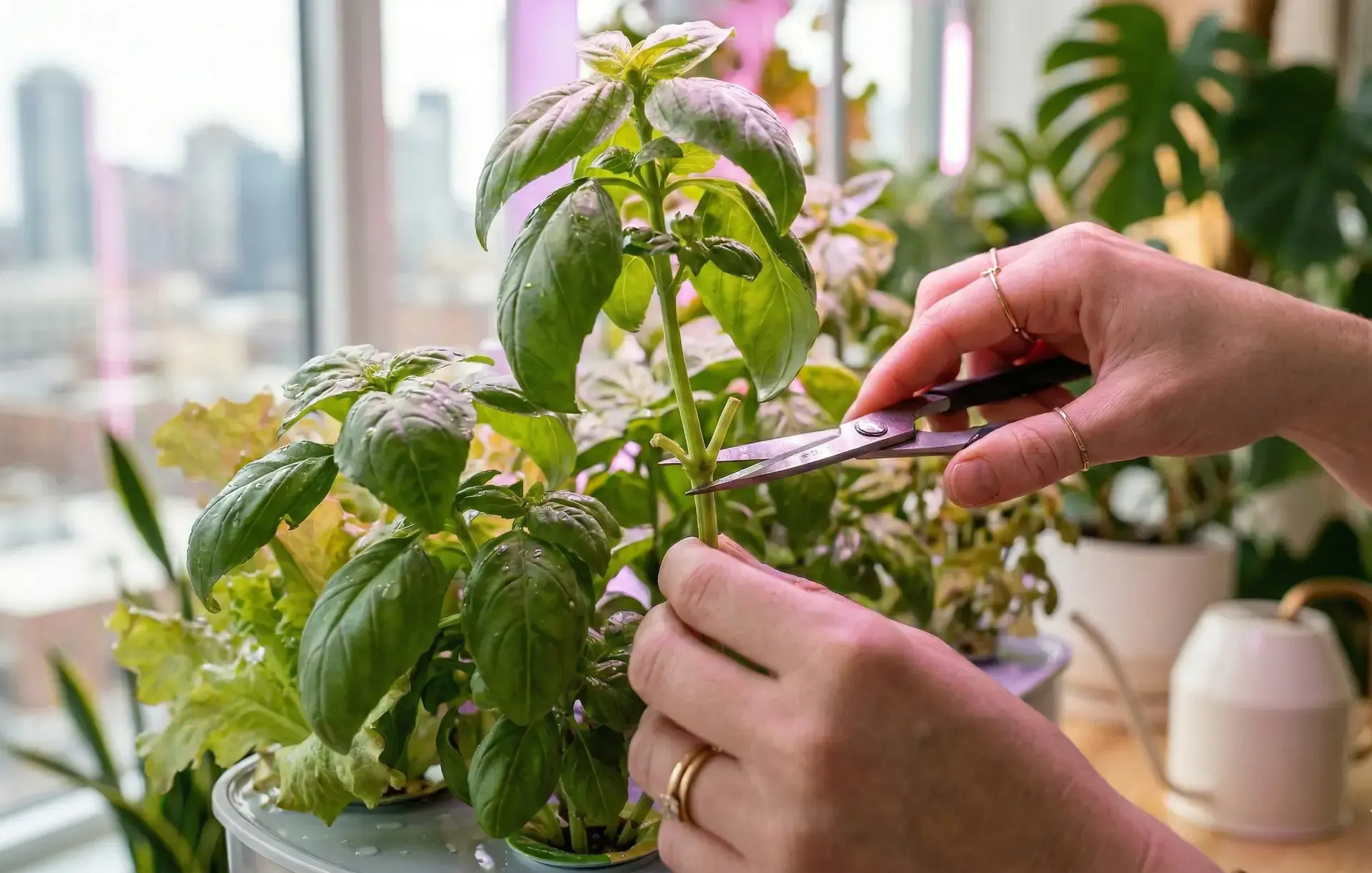
Look for a pair of healthy leaves growing opposite each other on the stem. Right above that point you will usually see where two new branches can form. When you cut the main stem just above those nodes, the plant becomes wider and bushier instead of continuing to stretch upward.
- Wait until the plant is about 6 to 8 inches tall
- Find a strong pair of leaf nodes on the stem
- Cut about 1/4 inch above the nodes with clean scissors
For the best long-term harvest, take a little at a time. A good rule is to remove no more than about one-third of the foliage in one session. Then give it a few days to respond and branch out again before the next cut.
🌼 Watch for flowers
If flower buds appear, pinch them off quickly. Once basil shifts into flowering mode, leaf production slows and the flavor becomes less tender. Regular trimming helps delay that shift, which is another reason pruning matters so much for growing hydroponic basil long-term.
⚠️ Common Hydroponic Basil Mistakes
Most hydroponic basil problems are not mysterious. They usually come from the same small group of issues. If something looks wrong, check these first before changing anything else.
- Ignoring pH: The plant looks hungry even though nutrients are present. Always test pH before adjusting nutrients.
- Weak light: Stems get tall, thin, and floppy. Lower the lamp or increase daily hours.
- No pruning: The basil grows upward instead of outward and becomes a single bare stalk.
- Old reservoir water: Growth slows and the solution gets out of balance. Change it fully every 1 to 2 weeks — never just top off indefinitely.
- Too many seedlings per pod: Plants crowd each other and never get strong. Thin to one seedling early.
- EC too high too early: Seedlings are sensitive. Start at EC 1.0 to 1.4 and increase gradually as the plant matures.
- Algae in the reservoir: Green slime on roots means light is leaking in through the container. Wrap it in foil or tape. My full guide on why algae keeps growing in hydroponic jars covers every fix.
If you want to compare setup styles before expanding, this post helps: DWC vs Kratky for Apartments: Which Is Easier for Beginners.
→ USDA National Agricultural Library — Hydroponics Resource Guide
→ University of Maryland Extension — Growing Basil at Home
→ Penn State Extension — Hydroponic Nutrient Management
💬 A Word From Sarah
I still remember the first time I snipped real basil from my own little indoor setup and dropped it straight into hot pasta. The smell was wild. Way better than anything from those plastic grocery packs. The thing that changed my results most was not the system or the nutrients — it was testing pH before touching anything else. I spent months adding more fertilizer to a plant that could not absorb what was already in the water. Once I fixed that habit, the basil took care of itself. Start simple, watch the pH, keep the light steady, and let the plant teach you the rest.
❓ Frequently Asked Questions
⏱️ How long does hydroponic basil take to grow?
Basil usually sprouts in 3 to 7 days and you can often take your first small harvests around 5 to 6 weeks after planting if light, nutrients, and pruning are all on point. Growth picks up after the first pruning, so the second and third harvests come faster than the first.
🧪 What is the best pH for hydroponic basil?
A good target for most home setups is 5.8 to 6.2. If the pH drifts too far outside that range, basil struggles to absorb nutrients even when the reservoir is full. Check pH every two to three days during the first month until you understand your system’s natural drift rate.
⚗️ What EC should I use for hydroponic basil?
Start seedlings at EC 1.0 to 1.4 mS/cm to avoid burning young roots. Once the plant is established and actively producing leaves, increase gradually to 1.6 to 2.2 mS/cm for maximum leaf production. If you see crispy brown leaf edges, EC is too high. Pale, slow growth usually means EC is too low.
✂️ How often should I prune hydroponic basil to keep it bushy?
Start pruning once the plant reaches about 6 to 8 inches tall and has several strong leaf pairs. After the first cut, a light harvest every few days works better than waiting too long and cutting everything at once. Never remove more than one-third of the foliage in a single session or growth will stall.
🌿 Why is my hydroponic basil getting tall but not bushy?
That usually happens when the light is too weak, the lamp is too far away, or you are picking random leaves instead of cutting above leaf nodes. Fix the light first by dropping it closer to the canopy, then prune correctly so the plant branches outward. Consistent pruning above leaf nodes is what creates the dense, bushy shape.
🔌 Can I grow hydroponic basil without a pump?
Yes. The Kratky method grows excellent basil with no pump, no electricity, and no noise — just a dark jar, a net cup, and nutrient solution. As the plant drinks down the water level, an air gap forms and the roots absorb oxygen from it. For apartments where silence matters, Kratky is often the better choice over active DWC systems.
🩺 Why are my hydroponic basil leaves turning yellow?
Yellow leaves on hydroponic basil almost always point to pH that has drifted above 6.5, which locks out nitrogen and iron even when nutrients are present in the water. Test pH first before adding more fertilizer. Lower it to 6.0, wait 48 hours, and check if the color improves before making any other changes to the reservoir.
Happy growing! 🌿
— Sarah, Urban Hydro Space

Sarah is the founder of Urban Hydro Space and an indoor gardening enthusiast dedicated to helping apartment dwellers grow fresh herbs and vegetables in small spaces. With hands-on experience testing hydroponic systems, she shares practical tips and honest product reviews to make indoor gardening accessible for beginners.