⏳ 21 min read · Last updated: March 2026
The best herbs for small hydroponics are not the ones you see in every gardening video, they are the compact, fast-growing varieties that actually survive on a kitchen counter without a greenhouse, a pump, or an engineering degree. I learned this the hard way. I planted two giant sweet basil plants in a five-gallon DWC bucket and shoved it under a single 10-watt desk lamp. Six weeks later I had two yellowing stalks and a reservoir full of slimy brown roots. The problem was not my technique. It was my plant selection, I had picked varieties that needed far more light, space, and airflow than any apartment counter could provide.
After that failure I spent about three months testing different indoor hydroponic herbs in a Kratky mason jar setup on my kitchen shelf. Some thrived. Most did not. What I found is that the right small hydroponic herbs share three traits: they stay compact under frequent pruning, they tolerate the mild temperature swings of a home environment, and they produce usable harvests fast enough to keep you motivated. This post covers the seven varieties that consistently delivered, how to set each one up correctly, and exactly what to do when things go wrong.
🌿 Why These Are the Best Herbs for Small Hydroponics
Not every edible plant belongs in a countertop water system. Fruiting plants like tomatoes and peppers demand huge root zones, powerful lighting, and months of waiting before a single harvest. Tall plants like dill can hit your grow light within three weeks. Root vegetables obviously will not work at all.
However, certain culinary herbs evolved to stay compact, tolerate regular cutting, and produce dense clusters of edible leaves quickly. These are the ones worth growing. The herbs on this list share a specific set of traits that make them suited for tight apartment setups:
- They stay compact under regular pruning
- They produce usable leaves within weeks rather than months
- They adapt well to mild home environment fluctuations like temperature shifts and small reservoirs
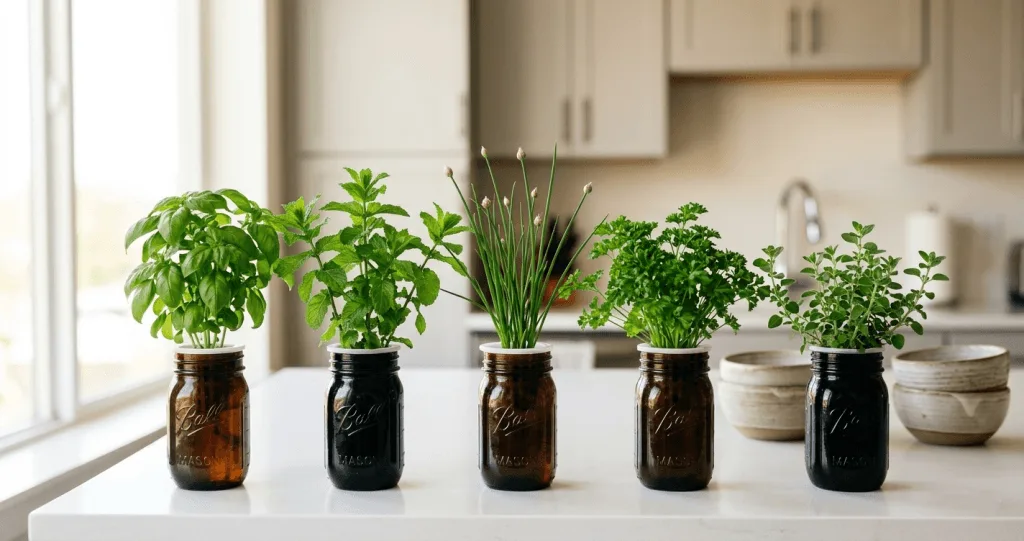
Additionally, all seven work in a passive Kratky setup with no pump and no electricity, which means no noise, no vibration, and no increase to your power bill. A mason jar, a net cup, and some nutrient solution is a fully functional system for every herb on this list. These are the traits that separate the best herbs for small hydroponic gardens from the plants that will frustrate you within a month.
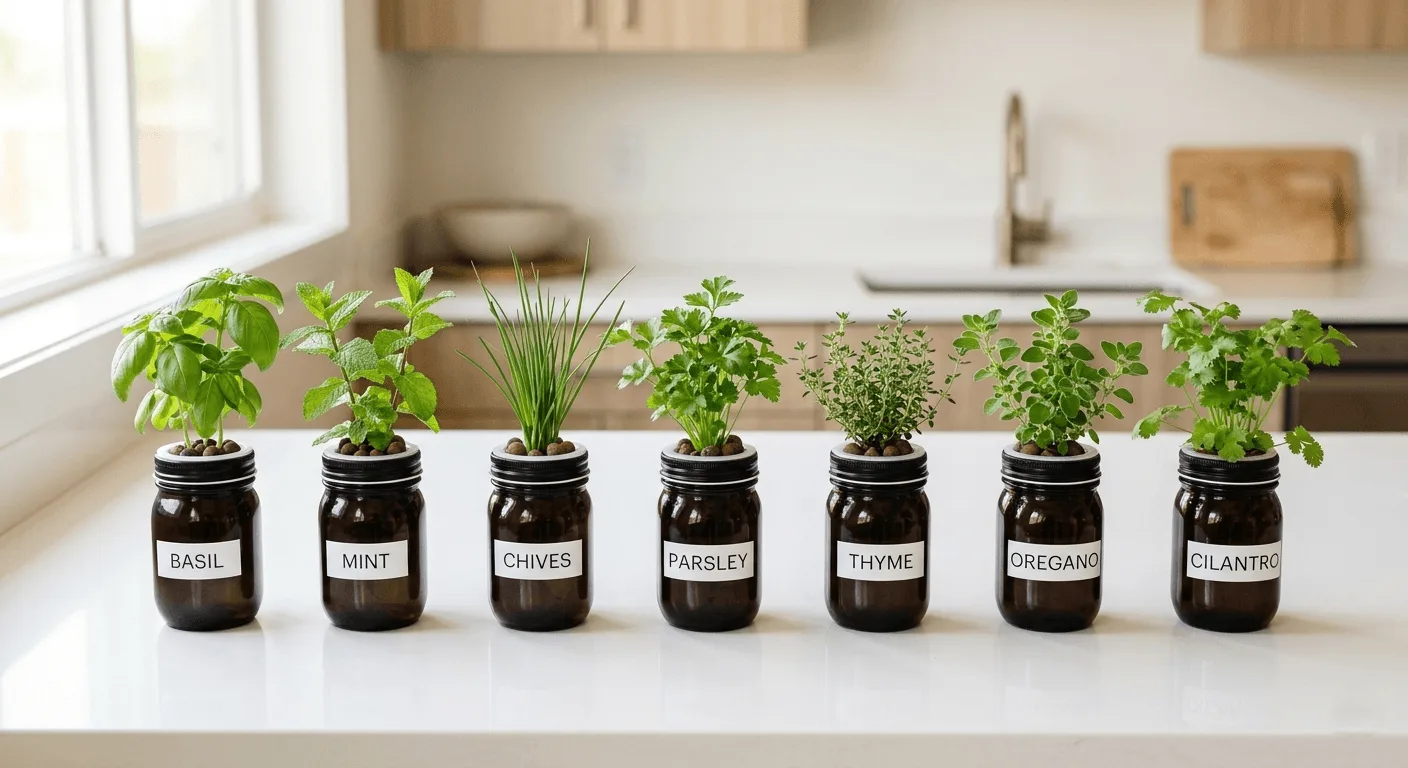
- Basil, mint, and chives deliver the fastest results for beginners. Expect first harvests in 3 to 5 weeks.
- Keep your reservoir pH between 5.5 and 6.5 for most of these herbs. Cilantro prefers the higher end at 6.5 to 6.7.
- Always prune above a leaf node to force bushy branching instead of a single tall stalk.
- Top off water daily and do a full reservoir change every two weeks to prevent salt buildup.
- Keep grow lights 6 to 8 inches above the canopy for leafy herbs and 4 to 6 inches for oregano to boost essential oil production.
- Want results fast: start with Basil
- Low light or north-facing window: go with Chives or Mint
- Cook Italian and Mediterranean food: grow Basil, Thyme, and Oregano together
- Want the most versatile kitchen trio: grow Basil, Chives, and Parsley first
- Why These Are the Best Herbs for Small Hydroponics
- Setting Up Small Hydroponic Herbs: What You Need to Know First
- Basil: Best All-Round Herb for Small Hydroponic Systems
- Mint: The Easiest Hydroponic Herb You Can Grow Indoors
- Chives: Best Space-Saving Herb for Small Hydroponic Gardens
- Parsley: Slow to Germinate, Months of Hydroponic Harvests
- Thyme: A Low-Maintenance Herb for Small Hydroponic Setups
- Oregano: Small Hydroponic Footprint, Intense Flavor
- Growing Cilantro Hydroponically: High Reward if You Manage the Heat
- Feeding Your Hydroponic Herbs: EC and pH Made Simple
- Grow Lights for Indoor Herbs: What Apartment Windows Cannot Do
- A Word From Sarah
- Frequently Asked Questions
🌱 Setting Up Small Hydroponic Herbs: What You Need to Know First
Before choosing which herbs for hydroponic systems to grow, it helps to understand two things: how much vertical space you actually have, and how quickly a small reservoir changes chemistry. Both factors determine which plants will thrive and which will give you problems.
⏱️ Growth Habit and Vertical Space
Countertop systems typically give you 12 to 18 inches of vertical clearance between the net cup and the grow light. That is your entire usable growing height. Herbs that grow upright and dense like basil, chives, and parsley fit this constraint well. Sprawling herbs like oregano need lateral management, but they work fine if you trim the trailing stems back weekly.
The key habit to build early is pruning above a leaf node rather than just cutting the top off. When you cut above a node, the stem forks into two new branches at that point. Do this on a consistent schedule and a single basil plant turns into a dense, multi-stemmed bush within a month. Cut randomly below a node, however, and you stall the plant’s branching response entirely.
💧 Small Reservoirs and Why They Demand Attention
A one-gallon mason jar or small countertop unit holds roughly 800ml to 1.5 liters of nutrient solution. When a mature basil plant drinks 100ml per day in warm weather, that reservoir changes chemistry fast:
- Nutrient salts concentrate as water is consumed, pushing EC higher
- Roots release acids into the water, lowering pH over time
- In a one-gallon jar, these shifts become a problem within three to four days
The practical solution is straightforward. Top off the reservoir daily with plain pH-adjusted water to replace what was consumed, and do a full water change every two weeks to flush accumulated salts and reset the chemistry. This single habit prevents most of the problems beginners blame on deficiencies or disease.
🍃 Basil: Best All-Round Herb for Small Hydroponic Systems
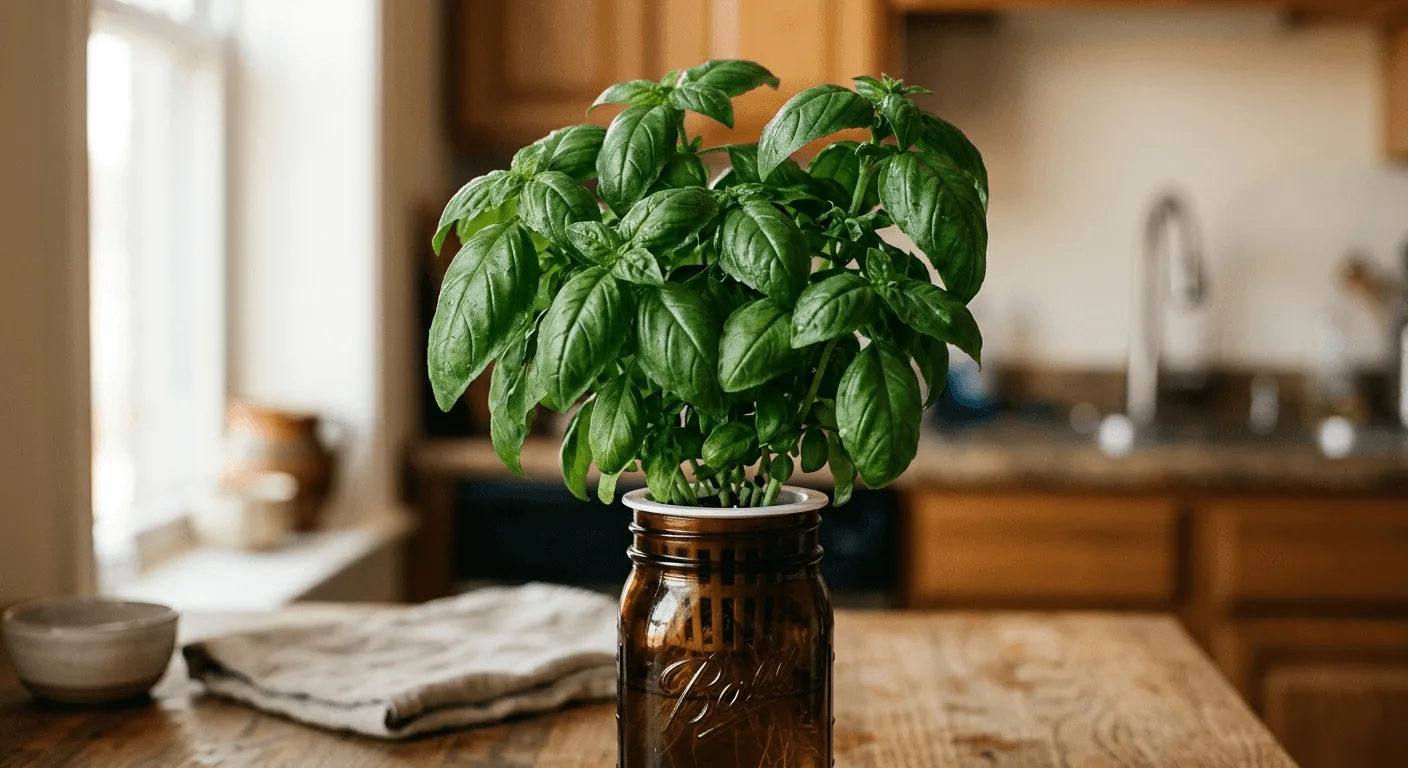
If I had to recommend one herb to every person starting their first hydroponic setup, it would be basil. Seeds germinate in five to ten days. The first true leaves appear within two weeks. By week four you are making pesto. No other culinary herb gives you that feedback loop that quickly, and that matters a lot when you are learning a new system and need confirmation that something is actually working.
Basil also tolerates beginner mistakes better than most small hydroponic herbs. Slightly high EC? It shows a little tip burn but recovers. pH drifts to 7.0? The leaves pale slightly but bounce back once you correct it. This forgiveness makes it the best learning herb on the list. For a full breakdown of varieties, sponge setup, and nutrient ratios, see the complete guide to growing hydroponic basil in a small apartment.
✂️ How to Prune Basil for a Bushy Shape
Left unpruned, basil grows as a single central stalk. It gets tall fast, hits your grow light, scorches the top leaves, and produces far less usable foliage than a well-managed plant. The fix is simple but it requires consistency.
When your basil reaches 6 to 8 inches tall, locate the third or fourth set of leaves from the top and cut the stem just above that node. The plant responds by sending two new shoots from that cut point. Repeat this on each new branch every ten to fourteen days. After a month of this, the same plant that would have been a single stalk is now a dense, multi-branching bush that produces three to four times as many leaves.
🩺 Why Basil Leaves Turn Yellow in Hydroponic Systems
Yellow basil leaves are the most common problem beginners report. The cause is almost always one of two things: nitrogen deficiency from a pH that has drifted too high, or genuine nitrogen starvation from an EC that is too low. Test pH before doing anything else. If it sits above 6.5, the plant cannot absorb iron and nitrogen even if those elements are present in the water. Lower pH to 6.0 first and wait 48 hours before making any other change.
If your basil leaves turn yellow, work through these steps in order:
- Test pH first. If above 6.5, add pH Down in small increments until you reach 6.0 to 6.2.
- Test EC. If below 1.5, do a full water change with fresh solution at EC 1.8.
- Check water temperature. Basil roots suffer above 72°F (22°C) because warm water holds less oxygen.
- Wait 48 hours before making any additional adjustments. Stacking corrections causes more harm than the original problem.
☘️ Mint: The Easiest Hydroponic Herb You Can Grow Indoors
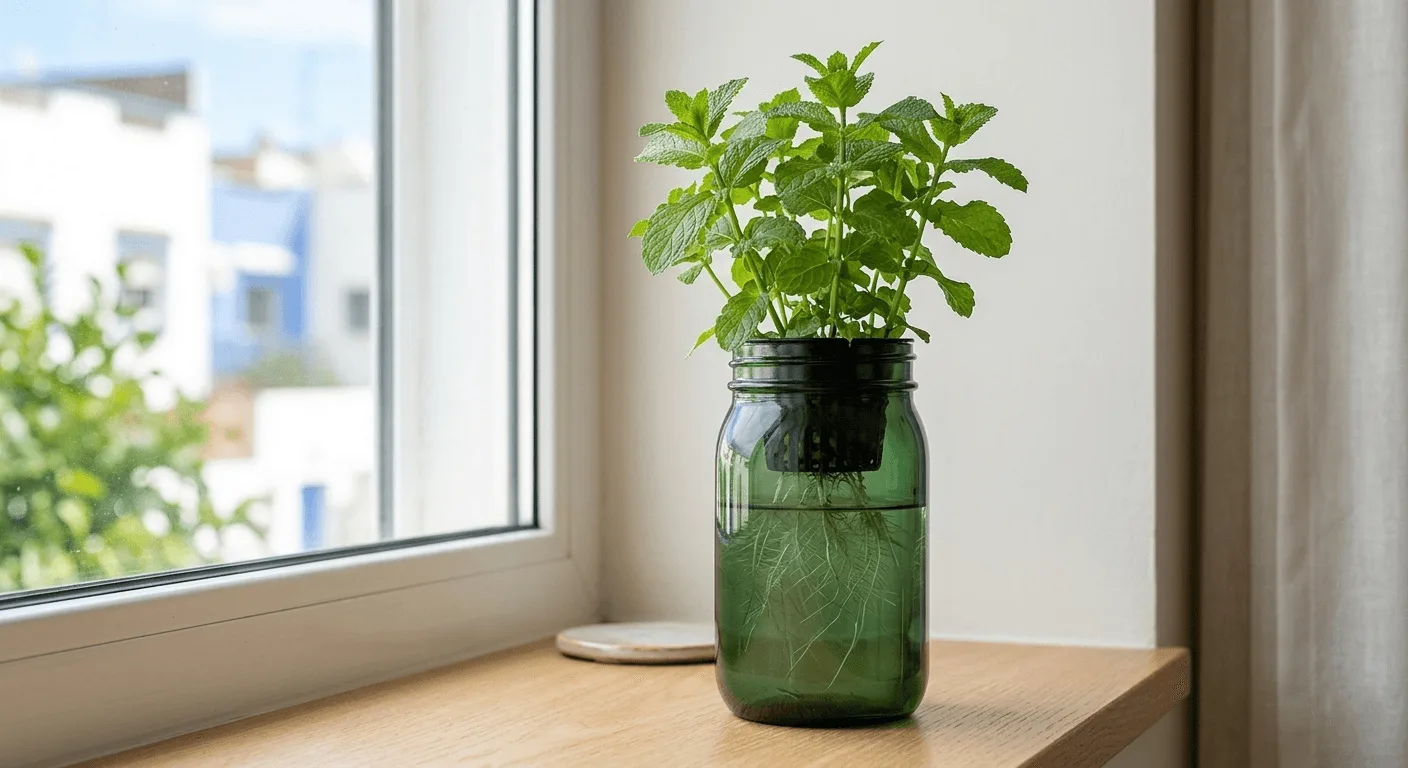
Mint is the herb I recommend to anyone who has killed a plant before and lost confidence. It tolerates pH swings, inconsistent watering, low light, and heavy harvesting. The challenge with mint is not keeping it alive. It is keeping it from taking over everything around it.
In a shared multi-pod system, mint roots will grow through partition gaps into neighboring net cups within three to four weeks. Once they reach another plant’s root zone, they outcompete it for oxygen and nutrients. Therefore, the simplest solution is to grow mint in its own dedicated container rather than sharing a reservoir with other indoor hydroponic herbs.
🫙 Why the Kratky Method Works Best for Mint
A passive Kratky setup is the ideal environment for mint. It requires nothing more than a dark jar, a net cup, a rockwool cube, and nutrient solution. The roots fill the jar quickly, which in a pump-based system would clog the intake and disrupt flow. In a Kratky jar, however, there is no pump to clog. The roots hang freely in the solution and the plant thrives.
The one rule with Kratky mint is the air gap. As the plant consumes the nutrient solution, the water level drops and leaves a space between the water surface and the bottom of the net cup. This gap is where the roots absorb oxygen. When you top off the jar, never fill it all the way back to the net cup. Leave at least one inch of air gap. Filling to the top drowns the roots and causes rot within days.
A few other things worth knowing for Kratky mint:
- Use a dark jar or wrap a clear jar in black tape to block light from the solution
- Light hitting the nutrient solution causes algae blooms that consume oxygen and foul the water
- Top off with plain pH-adjusted water between full changes, not fresh nutrient solution
🔍 Fixing Leggy, Weak Mint Stems
When mint stems grow long and thin with wide spacing between leaf pairs, the plant is not getting enough light. The stem is reaching toward a source it cannot find. Moving a grow light from 12 inches to 6 to 8 inches above the canopy will stop this within a week.
If your mint is already leggy, cut the stretched stems back to a healthy node, then drop the light. New compact growth will emerge from the cut points within five to seven days.
🌱 Chives: Best Space-Saving Herb for Small Hydroponic Gardens
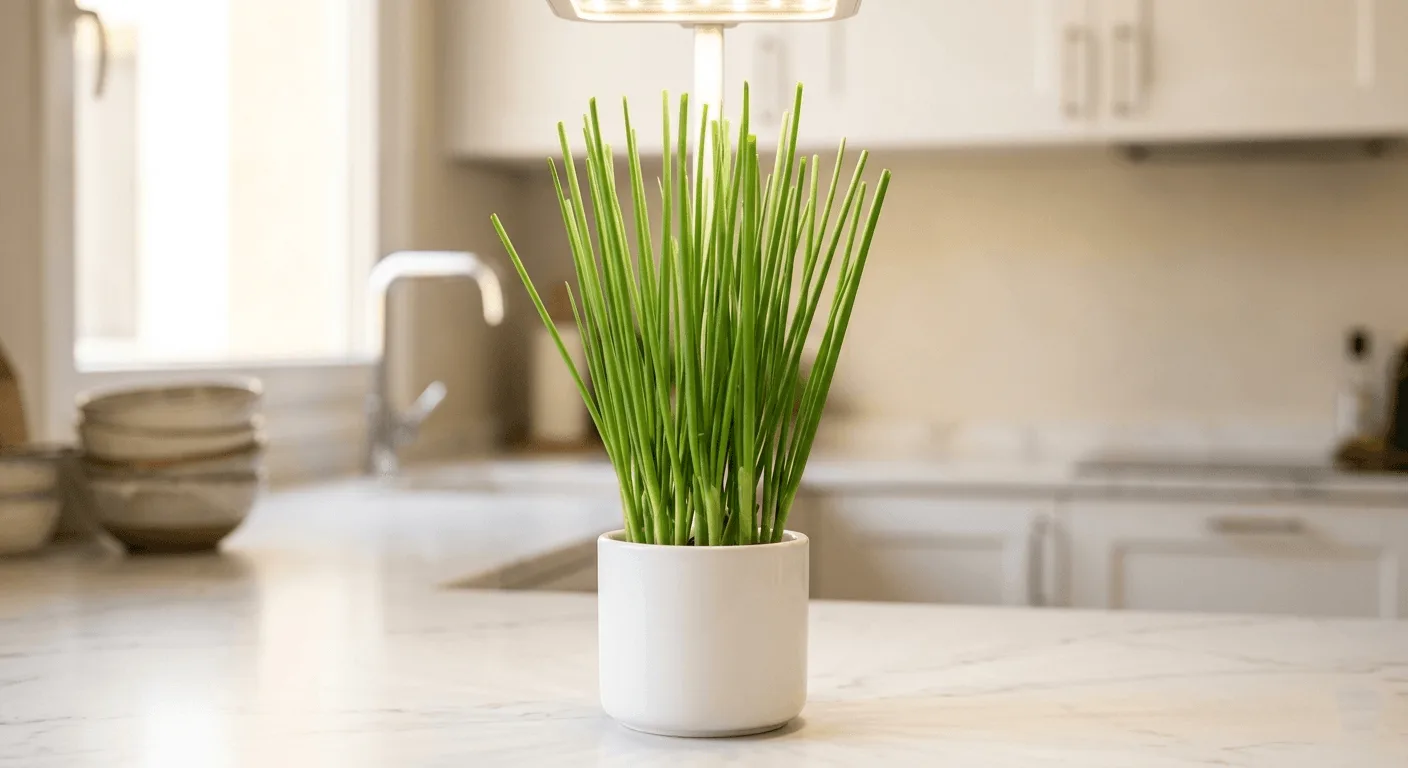
Chives are underrated in most hydroponic herb guides. They grow straight up, occupy almost no horizontal space, and can be tucked between larger plants without competing for canopy light. Their shallow, fine root system fits comfortably in small mason jars or compact pods. Because you harvest by cutting the hollow leaves straight across and leaving a two-inch stub, the plant regrows from the base within days.
One chive pod, harvested correctly, can produce continuous cuttings for four to five months before the flavor starts to fade and replanting makes sense.
💡 Light Placement for Straight, Upright Chives
Chives need light coming from directly overhead. If your light sits off to one side, the leaves lean toward the source and eventually flop over. This is not a structural problem. It is purely a light direction issue. Position your LED panel directly above the pod and the leaves will grow straight. If you use a shelf with a side-mounted light, rotate the container 180 degrees every three days to keep growth even.
Chives perform well on 12 to 14 hours of light per day. They do not need the extended 14-plus hours that oregano and thyme prefer.
🚨 Preventing Bulb Rot at the Base of Hydroponic Chives
The small white bulb cluster at the base of chives rots quickly if submerged. The roots below the bulb should reach the solution, while the bulb itself should sit above the waterline inside the net cup. Keep the reservoir level just below the bottom of the net cup and let the roots extend down into the solution on their own.
If you see brown slime forming at the base or smell something sour from the jar:
- Check the water level first. Nine times out of ten the reservoir has been overfilled.
- Lower the water level and trim any brown root material with sterile scissors.
- Rinse the jar with a diluted hydrogen peroxide solution before refilling.
The complete guide to preventing root rot in small hydroponic systems covers this recovery process in full detail.
🌿 Parsley: Slow to Germinate, Months of Hydroponic Harvests
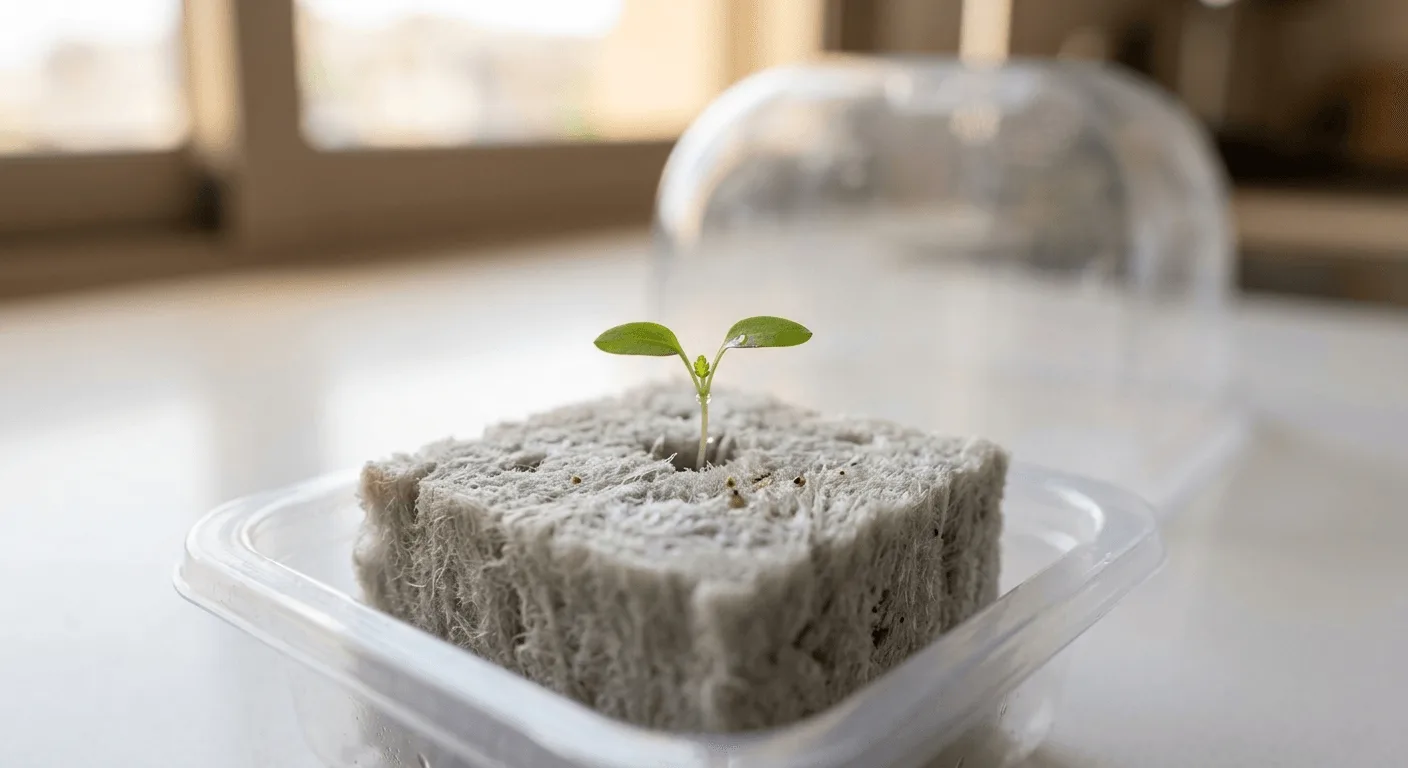
Parsley is the most patient herb on this list. Seeds can take 14 to 21 days to germinate and the plant spends its first few weeks building root mass rather than visible top growth. Beginners often assume the seeds have failed and pull them. They have not. Give it three full weeks before giving up.
The payoff for waiting is a plant that produces reliably for three to four months with almost no intervention. Once established, parsley forms a tight rosette of dense, dark green leaves that keeps pushing new growth from its center crown as long as you harvest correctly.
⏳ Getting Parsley Germination Right
Parsley seeds have a hard outer coating that slows water absorption. Soaking the seeds in room-temperature water for 12 to 24 hours before placing them in a rockwool cube speeds germination noticeably, often cutting the wait from 21 days down to 10 to 14.
After soaking, follow this process:
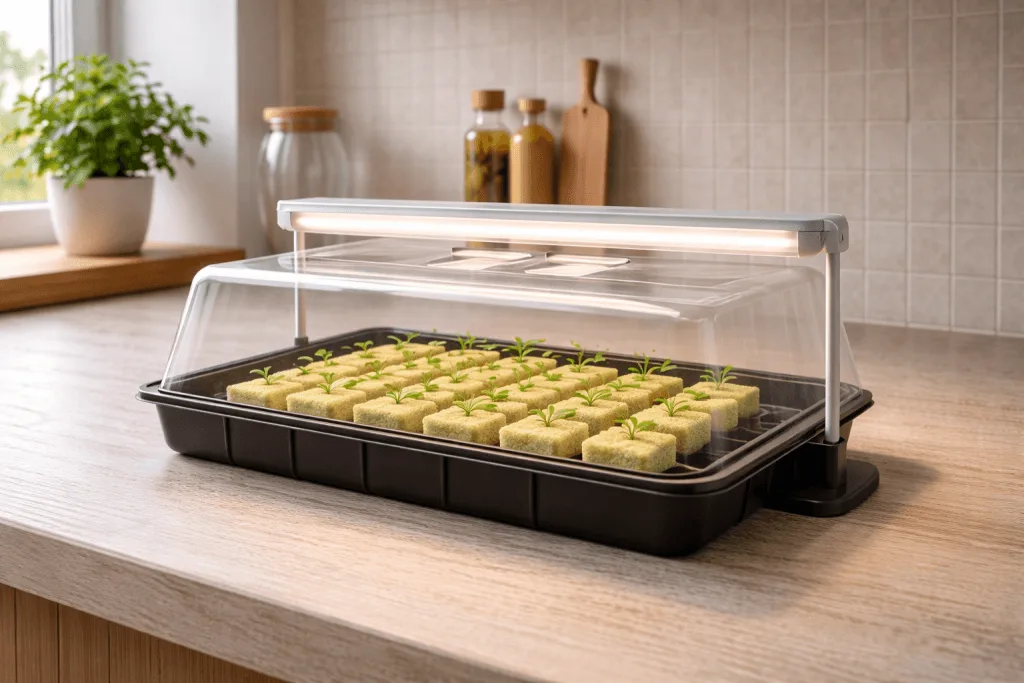
- Place the seeds in a pre-soaked rockwool cube
- Cover the tray with a clear plastic dome to trap humidity
- Keep the tray somewhere warm, around 68 to 72°F
- Check daily and mist the dome if condensation disappears
Letting the cube dry out during germination is the most common reason parsley seeds fail to sprout. Fortunately, the dome prevents this without any extra effort.
🔪 Harvesting Parsley Without Stalling Growth
Parsley grows new leaves from the center of the plant outward. The correct technique is to take the oldest outer stems first, cutting them cleanly at the base near the growing media. Never cut the inner crown or the newest central leaves. That is the plant’s active growing point and removing it stops new production entirely.
Taking two or three outer stems every five to seven days keeps the plant producing without stressing it. As a result, frequent light harvesting works far better than infrequent heavy cutting for long-term output.
🌲 Thyme: A Low-Maintenance Herb for Small Hydroponic Setups
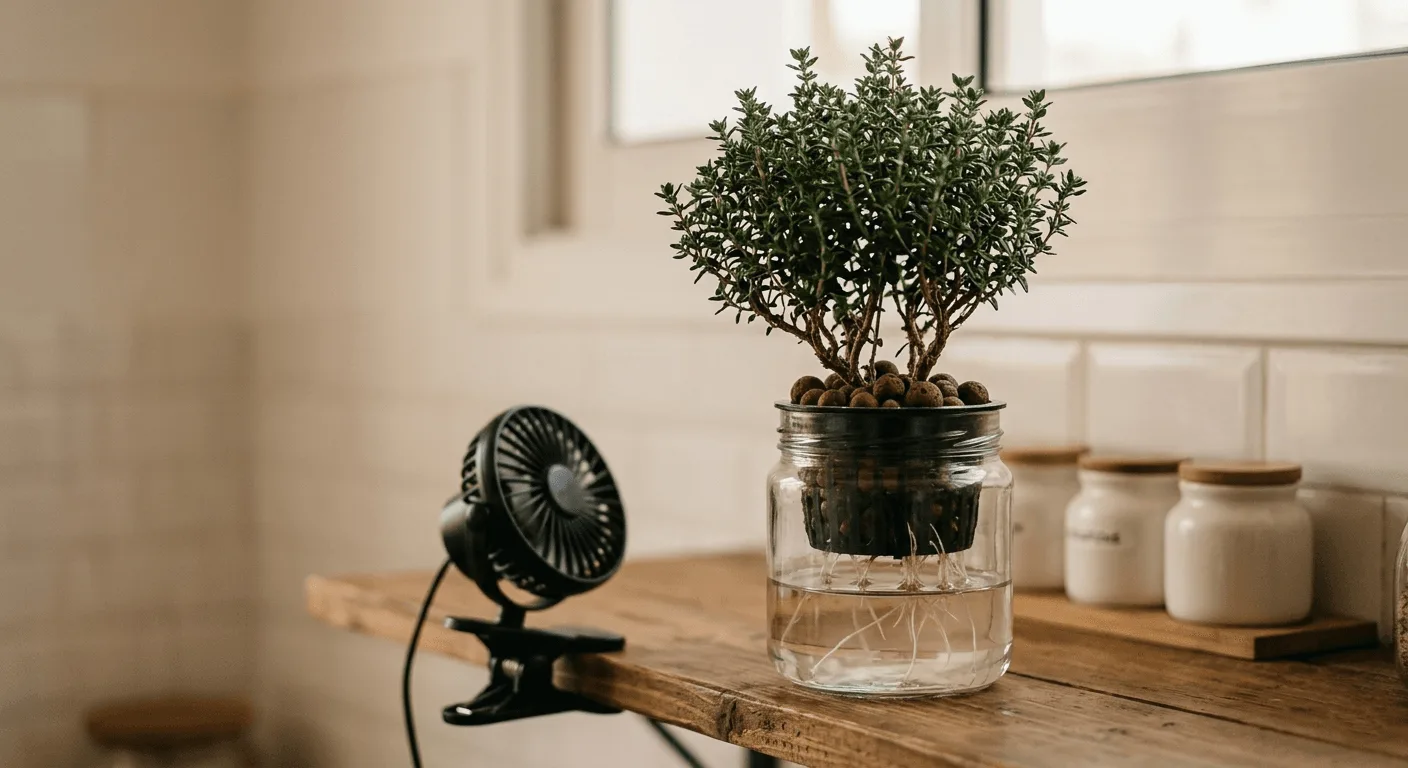
Thyme is the most hands-off herb on this list once established. It drinks less water than basil, needs fewer nutrients than mint, grows slowly enough that you rarely need to prune it more than once a month, and tolerates a wider pH range than almost anything else here. The trade-off is time. You will wait eight to ten weeks for the first real harvest and the early growth looks discouragingly small.
The setup detail that catches people off guard is moisture management. Unlike basil or mint, thyme originated in dry Mediterranean hillsides and its woody stems rot quickly if they stay wet. Keep the water level below the net cup so the stem base sits in air, not in solution.
🧪 pH and EC Targets for Thyme in Small Hydroponic Systems
Thyme performs well across a wide pH range of 5.5 to 7.0, which makes it one of the easiest herbs to manage from a chemistry standpoint. Keep EC between 1.2 and 1.6. Running thyme at the same EC you use for basil (1.8 to 2.2) causes leaf tip burn within two weeks.
I made this mistake in my first shared reservoir and lost half a thyme plant before figuring out the cause. If you are growing thyme alongside heavy feeders in one tank, set the reservoir to EC 1.5 as a compromise. The basil will grow slightly slower. The thyme will be healthier. That trade-off is worth it.
🌬️ Why Thyme Needs Air Movement Indoors
Outdoors, constant wind pushes against thyme stems and causes them to develop a dense, fibrous internal structure. Indoors, however, without that resistance, the stems stay soft and flimsy. A small clip fan running two to three hours per day, positioned to create gentle air movement across the canopy, solves this completely. The stems visibly thicken over two weeks of consistent exposure.
This step is not optional for long-term thyme health indoors. It is one of those things that looks unnecessary until you skip it and see the difference.
🍂 Oregano: Small Hydroponic Footprint, Intense Flavor
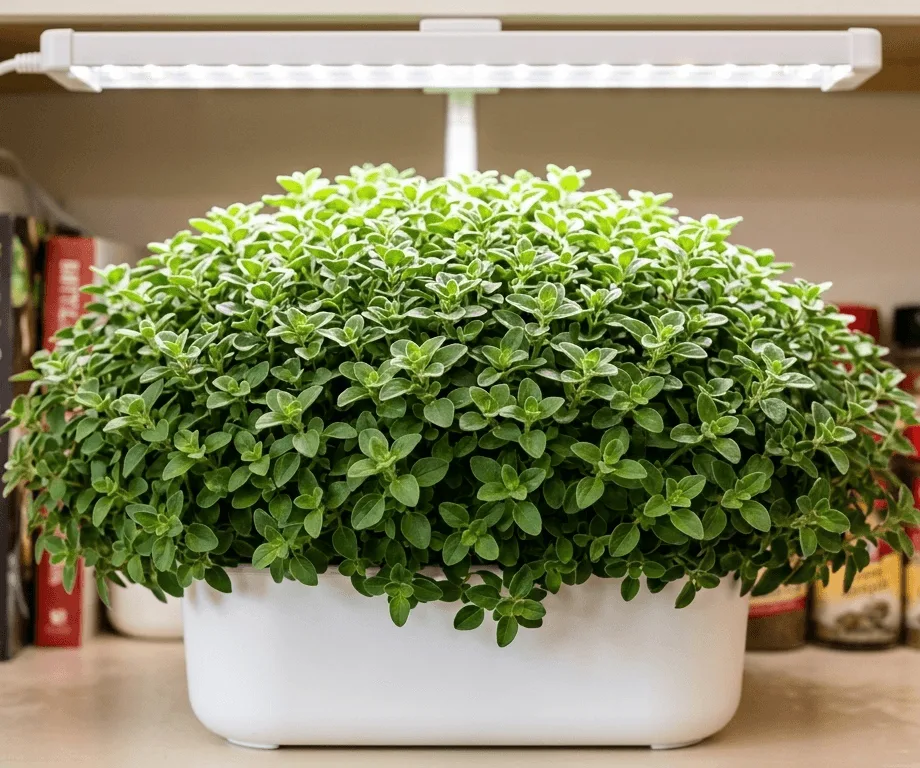
Greek oregano is one of the more surprising performers among herbs for hydroponic systems. Given that it naturally grows in dry, rocky soil, you might expect it to struggle in water. With the right moisture management, however, it actually thrives, and the flavor of hydroponically grown oregano under strong LED light can be more intense than store-bought dried oregano. The essential oil concentration is directly tied to light intensity. More light means more flavor.
Oregano creeps outward rather than growing upright. Left unmanaged it will drape over the edge of your system within a month. Pinching the trailing stems back weekly keeps it mounded and compact.
☀️ Light Distance for Maximum Oregano Flavor
For leafy herbs like basil and chives, keeping lights at 6 to 8 inches prevents stretch without bleaching. Oregano, however, benefits from slightly more intensity. Position the LED panel 4 to 6 inches above the canopy to drive essential oil production in the leaves. Without enough intensity the leaves taste flat, which defeats the purpose of growing it fresh.
Run oregano on a 14-hour light schedule. The extended day length mimics Mediterranean summer conditions and keeps the plant in active vegetative growth. See the apartment hydroponic light schedule guide for 9-to-5 workers for tips on setting timers around a work schedule.
🧯 Treating Powdery Mildew on Hydroponic Oregano
Oregano’s dense, low growth habit traps humid air between the stems, creating conditions where powdery mildew can form. You will see it first as small white dusty patches on the older inner leaves. Fortunately, if you catch it early it is easy to manage.
Here is how to deal with it when you spot it:
- Remove any visibly infected leaves immediately and dispose of them away from your other plants
- Mix 3ml of 3% hydrogen peroxide per liter of plain water and mist the remaining foliage lightly
- Repeat every three days for two weeks
- Set up a small clip fan nearby to improve airflow as a long-term preventive measure
Avoid commercial fungicide sprays indoors. Residue on food-producing plants in an enclosed kitchen is not a risk worth taking.
🌾 Growing Cilantro Hydroponically: High Reward if You Manage the Heat
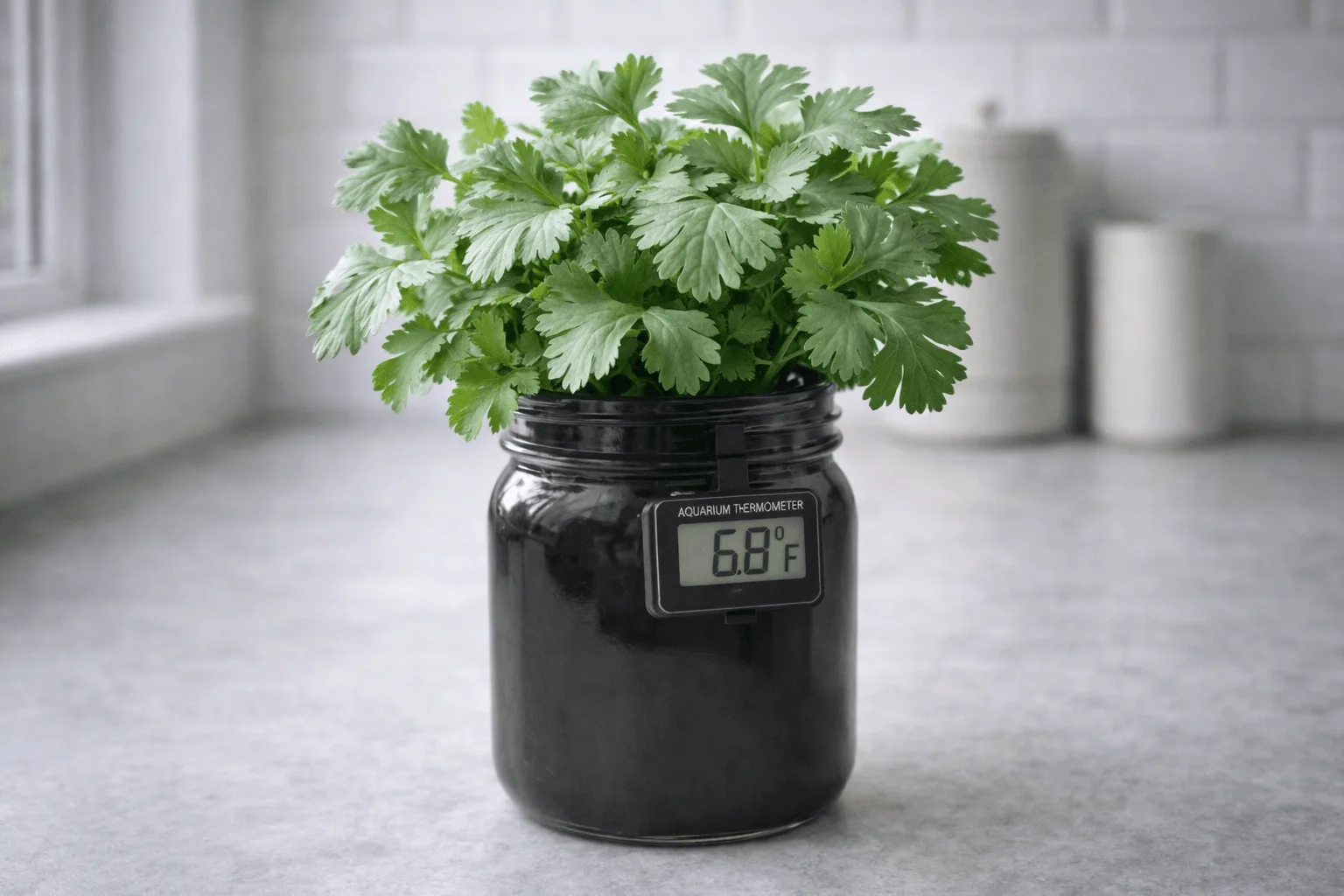
Cilantro is the only herb on this list I would call genuinely difficult for beginners. Not because it is complicated to set up, but because it bolts the moment it experiences stress. Warm water, inconsistent light, root crowding, or even a few days of elevated room temperature can trigger it. Once cilantro bolts, the leaves turn bitter and the harvest window closes fast.
That said, cilantro in a well-managed cool setup produces more flavor per square inch of counter space than almost any other indoor hydroponic herb. It is worth growing once you have a few successful harvests with basil or mint under your belt.
🌡️ Keeping the Reservoir Cool Enough for Cilantro
Cilantro wants water temperatures between 65 and 70°F (18 to 21°C). Above 75°F (24°C) the roots become stressed and bolting is almost guaranteed. In a warm apartment this is the hardest parameter to maintain in summer.
Practical solutions that actually work:
- Keep the container away from heat vents, appliances, and direct afternoon sun
- Use a Kratky setup instead of a pump-based system since pumps generate heat that raises reservoir temperature
- Drop one or two ice cubes into the reservoir on hot afternoons to bring the temperature down
- Keep a cheap aquarium thermometer in the jar during summer to monitor it daily
🩹 What to Do When Cilantro Starts to Bolt
The early sign of bolting is a thick central stalk forming in the middle of the plant with leaves that are smaller and more finely divided than the broad outer leaves. At this point you have a short window to salvage the harvest:
- Cut the central stalk immediately at the base
- Harvest as many of the large outer leaves as you can right away
- Move the container to a cooler spot
If flower buds have already formed, the leaves will taste bitter and the plant is essentially done. The fastest path forward is to harvest what you can and start fresh seeds. Planting a new batch every two weeks gives you a rolling supply that accounts for each plant’s short productive window.
🧪 Feeding Your Hydroponic Herbs: EC and pH Made Simple
Two numbers govern everything in a hydroponic system: EC and pH. EC (electrical conductivity) measures how much dissolved fertilizer is in your water, while pH determines whether the roots can physically absorb that food. You can have perfect EC and feed the plant nothing at all if pH is wrong. Managing these two numbers correctly is what separates a thriving small hydroponic herb garden from a jar of rotting roots.
Both measurements require a digital pen meter. Analog color-drop kits work in a pinch but are not precise enough for small systems where small shifts matter. A basic digital EC and pH pen costs under $30 combined and is the single most useful tool in a small hydroponic setup. See the beginner hydroponic nutrients guide with feeding schedules for small apartment systems for exact mixing ratios.
⚗️ EC Targets for Small Hydroponic Herb Gardens
The biggest EC mistake I made early on was running one concentration across all my plants. I had mint, thyme, and basil in a shared reservoir at EC 2.2. That is optimal for mint and basil but enough to cause chronic tip burn on the thyme. The thyme looked perpetually damaged despite otherwise perfect conditions. Dropping the shared reservoir to EC 1.5 fixed the thyme and barely affected the basil output.
A quick reference for managing shared vs. individual systems:
- Shared reservoir: target EC 1.5 as a safe middle ground for mixed plantings
- Basil solo: EC 1.8 to 2.2 for maximum leaf production
- Mint solo: EC 2.0 to 2.4
- Thyme or oregano solo: EC 1.2 to 1.6 to avoid tip burn
- Parsley or cilantro solo: EC 1.4 to 1.8
⚖️ Keeping pH in Range for Hydroponic Herbs
For most of these herbs, you want pH between 5.5 and 6.5. Cilantro sits higher at 6.5 to 6.7, which is why mixing it with basil (which prefers 5.5 to 6.0) in the same reservoir causes problems for one or the other. Never share a reservoir between cilantro and any other herb on this list.
Plant roots naturally release acids into the water as a metabolic byproduct, so pH drifts downward over time in an active system. Check pH every two to three days during the first month until you understand your system’s drift rate. Most small setups need a few drops of pH Up every three to four days to stay in range. Furthermore, full water changes every two weeks reset accumulated salt and pH drift at once, which is more effective than continuously correcting a solution that has been running for weeks.
| Herb | Target EC | Target pH |
|---|---|---|
| Sweet Basil | 1.8 to 2.2 | 5.5 to 6.5 |
| Mint | 2.0 to 2.4 | 5.5 to 6.0 |
| Chives | 1.8 to 2.0 | 6.0 to 6.5 |
| Parsley | 1.4 to 1.8 | 5.5 to 6.5 |
| Thyme | 1.2 to 1.6 | 5.5 to 7.0 |
| Oregano | 1.2 to 1.6 | 6.0 to 7.0 |
| Cilantro | 1.4 to 1.8 | 6.5 to 6.7 |
→ University of Maryland Extension — Introduction to Hydroponics
→ Royal Horticultural Society — Growing Plants Hydroponically
💡 Grow Lights for Indoor Herbs: What Apartment Windows Cannot Do
Most apartment windows provide two to four hours of direct sun on a clear day, filtered through UV-blocking glass. Fast-growing herbs for hydroponic systems need 12 to 14 hours of usable light daily. Even the best south-facing window cannot bridge that gap, particularly in winter or in overcast climates. Without adequate light hours, growth slows, stems stretch, and flavor drops noticeably.
A full-spectrum LED panel drawing 20 to 36 watts of actual power is sufficient for a two-foot countertop setup. Modern LED panels run cool and draw very little electricity — adding roughly $1 to $3 per month to your power bill at 14 hours per day. Here is how to position it correctly based on what you are growing:
- Leafy herbs (basil, mint, chives, parsley): keep the panel 6 to 8 inches above the canopy
- Woody herbs (oregano, thyme): drop to 4 to 6 inches to drive essential oil production
- Cilantro: keep at 6 to 8 inches and prioritize cool temperatures over light intensity
Set a timer for 14 hours on, 10 hours off. Plants need the dark period to rest and process the energy they collected during the day. Running lights continuously does not accelerate growth. It exhausts the plant over time.
For specific panel recommendations sized for small apartment shelves, the best grow lights for apartment hydroponics under $50 guide covers options that work well for everything on this list.
💬 A Word From Sarah
The moment that genuinely changed how I grow indoor hydroponic herbs was the day I stopped treating every yellowing leaf as a fertilizer problem. For the first year, whenever something looked off, my first move was to add more nutrients or switch formulas. In almost every case, the real issue was pH drift that had been quietly locking out minerals already in the water. The plants were not hungry. They just could not absorb what was already there. Once I started testing pH before touching anything else, my success rate jumped immediately. If there is one habit worth building before any other, that is it: test pH first, always, before assuming the plant needs more food.
❓ Frequently Asked Questions
🌱 What is the easiest herb to grow hydroponically for beginners?
Sweet basil is the easiest hydroponic herb for beginners. It germinates in five to ten days, produces its first true leaves within two weeks, and tolerates beginner mistakes like minor pH drift or slightly high EC better than any other herb on this list. Start with one basil plant before adding anything else to your setup.
🪟 Can I grow hydroponic herbs with just a sunny window?
Chives and mint can survive in a bright south-facing window, but every other small hydroponic herb on this list will stretch and lose significant flavor without supplemental LED lighting. Apartment windows provide two to four hours of filtered sunlight daily. Herbs need 12 to 14 hours. A small LED panel bridges that gap for about $1 to $3 per month in electricity.
💧 How often should you change the water in a hydroponic herb system?
Top off daily with plain pH-adjusted water to replace what the plants have consumed. Do a full reservoir change every two weeks by emptying, rinsing, and refilling with fresh nutrient solution. Daily top-offs prevent salt concentration from rising. The full change every two weeks resets chemistry and prevents pathogen buildup that accumulates in any standing water system over time.
🧂 Can I grow different hydroponic herbs in one reservoir?
Mixing herbs for hydroponic systems in one reservoir works if they share overlapping EC and pH needs. Basil, chives, and parsley grow well together at EC 1.5 and pH 5.8 to 6.2. Do not mix cilantro with any other herb since its pH range (6.5 to 6.7) does not overlap with the rest. Keep mint in its own container since its roots outcompete everything else.
🔌 Do hydroponic herbs need a pump?
All seven small hydroponic herbs on this list grow well in a passive Kratky setup with no pump, no electricity, and no noise. A dark jar, a net cup, rockwool, and nutrient solution is a fully functional hydroponic system. Pumps speed growth in DWC setups but are not required. See the DWC vs Kratky comparison for apartment beginners for help choosing.
🚰 Can you use tap water for hydroponics?
Standard tap water works for small hydroponic herb gardens in most cities. Let it sit uncovered overnight before use to allow chlorine to dissipate. Then test the starting pH and EC before adding nutrients. If your tap water starts above EC 0.4 or pH 7.5, consider using filtered water to give yourself a cleaner baseline to work from.
🍽️ Do hydroponic herbs taste the same as soil-grown?
For most indoor hydroponic herbs, flavor matches or exceeds soil-grown. Basil and mint grown under strong LED light often taste more intense than supermarket herbs that spent days in a bag. Oregano and thyme require adequate light intensity to produce their essential oils, but under proper lighting both taste excellent. The main flavor variable is light quality, not the growing method itself.
📅 How long do hydroponic herbs last?
Lifespan varies by herb. Basil and cilantro last two to three months before bolting or declining. Mint, chives, and parsley produce for four to six months with proper harvesting. Thyme and oregano are perennials and can last well over a year in a well-maintained system. Replanting on a rolling schedule keeps your counter productive year-round rather than having everything end at once.
🔄 Can I transfer a soil herb into a hydroponic system?
Transferring soil herbs into hydroponics is possible but rarely worth the effort for beginners. Soil roots and water roots have different structures, and the transition causes significant stress. Starting fresh from seed or a clean stem cutting placed directly in water gives a much higher success rate. Furthermore, it takes far less time and effort than trying to transition an established soil plant.
Happy growing! 🌿
— Sarah, Urban Hydro Space

Sarah is the founder of Urban Hydro Space and an indoor gardening enthusiast dedicated to helping apartment dwellers grow fresh herbs and vegetables in small spaces. With hands-on experience testing hydroponic systems, she shares practical tips and honest product reviews to make indoor gardening accessible for beginners.