⏳ 18 min read · Last updated: March 2026
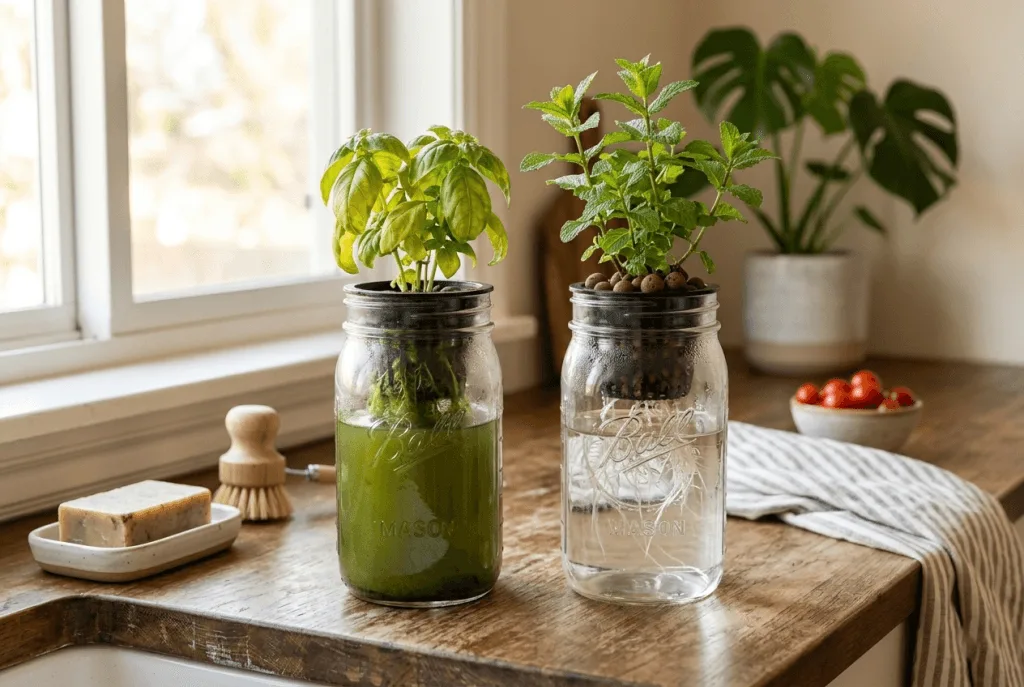
My first basil plant looked fine for about ten days. Then the water in the mason jar turned a murky green almost overnight. Algae in hydroponic jars spreads fast when clear glass sits under bright light with nutrient-rich water inside, and I had all three conditions lined up perfectly. I tipped the whole thing down the drain and convinced myself I wasn’t cut out for this hobby. That was the wrong call, and I’ve watched a lot of beginners make the same one.
Green water is fixable, and most of the time it doesn’t require anything more than what you already have at home. This guide covers five light-blocking methods that work in apartments, a step-by-step root-cleaning process that won’t damage fragile roots, and the nutrient adjustments that starve a bloom mid-cycle. Once you understand what’s driving the problem, preventing it becomes a matter of routine rather than damage control.
🦠 Why Algae in Hydroponic Jars Spreads So Fast
Algae is a photosynthetic organism, which means it needs the same two things your herbs need: light and nutrients. When those combine with warm water in a clear container, conditions are close to perfect for a rapid bloom. Understanding which factor is driving your specific situation makes treatment much more straightforward.
- Cover clear containers to block 100% of light from reaching the water.
- Rinse affected roots with a diluted 3% hydrogen peroxide solution.
- Keep reservoir temperatures below 72°F (22°C) to slow algae growth.
- Top off with plain pH-adjusted water daily. Do a full water change every 2 weeks.
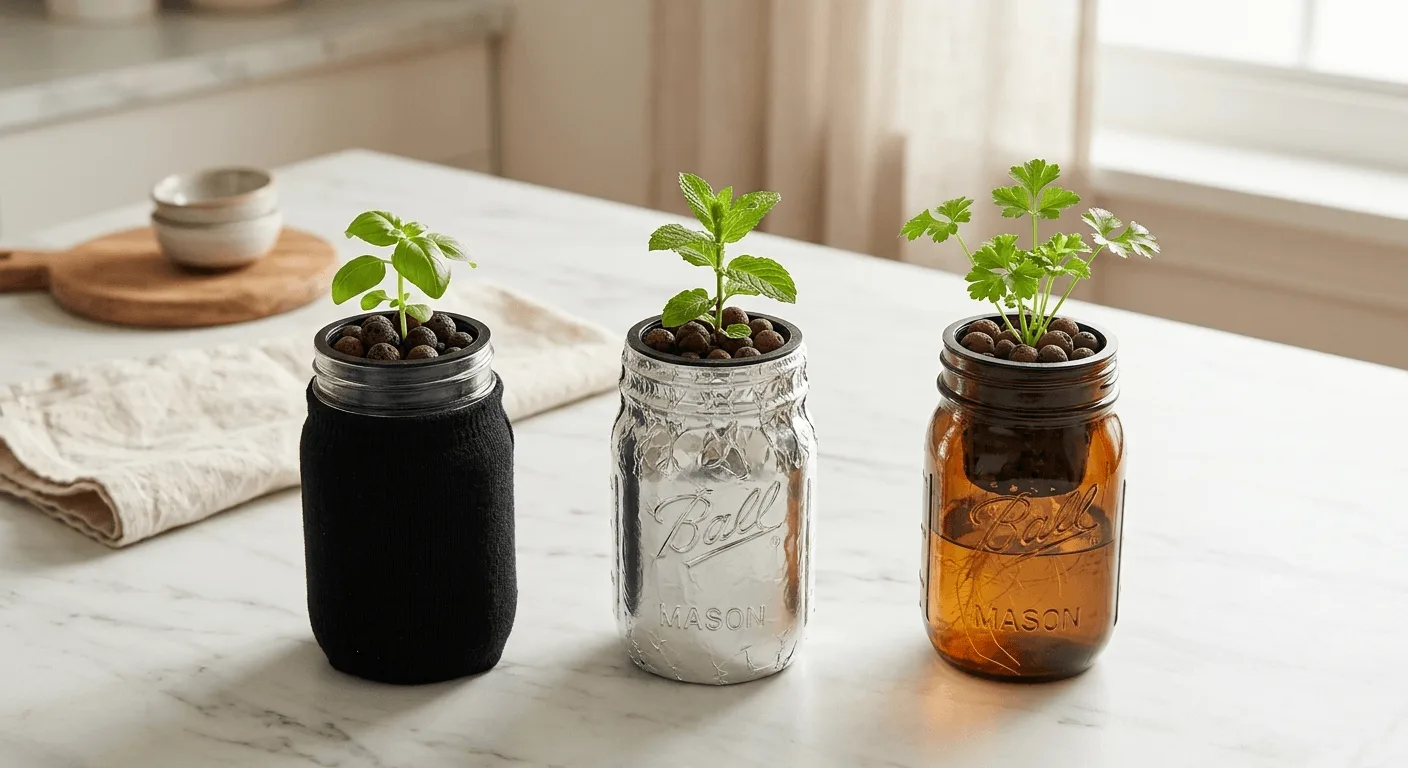
- No outdoor space for painting → thick black socks
- Tight budget → aluminum foil
- Best look for a living room → decorative cachepots
- Prefer a vintage style → amber glass jars
☀️ Light and Nutrients: The Two Triggers
Light is the main trigger. Without it, algae cannot photosynthesize or reproduce, regardless of how much fertilizer is in the water. Clear glass on a sunny windowsill transmits the full light spectrum directly into the nutrient solution. That’s why a clean jar can turn green within a week of being placed near a spring window.
Nutrients make the problem worse. A basil solution kept at EC 1.8 to 2.2 provides an abundant food source for anything that can photosynthesize, not just your herbs. The same is true for lettuce running at EC 1.0 to 1.6. Plain tap water may stay clear for weeks under the same light, but add fertilizer and that timeline shortens fast.
🧪 Is Green Water Harmful to Your Plants?
A slight green tint won’t kill a plant overnight. However, a thick bloom creates three problems that add up quickly. First, algae competes for the dissolved oxygen your roots depend on. As oxygen levels drop, root function slows and growth stalls. Second, algae respiration shifts the water’s pH throughout the day. You might set it carefully to pH 6.0 in the morning, only to find it has drifted out of range by evening. Third, that pH instability causes nutrient lockout, meaning your plant can’t absorb minerals even though they’re present in the water. Pale leaves and drooping stems with a full reservoir are a classic sign of this cycle in progress. If you’re running a Kratky mason jar, the guide on building a Kratky jar setup for apartments covers how to set up a light-proof container from the start.
🔍 Algae vs. Root Rot: How to Tell the Difference
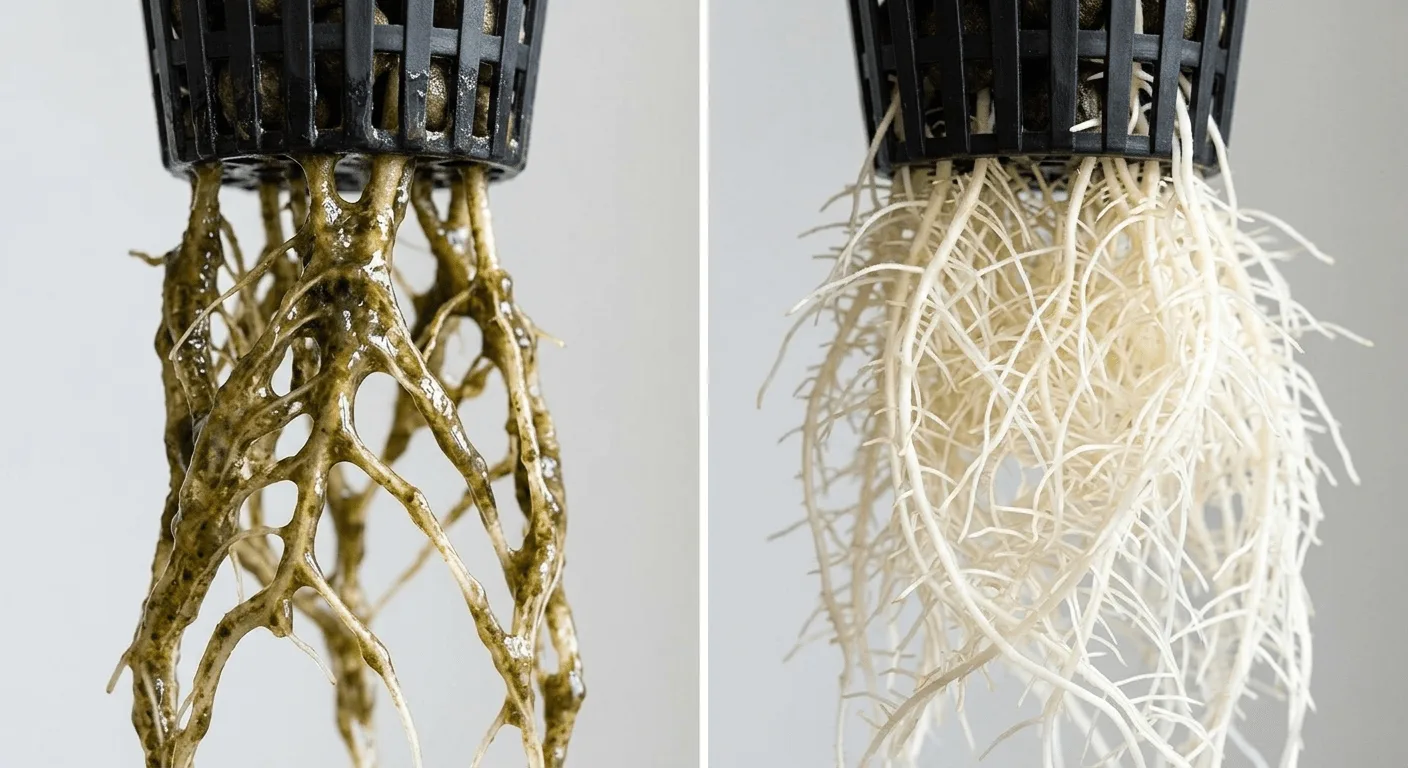
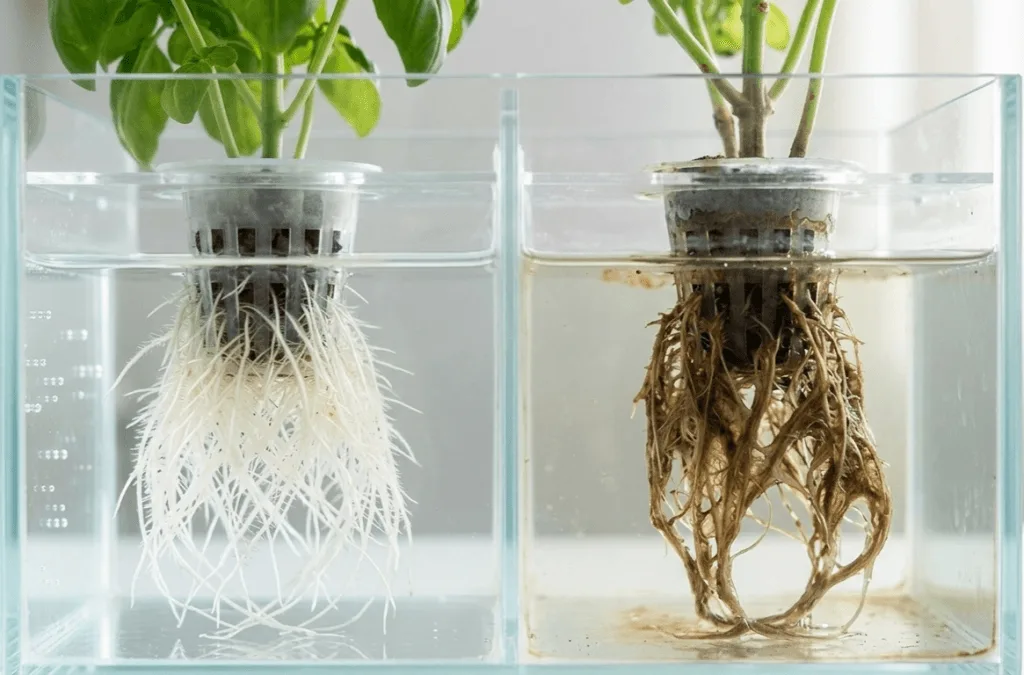
Both conditions discolor roots, but they require different treatments. Algae coats the outside of roots with a green or brown slime, while the underlying root tissue typically stays firm and white underneath. Root rot, by contrast, turns roots brown or black throughout, makes them mushy, and causes them to break apart when touched. A quick squeeze tells you a lot. Firm roots with surface green are salvageable with a wash. Soft, foul-smelling roots indicate fungal damage that’s much harder to reverse.
For a deeper look at avoiding the more serious condition, the guide on preventing root rot in small hydroponic systems walks through the underlying causes and early warning signs.
🛡️ 5 Apartment-Friendly Ways to Block Light from Hydroponic Jars
The single most effective fix for algae in hydroponic jars is cutting off its light supply. A reservoir that stays dark can’t sustain a bloom, no matter how much fertilizer you’re running. Living in an apartment limits some DIY options, but the five methods below cover every situation from a tight budget to a living room display.
🧦 The Sock Method
Stretch a clean, opaque black sock over your jar and pull it up to meet the net cup at the top. That’s the whole method. It takes about five seconds, requires no tools, and slides off easily when you need to check root growth or water levels. For most windowsill setups, a single thick sock is enough.
Thin dress socks won’t work under strong lighting. If your jars run under a 14-hour grow light cycle, use two socks layered together to ensure complete darkness. Slide them down at water change time, check the roots, then pull them back up. The sock method works well because it’s easy to maintain without interrupting your routine.
🖌️ Painting Jars
For a permanent solution, paint gives you full control over both light blocking and aesthetics. Apply a base coat of black spray paint, let it dry fully, then add a topcoat of white or any color that suits your kitchen. The white outer layer helps reflect heat away from the reservoir. However, spray paint requires outdoor space for ventilation. If you don’t have a balcony, thick acrylic craft paint applied with a foam brush achieves the same result with three or four coats and is safe for indoor use.
🗞️ Aluminum Foil
Foil wraps tightly around a jar in under a minute, reflects both light and heat, and costs almost nothing. Wrap a sheet around the glass and secure it with a rubber band. The main drawback is durability. Foil creases and tears easily during water changes, so it needs replacing every few weeks. Black construction paper is a tidier alternative when heat reflection isn’t a priority. Cut it to size, wrap it around the jar, and tape the seam. Paper won’t survive water splashes well, so it’s best for jars kept away from direct moisture.
🧻 Amber Glass Jars
Amber and violet glass filter out the light wavelengths that trigger algae most strongly. Apothecary-style amber jars are easy to find online or at thrift stores, and they look good on a counter without any modification. For a setup near a window with indirect light, amber glass usually provides enough protection to get through a full harvest without a significant bloom. Under a powerful LED panel at close range, however, some green may still form over several months. In that case, pair the amber jar with a cachepot for full coverage.
🪴 Decorative Cachepots
Drop your clear jar inside a slightly larger ceramic or metal planter. The outer pot blocks all light while the small air gap between the two vessels adds a layer of thermal insulation. This option works well in living rooms and shared spaces where a hydroponic setup needs to blend in. From the outside, it looks like a standard soil plant. Make sure the outer pot is tall enough to reach the base of the net cup so no light enters from the top of the jar.
🧽 How to Clean Algae-Covered Roots Without Damaging Them
Covering the glass stops new growth, but it won’t clear the slime that’s already there. You need to wash the roots manually, then transfer the plant to a clean jar with fresh solution. Done gently, this takes about ten minutes and plants recover well. The goal is rinsing, not scrubbing. Microscopic tears in root tissue invite bacteria, which turns a simple algae problem into a more serious infection.
🚿 Step-by-Step Root Wash
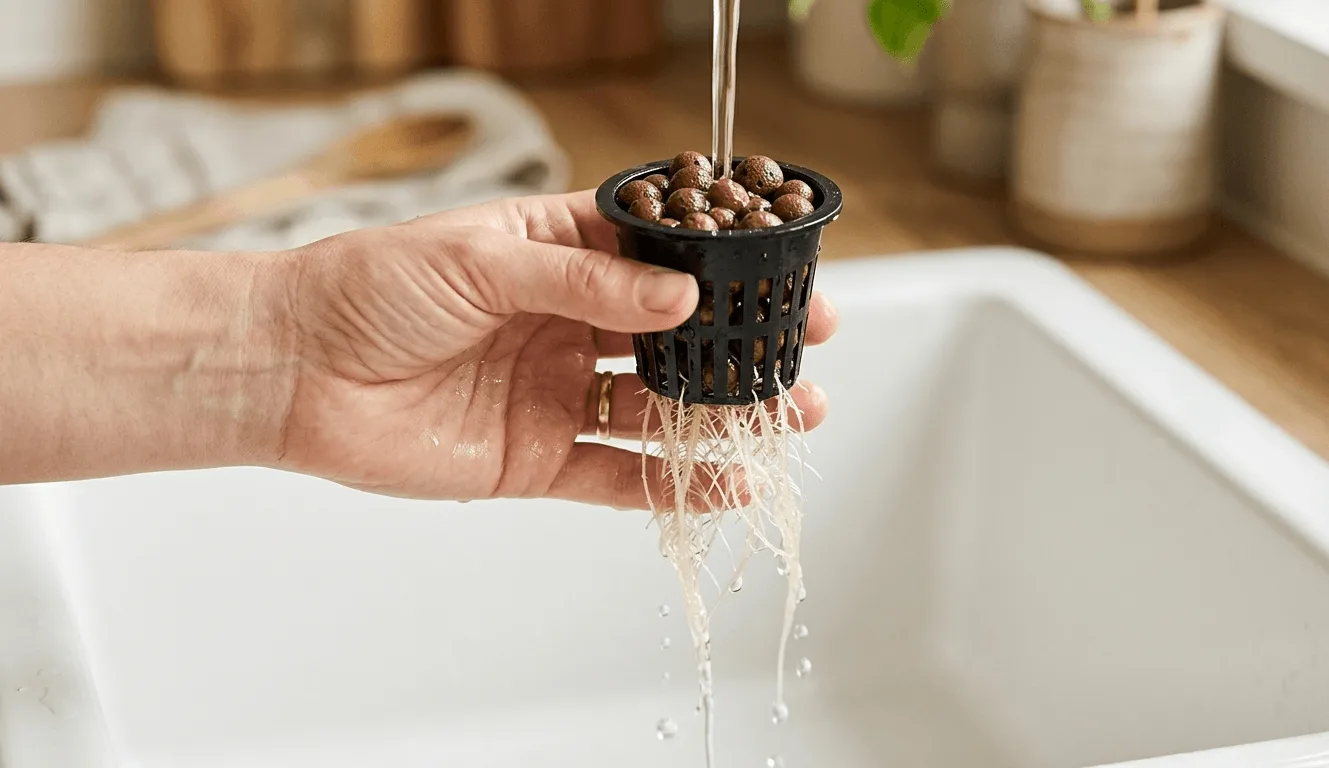
Work over a clean sink with a sterilized replacement jar ready before you start. Follow these steps in order:
- Lift the net cup from the jar and gently squeeze excess water from the root mass.
- Hold the plant over the sink and run lukewarm tap water at low pressure directly through the roots.
- Tilt the root mass at a 45-degree angle so water flows along the strands rather than flattening them.
- Use clean fingertips to gently separate tangled roots while the water runs through.
- Transfer the plant to the fresh jar filled with newly mixed solution at the correct EC and pH.
💧 Using Diluted Hydrogen Peroxide
If plain water leaves visible green staining, a mild peroxide rinse breaks down the remaining organic material. Mix 1 to 2 tablespoons of 3% hydrogen peroxide per quart of plain water. Submerge the root mass for about five minutes. You’ll see small bubbles forming as the solution reacts with the organic buildup. After the dip, rinse the roots under the tap before moving the plant to its clean jar. Avoid repeating this treatment more than once per outbreak, because repeated peroxide exposure slows root hair development and delays recovery.
🚨 When Washing Doesn’t Work
If green slime returns within a few days despite clean roots and a covered jar, the source is likely in the growing medium. Rockwool cubes and clay pebbles hold spores deep in their structure, beyond what a surface rinse can reach. If you need to start fresh seeds in new rockwool, my guide on starting hydroponic seeds in rockwool walks through prep and moisture control. Work through this checklist before replacing anything:
- Confirm the light-blocking cover reaches below the water line, not just the rim of the jar.
- Check the top of the net cup for green patches. Cover any exposed rockwool with a dark cardboard disc.
- Drop nutrient strength to half your normal EC for 3 to 5 days to reduce the food supply available to the algae.
- If the problem continues, replace the clay pebbles with fresh sterile media and start with a clean jar.
Once the outbreak is cleared, a proper system clean before your next planting round prevents it from coming back. My guide on how to clean a small hydroponic system in an apartment walks through the full process step by step.
⚖️ Managing Nutrients to Stop Algae in Hydroponic Jars from Returning
Light is the primary driver of algae growth, but nutrient concentration and water temperature determine how fast it spreads once it takes hold. Adjusting these two variables gives you a second line of defense alongside light blocking. The guide on the best hydroponic nutrients for small apartment systems covers balanced formulas that make precise dosing straightforward, which helps here because overfeeding contributes directly to recurring outbreaks.
📉 Lowering EC During an Active Outbreak
High fertilizer concentration feeds a bloom as efficiently as it feeds your herbs. When you’re dealing with an active outbreak, reducing EC buys time while you address the light issue. Dilute your reservoir with plain pH-adjusted water to bring EC down by half. Hold this weaker solution for 3 to 5 days while checking the roots daily. Most established herbs handle a short nutritional reduction well. Algae strains don’t sustain growth at the lower concentration, particularly when combined with a covered jar. If you want exact EC targets for your specific herb, the free pH and nutrient calculator gives you the right numbers in under a minute. Once the water runs clear, return to your normal feeding schedule. My beginner hydroponic nutrients guide covers the full feeding schedule so you know exactly what a healthy baseline looks like.
🌡️ Water Temperature and Algae Growth Rate
Algae multiplies faster in warm water. A jar sitting on a countertop in a warm apartment can reach 78°F to 80°F (25°C to 26°C) on a summer afternoon, and at that temperature a minor bloom can become severe within 48 hours. The target range for most herbs is 65°F to 72°F (18°C to 22°C). Moving jars away from south-facing windows in the afternoon, or wrapping them in reflective foil, helps keep temperatures closer to that range. When mixing fresh solution, start with cool tap water rather than room-temperature water to bring the baseline temperature down before the plant goes back in.
🪷 Does Aeration Help?
Air pumps and air stones increase dissolved oxygen in the reservoir, which helps roots outperform algae under mild conditions. However, for a simple Kratky setup, light blocking and EC management are more effective and less complicated than adding hardware. If you’re weighing whether to add a pump at all, the comparison of DWC vs Kratky for apartment beginners breaks down when aeration is worth it and when it isn’t. If you do add aeration, place a thick silicone mat under the reservoir to reduce vibration noise and suspend the air stone about an inch above the bottom of the jar to minimize rattling. My guide on quieting a noisy hydroponic pump in an apartment has more tips if vibration becomes an issue. That said, an uncovered jar with an air pump will still develop algae faster than a covered jar without one.
→ University of Minnesota Extension: Small-Scale Hydroponics
→ University of Maryland Extension: Hydroponics for Home Gardeners
📅 Long-Term Habits That Keep Hydroponic Jars Clear
Once you’ve dealt with an outbreak and covered your jars, a small amount of regular maintenance is all that stands between you and a clean setup year-round. These habits take ten to fifteen minutes per week and prevent the conditions that trigger a new bloom from building back up.
⏱️ A Consistent Water Change Schedule
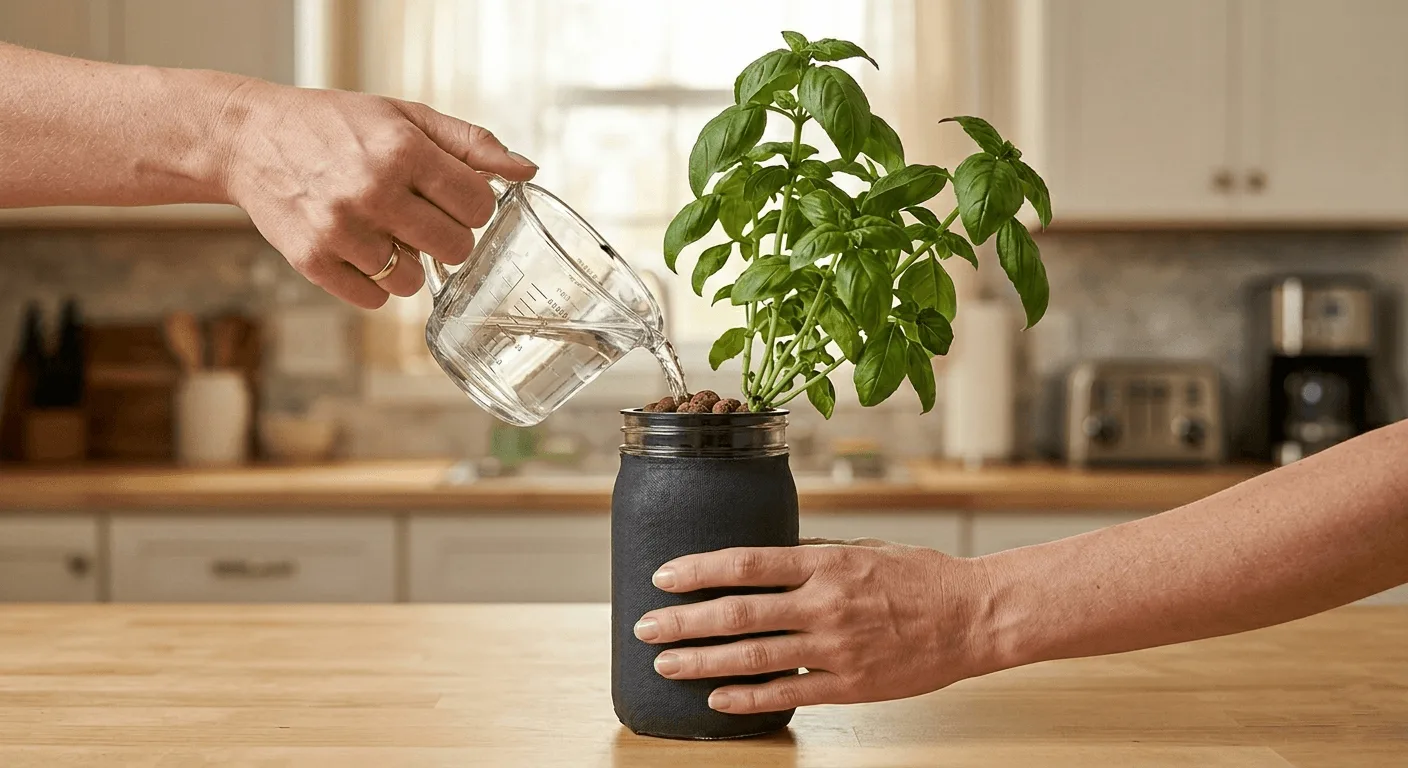
Stagnant water left unchanged for weeks develops mineral buildup and pH drift, both of which favor algae. The right schedule is a daily top-off with plain pH-adjusted water to replace what the plant drinks, plus a full drain and refill every 2 weeks. At the full change, wipe the inside of the glass, rinse the roots briefly under the tap, and mix a fresh batch of solution at the correct EC and pH. Tying this task to something you already do on a fortnightly basis makes it easier to stay consistent without tracking it separately.
🌿 Reading Plant Health Signals Early
Your plant will usually show signs of a developing problem before the water turns green. Drooping leaves with a full reservoir mean roots aren’t getting enough oxygen. Pale or yellowing new growth, when the water looks fine, often points to pH drift caused by algae activity. The guide on why hydroponic herb leaves turn yellow in apartments gives a useful framework for separating algae-related pH lockout from a real nutrient deficiency. Always check root color and water pH before adding more fertilizer.
🧰 Knowing When to Start Fresh
Some plants are too far gone to save. If the roots have gone black and the stem shows signs of rot at the base, starting over is faster than trying to rehabilitate the plant. Attempting to nurse a severely damaged herb back to health risks spreading infection to nearby healthy jars. When you reach this point, dispose of the plant, soak the empty jar in a white vinegar solution for 30 minutes, scrub it with a bottle brush, and leave it to dry in a well-lit spot for a day before reusing. A new seedling in a clean, covered jar will overtake a struggling plant within a week or two. Use the hydroponic shopping list builder to make sure you have everything before you restart.
→ Beginner Hydroponic Nutrients Guide with Feeding Schedule
→ How to Prevent Root Rot in Small Hydroponic Systems
→ DWC vs Kratky for Apartments: Which Is Right for You?
→ Apartment Hydroponic Light Schedule for Your 9-to-5
💬 A Word From Sarah
I used to think the sock method was reliable until two jars kept turning green while all the others stayed clear. The problem turned out to be the angle of the afternoon light through my west-facing window. In late afternoon, the sun came in low and hit the base of the jars from underneath the sock where I hadn’t pulled it down far enough. The sock was covering the middle and upper half but leaving a gap at the bottom inch of glass. Moving those two jars six inches to the left, out of the direct angle, stopped the recurring outbreaks entirely. Light angle matters as much as light intensity. Before you decide a blocking method isn’t working, spend a few minutes watching exactly where your afternoon light lands on each jar.
❓ Frequently Asked Questions
🌱 Which herb is easiest to grow without algae problems?
Basil is the most forgiving starting point. It grows fast, and its large canopy leaves naturally shade the top of the jar, which reduces light penetration around the net cup. Pair it with a dark sock and you have double coverage with minimal effort. Most growers see their first harvest within 3 to 4 weeks. For a full list of beginner-friendly options, see the best herbs for small hydroponic systems.
🚰 Can I use tap water in my hydroponic jars?
Yes. For most herb setups, tap water works fine. Municipal water contains trace minerals and occasional dormant spores, but neither causes a problem on its own. Light reaching the nutrient solution is what triggers a bloom. Keep the jar covered and tap water is a perfectly acceptable base for your nutrient solution.
💧 How often should I change the water in a hydroponic jar?
Top off daily with plain pH-adjusted water to replace what the plant drinks. Do a full drain and refill every 2 weeks. At the full change, rinse the jar, wipe the inside, and mix a fresh nutrient solution at the correct EC and pH. This prevents mineral buildup and pH drift, both of which favor algae growth.
🌊 Do I need an air pump to prevent algae in hydroponic jars?
No. An air pump raises dissolved oxygen, which gives roots an advantage over algae, but it won’t stop a bloom on its own. Blocking all light from the reservoir is far more effective than any amount of aeration. A Kratky jar with a covered container will outperform an uncovered jar with an air pump every time.
🧽 How do I remove hardened green stains from inside a glass jar?
Soak the empty jar in warm water mixed with white vinegar for 30 minutes. The acid breaks down the mineral-organic crust algae leaves on glass. After soaking, scrub with a bottle brush to remove the loosened residue. Rinse well before refilling. For stubborn rings, a second soak in undiluted vinegar usually clears them.
✂️ Does algae damage the plant stem as well as the roots?
Algae typically stays in the water and on the roots below the net cup. However, if slime climbs the rockwool and reaches the base of the stem, it traps moisture and can cause stem rot at the collar. Keep the water level about an inch below the net cup once roots have established to reduce this risk.
Will adding a snail to the jar help control algae?
No. A small hydroponic jar doesn’t provide the oxygen, filtration, or space an aquatic animal needs to survive. Adding a snail or fish would cause the animal to die quickly and create a more serious contamination problem than the algae itself. Stick to light blocking and manual cleaning to keep the water clear.
Happy growing! 🌿
— Sarah, Urban Hydro Space

Sarah is the founder of Urban Hydro Space and an indoor gardening enthusiast dedicated to helping apartment dwellers grow fresh herbs and vegetables in small spaces. With hands-on experience testing hydroponic systems, she shares practical tips and honest product reviews to make indoor gardening accessible for beginners.